
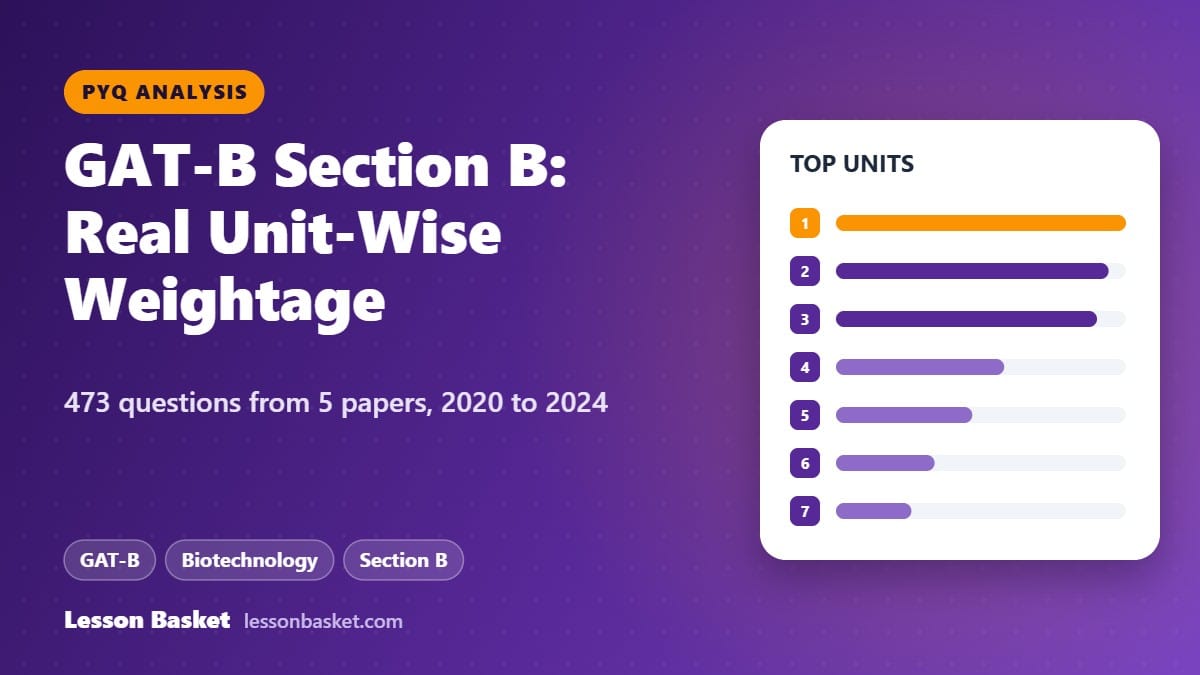
A unit-by-unit breakdown of how GAT-B Section B allocates its questions, built from a direct count of 473 real questions across the last 5 papers.
GAT-B (Graduate Aptitude Test Biotechnology) tests Biotechnology and allied areas through a 15-unit syllabus. Every Section B question from the five NTA-format papers (2020 to 2024, the years matching the current 60-question Section A and 100-question Section B structure) was read and classified into its syllabus unit, then tallied. The chart and table below show exactly how those 473 questions were distributed.
Real unit-wise weightage, ranked
The full table
“Avg. Qs per 100” scales each share to Section B’s real 100-question format.
| Rank | Unit | Share of exam | Avg. Qs / 100 |
|---|---|---|---|
| 1 | Applied Biology | 18.4% | 18.4 |
| 2 | Methods in Biology | 17.3% | 17.3 |
| 3 | Biomolecules | 16.5% | 16.5 |
| 4 | Fundamental Processes | 10.6% | 10.6 |
| 5 | Immunology | 8.7% | 8.7 |
| 6 | Diversity of Life Forms | 6.3% | 6.3 |
| 7 | Metabolism | 4.7% | 4.7 |
| 8 | Ecological Principles | 4.2% | 4.2 |
| 9 | Cellular Organization | 3.6% | 3.6 |
| 9 | Inheritance Biology | 3.6% | 3.6 |
| 11 | Evolution & Behaviour | 1.9% | 1.9 |
| 12 | System Physiology – Plant | 1.7% | 1.7 |
| 13 | System Physiology – Animal | 1.5% | 1.5 |
| 14 | Developmental Biology | 0.6% | 0.6 |
| 15 | Cell Communication & Signalling | 0.4% | 0.4 |
Where to actually spend your time
- Applied Biology
- Methods in Biology
- Biomolecules
- System Physiology – Plant
- System Physiology – Animal
- Developmental Biology
- Cell Communication & Signalling
How to use this
- Put a third of your time on the top three unitsApplied Biology, Methods in Biology and Biomolecules together are 52% of Section B, the single biggest lever you have for improving your score.
- Don’t import CSIR-NET’s priorities wholesaleFundamental Processes is the #1 unit on CSIR-NET but only #4 here; System Physiology (Plant and Animal) is top-5 on CSIR-NET but near the bottom on GAT-B. If you’re preparing for both, keep separate priority lists.
- Don’t over-invest in the barely tested unitsSystem Physiology, Developmental Biology and Cell Communication & Signalling are each under 2% of Section B. Know the fundamentals, but spend question-bank time on Applied Biology or Biomolecules.
- Don’t under-rate ImmunologyAt 8.7% it consistently outperforms Ecological Principles, Cellular Organization and Inheritance Biology on the real Section B paper, despite getting less syllabus space than Molecular Biology.
Methodology
Every Section B question in the 5 papers below was read individually and classified into one of the 15 syllabus units, then tallied. Only NTA-format papers (2020 onward) were used: pre-2020 “BET”-format papers use a different section structure and aren’t comparable.
Keep going