
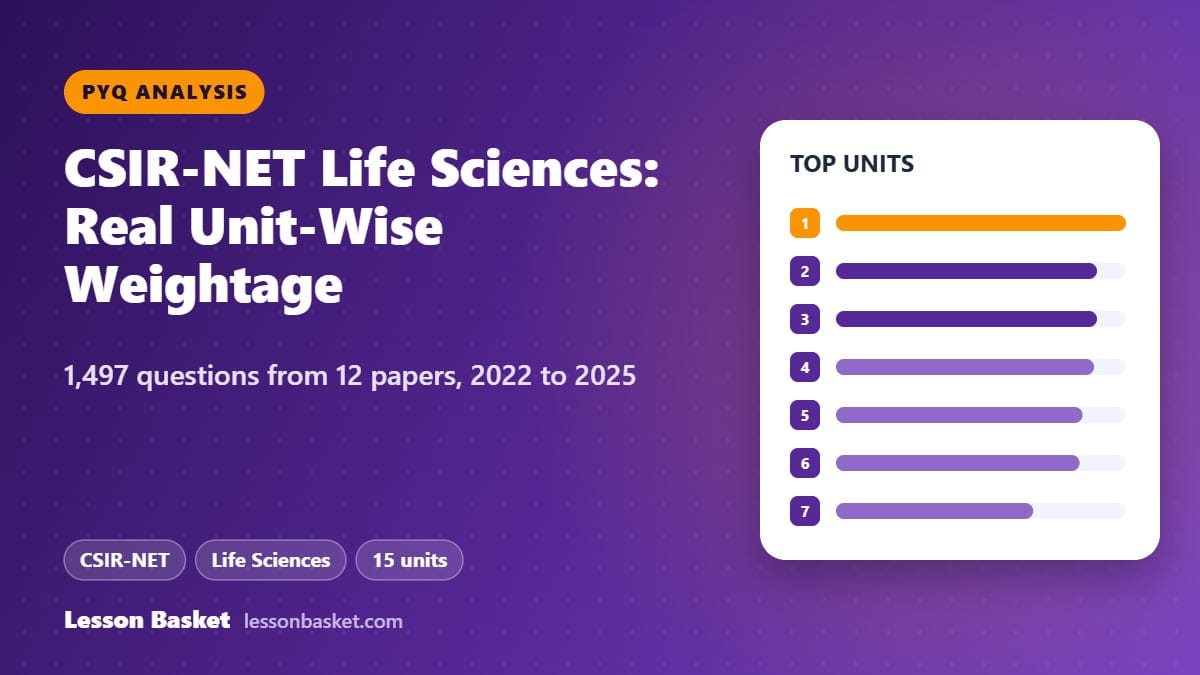
A unit-by-unit breakdown of how the CSIR-NET Life Sciences exam allocates its questions, built from a direct count of 12 real past papers, not an estimate.
The CSIR-NET Life Sciences exam does not test its syllabus units equally. For this analysis the syllabus is split into 15 units. Every Part B and Part C question across 12 real papers (February 2022 to December 2025, both shifts where two were held) was read and classified into its unit, then tallied. The chart and table below show exactly how those 1,497 questions were distributed: the real, measured shape of the exam.
Real unit-wise weightage, ranked
The full table
“Avg. Qs per paper” scales each share to a 125-question paper, the average size of Part B + Part C combined across the 12 papers analysed.
| Rank | Unit | Share of exam | Avg. Qs / paper |
|---|---|---|---|
| 1 | Fundamental Processes (Molecular Biology) | 10.2% | 12.8 |
| 2 | Methods in Biology | 9.2% | 11.5 |
| 2 | System Physiology – Animal | 9.2% | 11.5 |
| 4 | Ecological Principles | 9.1% | 11.4 |
| 5 | System Physiology – Plant | 8.7% | 10.9 |
| 6 | Evolution & Behaviour | 8.6% | 10.8 |
| 7 | Inheritance Biology | 6.9% | 8.6 |
| 8 | Developmental Biology | 6.7% | 8.4 |
| 9 | Cellular Organization | 6.3% | 7.9 |
| 10 | Applied Biology | 5.7% | 7.1 |
| 11 | Biomolecules | 5.5% | 6.9 |
| 12 | Metabolism | 4.1% | 5.1 |
| 13 | Immunology | 3.8% | 4.8 |
| 14 | Diversity of Life Forms | 3.7% | 4.6 |
| 15 | Cell Communication & Signalling | 2.2% | 2.8 |
Where to actually spend your time
- Fundamental Processes (Molecular Biology)
- Methods in Biology
- System Physiology – Animal
- Ecological Principles
- System Physiology – Plant
- Evolution & Behaviour
- Immunology
- Diversity of Life Forms
- Cell Communication & Signalling
Practise each unit with previous year questions
Weightage tells you where to spend time; past questions show you how each unit is actually asked. Every unit below has its own page with all of its questions from the last 11 papers, sorted by subtopic, each linked to NTA’s final answer key and a worked solution. All the full papers are on the CSIR-NET previous year question papers page.
- Unit 1: Molecules and their Interaction Relevant to Biology (111 questions)
- Unit 2: Cellular Organization (99 questions)
- Unit 3: Fundamental Processes (126 questions)
- Unit 4: Cell Communication and Cell Signaling (95 questions)
- Unit 5: Developmental Biology (96 questions)
- Unit 6: System Physiology – Plant (131 questions)
- Unit 7: System Physiology – Animal (116 questions)
- Unit 8: Inheritance Biology (108 questions)
- Unit 9: Diversity of Life Forms (63 questions)
- Unit 10: Ecological Principles (129 questions)
- Unit 11: Evolution and Behaviour (127 questions)
- Unit 12: Applied Biology (64 questions)
- Unit 13: Methods in Biology (110 questions)
How to use this
- Rank your revision by measured weightNot by how many pages a topic takes in a textbook. Diversity of Life Forms looks enormous on paper (taxonomy, phyla, classification), but it has consistently been one of the two lowest-yielding units across all 12 papers, individually, not just on average.
- Don’t treat Ecology and Methods as side topicsEcological Principles and Methods in Biology carry real weight. Together with Fundamental Processes and both System Physiology units, they make up over half the exam and hold the same rank shift after shift.
- Keep Cell Communication in proportionCell Communication & Signalling is the smallest unit at 2.2%. Core pathways are worth knowing; it doesn’t warrant extensive dedicated practice relative to the top units.
- Size your revision time by questions per paperA unit worth 12.8 questions per paper deserves roughly four times the attention of one worth 2.8.
Methodology
Every Part B and Part C question in the 12 papers below was read individually and classified into exactly one of the 15 units, then tallied. This is a direct count of real exam content across independently verified papers, checked shift by shift for consistency.
Keep going