

All 145 questions from the CSIR-NET Life Sciences June 2025 paper, typed out in full, with NTA’s final answer key, a worked solution for every question and every diagram.
The Joint CSIR-UGC NET June 2025 Life Sciences paper was held on 28 July 2025. Below you will find every question from Part A (General Aptitude), Part B and Part C, in the order they appeared, each tagged with its syllabus unit. Tap Show answer and solution under any question to check the official answer and see how to reach it.
Marking scheme
| Part | Questions | Answer | Marks each | Wrong answer | Max marks |
|---|---|---|---|---|---|
| A: General Aptitude | Q1–20 | 15 | 2 | −0.5 | 30 |
| B: Life Sciences | Q21–70 | 35 | 2 | −0.5 | 70 |
| C: Life Sciences | Q71–145 | 25 | 4 | −1 | 100 |
| Total | 145 | 75 | 200 |
Which units this paper tested
We tagged each of the 125 Part B and Part C questions with its CSIR-NET syllabus unit. In this paper, Evolution and Behavior, System Physiology – Animal and System Physiology – Plant carried the most questions.
Practise any unit across all 11 papers, with every question linked to a worked solution:
Jump to a question
Part A: General Aptitude (Q1–20)
20 questions; answer any 15. Each carries 2 marks, and a wrong answer costs 0.5.
On a spherical balloon of 10 cm radius, a circular colour patch has an area of 25 cm2. If the balloon is uniformly expanded to a sphere of 50 cm radius, the area of the colour patch in cm2 would be
- 1125
- 2625
- 350
- 4500
Show answer and solution
Surface area scales with the square of the radius. The radius grows 5 times, so every patch on the surface grows 52 = 25 times: 25 × 25 = 625 cm2.
Average age of 20 students of a class is 10 years. Average age of these students together with their five teachers is 14. The age of Ramesh Sir, one of their five teachers, is exactly the same as the average age of all their five teachers. The sum of the ages (in years) of all the students and Ramesh Sir is
- 1214
- 2224
- 3230
- 4241
Show answer and solution
Students’ total age = 20 × 10 = 200. All 25 people total 25 × 14 = 350, so the five teachers total 150 and average 30. Ramesh Sir is 30, so the sum is 200 + 30 = 230.
A pilgrim starts walking for a journey of 115 km. On the first day he covers 7 km, the next day 9 km, and likewise keeps adding 2 km everyday till he reaches 15 km per day which he maintains for the rest of the journey. How many days in all will he take to complete the journey?
- 17
- 28
- 39
- 410
Show answer and solution
Days 1–4 cover 7 + 9 + 11 + 13 = 40 km. From day 5 he walks 15 km a day, and the remaining 75 km take 5 more days. Total: 4 + 5 = 9 days.
A 2 cm wide wooden strip is to be fixed on a photo of 40 cm × 30 cm size all along its four sides. What is the minimum length of the wooden strip required?
- 1124 cm
- 2128 cm
- 3132 cm
- 4140 cm
Show answer and solution
Lay the strips without overlapping at the corners: two full-length strips of 40 cm along the long sides, and two strips of 30 − 2 − 2 = 26 cm between them. Length = 2 × 40 + 2 × 26 = 132 cm.
The population of a town over the years 2000-2007 is shown in the given figure.
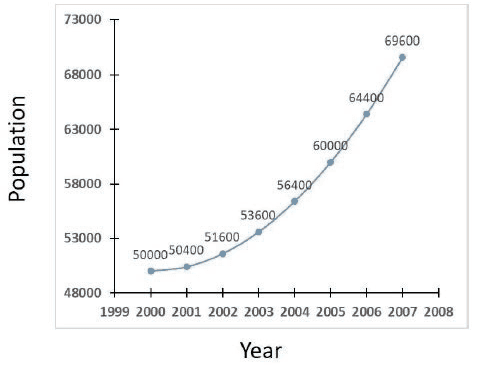
It can be inferred that during 2000-2007,
- 1the population increased linearly
- 2the rate of increase of the population increased linearly
- 3the rate of increase of the rate of increase of the population increased linearly
- 4the population increased exponentially
Show answer and solution
Year-on-year increases are 400, 1,200, 2,000, 2,800, 3,600, 4,400 and 5,200: each is 800 more than the last. The population is not linear and not exponential (the ratio is not constant), but its rate of increase rises linearly, so the curve is quadratic.
If any 9 papers are drawn from a both side printed book, the sum of their page numbers can NEVER be ______.
- 19 × (9 + 1) / 2
- 2divisible by 3
- 3179
- 4171
Show answer and solution
Each leaf carries pages 2k−1 and 2k, which sum to 4k − 1. Nine leaves sum to 4(k1+…+k9) − 9, which is always 3 more than a multiple of 4 and at least 4 × 45 − 9 = 171. 9 × 10/2 = 45 fails on both counts. 171 and 179 are possible, and so are multiples of 3 such as 171.
Which of the following is true?
- 1πππ < eee < 333
- 2πππ < 333 < eee
- 3333 < eee < πππ
- 4eee < 333 < πππ
Show answer and solution
ee ≈ 15.2, so eee ≈ 3.8 × 10⁶. 333 = 327 ≈ 7.6 × 10¹². ππ ≈ 36.5, so πππ ≈ 1.3 × 10¹⁸. Order: e < 3 < π towers.
The areas (in km2) under forests in four countries A, B, C and D for the years 2014 and 2024 are shown in the given bar chart:
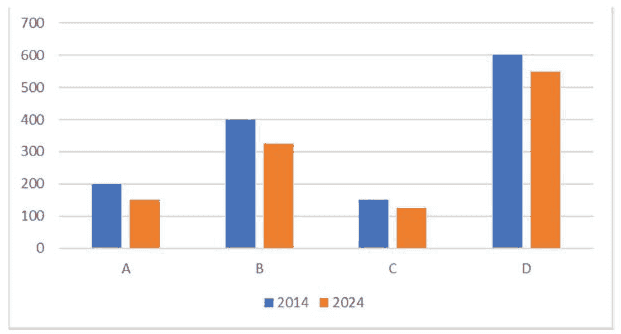
The minimum percentage of deforestation during 2014-2024 was in country
- 1A
- 2B
- 3C
- 4D
Show answer and solution
Percentage loss = (2014 − 2024)/2014. A: 50/200 = 25%. B: 75/400 = 18.8%. C: 25/150 = 16.7%. D: 50/600 = 8.3%, the smallest. D lost as much area as A, but from a much larger forest.
A block of marble 5 m × 4 m × 2 m in size is cut into rectangular tiles of 1 m × 0.5 m size having thickness of 10 cm. Assuming 10% wastage in cutting, how many tiles will be made?
- 1240
- 2360
- 3480
- 4720
Show answer and solution
Block volume = 5 × 4 × 2 = 40 m3. One tile = 1 × 0.5 × 0.1 = 0.05 m3, giving 800 tiles with no waste. Losing 10% leaves 800 × 0.9 = 720.
What is the remainder when 20232024 + 20252024 is divided by 2024?
- 10
- 22
- 3223
- 42023
Show answer and solution
Modulo 2024, 2023 ≡ −1 and 2025 ≡ +1. Both raised to an even power give 1, so the sum leaves a remainder of 1 + 1 = 2.
If there is rainfall in a village, flowers will bloom. If flowers bloom, celebrations will definitely take place. Flowers did not bloom. Which of the following is certain?
- 1Celebrations took place
- 2Celebrations did not take place
- 3It did not rain
- 4It rained too much
Show answer and solution
“Rain → bloom” means “no bloom → no rain” (the contrapositive). Flowers did not bloom, so it did not rain. Nothing follows about celebrations, which could have other causes.
MAN is to CROWD is as TREE is to ______
- 1FOREST
- 2FRUIT
- 3BRANCH
- 4ROOT
Show answer and solution
A crowd is a large gathering of men. A large gathering of trees is a forest. Fruit, branch and root are parts of a tree, not a collection of trees.
A man on a cycle is travelling on a terrain whose height (h) vs distance (d) can be described by a function 10d4 − 5d2 in a certain unit (h can be negative). Starting at d = 0, the cycle will have the maximum velocity without pedaling at:
- 1d = 1/2
- 2d = 2
- 3d = 1
- 4d = √2
Show answer and solution
Without pedalling, speed comes from losing height, so it is greatest at the lowest point. dh/dd = 40d3 − 10d = 0 gives d2 = 1/4, so d = 1/2. There h = 10/16 − 5/4 = −0.625, the minimum height.
∛0.99 is closest to
- 10.33
- 20.14
- 30.99
- 40.45
Show answer and solution
The cube root of a number just below 1 is just below 1, and even closer to it: ∛0.99 ≈ 1 − 0.01/3 ≈ 0.997. The nearest option is 0.99.
In a box there are 4 white balls and 6 black balls. A ball is drawn at random. If it is white, it is put back along with two more white balls in the box. If it is black, it is put back in the box and then two black balls are thrown out of the box. Now a ball is drawn again at random from the box. Then, what is the probability that it is black?
- 11/2
- 21/3
- 31/4
- 41/5
Show answer and solution
If the first ball is white (probability 0.4), the box becomes 6 white and 6 black, so P(black) = 1/2. If it is black (0.6), the box becomes 4 white and 4 black, so P(black) = 1/2. Either way the answer is 1/2.
If a map is placed in such a manner that east becomes southeast, then what will northeast become?
- 1North
- 2East
- 3West
- 4South
Show answer and solution
East turning into south-east is a 45° clockwise turn. Turning north-east 45° clockwise gives east.
The sixth largest three-digit odd number among those with all digits distinct is
- 1989
- 2987
- 3973
- 4971
Show answer and solution
Odd three-digit numbers with distinct digits, largest first: 987, 985, 983, 981, 975, 973. 989 repeats a digit.
A fresh water tap fills a fish tank in 40 minutes. The same tank is filled by a salt water tap in 120 minutes. If both the taps are open, how many minutes will it take to fill the tank?
- 145 minutes
- 230 minutes
- 325 minutes
- 420 minutes
Show answer and solution
Combined rate = 1/40 + 1/120 = 3/120 + 1/120 = 4/120 = 1/30 of the tank per minute, so it fills in 30 minutes.
“Amit is a businessman, so he must be rich”. From which of the following statements does the implication follow?
- 1Only businessmen are rich
- 2If one is not a businessman, he cannot be rich
- 3All businessmen are rich
- 4Some businessmen are rich
Show answer and solution
The argument needs a premise covering every businessman: “All businessmen are rich” plus “Amit is a businessman” gives “Amit is rich”. “Only businessmen are rich” runs the other way, and “some” is not enough.
An empty plastic mug floats in a bucket of water. When a solid iron ball is kept in the mug it doesn’t sink. When the ball is put in the water it sinks. Compared to when the ball is in water, the water level in the bucket when the ball is in the mug is
- 1the same
- 2higher
- 3lower
- 4higher or lower depending on the surface area of the ball.
Show answer and solution
Floating in the mug, the ball displaces its own weight of water. Iron is about 7.8 times denser than water, so that is far more than its own volume, which is all it displaces once sunk. So the water stands higher when the ball is in the mug.
Part B: Life Sciences (Q21–70)
50 questions; answer any 35. Each carries 2 marks, and a wrong answer costs 0.5.
Which one of the following enzymes can unwind short stretches of DNA helix immediately ahead of a replication fork?
- 1Helicase
- 2Topoisomerase
- 3DNA polymerase
- 4DNA gyrase
Show answer and solution
Most textbooks credit helicase with separating the strands at the fork. NTA’s final key, however, gives DNA gyrase. Gyrase, a type II topoisomerase, adds negative supercoils ahead of the fork, which relieves the over-winding there and makes the DNA easier to open. For scoring, follow the key: option 4.
Which one of the following is an example of asymmetric cell division in plants?
- 1Formation of stomatal guard cells from a guard mother cell
- 2First mitotic division of a microspore
- 3First mitotic division of a megaspore
- 4Cell division in the root elongation zone
Show answer and solution
The first mitosis of the microspore (pollen mitosis I) is strongly asymmetric. It produces a large vegetative cell and a small generative cell with different fates. A guard mother cell divides symmetrically into two equal guard cells.
Which one of the following are NOT glial cells?
- 1Schwann cells
- 2Ependymal cells
- 3Satellite cells of nervous system
- 4Basket cells
Show answer and solution
Basket cells are inhibitory GABAergic interneurons of the cerebellum and cortex, so they are neurons, not glia. Schwann cells (peripheral myelin), ependymal cells (lining the ventricles) and satellite cells (around ganglion neurons) are all glial cells.
A 16S rRNA gene-based maximum-likelihood tree of soil isolates shows a long branch at the node connecting a clade of Actinobacteria to a clade of Proteobacteria. Which artefact is most likely to be present here?
- 1Compositional heterogeneity causing long-branch attraction
- 2Homoplasy in peptidoglycan cross-link pattern
- 3Inaccurate rooting due to midpoint placement causing long-branch attraction
- 4Over-parametrization of the GTR+G model
Show answer and solution
Actinobacteria are GC-rich and many Proteobacteria are not. That compositional heterogeneity breaks the assumption of a constant base composition built into standard substitution models. Unrelated GC-rich lineages can then be drawn together as long branches (long-branch attraction).
Which one of the following carotenoids is NOT involved in the nonphotochemical quenching of chlorophyll fluorescence in plants?
- 1Zeaxanthin
- 2Violaxanthin
- 3Antheraxanthin
- 4Canthaxanthin
Show answer and solution
Non-photochemical quenching uses xanthophyll-cycle pigments: violaxanthin is de-epoxidised through antheraxanthin to zeaxanthin in high light, and lutein also contributes. Canthaxanthin is a ketocarotenoid found in some algae, bacteria and animals, not in the plant xanthophyll cycle.
Steroidogenic acute regulatory protein (StAR) facilitates transfer of cholesterol in which of the following sub-cellular organelles?
- 1Nucleus
- 2Golgi bodies
- 3Mitochondria
- 4Endoplasmic reticulum
Show answer and solution
StAR moves cholesterol from the outer to the inner mitochondrial membrane, where CYP11A1 (the side-chain cleavage enzyme) turns it into pregnenolone. That transfer is the rate-limiting step of all steroid hormone synthesis.
Which one of the following is the correct chronological order of major eras from oldest to youngest?
- 1Proterozoic → Archean → Phanerozoic
- 2Archean → Proterozoic → Phanerozoic
- 3Archean → Phanerozoic → Proterozoic
- 4Proterozoic → Phanerozoic → Archean
Show answer and solution
The Precambrian is split into the Archean (about 4.0–2.5 billion years ago, first microbial life) and the Proterozoic (2.5 billion to 539 million years ago, oxygenation and the first eukaryotes). The Phanerozoic eon, with abundant visible life, follows.
Tomato plants in a subtropical field began to show progressive wilting, interveinal chlorosis, and root rot. The subsequent laboratory analysis indicated coenocytic hyphae along with the presence of thick-walled oospores. Additionally, the disease progressed rapidly in humid conditions. Which one of the following organisms is NOT likely to be responsible for the infection?
- 1Pythium aphanidermatum
- 2Phytophthora nicotianae
- 3Fusarium oxysporum
- 4Phytophthora infestans
Show answer and solution
Coenocytic (non-septate) hyphae and thick-walled oospores are the signature of oomycetes such as Pythium and Phytophthora. Fusarium oxysporum is a true fungus (an ascomycete) with septate hyphae and chlamydospores, never oospores, so it cannot be the cause here.
Which one of the following statements about glycosaminoglycans (GAGs) is INCORRECT?
- 1GAGs are distinguished by their sugars, the type of linkage between the sugars, and the number and location of sulphate groups.
- 2They are one of the most anionic molecules made by animal cells.
- 3They are branched polysaccharides, usually made up of repeating units of a sulphated amino sugar and a uronic acid.
- 4Severe loss of GAGs can lead to premature aging.
Show answer and solution
Statement 3 is wrong. GAGs are unbranched polysaccharides of repeating disaccharides, usually an amino sugar (often sulphated) plus a uronic acid. The others are true. Their sulphate and carboxyl groups make them among the most anionic molecules in the body.
In the classical metapopulation model as articulated by Richard Levins (1969, 1970), the metapopulation is considered to be a collection of subpopulations occupying different patches. Which one of the following conditions should be met for a population to be considered as a metapopulation?
- 1Individual subpopulations should have realistic chances of extinction and recolonization.
- 2The dynamics of the subpopulations should be dependent on each other.
- 3Recolonization of a patch after extinction should be mainly through dispersal from the mainland patch.
- 4Population dynamics in the various patches should be synchronous.
Show answer and solution
Levins’ model treats a metapopulation as many patches that each have a real chance of going extinct and being recolonised. Regional persistence comes from the balance between the two. Subpopulations are assumed to fluctuate independently (asynchronously). A mainland source belongs to the mainland–island model, not the Levins model.
In a study on honey bee foraging, researchers investigated how dopamine release in the mushroom bodies affects the bee’s ability to learn floral odours associated with a nectar reward. Which of Tinbergen’s Four Questions does this study primarily address?
- 1What is the evolutionary origin of odour-based learning in hymenopterans?
- 2How does floral odour learning improve foraging efficiency and reproductive success?
- 3What mechanism underlies the association between floral odour and reward in bees?
- 4How does floral odour learning change over the lifespan of a honey bee?
Show answer and solution
Asking how dopamine in the mushroom bodies links odour to reward is a question about mechanism, the proximate “how does it work” question. Option 1 is evolutionary history, option 2 adaptive value, and option 4 development.
The subclasses of terpenes that are generally volatile and often stored in glandular hairs or secretory cavities of leaves and fruits of herb and spice plants are
- 1monoterpenes and sesquiterpenes
- 2sesquiterpenes and triterpenes
- 3diterpenes and triterpenes
- 4triterpenes and tetraterpenes
Show answer and solution
Monoterpenes (C10, such as menthol and limonene) and sesquiterpenes (C15) are small and volatile. They make up most essential oils, stored in glandular trichomes and secretory cavities of mint, basil and citrus. Di-, tri- and tetraterpenes are too large to be volatile.
A student exposed a plant to a herbicide that blocks electron transport both in Photosystem II and Photosystem I. What is the likely outcome?
- 1Increased production of NADPH and ATP
- 2Only ATP would be produced but not NADPH
- 3Neither ATP nor NADPH would be produced
- 4The Calvin cycle would operate more efficiently
Show answer and solution
With electron flow blocked at both photosystems there is no linear electron transport: no reduced ferredoxin, so no NADPH, and no proton gradient, so no ATP. Without either, the Calvin cycle stops.
The Cre-lox system is used to successfully delete a gene specifically in T cells in mice. Which one of the following options is correct?
- 1Lox P recombination sequences were introduced in tandem at the 5′ end of the gene.
- 2Lox P recombination sequences were introduced at the 3′ end of the gene.
- 3Mutant Lox P sites were introduced on either side of the gene and mice were infected with bacteriophage P1 to provide Cre recombinase.
- 4Mice containing Lox P sites on both 5′ and 3′ ends of the gene were mated with mice that are transgenic for Cre recombinase under control of an inducible promoter.
Show answer and solution
Conditional knockout needs the gene flanked by loxP sites in the same orientation (“floxed”) at both ends, crossed with mice carrying a Cre transgene whose promoter limits where or when Cre is active. Only then is the gene deleted in the chosen cells. One or both sites at a single end deletes nothing, and phage infection is not used in mice. Option 4 is the only workable design.
Which one of the following phytopathogenic bacteria is predominantly transmitted through insects?
- 1Xanthomonas oryzae
- 2Ralstonia solanacearum
- 3Xylella fastidiosa
- 4Pseudomonas syringae
Show answer and solution
Xylella fastidiosa lives only in the xylem and is spread from plant to plant by xylem-feeding insects (sharpshooter leafhoppers and spittlebugs). It causes Pierce’s disease of grapevine and olive quick decline. The other three spread mainly through water, soil, wounds and seed.
Ectopic expression of the Vestigial protein in developing eye, antennae and leg discs of Drosophila converts the normal structure into wing tissue. Which one of the following statements is true based on the above information?
- 1Vestigial expression is essential for wing development.
- 2Cells in the eye, antennae and leg discs are incompetent for wing tissue specification.
- 3Vestigial is downstream of the same Hox genes in all developing segments.
- 4Leg and wing discs originate from distinct embryonic precursors.
Show answer and solution
vestigial is the wing “selector” gene. Forcing its expression turns eye, antenna and leg cells into wing tissue, which shows it is sufficient to specify wing. vg null flies have no wings, which shows it is needed. So Vestigial is essential for wing development. The conversion also shows those discs were competent to respond.
Which one of the following features differentiates bacteria from archaea?
- 1Presence of a cell wall made up of peptidoglycan
- 2Absence of a nuclear membrane
- 3Presence of a single circular chromosome
- 4Presence of multi-cistronic operons
Show answer and solution
A cell wall of peptidoglycan is found only in bacteria. Archaea use pseudomurein, S-layer proteins or other polymers, never peptidoglycan. Both groups lack a nuclear membrane, usually have one circular chromosome, and use polycistronic operons.
Which one of the following relationships correctly represents the narrow sense heritability? (VA – additive variance, VD – dominance variance, VI – interaction variation, VGE – genotype × environmental variance, VT – total variance)
- 1VA / VT
- 2VA / VGE
- 3VA + VD + VI / VT
- 4VD / VT
Show answer and solution
Narrow-sense heritability is the fraction of total phenotypic variance due to additive genetic variance: h2 = VA/VT. Adding VD and VI to the top gives broad-sense heritability.
The activation of Cdk2 in vertebrates is dependent on
- 1dissociation of the inhibitory subunit
- 2association with cyclin A
- 3inactivation of CAK
- 4activity of Wee1 kinase
Show answer and solution
A CDK has no activity on its own. Cdk2 becomes active when it binds its cyclin (cyclin E at G1/S, cyclin A in S phase) and is phosphorylated on Thr160 by CAK. Inactivating CAK or adding Wee1 phosphorylation would switch it off.
Two temperature-sensitive mutants of Escherichia coli were mated with each other and none of the resulting exconjugants showed the wild-type phenotype. These mutations are:
- 1Allelic
- 2Non-allelic
- 3Recessive
- 4Dominant-negative
Show answer and solution
Conjugation makes partial diploids in which the two mutations can complement each other. If no exconjugant is wild type, the mutations cannot complement, so they lie in the same gene (allelic).
For a given organism, which one of these life history attributes is associated with the broadest range of environmental tolerance?
- 1Survival
- 2Growth
- 3Reproduction
- 4Fecundity
Show answer and solution
An organism can survive across a wider range of conditions than it can grow in, and it can grow across a wider range than it can reproduce in. Reproduction (fecundity) has the narrowest tolerance, which is why species ranges are often set by where they can breed.
Drosophila melanogaster has 4 pairs of chromosomes. There is no recombination in males of this species. What is the number of possible combinations of chromosomes in gametes of males?
- 1Four
- 2Eight
- 3Sixteen
- 4Thirty-two
Show answer and solution
Male Drosophila have no crossing over, so each chromosome goes into a gamete whole. Four pairs, each sending one of two homologues independently, give 24 = 16 combinations.
A transcript of a gene is shown below, with lines showing introns and rectangles showing exons. A mutation from ‘T’ at the 6th nucleotide position to ‘A’ in the 1st exon of the transcript is isolated.
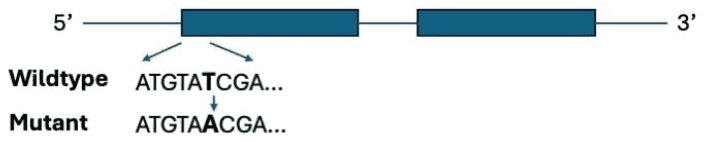
Which one of the following options accurately describes the outcome of this mutation?
- 1Gain of function
- 2Loss of function
- 3No change
- 4Formation of an altered protein
Show answer and solution
Exon 1 reads ATG TAT CGA…, so the change of T to A at position 6 turns the second codon TAT (Tyr) into TAA, a stop codon. Translation stops after the first amino acid, and the mRNA is likely destroyed by nonsense-mediated decay, so the result is loss of function.
The levels of which one of the following parameters of blood are measured to check cardiac damage?
- 1Creatine
- 2Creatine kinase
- 3Peroxidase
- 4Urea
Show answer and solution
Creatine kinase, especially its MB isoenzyme, leaks from damaged heart muscle into the blood and rises within hours of a heart attack. Today it is used alongside cardiac troponins. Creatine and urea reflect muscle mass and kidney function.
Which of the following features establishes stromatolites as a source of early evidence for life on earth?
- 1Fossilized bones that have been deeply embedded in a silica-rich matrix
- 2Layered accretion structures that have been formed as a result of mineral precipitation
- 3Biogenic laminated structures that have been influenced by phototrophic microbial mats
- 4Conical limestone mounds that were created by reduced volcanic geothermal activity
Show answer and solution
Stromatolites are laminated mounds built by microbial mats, mainly photosynthetic cyanobacteria, that trap and bind sediment and drive carbonate precipitation layer by layer. Examples about 3.5 billion years old are among the oldest evidence of life. Purely chemical layering would not count as biogenic.
Which one of the following does NOT promote aging in humans?
- 1Increased oxidative stress
- 2Defects in DNA repair enzymes
- 3Activation of telomerase
- 4Reduced biosynthesis of leukotrienes
Show answer and solution
Oxidative stress and faulty DNA repair speed up ageing. Telomerase activation does the opposite: it rebuilds telomeres and delays replicative senescence, which is why it is active in germ cells, stem cells and most cancers.
In the catalytic triad of trypsin protease, serine forms a hydrogen bond with the histidine side chain. What will be the effect of this interaction on the pKa of the serine side chain?
- 1The pKa decreases because the hydrogen bonding with histidine stabilises serine side chain’s protonated state.
- 2The pKa increases because the hydrogen bonding with histidine stabilises serine side chain’s deprotonated state.
- 3The pKa decreases because the hydrogen bonding with histidine stabilises serine side chain’s deprotonated state.
- 4The pKa increases because the hydrogen bonding with histidine stabilises serine side chain’s protonated state.
Show answer and solution
The histidine pulls on the serine O–H and takes its proton, stabilising the negatively charged alkoxide (the deprotonated form). Stabilising the base form lowers the pKa of serine from about 13 to a value where it can act as a strong nucleophile at physiological pH.
Which one of the following would be most suitable to study early embryogenesis event using live microscopy of unstained C. elegans embryos?
- 1Confocal microscope
- 2Fluorescence microscope
- 3Differential Interference Contrast microscope
- 4Super-resolution microscope
Show answer and solution
Differential interference contrast (Nomarski) microscopy shows nuclei, cell boundaries and division planes in living, unstained C. elegans embryos at high resolution. It was used to trace the complete embryonic cell lineage. Fluorescence, confocal and super-resolution methods need a fluorophore.
Which one of the following statements about human papillomavirus is correct?
- 1The viral structural protein-encoding genes occasionally integrate into the host genome, leading to cervical cancer.
- 2The viral protein E7 promotes Rb binding to the E2F, which allows uncontrolled entry into the S Phase of the cell cycle.
- 3The viral protein E6 binds to p53 and prevents its degradation.
- 4They infect cervical epithelial cells and maintain themselves in a latent phase as extrachromosomal plasmids.
Show answer and solution
In basal cells of the cervical epithelium, HPV keeps its genome as a low-copy episome (an extrachromosomal plasmid), largely latent. The other statements are reversed. Integration that drives cancer keeps the E6/E7 oncogenes, not structural genes. E7 releases E2F from Rb. E6 promotes p53 degradation.
Which one of the following options best represents cholesterol distribution as a percentage of total membrane lipid in a typical animal cell?
- 1lysosomal membrane > smooth ER > plasma membrane > inner mitochondrial membrane
- 2smooth ER > plasma membrane > lysosomal membrane > inner mitochondrial membrane
- 3plasma membrane > lysosomal membrane > smooth ER > inner mitochondrial membrane
- 4plasma membrane > inner mitochondrial membrane > smooth ER > lysosomal membrane
Show answer and solution
Cholesterol is richest in the plasma membrane (up to 30–40% of lipid) and the late endocytic and lysosomal membranes. There is less in the ER, where cholesterol is made but quickly exported, and least in the inner mitochondrial membrane, which is rich in cardiolipin.
The heterotrimeric G-protein signaling component that is uniquely present in the plant lineage is
- 1GTPase-accelerating protein
- 2G-protein-coupled receptor
- 3regulator of G-protein signaling
- 4extra-large Gα subunit
Show answer and solution
Plants have, besides the canonical Gα, extra-large Gα proteins (XLGs): a Gα-like domain joined to a long N-terminal extension. They are found only in the plant lineage. GAPs, RGS proteins and GPCR-like proteins also occur in animals or fungi.
Why might a plant species evolve cleistogamous flowers in addition to chasmogamous ones?
- 1To avoid inbreeding depression, a characteristic feature of cleistogamy
- 2To ensure cross-pollination, a key objective of cleistogamy
- 3To increase reproductive success in response to uncertainty in pollination
- 4To enhance the phenomenon of pollinator attraction
Show answer and solution
Cleistogamous flowers never open and self-pollinate, so they set seed even when pollinators are scarce or the weather is bad. Open chasmogamous flowers keep the chance of outcrossing. Having both is a bet-hedging strategy that secures reproduction when pollination is uncertain. Cleistogamy itself causes inbreeding, not cross-pollination.
If 19% of the nucleotides in a genome are “A”, what percent are “C”, “G”, and “T”?
- 1C = 31%, G = 31%, and T = 19%
- 2C = 19%, G = 19%, and T = 31%
- 3C = 31%, G = 19%, and T = 31%
- 4C = 19%, G = 31%, and T = 31%
Show answer and solution
In double-stranded DNA, A pairs with T and G with C, so T = 19%. G + C = 100 − 38 = 62%, split equally: C = G = 31%.
According to the Oparin-Haldane hypothesis, which one of the following statements best describes the Earth’s early atmosphere?
- 1Rich in oxygen and nitrogen
- 2Composed primarily of carbon dioxide and oxygen
- 3Reducing atmosphere with gases such as methane and ammonia
- 4Similar to the current atmosphere of Earth
Show answer and solution
Oparin and Haldane proposed that the early atmosphere had little or no free oxygen and was reducing, rich in methane, ammonia, hydrogen and water vapour. In it, energy from lightning or UV could build organic molecules, as Miller and Urey later showed.
Which of the following chemical modifications of uridine residue occur after transcription of tRNA?
- 1Ribothymidine and pseudouridine
- 2Ribothymidine and N3-methyluridine
- 3N3-methyluridine and pseudouridine
- 4Pseudouridine and N1-Methylpseudouridine
Show answer and solution
Two common post-transcriptional changes of uridine in tRNA are pseudouridine (ψ, made by isomerisation) and ribothymidine (T, 5-methyluridine). Both are found in the TψC loop that gives that arm its name.
Which one of the following is NOT a microbe-associated molecular pattern (MAMP) of phytopathogens?
- 1flg22, a 22 amino-acid peptide
- 2pep13, a 13 amino-acid peptide
- 3elf26, a 26 amino-acid peptide
- 4systemin, an 18 amino-acid peptide
Show answer and solution
flg22 (from bacterial flagellin), elf18/26 (from elongation factor Tu) and pep13 (from an oomycete cell-wall transglutaminase) are all microbial patterns that plant receptors recognise. Systemin is the plant’s own 18-amino-acid wound peptide from tomato, a damage signal rather than a microbial one.
Which one of the following datasets (expressed as mean ± SD) is most likely to follow a Gaussian (normal) distribution, considering that the data cannot have any negative values?
- 1296 ± 190 picomolar concentration of insulin in human blood samples
- 258 ± 45 number of a particular species of bacteria in the rhizosphere
- 3160 ± 20 mg/dL of blood cholesterol concentration in human athletes
- 44 ± 8 number of insects caught in a trap from an agricultural field
Show answer and solution
For a variable that cannot go negative, a normal distribution is plausible only if the mean lies several SDs above zero. For 160 ± 20 the mean is 8 SD from zero. In the other three the SD is large relative to the mean, so the data must be skewed to the right.
Which one of the following habitats harbors the critically endangered Great Indian Bustard (Ardeotis nigriceps)?
- 1Sal forests of Madhya Pradesh
- 2Desert grasslands of Rajasthan
- 3Shola grasslands of southern India
- 4Terai grasslands of northeastern India
Show answer and solution
The Great Indian Bustard lives in open, dry grasslands and semi-arid scrub. Its largest remaining population is in the Thar desert grasslands of Rajasthan (Desert National Park), with a few birds in Gujarat, Maharashtra and Karnataka. Power-line collisions are its main threat today.
Under the current rules of taxonomy, which one of the following organismal lineages can legitimately receive genus names either under the ICN or under the ICNP, based on the authors’ choice?
- 1Chlorophyta (Green algae)
- 2Bacillariophyta (Diatoms)
- 3Cyanobacteria (Blue-green algae)
- 4Mycetozoa (Slime moulds)
Show answer and solution
Cyanobacteria are prokaryotes, so the bacteriological code (ICNP) covers them, but they are also traditionally named as blue-green algae under the botanical code (ICN). Authors may still publish their genus names under either code.
Which one of the following statements depicts the correct function of TFIIB?
- 1It binds to the TATA box and helps in the proper positioning of RNA pol II.
- 2It plays an important role in the elongation phase of transcription.
- 3It forms the transcription initiation complex by interacting with RNA pol II and TBP.
- 4It acts as a coactivator that facilitates the binding of enhancers to the promoter.
Show answer and solution
TFIIB binds TBP on the TATA box and contacts RNA polymerase II, bridging the two to build the pre-initiation complex and helping to choose the start site. TBP, not TFIIB, binds the TATA box itself.
All of the following are covered by lipid monolayers, EXCEPT
- 1lipid droplet
- 2very low-density lipoprotein
- 3endocytic vesicles
- 4chylomicrons
Show answer and solution
Lipid droplets, VLDL and chylomicrons have a core of neutral lipid (triacylglycerol and cholesteryl esters) covered by a phospholipid monolayer. Endocytic vesicles enclose water-filled lumens and are bounded by an ordinary bilayer.
Which one of the following proteins is responsible for the permeability of Mg2+ through the tight junctions of tubular cells in the thick ascending limb of Henle?
- 1Claudin – 2
- 2ZO – 1
- 3Claudin – 16
- 4ZO – 3
Show answer and solution
Claudin-16 (paracellin-1), with claudin-19, forms a paracellular cation pore in the thick ascending limb through which Mg2+ and Ca2+ are reabsorbed. Mutations cause familial hypomagnesaemia with hypercalciuria. Claudin-2 forms a leaky pore in the proximal tubule.
Which of the following statements indicates the relationship between basal metabolic rate and body size for organisms within a taxonomic group?
- 1Basal metabolic rate increases linearly with body size
- 2Weight-specific basal metabolic rate is independent of body size
- 3Weight-specific basal metabolic rate decreases non-linearly with body size
- 4Basal metabolic rate increases non-linearly with body size.
Show answer and solution
Basal metabolic rate scales with body mass as about M0.75 (Kleiber’s law): it increases non-linearly with size. Per kilogram, M−0.25 means mass-specific rate decreases non-linearly. Both statements are true, and NTA accepted options 3 and 4.
The reactions of the urea cycle occur in two different cellular compartments and generate the following intermediates.
- A. Argininosuccinate
- B. Citrulline
- C. Ornithine
Which intermediate(s) must be transported across the mitochondrial inner membrane?
- 1A and B
- 2B and C
- 3A and C
- 4A only
Show answer and solution
Citrulline is made in the mitochondrial matrix from carbamoyl phosphate and ornithine, then exported to the cytosol. There it becomes argininosuccinate, then arginine, which arginase splits to urea and ornithine. Ornithine must be imported back into the mitochondrion (by ORNT1). So B and C cross the membrane.
Which one of the following is the correct arrangement of amino acid dipeptides in increasing order of the area of allowed regions in the Ramachandran map?
- 1Gly-Gly < Pro-Pro < Ala-Ala ~ Phe-Phe
- 2Phe-Phe < Ala-Ala < Pro-Pro ~ Gly-Gly
- 3Pro-Pro < Phe-Phe ~ Ala-Ala < Gly-Gly
- 4Ala-Ala < Phe-Phe < Gly-Gly < Pro-Pro
Show answer and solution
Proline’s ring fixes φ at about −60°, so Pro–Pro has the smallest allowed area. Ala and Phe have the usual β-carbon and similar maps. Gly–Gly, with only a hydrogen side chain, has by far the largest allowed region.
Which one of the following biofuels is classified as a first-generation biofuel?
- 1Cellulosic ethanol
- 2Bio-ethanol
- 3Lignin-based biofuels
- 4Algal biofuels
Show answer and solution
First-generation biofuels are made from food crops: bioethanol fermented from sugar or starch (sugarcane, maize) and biodiesel from vegetable oil. Cellulosic and lignin-based fuels are second generation, and algal fuels third.
Ribosomes attach to the endoplasmic reticulum via
- 1differing surface ribosomal protein composition that allow it to interact with polar headgroups on the ER lipid bilayer.
- 25′UTR of mRNA being translated that directs the localization of the ribosomes to the ER.
- 3the translated nascent chain which carries a signal allowing interaction with SRP-receptor on the ER.
- 4tethered mRNAs that interact with rRNA.
Show answer and solution
Ribosomes are steered to the ER by what they are making. As the signal sequence of the nascent chain emerges, SRP binds it and pauses translation. SRP then docks on the SRP receptor in the ER membrane, which hands the ribosome to the Sec61 translocon.
Which one of the following molecules is transported into enterocytes from intestinal lumen by GLUT5?
- 1Glucose
- 2Galactose
- 3Fructose
- 4Lactose
Show answer and solution
GLUT5 on the brush border is a facilitative transporter specific for fructose. Glucose and galactose enter by the Na+-coupled SGLT1, and all three leave the cell through GLUT2.
Mutation of homeotic genes often results in which one of the following developmental defects in Drosophila?
- 1Polarity defects in every segment along the A-P axis
- 2Absence of every other segment along the A-P axis
- 3Transformation of one segment into another
- 4Absence of a group of contiguous segments
Show answer and solution
Hox (homeotic) genes give each segment its identity, so mutating them turns one segment into the likeness of another (for example a second pair of wings in Ubx mutants). Missing alternate segments is a pair-rule defect, and missing contiguous blocks is a gap defect.
In the circular synteny maps of Poaceae family, providing insights into the origin and evolution of grass genomes, which one of the following genomes should represent the “innermost” circle?
- 1Arabidopsis thaliana chromosomes (n = 5)
- 2maize chromosomes (n = 10)
- 3rice chromosomes (n = 12)
- 4ancestral chromosomes (n = 12)
Show answer and solution
Grass synteny circles (Moore and colleagues, 1995) are drawn around a reconstructed ancestral grass genome (n = 12) at the centre, with rice, maize, wheat and others in concentric rings aligned to it. Arabidopsis is a dicot and not part of the grass comparison.
Part C: Life Sciences, analytical (Q71–145)
75 questions; answer any 25. Each carries 4 marks, and a wrong answer costs 1.
An embryo lethal recessive mutation in a plant gene “R” located on chromosome 1 was rescued by an ectopically integrated GFP-tagged wild type “R” transgene (R-comp) which is inserted in chromosome 4. When a female homozygous R-comp plant is crossed to a male purple-coloured recessive mutant, some of the resultant F1 embryos showed chromosome segregation defects. The plants regenerated from these embryos were purple and sterile, and found to contain the wild type gene “R” but not the R-comp transgene. What is the ploidy of the above F1 plants?
- 1Triploid
- 2Haploid
- 3Chromosome 4 trisomy
- 4Monosomic diploid
Show answer and solution
Plants that carry only the wild-type R from the father, lack the maternal R-comp transgene, show the recessive purple colour and are sterile have lost the whole maternal genome. Uniparental genome elimination left a haploid with only paternal chromosomes, as in centromere-mediated haploid induction.
Gastric juice (pH 1.5) is produced by pumping HCl from blood plasma (pH 7.4) into the stomach. Calculate the amount of free energy required for H+ transport to produce one litre of gastric juice at 37°C. How many moles of ATP must be hydrolyzed to provide this amount of energy? (The free energy change for ATP hydrolysis under cellular conditions is about −58 kJ/mol.) (R = 8.315 J/mol/K)
- 134 – 36 kJ/mol and 0.6 – 0.61 mol
- 23.4 – 3.6 kJ/mol and 6.0 – 6.1 mol
- 322 – 23 kJ/mol and 0.3 – 0.31 mol
- 417 – 18 kJ/mol and 3.0 – 3.1 mol
Show answer and solution
Free energy per mole of H+ moved = RT ln(Cout/Cin) = 8.315 × 310 × ln(107.4−1.5) = 2,578 × 13.59 ≈ 35 kJ/mol. Divided by 58 kJ per ATP, that is about 0.60 mol ATP per mole of H+, which is what the key gives. (One litre at pH 1.5 holds 0.032 mol H+, so it would need about 0.019 mol ATP.)
Spindle assembly requires the formation of numerous new microtubules. To meet this demand, the spindle contains a large number of regulatory factors. A few protein/protein complexes are mentioned below:
- A. γ-TuRCs
- B. Augmin
- C. TPX2
- D. Dynein
Which one of the following options includes all the factors that directly impact microtubule nucleation for spindle assembly?
- 1A only
- 2A and B only
- 3A, B, and C only
- 4A, B, C, and D
Show answer and solution
Spindle microtubules are nucleated by γ-TuRC. Augmin recruits γ-TuRC onto existing microtubules for branching nucleation, and TPX2, released by Ran-GTP near chromosomes, stimulates nucleation. Dynein is a motor that organises spindle poles but does not nucleate microtubules.
The baroreceptors present in the carotid sinus and aortic arch are stretch receptors that provide neural signals to the brain stem for the maintenance of normal blood pressure. The activity of baroreceptors in the regulation of blood pressure and heart rate are proposed in the following statements:
- A. The increased baroreceptor discharge due to high blood pressure in the carotid sinus and aortic arch stimulates the tonic discharge of sympathetic nerves to blood vessels and heart.
- B. A decline in the pulse pressure without a change in mean pressure increases the rate of baroreceptor discharge.
- C. Baroreceptors are more sensitive to pulsatile change of blood pressure than to constant blood pressure.
- D. The increased baroreceptor discharge excites the vagal innervations to the heart.
Which one of the following options represents all correct statements?
- 1A, B, C and D
- 2A, C and D only
- 3C and D only
- 4A and B only
Show answer and solution
Higher pressure increases baroreceptor firing, which inhibits sympathetic outflow (so A is wrong) and excites vagal output to the heart (D). The receptors respond more to pulsatile than to steady pressure (C), so a smaller pulse pressure at the same mean lowers their firing (so B is wrong). C and D are correct.
The following statements are made regarding vesicle formation, transport, and fusion in cells expressing a mutant Arf protein. This mutant Arf protein is constitutively bound to GTP but is defective for GTP hydrolysis.
- A. COPI-coated vesicles are only formed from their normal location.
- B. Arf is constitutively bound to a membrane.
- C. COPII-coated vesicle fusion with the target membrane is aberrant.
- D. COPI-coated vesicle fusion with the target membrane is disrupted.
Which one of the following options represents the combination of all correct statements?
- 1A and B only
- 2A, B, and D
- 3B and C only
- 4B and D only
Show answer and solution
Arf-GTP recruits the COPI coat, and GTP hydrolysis is needed to shed it. Locked in the GTP form, Arf stays permanently on membranes (B), and COPI vesicles keep their coat and cannot fuse (D). COPII vesicles depend on Sar1, not Arf, so they are unaffected (C wrong). Coats also assemble at abnormal sites (A wrong).
The operation of the photorespiratory (C2) pathway involves cooperative interaction among three separate subcellular organelles, namely, chloroplast, mitochondria and peroxisomes. Following are certain statements regarding C2 pathway:
- A. 2-phosphoglycolate formed in the chloroplast is converted to glycolate by the action of phosphoglycolate phosphatase.
- B. Glycolate exits chloroplast by diffusion and enters peroxisome through a glycolate transporter.
- C. In the peroxisomes, glycolate reacts with O2 and produces glyoxylate and H2O2.
- D. Only serine:glyoxylate aminotransferase is involved in the conversion of glyoxylate into serine in a peroxisomal reaction.
Which one of the following options correctly marks the above statements as TRUE (T) or FALSE (F)?
- 1A-T, B-T, C-F, D-T
- 2A-F, B-T, C-F, D-T
- 3A-F, B-T, C-T, D-T
- 4A-T, B-F, C-T, D-F
Show answer and solution
A is true: phosphoglycolate phosphatase makes glycolate in the chloroplast. B is false: glycolate leaves the chloroplast through a transporter (PLGG1) rather than by simple diffusion. C is true: peroxisomal glycolate oxidase makes glyoxylate and H2O2. D is false: glyoxylate becomes glycine in the peroxisome (via glutamate:glyoxylate and serine:glyoxylate aminotransferases), and serine is made in the mitochondrion.
The following statements are related to airway resistance of lungs in healthy humans:
- A. The resistance to airflow increases with increasing lung volume.
- B. The major site of airway resistance is in the first eight generations of airways.
- C. The smallest airways contribute very little to the overall total resistance of the bronchial tree.
- D. Breathing a mixture of oxygen-helium instead of oxygen-nitrogen results in a decrease of airway resistance.
Which one of the following options represents all correct statements?
- 1B and D only
- 2B, C and D
- 3A and B only
- 4A and D only
Show answer and solution
A is false: airways widen as the lungs inflate, so resistance falls at higher lung volume. B and C are true: most resistance lies in the medium-sized bronchi of the first eight or so generations, because the very many small airways sit in parallel. D is true: helium is much less dense than nitrogen, which reduces turbulence and resistance. B, C and D.
As per the 2020 FAO Global Forest Resources Assessment, the climatic domains ranked in descending order based on their proportion and distribution of global forest area are:
- 1Tropical, Subtropical, Temperate, Boreal
- 2Tropical, Boreal, Temperate, Subtropical
- 3Boreal, Tropical, Subtropical, Temperate
- 4Boreal, Temperate, Subtropical, Tropical
Show answer and solution
In FAO’s Global Forest Resources Assessment 2020, forests are split by climatic domain as tropical 45%, boreal 27%, temperate 16% and subtropical 11%. That gives tropical, boreal, temperate, subtropical.
Given below is a table listing the names of compounds/products derived from animals or plants (Column X) and their use/application (Column Y).
| Column X | Column Y |
|---|---|
| A. Bacoside | i. Chemotherapy for leukaemia and lymphoma |
| B. Vincristine | ii. Coating for pills and food glazing |
| C. Lanolin | iii. Cognitive enhancer |
| D. Shellac | iv. Skin creams and moisturizers |
Which one of the following options represents all correct matches between Column X and Column Y?
- 1A (iii), B (i), C (ii), D (iv)
- 2A (ii), B (iii), C (iv), D (i)
- 3A (i), B (iv), C (iii), D (ii)
- 4A (iii), B (i), C (iv), D (ii)
Show answer and solution
Bacosides, from Bacopa monnieri (brahmi), are used as memory and cognition enhancers. Vincristine, from Catharanthus roseus, treats leukaemias and lymphomas. Lanolin (wool wax) goes into skin creams. Shellac, the lac insect resin, glazes pills and sweets.
The table below lists genes (Column X) and their encoded proteins (Column Y) that play an important role in plant response to biotic stress.
| Column X | Column Y |
|---|---|
| A. SID1 | i. Isochorismate synthase |
| B. SID2 | ii. Cytochrome P450 monooxygenase |
| C. PAD3 | iii. ABC transporter |
| D. PEN3 | iv. MATE transporter |
Which one of the following options represents the correct match between Column X and Column Y?
- 1A-ii, B-i, C-iv, D-iii
- 2A-iii, B-iv, C-ii, D-i
- 3A-iv, B-i, C-ii, D-iii
- 4A-iv, B-ii, C-iii, D-i
Show answer and solution
In Arabidopsis salicylic acid signalling, SID1 (EDS5) is a MATE transporter that exports SA from the chloroplast, and SID2 (ICS1) is isochorismate synthase, which makes SA. PAD3 is the cytochrome P450 (CYP71B15) that finishes camalexin synthesis, and PEN3 is an ABC transporter for antifungal compounds at the cell surface.
The activity of two promoters (A and B) upstream of a luciferase reporter in response to transcription factor TF-X in a cell line was studied. Luciferase activity was measured in cells following overexpression and RNAi silencing of TF-X and compared to control (Native TF-X level). The luciferase enzyme activity is tabulated below.
| Condition | pGene A: Luciferase activity (Arbitrary Units) | pGene B: Luciferase activity (Arbitrary Units) |
|---|---|---|
| Native TF-X levels | 9 | 2 |
| Overexpression of TF-X | 2 | 9 |
| RNAi-silenced TF-X | 2 | 2 |
Based on the above table, following statements were made
- A. TF-X is needed for basal activity of promoter A.
- B. TF-X is needed for basal activity of promoter B.
- C. TF-X functions both as a positive and negative regulator for promoter A.
Which one of the following options represents correct statement(s)?
- 1A only
- 2B only
- 3A and B
- 4A and C
Show answer and solution
Promoter A falls from 9 to 2 when TF-X is silenced, so TF-X is needed for its basal activity (A). It also falls to 2 when TF-X is overexpressed, so too much TF-X represses it: TF-X acts both positively and negatively (C). Promoter B is unchanged at 2 when TF-X is silenced, so its basal activity does not need TF-X (B is false).
A network of genes regulates vertebrate eye development. The loss or gain of function of select genes are listed in Column X, and their effects or phenotypes are listed in Column Y.
| Column X | Column Y |
|---|---|
| A. Loss of function of Shh | i. No eyes |
| B. Elevated levels of Shh in the prechordal plate | ii. Disruption of anterior neural tube specification |
| C. Loss of function of Otx2 | iii. Defective pigmented retina |
| D. Loss of function of Mitf | iv. Failure to split the eye field to form bilateral eye fields |
Which one of the following options represents all correct matches between column X and column Y?
- 1A – iv, B – i, C – ii, D – iii
- 2A – ii, B – iii, C – i, D – iv
- 3A – iii, B – ii, C – iv, D – i
- 4A – iv, B – ii, C – i, D – iii
Show answer and solution
Without Shh from the midline, the single eye field is not split into two, causing cyclopia (A–iv). Too much Shh in the prechordal plate represses Pax6 and the eyes fail to form (B–i). Otx2 is needed to specify the anterior neural tube, the forebrain and midbrain (C–ii). Mitf specifies the retinal pigment epithelium (D–iii).
The Red List of the IUCN categorises species (Column X) under multiple threat levels (Column Y). Match the following species with their IUCN status (as of the latest reports):
| Column X | Column Y |
|---|---|
| A. Jerdon’s Courser (Rhinoptilus bitorquatus) | i. Critically Endangered |
| B. Indian Star Tortoise (Geochelone elegans) | ii. Endangered |
| C. Indian Dwarf Banana (Musa mannii) | iii. Least Concern |
| D. Teak (Tectona grandis) | iv. Vulnerable |
- 1A-(i), B-(iv), C-(ii), D-(iii)
- 2A-(iv), B-(i), C-(ii), D-(iii)
- 3A-(iv), B-(ii), C-(i), D-(iii)
- 4A-(i), B-(iv), C-(i), D-(ii)
Show answer and solution
On the IUCN Red List, Jerdon’s courser is Critically Endangered, the Indian star tortoise Vulnerable, the wild dwarf banana Musa mannii of Assam Critically Endangered, and teak Endangered (assessed in 2017, owing to the loss of natural teak forests).
Sucrose transport in plant cells follows both active transport and diffusion mechanisms. The given figure shows the rate of sucrose uptake by soybean protoplasts as a function of the external sucrose concentrations.
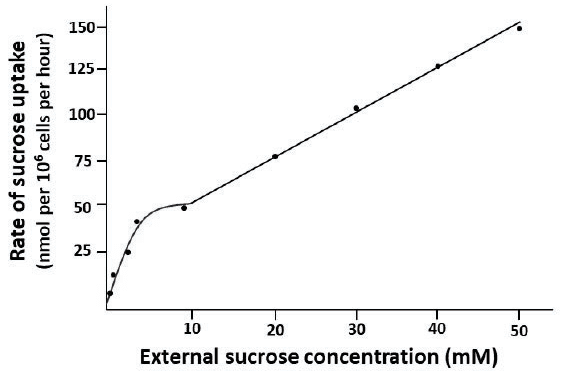
Based on the given information, a researcher made following interpretations:
- A. Sucrose uptake at low concentration (<10 mM) is facilitated by an energy-dependent process.
- B. Sucrose uptake at low concentrations is a carrier-independent process.
- C. At higher concentrations, sucrose enters the cells by diffusion down its concentration gradient.
- D. Inhibition of ATP synthesis with metabolic poison can block only the linear component.
Which one of the following options represents the combination of all correct interpretations?
- 1A and B
- 2B and C
- 3A and C
- 4C and D
Show answer and solution
Below about 10 mM, uptake rises steeply and then levels off, the saturable behaviour of a carrier (an energy-dependent sucrose–H+ symporter), so A is true and B false. Above that, uptake rises in a straight line with concentration: diffusion down the gradient (C true). A metabolic poison would block the saturable, active component, not the linear one (D false).
In a dioecious plant species, a single gene is responsible for petal colour. A cross between a true breeding red female and a true breeding white male gave rise to all red male and all white female F1 progeny. However, the reciprocal cross produced all red males and all red females.
Which one of the following explains the inheritance of petal colour?
- 1The gene is located in the mitochondrial genome.
- 2Males are homogametic; gene is located on the sex chromosome.
- 3Females are homogametic; gene is located on the sex chromosome.
- 4The gene is located on an autosome.
Show answer and solution
The cross results show the trait following the sex chromosomes. In the first cross, daughters resemble the father and sons the mother, which is what happens when females are heterogametic (ZW) and males homogametic (ZZ), with red dominant. Red female ZRW × white male ZwZw gives red ZRZw sons and white ZwW daughters. The reciprocal cross, white female × red ZRZR male, gives all red offspring.
A population of Indian wolf shows logistic growth. Let the carrying capacity (K) be 200 and intrinsic rate of increase, r = 0.05. What is the maximum possible growth rate for the population (in terms of individuals per time unit)?
- 12.0
- 22.5
- 33.5
- 45.0
Show answer and solution
Logistic growth, dN/dt = rN(1 − N/K), is fastest at N = K/2, where it equals rK/4 = 0.05 × 200/4 = 2.5 individuals per unit time.
Equal numbers of particles of a mutant viral strain ‘A’ and the wild-type strain (WT) were used to separately infect equal numbers of synchronized compatible host mammalian cells. RNA from host mammalian cells were subjected to real-time quantitative PCR to analyze levels of the viral gag gene and host beta-tubulin after 24 hrs. Ct values for the above measurements are listed below.
| Ct values of transcript | Infected with ‘A’ | Infected with ‘WT’ | Uninfected |
|---|---|---|---|
| gag | 22 | 23 | 36 |
| beta-tubulin | 17 | 18 | 17 |
By how much have the gag transcripts in ‘A’-infected cells changed with respect to ‘WT’-infected cells?
- 1Reduced to 1/32 of WT
- 2Reduced to 1/4 of WT
- 3Reduced to 1/2 of WT
- 4No change
Show answer and solution
Normalise to β-tubulin. For ‘A’, ΔCt = 22 − 17 = 5. For WT, ΔCt = 23 − 18 = 5. ΔΔCt = 0, so the relative level is 20 = 1: no change. The raw Ct difference of 1 is due only to different amounts of input RNA.
Given below is the list of molecules that target the nervous system (Column X) and their modes of action (Column Y).
| Column X | Column Y |
|---|---|
| A. Lidocaine | i. is composed of two polypeptides: one helps to release acetylcholine at synapses with muscle cells, facilitating entry of a protease into the cytosol of the axon terminus. |
| B. Botulinum toxin | ii. blocks norepinephrine reuptake and prolongs the stimulation of postsynaptic neurons. |
| C. Cocaine | iii. binds to amino acid residues that line the channel pore and prevent the influx of Na+, and thus the generation of an action potential. |
| D. Desipramine | iv. binds to the dopamine transporter and inhibits the reuptake of dopamine, prolonging the stimulation of postsynaptic neurons. |
Which one of the following options represents the correct matches between Column X and Column Y?
- 1A-ii; B-i; C-ii; D-iv
- 2A-iv; B-ii; C-iii; D-i
- 3A-iii; B-iv; C-i; D-ii
- 4A-iii; B-i; C-iv; D-ii
Show answer and solution
Lidocaine blocks the pore of voltage-gated Na+ channels (A–iii). Botulinum toxin is a two-chain toxin: the heavy chain gets the light-chain protease into the nerve terminal, where it cleaves SNAREs (B–i). Cocaine blocks the dopamine transporter (C–iv). Desipramine, a tricyclic antidepressant, blocks noradrenaline reuptake (D–ii).
Given below are a few biological lipids (Column X) and their chemical nature (Column Y).
| Column X | Column Y |
|---|---|
| a. Sphingomyelin | i. Galactose linked to ceramide |
| b. Archaeal membrane lipid | ii. Ether-linked alkene |
| c. Non-polar lipids | iii. Triacylglycerol |
| d. Plasmalogens | iv. Phosphocholine head group |
| e. Cerebrosides | v. Very long branched chain fatty acids |
Which one of the following options correctly matches the lipid to its chemical nature?
- 1a:v; b:iv; c:i; d:iii; e:ii
- 2a:v; b:i; c:iii; d:ii; e:iv
- 3a:iv; b:v; c:iii; d:ii; e:i
- 4a:iv; b:iii; c:ii; d:i; e:v
Show answer and solution
Sphingomyelin has a phosphocholine head on ceramide (a–iv). Archaeal lipids are ether-linked, branched isoprenoid chains (b–v). Triacylglycerol is the typical neutral lipid (c–iii). Plasmalogens carry an ether-linked alkenyl (vinyl ether) chain at C-1 (d–ii). Cerebrosides are galactose or glucose joined to ceramide (e–i).
A novel DNA-binding protein (P) was tested for its mode of binding with DNA (D), for which a DNase I assay was performed. P was incubated with DNA to form a P-D complex, to which DNase I was added. Assume constant concentration of P, D, and DNase I. The reaction was terminated at increasing time-points (minutes) and resolved on a sequencing-grade polyacrylamide gel.

Based on the results of the DNase I digest, which one of the following options is the correct interpretation?
- 1P does not bind to D, thereby generating a banding pattern of D.
- 2P binds to D at a specific site, generating a banding pattern of D.
- 3P binds and exposes multiple sites on D, generating a banding pattern of D.
- 4P binds to only the 5′ and 3′ ends of D, generating a banding pattern of D.
Show answer and solution
Without P, DNase I gives a ladder of bands. With P, at every time point, there are more cleavage products, and new bands appear that are absent in DNA alone. A protein that protected one site would leave a gap (a footprint). Instead P makes many sites hypersensitive, so it binds and exposes multiple sites on D.
The following statements are made about transgenic mice technologies:
- A. Catalytically inactive Cas9 fused to a transcription activator can be used to activate specific gene expression.
- B. Using CRISPR/Cas9, a precise gene replacement in a target locus can be accomplished by non-homologous end joining repair.
- C. Using CRISPR/Cas9, many genes can be targeted at once by expressing many guide RNAs in the same cell.
- D. All chimeric mice derived by injecting engineered mouse embryonic stem cells into blastocysts will carry the transgene in the germ line.
- E. In the Cre-lox conditional system, the Cre recombinase is inserted into the gene to be knocked out.
Which one of the following options represents the combination of all correct statements?
- 1A, C, and E
- 2A and C only
- 3B, D, and E
- 4B and D only
Show answer and solution
A is true: dCas9 fused to an activator (CRISPRa) switches genes on. B is false: precise replacement needs homology-directed repair with a donor, not NHEJ. C is true: several guide RNAs allow multiplexed editing. D is false: only some chimeras pass the ES-cell genome through the germ line. E is false: Cre is expressed from a separate transgene, and it is loxP that flanks the target gene. A and C.
The figure below is a schematic representation of the replication fork. The different proteins associated with DNA replication are marked by A, B, C, D, E, and F.
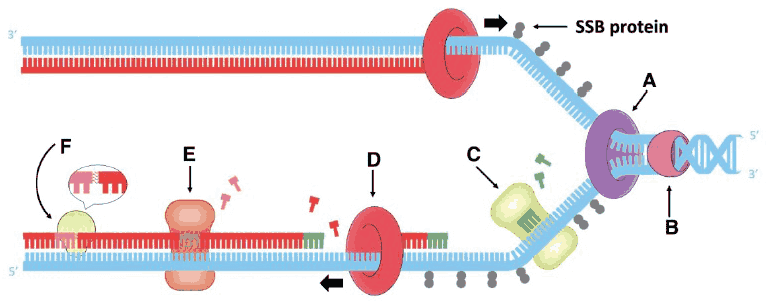
Which one of the following options correctly represents the names of these proteins?
- 1A: DNA Helicase; B: DNA Gyrase; C: DNA Primase; D: DNA pol III; E: DNA pol I; F: DNA Ligase
- 2A: DNA Gyrase; B: DNA Helicase; C: DNA Primase; D: DNA pol II; E: DNA pol I; F: DNA Ligase
- 3A: DNA Helicase; B: DNA Gyrase; C: DNA Primase; D: DNA pol III; E: DNA pol II; F: DNA Ligase
- 4A: DNA Gyrase; B: DNA Helicase; C: DNA Primase; D: DNA pol II; E: DNA pol III; F: DNA Ligase
Show answer and solution
At the fork, helicase (A) opens the strands while gyrase (B) removes supercoils ahead of it. Primase (C) lays RNA primers on the lagging strand, and DNA pol III (D) extends them. DNA pol I (E) replaces the primers with DNA, and ligase (F) seals the nicks.
Panel (I) represents two alleles of a gene. The coding region of the wild type allele (R) is 3 Kb long while the mutant allele (r) has a 0.5 Kb insertion. The black box indicates insertion in the r allele. Three primers indicated as X, Y and Z were designed to develop PCR based DNA markers associated with the gene.
A cross was carried out between lines with the genotypes RR and rr. The F1 progeny was selfed. Panel (II) and (III) represent the probable patterns of DNA markers observed in the F2 progeny using different primer combinations.
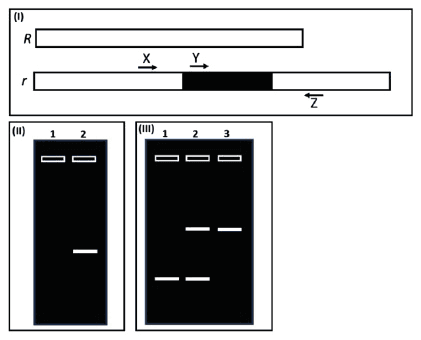
Which one of the following statements is correct?
- 1Panel III represents the pattern when primers Y and Z are used for amplification.
- 2Panel II is an example of a dominant DNA marker.
- 3The F2 progeny as represented in Panel II, will have 50% of the progeny showing no amplified fragment (lane 1).
- 4A rare recombination event between the regions represented by primers X and Y will lead to changes in the amplification patterns observed in Panels II and III.
Show answer and solution
Primer Y lies inside the insertion, so Y + Z amplifies only the r allele. That gives a band or no band (Panel II), a dominant marker: RR shows nothing, while Rr and rr look the same. X + Z amplifies both alleles at different sizes, so heterozygotes show two bands (Panel III, codominant). Only a quarter of F2 plants (RR) would lack a band, not half.
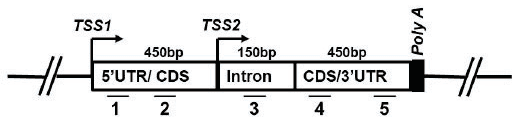
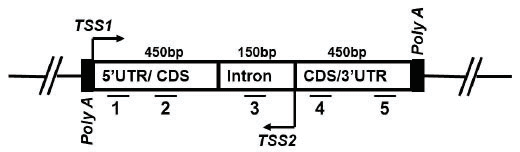
Shown below is a Northern blot profile with five independent probes representing the transcript from a single genetic locus.

Based on the Northern blots, which of the diagrams below best represents the order of genes encoded in the genetic locus? Note: Exon and intron junctions are given only for the transcript from TSS1. For options 2, 3 & 4, the mature transcript from TSS2 retains the intron.
- 1

- 2

- 3

- 4



Show answer and solution
From TSS1, the spliced mRNA is 450 + 450 = 900 bp and the unspliced one 1,050 bp. From TSS2, which starts in the intron, the transcript is 150 + 450 = 600 bp. Probes in exon 1 (1 and 2) detect 1,050 and 900. The intron probe (3) detects 1,050 and 600. Exon 2 probes (4 and 5) detect all three. Option 2 matches this pattern.
A glucose biosensor exhibits Michaelis-Menten kinetics with a maximum current response, Imax = 250 μA, and a Michaelis constant, Km = 5.2 mM. If the glucose concentration in a sample is 3.4 mM, what is the current response (I) of the biosensor?
- 198.83 μA
- 2250 μA
- 329.06 μA
- 473.52 μA
Show answer and solution
The sensor follows Michaelis–Menten form: I = Imax[S]/(Km + [S]) = 250 × 3.4/8.6 = 98.8 µA.
The following statements are made about body temperature regulation in humans:
- A. As the skin temperature falls, the hypothalamic set point for sweating decreases.
- B. Acclimatization to cold activates the uncoupling protein (UCP) in mitochondria.
- C. Acclimatization to heat decreases aldosterone secretion.
- D. Sodium ion concentration in sweat decreases upon acclimatization to heat.
- E. When the body temperature becomes high, the skin blood vessels undergo vasodilation.
Which one of the following options represents the combination of all correct statements?
- 1A, B, and C
- 2B, D, and E
- 3B and C only
- 4A, D, and E
Show answer and solution
A is false: a cool skin raises the hypothalamic set point for sweating. B is true: cold acclimatisation induces UCP1 (thermogenin) in brown fat. C is false: heat acclimatisation increases aldosterone. D is true: higher aldosterone makes sweat glands reabsorb more Na+, so sweat becomes more dilute. E is true: heat causes skin vasodilation. B, D and E.
The ability to unwind RNA substrates I and II by translation regulator ‘X’ was studied. RNA substrates with radiolabeled antisense strand (*) were incubated with purified ‘X’ under the conditions listed below. Subsequently, RNA species were separated by polyacrylamide gel electrophoresis (PAGE), followed by autoradiography. The results are shown below:
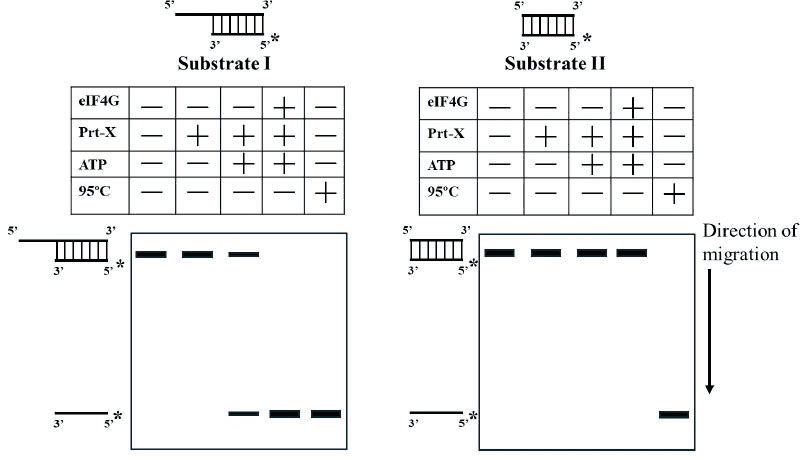
The following statements are made purely based on the observed gel patterns:
- A. X unwinds substrates with a 5′ overhang.
- B. Substrates which can be unwound by ‘X’ need ATP for efficient RNA unwinding.
- C. X unwinding activity is enhanced by the presence of eIF4G.
Which one of the following options represents the combination of all correct statements?
- 1A and B only
- 2B and C only
- 3A and C only
- 4A, B and C
Show answer and solution
Substrate I has a single-stranded 5′ overhang, while substrate II is blunt. X separates substrate I partly with ATP and completely with ATP plus eIF4G, and never separates substrate II. So X unwinds 5′-overhang substrates (A), needs ATP (B, since there is no unwinding with X alone), and works better with eIF4G (C). This is the behaviour of an eIF4A-type DEAD-box helicase.
Which one of the following statements best describes the function of magnetite in animal migration?
- 1Magnetite crystals generate electrical signals that amplify visual landmarks that guide flight.
- 2Magnetite acts as a biological compass.
- 3Magnetite stores magnetic energy that provides energy for long-distance flights.
- 4Magnetite emits magnetic pulses to keep the group together.
Show answer and solution
Magnetite (Fe3O4) crystals, found for example in the beak region of birds and in fish and bees, align with the Earth’s field and are thought to work as a magnetic compass (or map sensor), providing direction during migration. They neither store energy nor emit signals.
Lab-grown cells of a tumor (Wild type) expressing a novel cancer antigen, and a variant of the same tumor that has lost MHC class I expression, were injected subcutaneously into normal mice (dotted line) and into nude mice (solid line). The growth of the tumors in the two mouse strains is shown below.
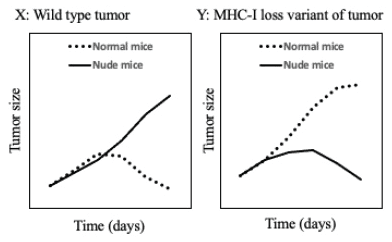
The following statements were made based on the results observed:
- A. In normal mice, CTLs recognize tumor cells in the presence, but not absence, of MHC-I.
- B. In nude mice, NK cells recognize tumor cells in the absence, but not in the presence, of MHC-I.
- C. CTLs and NK cells inhibit each other if MHC-I is present, but not if it is absent.
- D. In mice injected with tumors lacking MHC-I, antibodies generated with the help of CD4 cells restrain the growth of the tumor in nude mice.
Which one of the following options represents the combination of all correct statements?
- 1A and D
- 2B and C
- 3A and B
- 4A only
Show answer and solution
Wild-type tumours grow in nude mice, which lack T cells, but are rejected in normal mice: CTLs kill only MHC-I-positive cells (A). Tumours without MHC-I grow in normal mice, where CTLs cannot see them, but are held back in nude mice, consistent with NK cells attacking cells that lack MHC-I (“missing self”, B). Nothing shows CTLs and NK cells inhibiting each other, and nude mice cannot make T-dependent antibodies.
Eukaryotes regulate gene expression via histone modifications. In the table given below, the histone modification (column X), its association with chromatin type (column Y), and their impact on gene expression (column Z) is listed.
| Histone modification (X) | Association with chromatin type (Y) | Gene expression (Z) |
|---|---|---|
| (A) H4K4me3 | (a) highly accessible open chromatin | (i) ON |
| (B) H3K9me3 | (b) only facultative heterochromatin | (ii) OFF |
| (C) H3K9ac | (c) both constitutive and facultative heterochromatin | |
| (D) H3K27me3 |
Which one of the following options correctly matches all terms in the most appropriate combination?
- 1(A)-(a)-(i); (B)-(c)-(ii); (C)-(a)-(i); (D)-(b)-(ii)
- 2(A)-(b)-(i); (B)-(b)-(ii); (C)-(c)-(i); (D)-(a)-(ii)
- 3(A)-(c)-(ii); (B)-(a)-(i); (C)-(a)-(i); (D)-(c)-(ii)
- 4(A)-(c)-(i); (B)-(a)-(ii); (C)-(a)-(ii); (D)-(b)-(i)
Show answer and solution
NTA dropped this question, so everyone received its marks. Its column X lists “H4K4me3”, presumably meaning H3K4me3, and the matches are open to argument (option 1 would otherwise be the best fit). For revision: H3K4me3 and H3K9ac mark open, active chromatin, H3K9me3 marks constitutive (and some facultative) heterochromatin, and H3K27me3 marks facultative heterochromatin.
Given below are statements about the action of glucagon in human body:
- A. It does not cause glycogenolysis in muscle.
- B. It decreases ketone bodies formation in the liver.
- C. It does not cause lipolysis in the liver.
- D. It inhibits conversion of phosphoenolpyruvate to pyruvate in the liver.
Which one of the following options represents both correct statements?
- 1A and B
- 2B and C
- 3C and D
- 4A and D
Show answer and solution
Muscle has no glucagon receptors, so glucagon does not break down muscle glycogen (A true). In the liver it raises ketone body formation (B false). Through PKA it phosphorylates and inhibits liver pyruvate kinase, blocking PEP → pyruvate so that PEP goes to gluconeogenesis (D true). A and D.
Interactions among ‘maternal effect gene’ and ‘gap gene’ products are crucial for establishing embryonic domains in the Drosophila embryo. Which one of the following options DOES NOT show the correct interactions?
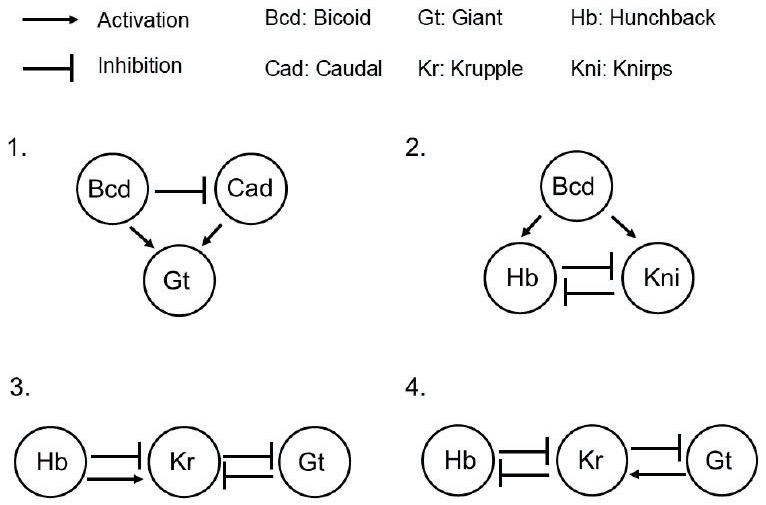
- 1Diagram 1
- 2Diagram 2
- 3Diagram 3
- 4Diagram 4
Show answer and solution
The known interactions: Bicoid represses caudal translation, and both activate giant (diagram 1). Bicoid activates hunchback and knirps, which repress each other (diagram 2). Hunchback activates Krüppel at low levels and represses it at high levels, and Krüppel and Giant repress each other (diagram 3). Diagram 4 shows Giant activating Krüppel, which is wrong.
Lettuce seed germination is a typical photo-reversible response controlled by phytochrome. Seeds in a petridish were exposed to Red light (R), Far-Red light (FR) or kept in the dark (black bar) according to the schedule in Column X. The effect on seed germination is provided in Column Y.
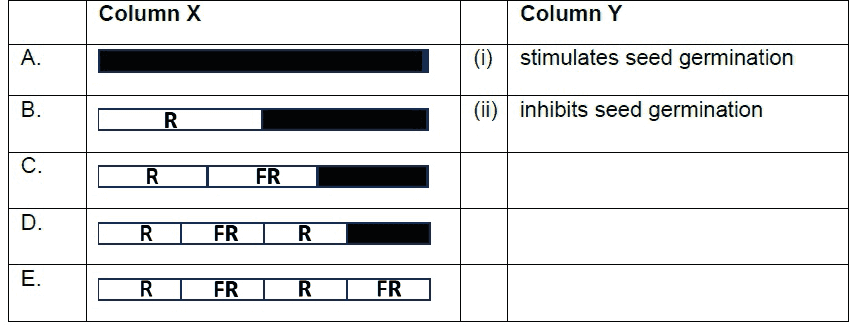
Which one of the following combinations represents the correct match between Column X and Column Y?
- 1A-i, B-ii, C-i, D-ii, E-i
- 2A-i, B-i, C-i, D-i, E-ii
- 3A-ii, B-ii, C-ii, D-ii, E-i
- 4A-ii, B-i, C-ii, D-i, E-ii
Show answer and solution
Lettuce seed germination is promoted by red light and reversed by far-red, and only the last treatment counts. Dark only: no germination (A–ii). R: germinates (B–i). R then FR: no (C–ii). R, FR, R: yes (D–i). R, FR, R, FR: no (E–ii).
Proteins possess a sorting signal known as a nuclear localization signal (NLS) for their import into the nucleus. A few statements are given below on the import of proteins destined for the nucleus.
- A. The import receptor binds to the nuclear localization signal.
- B. The import receptor contains several low-affinity binding sites for the nucleoporins.
- C. The nuclear import receptor-cargo complex is dissociated by RanGDP in the nucleus.
- D. The nuclear import receptor-cargo complex binds to RanGTP in the cytosol and traverses the nuclear envelope.
Which one of the following options has all the correct statements about nuclear protein import?
- 1A only
- 2A and B
- 3B and C
- 4C and D
Show answer and solution
Importin binds the NLS (A true). It carries many weak binding sites for the FG repeats of nucleoporins, which is how it slips through the pore (B true). In the nucleus, RanGTP, not RanGDP, binds importin and releases the cargo (C false). The complex crosses the pore without Ran and meets RanGTP only inside the nucleus (D false). A and B.
The following statements are made regarding leaf development in plants:
- A. The activity of KNOX1 and ARP are mutually repressive to help establish a separate identity for emerging leaf primordium.
- B. PHANTASTICA is required for adaxial cell fate during leaf development.
- C. KANADI genes promote abaxial cell fate during leaf development.
- D. miR166 binds to KANADI mRNA and degrades it on the abaxial side of the leaf primordium.
- E. Overexpression of KNOX1 increases leaf complexity and indeterminacy.
Which one of the following options represents all correct statements?
- 1A, B, C and E
- 2A, C, D and E
- 3A, B, C, and D
- 4A, B, D and E
Show answer and solution
A is true: KNOX1 (in the meristem) and ARP (in the leaf primordium) repress each other. B is true: PHANTASTICA is needed for adaxial identity in Antirrhinum. C is true: KANADI genes promote abaxial fate. E is true: extra KNOX1 makes leaves more complex and lobed. D is false: miR166 targets the adaxial HD-ZIP III mRNAs (PHB, PHV, REV), not KANADI.
Different segments of the renal tubule (Column X) and the sodium transporter in the apical membrane of tubular cells (Column Y) are given below:
| Column X | Column Y |
|---|---|
| a. Proximal tubule | i. Na+ channel (ENaC) |
| b. Collecting duct | ii. Na+-K+-2Cl− co-transporter |
| c. Thick ascending limb | iii. Na+-Cl− co-transporter |
| d. Distal convoluted tubule | iv. Na+-amino acid co-transporter |
Which one of the following options represents the correct match between Column X and Column Y?
- 1a – iv, b – i, c – ii, d – iii
- 2a – ii, b – iv, c – i, d – iii
- 3a – i, b – ii, c – iii, d – iv
- 4a – iii, b – iv, c – i, d – ii
Show answer and solution
Apical Na+ entry differs along the nephron. In the proximal tubule it comes with glucose and amino acids (a–iv) and by Na+/H+ exchange. The collecting duct uses ENaC (b–i). The thick ascending limb uses NKCC2 (c–ii). The distal convoluted tubule uses NCC (d–iii), the target of thiazides.
The Satpura Hypothesis suggests that the Satpura Range in central India acted as a bridge for the migration of Malayan taxa into peninsular India. However, empirical observations do not fully support this hypothesis. Consider the following statements made in the context of biogeographic patterns.
- A. The shared characteristics of some Malayan fauna and that of peninsular India is due to convergent evolution in similar environments.
- B. The said flora and fauna originated in the Indian subcontinent and then dispersed to south-east Asia (‘out-of-India’).
- C. Vicariance biogeography split ancestral populations, leading to the diversification of species.
- D. Pleistocene glaciation created conditions for the dispersal of high-altitude Himalayan taxa to the Western Ghats.
Which combination of the above statements have been proposed as alternative explanations for the Satpura hypothesis?
- 1A, B and C
- 2A, B and D
- 3A and B only
- 4B, C and D
Show answer and solution
The Satpura hypothesis explains Malayan species in the Western Ghats by migration along the central Indian hills. NTA’s key lists three proposed alternatives: convergent evolution (A), “out-of-India” dispersal after the Indian plate docked (B), and dispersal through cooler, wetter Pleistocene glacial conditions (D). Its answer is A, B and D.
Izumo and Juno are two proteins that are expressed in sperm and egg, respectively and play critical roles in mediating interactions between them. The following experiments were carried out with Izumo and Juno:
- A. Sperms from a male mouse, where Izumo has been knocked out, could not fertilize eggs from a normal female.
- B. Two independent kidney cell lines were developed, one expressing Izumo and the other expressing Juno. If the two cells are mixed, the cells will tend to aggregate with each other.
- C. Whole mount immunostaining for Izumo and Juno indicated specific staining on the sperm and egg, respectively.
Which one of the following options lists experiment(s) that demonstrate(s) interactions between Izumo and Juno?
- 1A only
- 2B only
- 3A and C
- 4C only
Show answer and solution
Only experiment B shows the two proteins binding each other: cells that share nothing except Izumo on one and Juno on the other stick together. A shows Izumo is necessary for fertilisation, and C shows where the proteins are, but neither shows an interaction.
A canonical Watson-Crick G:C base pair is stabilized by three hydrogen bonds formed between a donor (+0.25e) and acceptor (−0.35e) atom located at a distance r = 2.9 Å. Assume that the dielectric constant ‘D’ in the DNA core is 4, and in water is 78.5. Which one of the following options correctly represents the total difference in electrostatic interaction energy for all 3 hydrogen bonds when buried in the DNA core versus fully exposed to solvent?
(Modified Coulomb’s constant, k = 1389 kJ/mol·nm·e−2)
- 1−298.3 kJ/mol
- 2−104.7 kJ/mol
- 3−99.4 kJ/mol
- 4−5.338 kJ/mol
Show answer and solution
Each hydrogen bond: E = k q1q2/(D r) = 1389 × (0.25 × −0.35)/(0.29 D) = −419.1/D kJ/mol. In the core (D = 4): −104.8. In water (D = 78.5): −5.34. Difference per bond: −99.4. For three bonds: −298.3 kJ/mol.
Male crickets call at dusk when the light intensity falls below a certain level. A researcher kept these insects in the laboratory under two light regimes: i) constant light condition for 24 hours (LL) and ii) 12 hours Light and 12 hours Dark cycle (LD). The calling activity pattern of the crickets in these two regimes across all experimental days is represented in the figure below.

The statements below represent inferences that one can draw about circadian control of calling activity in these animals.
- A. Calling activity under LL represents free-running cycle and LD represents entrained cycle.
- B. Calling activity under LL represents entrained cycle and LD represents free-running cycle.
- C. The circadian control of calling activity is endogenous only.
- D. The circadian control of calling activity is exogenous only.
- E. The circadian control of calling activity has both endogenous and exogenous components.
Which one of the following options gives all correct statements about the inferences we can draw from this experiment?
- 1A and C
- 2B and C
- 3B and D
- 4A and E
Show answer and solution
In constant light (LL) the calling bout starts a little later each day, a free-running rhythm. That shows an internal clock with a period that is not exactly 24 hours, an endogenous component. In LD the bouts lock to lights-off: the clock is entrained by an external cue, an exogenous component. A and E.
Given below are a few statements related to genetics and linkage mapping in plants.
- A. Near Isogenic Lines are immortal populations.
- B. The physical distance between two polymorphic markers is not linearly related to their genetic distance.
- C. QTLs identified for a particular phenotype or trait of interest always contribute equally to the trait value.
- D. Association mapping is performed using unrelated individuals of the same population.
Which one of the following options correctly describes the above statements as “True” or “False”?
- 1A: True; B: False; C: True; D: False
- 2A: False; B: True; C: False; D: False
- 3A: True; B: True; C: False; D: True
- 4A: False; B: False; C: True; D: True
Show answer and solution
A is true: near-isogenic lines are true-breeding and can be grown repeatedly (“immortal”). B is true: recombination varies along chromosomes, so cM do not scale linearly with base pairs. C is false: QTLs differ in effect size, some major and some minor. D is true: association mapping uses a panel of unrelated individuals and exploits historical recombination.
Two samples were run on a flow cytometer and the data were plotted as histograms A and B, as shown below.
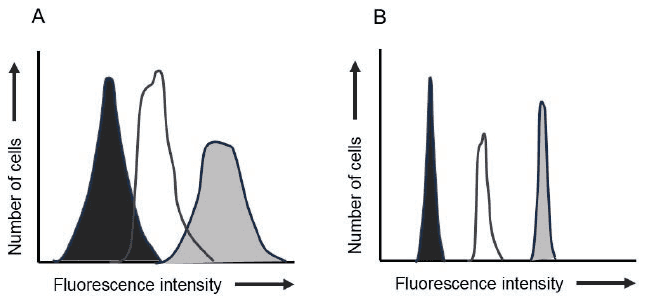
The following statements were made:
- A. Figure A represents three normal distributions with more variation within groups than between groups.
- B. Figure B represents three normal distributions with more variation between groups than within groups.
- C. The ANOVA-F test is likely to be statistically significant when applied to Figure B, but not to Figure A.
Which one of the following options represents the combination of all correct statements?
- 1A only
- 2A and B only
- 3B and C only
- 4A, B and C
Show answer and solution
In A the three histograms are broad and overlap: variation within groups is large compared with the distance between them. In B the peaks are narrow and far apart: between-group variation dominates. The ANOVA F ratio is between-group divided by within-group variance, so it is large, and likely significant, for B but not for A. All three statements are correct.
In a successional chronosequence (30 – 400 years) on a sand dune, Ammophilia dune grass dominates the youngest dunes, the prairie bunch grass Schizachrium dominates at 60 years, followed by Pinus species at later stages. Experimental seed additions were done to study seedling emergence (as a proportion of viable seeds) of all species on all the dunes (Panel 1). In addition, the effect of seed predation on seedling emergence (across dune ages) was also tested (Panel 2). The following figure presents results on seedling emergence.
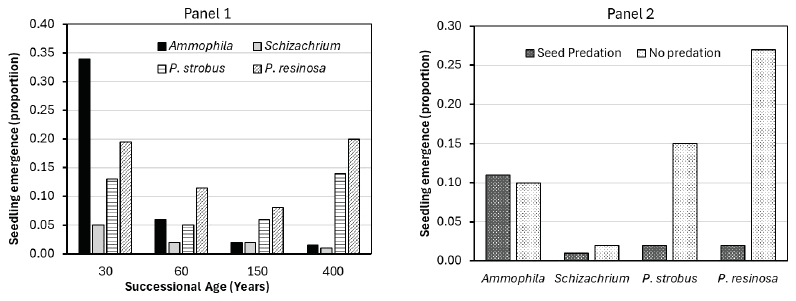
Based on the above, consider the following statements regarding the possible interpretation of the results.
- A. Late successional species can establish on younger dunes but may be limited by seed dispersal.
- B. Seed predation reduces the establishment of late successional species on younger dunes.
- C. Facilitation has stronger influence than colonization or seed predation on successional change.
- D. Late successional species cannot establish on younger dunes because of the sandy substrate.
Which combination of the above statements represents valid inference that can be drawn purely from the data presented above?
- 1A and B only
- 2A, B and C
- 3B, C and D
- 4B and C only
Show answer and solution
Panel 1: both pines emerge well on 30-year dunes, so late-successional species can establish on young dunes. Their absence there must come from something else, such as seed dispersal (A true, D false). Panel 2: predation cuts pine emergence from about 0.15–0.27 to 0.02 (B true). Facilitation was not tested, so C cannot be inferred.
The following figure shows the decomposition of selected plant litter constituents.

In the above, the correct identities of the symbols A, B, C and D are:
- 1A-Lignin, B-Phenols, C-Sugars, D-Cellulose
- 2A-Phenols, B-Lignin, C-Cellulose, D-Sugars
- 3A-Cellulose, B-Lignin, C-Sugars, D-Phenols
- 4A-Cellulose, B-Phenols, C-Lignin, D-Sugars
Show answer and solution
Litter components decay at very different rates, here shown on a log scale. Sugars go within a year (D), cellulose in a few years (C), and lignin over about 7 years (B). Phenolic compounds are the most persistent (A). This follows Minderman’s classic analysis of litter decomposition.
Match the animal phyla/classes (Column X) with their defining set of characteristics (Column Y).
| Column X | Column Y |
|---|---|
| A. Phylum Platyhelminthes | i. Bilateral symmetry, pseudocoelomate, complete digestive tract, often microscopic with a corona of cilia. |
| B. Phylum Annelida | ii. Radial symmetry (often pentamerous as adults), water vascular system, exclusively marine, deuterostomes. |
| C. Class Insecta | iii. Bilateral symmetry, acoelomate, triploblastic, usually with a flattened body and an incomplete digestive tract (if present). |
| D. Phylum Echinodermata | iv. Segmented body (metamerism) with a true coelom, chitinous chaetae (typically), closed circulatory system. |
| v. Exoskeleton of chitin, three main body parts (head, thorax, abdomen), six legs, usually with wings in the adult stage. |
- 1A-iii, B-iv, C-v, D-ii
- 2A-i, B-iv, C-v, D-ii
- 3A-iii, B-i, C-v, D-iv
- 4A-v, B-ii, C-iii, D-i
Show answer and solution
Platyhelminthes are flattened, triploblastic, acoelomate worms with an incomplete gut (A–iii). Annelids are segmented, with a true coelom, chaetae and a closed circulation (B–iv). Insects have a chitinous exoskeleton, three body parts, six legs and usually wings (C–v). Echinoderms are marine deuterostomes with pentaradial symmetry and a water vascular system (D–ii). Description i fits rotifers.
Given below are certain plant diseases and the pathogens responsible.
| Disease | Pathogen Type |
|---|---|
| A. Panama disease of Banana | i. Bacterial |
| B. Red ring disease of Coconut | ii. Fungal |
| C. Malformation of Mango | iii. Nematode |
| D. Citrus Canker | iv. Viral |
Which one of the following options correctly matches the disease with its pathogen?
- 1A-(iv), B-(iii), C-(i), D-(ii)
- 2A-(ii), B-(i), C-(iv), D-(i)
- 3A-(ii), B-(iii), C-(ii), D-(i)
- 4A-(iii), B-(iii), C-(i), D-(iv)
Show answer and solution
Panama disease of banana is caused by the fungus Fusarium oxysporum f. sp. cubense. Red ring of coconut is caused by the nematode Bursaphelenchus cocophilus. Mango malformation is fungal (Fusarium mangiferae). Citrus canker is bacterial (Xanthomonas citri).
Human prostate cancer cells expressing urokinase Plasminogen Activator (uPA) readily metastasize when injected into experimental animals. A scientist genetically modified prostate cancer cells and injected them into experimental animals. The possible observations are listed below:
- A. Overexpressing a mutant version of the uPA protein that does not bind to its receptor led to tumour formation but reduced metastasis.
- B. Overexpressing a mutant version of the uPA protein that does not bind to its receptor led to enhanced tumour formation as well as metastasis.
- C. Overexpressing a secreted version of the uPA receptor led to tumour formation but reduced metastasis.
- D. Overexpressing a secreted version of the uPA receptor reduced tumour formation as well as metastasis.
Which of the following options represents the combination of all correct observations?
- 1A and C
- 2B and D
- 3A and D
- 4B and C
Show answer and solution
uPA drives invasion only when bound to its receptor uPAR on the cell surface, where it focuses plasmin activity. A uPA mutant that cannot bind uPAR still allows a tumour to form but reduces metastasis (A). So does a secreted, soluble uPAR, which soaks up uPA away from the cell (C). Tumour growth itself does not depend on uPA.
Which one of the following matrices represents the correct choice regarding the two types of errors made in statistical hypothesis testing? H0 = Null hypothesis.
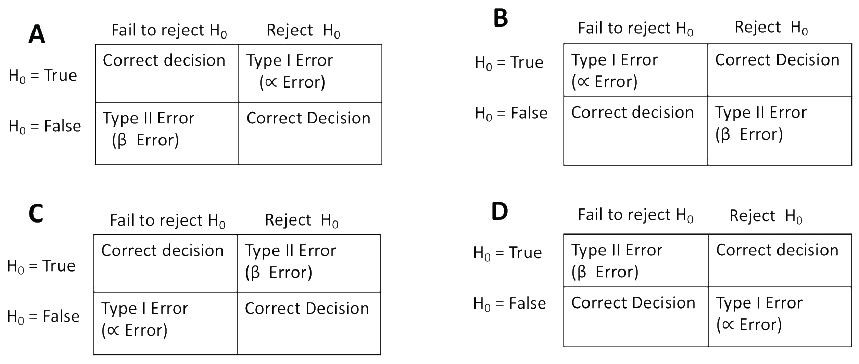
Choose the correct option.
- 1B
- 2A
- 3D
- 4C
Show answer and solution
Rejecting a true H0 is a Type I error (α). Failing to reject a false H0 is a Type II error (β). The other two cells are correct decisions. Matrix A arranges them correctly.
A transformation experiment is performed with two Pneumococcal strains. One strain is resistant to four drugs – A, B, C, and D, whereas the other is sensitive to all the drugs. Both strains are mixed and the mixture is plated on media containing various combinations of the drugs. The colonies obtained on these plates are given below:
| Drugs added | No. of colonies | Drugs added | No. of colonies |
|---|---|---|---|
| A | 1156 | CD | 786 |
| B | 1148 | ABC | 30 |
| C | 1161 | ABD | 42 |
| D | 1139 | ACD | 630 |
| AB | 46 | BCD | 36 |
| AC | 640 | ABCD | 30 |
| AD | 942 | ||
| BC | 51 |
Based on the above results, which one of the below options represents the most likely order of the drug-resistance genes?
- 1A-B-C-D
- 2A-C-B-D
- 3A-D-C-B
- 4A-D-B-C
Show answer and solution
Genes close together are often taken up on the same DNA fragment, so co-transformation is frequent. A and D give the most double transformants (942), then C and D (786), then A and C (640), while pairs with B are rare (B with C 51, with A 46). B lies farthest out, next to C. The order is A–D–C–B.
The below pedigree shows the inheritance pattern of gene X. A loss of function mutation of the gene leads to a disorder in adults. Further, gene X is imprinted leading to its inactivation. Individuals who carry the mutant allele are marked with a dot, while individuals who show the disorder are shaded.

The following statements were made:
- A. Gene X is maternally imprinted.
- B. Individual III.6 carries an imprinted allele.
- C. If individuals III.4 and III.5 have a child, the probability that it will carry at least one mutant allele is 0.75.
- D. If individuals III.4 and III.5 have a child, the probability that it will show the disorder is 0.75.
Which one of the following options represents all correct statements?
- 1A and C
- 2A and D
- 3B and C
- 4B and D
Show answer and solution
II.5 inherited the mutant allele from her father and is unaffected, while her children III.7 and III.8 inherited it from her and are affected. So the gene works only when inherited from the mother: it is paternally imprinted (A false). Everyone, including III.6, carries one silenced paternal copy (B true). III.4 × III.5, both carriers: P(at least one mutant allele) = 1 − 1/4 = 0.75 (C true). The child is affected only if the mother’s mutant allele is passed on, which has probability 0.5 (D false). B and C.
The table below presents the energy transfer values for various activities exhibited by three herbivores inhabiting a grassland with a net primary productivity (NPP) of 10000 kJ/m2/year.
| Herbivore | Ingestion (kJ/m2/year) | Egestion (kJ/m2/year) | Respiration (kJ/m2/year) |
|---|---|---|---|
| A | 4000 | 2000 | 1000 |
| B | 6000 | 3000 | 1000 |
| C | 8000 | 6000 | 1000 |
Based on the information provided, which one of the following options is NOT correct?
- 1C has the highest consumption efficiency but the lowest assimilation efficiency.
- 2B has the highest consumption efficiency, but C has the highest assimilation efficiency.
- 3A and B have the highest assimilation efficiencies.
- 4A has the lowest consumption efficiency.
Show answer and solution
Consumption efficiency = ingestion/NPP: A 40%, B 60%, C 80%. Assimilation efficiency = (ingestion − egestion)/ingestion: A 50%, B 50%, C 25%. So C has the highest consumption efficiency and the lowest assimilation efficiency, and A has the lowest consumption efficiency. Statement 2 is the one that is not correct: neither of its parts holds.
Given below are names of techniques (Column X) and their characteristic features measured for molecular characterization (Column Y).
| Column X | Column Y |
|---|---|
| A. X-ray crystallography | i. Fluorescence |
| B. NMR spectroscopy | ii. Polarization |
| C. Raman spectroscopy | iii. Diffraction |
| D. CD spectroscopy | iv. Wave number |
| E. Colorimetry | v. Chemical shift |
| vi. Ellipticity | |
| vii. Absorbance |
Which one of the following options represents all correct matches between Column X and Column Y?
- 1A (iii), B (v), C (iv), D (vi), E (vii)
- 2A (ii), B (iii), C (i), D (vii), E (vii)
- 3A (v), B (iv), C (iii), D (ii), E (i)
- 4A (iii), B (i), C (ii), D (vi), E (iv)
Show answer and solution
X-ray crystallography measures diffraction. NMR measures chemical shift. Raman spectra are plotted against wavenumber (Raman shift). CD measures ellipticity, the difference in absorption of left and right circularly polarised light. Colorimetry measures absorbance.
The following statements are made about the subcellular localization of steroid synthesizing enzymes in adrenal cortical cells.
- A. 3β-Hydroxysteroid dehydrogenase is present in mitochondria.
- B. 17α-Hydroxylase is present in the smooth endoplasmic reticulum.
- C. 11β-Hydroxylase is present in mitochondria.
- D. 21β-Hydroxylase is present in smooth endoplasmic reticulum.
Which one of the following options represents both correct statements?
- 1A and B
- 2B and C
- 3C and D
- 4A and D
Show answer and solution
In the adrenal cortex, CYP11A1, 11β-hydroxylase (C) and aldosterone synthase are mitochondrial. 17α-hydroxylase (B), 3β-HSD and 21-hydroxylase are in the smooth ER, so A is false and D is true apart from its “21β” wording. NTA accepted both option 2 (B and C) and option 3 (C and D).
Which one of the following options correctly represents mass extinction events in increasing order of percentage loss of species?
- 1Triassic, Devonian, Ordovician, Permian
- 2Permian, Triassic, Devonian, Ordovician
- 3Devonian, Triassic, Ordovician, Permian
- 4Permian, Ordovician, Triassic, Devonian
Show answer and solution
Approximate species losses in the “Big Five”: Late Devonian about 75%, end-Triassic about 76–80%, end-Ordovician about 85%, and end-Permian about 90–96%, the largest. In increasing order: Devonian, Triassic, Ordovician, Permian.
In early amphibian development, the ectodermal cells with BMP4 activity leads to epidermal ectoderm fate. If cells lack BMP4 activity, they take up a fate of neural ectoderm. BMP inhibitors like noggin dorsalize the ectodermal cells and give rise to neural ectoderm.
The following statements are made with reference to the above:
- A. The default fate of the ectoderm is to become neural tissue.
- B. Noggin mRNA will be depleted in lithium chloride treated gastrula.
- C. Injection of noggin mRNA into UV-radiated embryos at 1-cell stage rescued dorsal development.
Which one of the following options represents a combination of all correct statements?
- 1A only
- 2B only
- 3A and C
- 4B and C
Show answer and solution
A is true: ectoderm becomes neural unless BMP4 makes it epidermis, so neural is the “default”. B is false: lithium chloride dorsalises embryos (it inhibits GSK-3 and stabilises β-catenin), which increases organiser genes such as noggin. C is true: noggin mRNA rescues dorsal structures in UV-ventralised embryos. A and C.
The table below lists insect sensory structures (Column X) with their function (Column Y).
| Column X | Column Y |
|---|---|
| A. Dorsal rim area | i. Learning and memory |
| B. Mushroom body | ii. Polarisation vision |
| C. Antennal lobe | iii. Motor control |
| D. Central complex | iv. Mechanosensation |
Which one of the following options correctly matches column X and column Y?
- 1A-iii, B-iv, C-i, D-ii
- 2A-i, B-iii, C-ii, D-iv
- 3A-iv, B-ii, C-iii, D-i
- 4A-ii, B-i, C-iv, D-iii
Show answer and solution
The dorsal rim area of the compound eye detects polarised skylight (A–ii). Mushroom bodies are centres of learning and memory (B–i). The central complex controls navigation and motor coordination (D–iii). That leaves mechanosensation for the antennal lobe (C–iv), which is NTA’s match. The antennal lobe is best known as the primary olfactory centre, and antennal mechanosensory input is handled in the adjacent AMMC.
Given below are four niche-oriented models proposed to explain species-abundance distributions in ecological communities.
- A. The dominance-preemption model involves successive species preempting a dominant portion (50% or more) of the remaining niche-space.
- B. In the random fraction model, successive species invade and take over an arbitrary portion of the niche space of any species previously present. Here, irrespective of their dominance status, all species are subjected to niche division with equal probability.
- C. The MacArthur fraction model assumes that larger niches are more likely to be invaded by new species.
- D. The dominance-decay model postulates that the largest niche in an existing assemblage is always subject to a subsequent (random) division.
Assuming a process of community assembly that involves successive species invading and establishing in the community, what would be the correct order of evenness in community structure produced by these mechanisms?
- 1A > B > C > D
- 2A < B < C < D
- 3B > C > D > A
- 4D > B > A > C
Show answer and solution
In dominance pre-emption each newcomer takes at least half of what is left, giving the steepest, least even ranking. In random fraction any niche may be split. In the MacArthur fraction model larger niches are more likely to be split. In dominance decay the largest niche is always split, which evens things out most. Evenness: A < B < C < D.
A polymerase chain reaction (PCR) with all necessary reagents was carried out to amplify a 200 bp target region of a human Y chromosome. PCR was started with 100 copies of double stranded DNA (ds DNA) as template.

Assuming 100% PCR efficiency, how many copies of the desired 200bp fragment consisting of ONLY the target region would be produced at the end of the third PCR cycle?
- 1100
- 2200
- 31000000
- 40
Show answer and solution
Each original duplex gives only longer products in cycle 1, and the first two strands of exactly the target length appear in cycle 2. Duplexes of exact length appear first in cycle 3, which yields 23 − 2 × 3 = 2 per starting molecule. 100 templates × 2 = 200.
Given below are thermal melting curves for proteins A, P, Q and R. The X-axis denotes temperature, while the Y-axis indicates the concentration of unfolded protein.

Which one of the following options is true regarding comparative thermostability of protein A with respect to P, Q and R?
- 1A < P; A > Q; A > R
- 2A < P; A > Q; A = R
- 3A ~ P; A < Q; A < R
- 4A ~ P; A < Q; A > R
Show answer and solution
Stability is judged by the melting midpoint (Tm). A and P reach half-unfolding at about the same temperature (A ≈ P). Q and R unfold at higher temperatures than A, so both are more stable than A (A < Q, A < R). The plateau heights only reflect concentration.
A child injures his toe, which then becomes infected with Staphylococcus aureus. The following statements are made about the events that follow over the course of a week:
- A. The pathogen is conveyed to draining lymph nodes by macrophages.
- B. Danger signals are conveyed to high endothelial venules of draining lymph nodes through the fibroblastic reticular conduit system.
- C. Naïve B cells and T cells enter draining lymph nodes from high endothelial venules by a process that is initiated by ICAM-1-mediated rolling.
- D. Naïve B cells exit circulation at the site of injury and undergo clonal expansion in response to bacterial LPS.
Which one of the following options represents the combination of all correct statements?
- 1A and B only
- 2A and C only
- 3B and D only
- 4A, C and D
Show answer and solution
A is true: bacteria and their antigens reach the draining node in lymph, carried by phagocytes, macrophages and especially dendritic cells. B is true: the fibroblastic reticular conduits carry small lymph-borne molecules to the high endothelial venules. C is false: rolling on HEV is started by L-selectin, and ICAM-1 (with LFA-1) mediates the later firm arrest. D is false: naive B cells are activated in lymphoid organs, not at the wound. A and B.
Shown below is a hypothetical metabolic pathway leading to the production of lignin metabolite, and the three pathway enzymes (X, Y and Z), of which Z is regulated by feedback inhibition.

Which one of the following strategies will lead to the generation of plants with the highest level of lignin?
- 1Overexpression of the genes expressing enzyme X.
- 2Knockout of the gene expressing enzyme Y.
- 3Overexpression of the genes expressing enzymes X and Z.
- 4Overexpression of gene expressing enzyme X and knockout of gene expressing enzyme Y.
Show answer and solution
To push carbon into lignin, increase the flux into arogenate by overexpressing X, and stop it leaking to tyrosine by knocking out Y. Overexpressing Z adds little, because Z is held back by feedback inhibition from the downstream products. Option 4 combines both helpful changes.
The table below describes the effect of various antibiotics on protein translation in bacteria.
| Column X: Antibiotic | Column Y: Mechanism of action |
|---|---|
| A. Erythromycin | i. Binds to 23S rRNA in the 50S subunit of the ribosome |
| B. Chloramphenicol | ii. Binds to 50S ribosomal subunit and inhibits elongation of peptide chain |
| C. Tetracycline | iii. Binds to 30S ribosomal subunit interfering with binding of aminoacyl tRNA |
| D. Streptomycin | iv. Binds to 16S rRNA in the 30S subunit of the ribosome |
Which one of the following options represents all correct matches between Column X and Column Y?
- 1A – (i), B – (ii), C – (iii), D – (iv)
- 2A – (i), B – (iii), C – (ii), D – (iv)
- 3A – (iii), B – (i), C – (ii), D – (iv)
- 4A – (ii), B – (iii), C – (iv), D – (i)
Show answer and solution
Erythromycin (a macrolide) binds 23S rRNA in the exit tunnel of the 50S subunit (A–i). Chloramphenicol binds the 50S peptidyl transferase centre and blocks elongation (B–ii). Tetracycline binds the 30S subunit and blocks aminoacyl-tRNA entry to the A site (C–iii). Streptomycin binds 16S rRNA in the 30S subunit and causes misreading (D–iv).
Caterpillars produce defensive vibrations that travel through plant stems to deter its predators. The table below summarises data collected from three plant species, including vibration amplitude measured 10 cm from the caterpillar, predator response time, and the Young’s modulus of the stem.
| Plant Species | Vibration Amplitude (μm) | Latency to attack (sec) | Young’s modulus (MPa) |
|---|---|---|---|
| A | 2.3 | 3.0 | 250 |
| B | 1.8 | 2.1 | 110 |
| C | 0.7 | 1.3 | 45 |
Choose the option that correctly provides a mechanistic explanation for the data presented in the above table.
- 1A is a herbaceous plant and its stem dissipates energy faster compared to B and C which are woody plants.
- 2C is a woody plant, and predators detect vibrations on it more easily compared to A and B which are herbaceous plants.
- 3Predators are more inefficient on herbaceous plant species A and B, and more efficient on woody plant species C.
- 4C is an herbaceous plant and its stem is more likely to transmit vibrations more effectively when compared to plant species A and B which are woody.
Show answer and solution
Stem stiffness (Young’s modulus) marks A and B as woody and C as herbaceous. Predators attacked fastest on C even though the measured amplitude was smallest there. NTA’s key reads this as the soft stem of C transmitting the caterpillar’s vibrations to predators most effectively, so option 4.
An alpha helix formed by 30 residues is stabilized by 25 backbone hydrogen bonds in its folded state. Assume that the average energy of a hydrogen bond is ~10 kJ/mol, and the disruption in the peptide resonance causes a partial loss of 205 kJ/mol per peptide bond. Assume that the folding and unfolding process only changes peptide resonance stabilization partially and the loss of hydrogen bonding upon unfolding (ignore side-chain interactions and entropy losses). Which one of the following options represents the correct magnitude of the net energetic difference between the folded and unfolded state of the helix?
- 16195 kJ/mol
- 25945 kJ/mol
- 3250 kJ/mol
- 45695 kJ/mol
Show answer and solution
The folded helix gains 25 hydrogen bonds × 10 = 250 kJ/mol. On the problem’s assumptions it also keeps the resonance of the 29 peptide bonds, 29 × 205 = 5,945 kJ/mol. The net difference is 5,945 + 250 = 6,195 kJ/mol.
The following statements are related to different signaling pathways involved in tetrapod limb development.
- A. Shh released by the ZPA inhibits Fgf8 signaling in the AER.
- B. FGFs released by the AER activate Shh expression in the ZPA.
- C. Wnt7a expression in the dorsal ectoderm plays a role in limiting Shh expression in the ZPA.
- D. Overactivation of Wnt signaling in the ventral ectoderm causes an overgrowth of AER and formation of extra digits.
Which one of the following options represent all correct statements?
- 1A, B, and C
- 2A and D only
- 3B and D only
- 4B, C, and D
Show answer and solution
A is false: Shh from the ZPA maintains Fgf in the AER through Gremlin, a positive loop. B is true: AER FGFs keep Shh on in the ZPA. C is false: dorsal Wnt7a supports, rather than limits, Shh expression. D is true: excess Wnt in the ventral ectoderm expands the AER and can cause extra digits. B and D.
A 19th century phycologist described a soil dwelling cyanobacterium Nostoc arcus and cited three herbarium sheets (X, Y and Z) collected from different deserts, but no holotype was designated in that work. In 2024, a taxonomist intended to stabilize the name and hence selected sheet Z as the reference specimen due to the better morphological clarity and preservation of the sample.
What nomenclatural task is the taxonomist performing under the ICN?
- 1Designating a neotype because the original material was not sufficient.
- 2Designating a holotype because the best specimen is being chosen.
- 3Designating a lectotype because the original material consisted of syntypes.
- 4Designating an epitype because morphological details are clear.
Show answer and solution
When the author cited several specimens (syntypes) without naming a holotype, a later worker may choose one of them as the name-bearing type. That is a lectotype. A neotype is chosen only when all original material is lost. An epitype is an extra, interpretive specimen added to an ambiguous type.
Following are a few statements regarding mapping populations and principles of genetic mapping in crop species.
- A. For self-pollinating species, both F2 and F1-derived doubled haploids can serve as mapping populations.
- B. For cross-pollinating species, F1 population can be used for mapping studies.
- C. Bulk segregant analysis (BSA) is often used to identify linked markers for complex traits with multiple genes and environmental influences.
- D. In crop plants, sets of different breeding lines can be exploited for trait mapping.
- E. Breeding methods such as single-seed descent and pedigree selection promote genetic variability.
Which one of the following options represents the combination of all INCORRECT statements?
- 1A, B and C
- 2B, C and D
- 3C, D and E
- 4C and E only
Show answer and solution
C is incorrect: bulk segregant analysis works best for traits controlled by one or a few major genes, not complex polygenic traits. E is incorrect: single-seed descent and pedigree selection drive lines to homozygosity and reduce variability. A is true. B is true: the F1 of two heterozygous parents is used in pseudo-testcrosses. D is true. The incorrect pair is C and E.
The Hawk-Dove game serves as a model for conflict resolution in evolutionary game theory, wherein players 1 and 2 have the option of employing either an aggressive (Hawk) or a peaceful (Dove) strategy. The diverse interaction scenarios and their corresponding payoffs (P, Q, R, S) are presented in the following matrix:
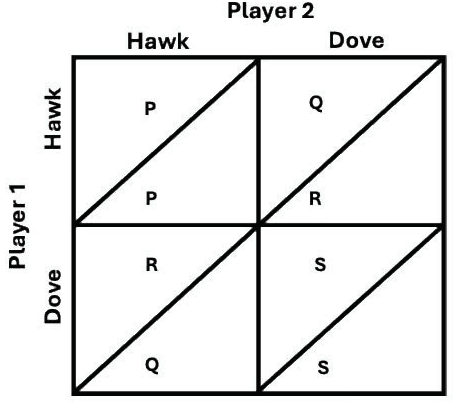
If V = the value of the resource (the benefit), C = the cost of losing a fight in the above matrix, which one of the following options correctly represents the payoffs?
- 1P = V, Q = 0, R = (V/2), S = (V−C)/2
- 2P = (V−C)/2, Q = V, R = 0, S = (V/2)
- 3P = V, Q = 0, R = (V−C)/2, S = (V/2)
- 4P = (V/2), Q = (V−C)/2, R = V, S = 0
Show answer and solution
Hawk vs hawk: each wins half the time and pays the cost of a fight, so P = (V − C)/2. Hawk vs dove: the hawk takes everything, Q = V, and the dove retreats with R = 0. Dove vs dove: they share, S = V/2.
If 10 μg of pure carbonic anhydrase catalyzes the hydration of 0.30 g of CO2 in 1 min at 37°C at Vmax, what is the turnover number (kcat) of carbonic anhydrase (in units of min−1)? (Mr of carbonic anhydrase is 30,000)
- 13.2 × 10³ min−1 to 3.3 × 10³ min−1
- 22.0 × 10⁷ min−1 to 2.1 × 10⁷ min−1
- 30.30 × 10⁷ min−1 to 0.31 × 10⁷ min−1
- 42.0 × 10³ min−1 to 2.1 × 10³ min−1
Show answer and solution
CO2: 0.30 g ÷ 44 = 6.82 × 10⁻³ mol per minute. Enzyme: 10 × 10−6 g ÷ 30,000 = 3.33 × 10⁻¹⁰ mol. kcat = 6.82 × 10⁻³ ÷ 3.33 × 10⁻¹⁰ ≈ 2.0 × 10⁷ min−1, one of the fastest enzymes known.
The following statements are made regarding TAL effectors that play an important role during bacterial pathogenesis in plants.
- A. They are bacterial proteins that are translocated into the host plant cells using the type IV secretion system.
- B. They harbour a central DNA-binding region comprising a tandem array of nearly identical repeats.
- C. They can act as both virulence factors as well as avirulence factors.
- D. They are only restricted to members of the Xanthomonas species that infect rice.
Which one of the following options represents the combination of all correct statements?
- 1A and B
- 2B and C
- 3C and D
- 4A and D
Show answer and solution
A is false: TAL effectors are injected through the type III secretion system. B is true: their DNA-binding domain is a tandem array of 34-amino-acid repeats, and residues 12–13 of each repeat specify one base. C is true: they induce susceptibility genes (virulence), but some activate resistance genes (avirulence). D is false: they occur across Xanthomonas and also in Ralstonia. B and C.
Shown in the table are some cultivated crops (Column X) and the chromosomal ploidy (Column Y).
| Column X | Column Y |
|---|---|
| A. Banana | i. Diploid |
| B. Breadwheat | ii. Triploid |
| C. Brown mustard | iii. Tetraploid |
| D. Cauliflower | iv. Hexaploid |
| E. Sugarcane | v. Octaploid |
Which one of the following options represents all correct matches between Column X and Column Y?
- 1A (v), B (ii), C (iii), D (i), E (iv)
- 2A (ii), B (iv), C (i), D (iii), E (v)
- 3A (v), B (iii), C (i), D (iv), E (ii)
- 4A (ii), B (iv), C (iii), D (i), E (v)
Show answer and solution
Cultivated banana is triploid (AAA, AAB). Bread wheat is hexaploid (AABBDD). Brown mustard, Brassica juncea, is an allotetraploid (AABB). Cauliflower, B. oleracea, is diploid. Modern sugarcane is highly polyploid, generally treated as octoploid.
Human lymphocytes were incubated with increasing concentrations of NaCl. Which one of the following options represents the correct response of the nucleus and the chromatin to increase in salt concentrations?
- 1The nucleus bursts at low NaCl concentrations, liberating the chromatin into the cytosol.
- 2At higher salt concentration the heterochromatin gets converted into euchromatin and comes out of the nucleus.
- 3The nucleus does not burst but the heterochromatin leaches out first.
- 4The nucleus does not burst but the euchromatin leaches out first.
Show answer and solution
NTA’s key gives option 3: the lymphocyte nucleus stays intact as salt rises, and the heterochromatin fraction leaches out first. Options 1 and 2 can be ruled out: the nuclear envelope and lamina do not burst at these concentrations, and salt does not turn heterochromatin into euchromatin.
A researcher simultaneously disrupted the activities of “Ferrochelatase” and “Chlorophyllide a oxygenase” enzymes involved in the biosynthesis of heme and chlorophyll, respectively in Arabidopsis. The researcher made the following predictions about the outcomes of the above experiments.
- A. The synthesis of “Chlorophyll a” from “Chlorophyllide a” will be inhibited.
- B. The synthesis of “Chlorophyll b” will be completely inhibited.
- C. The content of “Heme” molecule will be higher compared to wild-type plants.
- D. The metabolic flux will shift towards the biosynthesis of “Chlorophyll a”.
Which one of the following options represents the combination of all correct outcomes?
- 1A and B
- 2B and C
- 3C and D
- 4B and D
Show answer and solution
Blocking chlorophyllide a oxygenase stops the conversion of chlorophyll(ide) a to b, so no chlorophyll b is made (B). Blocking ferrochelatase cuts haem synthesis, so protoporphyrin IX is diverted to the Mg branch, raising flux to chlorophyll a (D). Haem falls (C is false), and chlorophyll a synthesis continues (A is false).
The primary sequence of a miRNA is given below.
5′ – UAGCUUAUCAGACUGAUGUUGA – 3′
The seed region of miRNA starts from the 2nd position to the 8th position. Which one of the following mRNA sequences would be targeted by the above miRNA?
- 15′ – CUCGAGGCAACAUCAGUCUGAUAAGCUAGAGCUC – 3′
- 25′ – CUCGAGUAGCUUAUUAGACUAAUGUUGAGAGCUC – 3′
- 35′ – CUCGAGAUUUGGUAUGCGCGAAUACCAAUCUCGA – 3′
- 45′ – CUCGAGGAGAUUGGUAUUCGCGCAUACCAAAUCU – 3′
Show answer and solution
A target must pair with the seed (nucleotides 2–8, AGCUUAU). Its complement read 5′→3′ is AUAAGCU. Option 1 contains …CAACAUCAGUCUGAUAAGCUA…, the full reverse complement of the miRNA, so it is the target. Option 2 merely repeats the miRNA sequence.
Following statements are made regarding the biosynthesis of phytohormones.
- A. Indole-3-butyric acid is converted to IAA by β-oxidation in peroxisomes.
- B. The gibberellin precursor, geranyl geranyl diphosphate is synthesized in the plastids.
- C. Cytokinins are synthesized from adenine nucleotides and dimethylallyl diphosphate in the mitochondria.
- D. The oxidative reactions that convert xanthoxin to abscisic acid occur in the cytosol.
- E. Cytochrome P450 monooxygenase enzyme family associated with endoplasmic reticulum catalyzes most of the reactions in brassinosteroid biosynthesis.
Which one of the following combinations contains all correct statements?
- 1A, C, D and E
- 2A, B, D and E
- 3B, C and D
- 4A, B and E only
Show answer and solution
A is true: IBA is converted to IAA by peroxisomal β-oxidation. B is true: GGPP for gibberellins is made in plastids by the MEP pathway. D is true: xanthoxin becomes ABA in the cytosol, via ABA2 and AAO3. E is true: ER-bound P450s (DWF4, CPD) carry out most brassinosteroid steps. C is false: cytokinin IPT enzymes are in plastids and the cytosol, not mitochondria. A, B, D and E.
Changes in NTA’s final answer key
Dropped: Q100 (marks given to everyone). Two options accepted: Q63, Q123. Every other question has the single answer shown.
How to revise from this paper
- Attempt it in one 3-hour sittingAnswer 15 in Part A, 35 in Part B and 25 in Part C, as in the real exam, before you check any answers.
- Score it with negative markingAdd 2 or 4 marks for each correct answer and subtract 0.5 or 1 for each wrong one. That is the number to track.
- Sort your mistakes by unitUse the unit tag on each question. Two or three wrong answers in the same unit tell you where to revise first.
- Repeat with a fresh paperTake a full-length mock a week later and compare your unit-wise mistakes.
Keep going