

All 145 questions from the CSIR-NET Life Sciences December 2024 paper (Shift 1), typed out in full, with NTA’s final answer key, a worked solution for every question and every diagram.
The Joint CSIR-UGC NET December 2024 Life Sciences exam was held on 1 March 2025 in two shifts. This page covers the morning shift (Shift 1, 9 am to 12 pm). Below you will find every question from Part A (General Aptitude), Part B and Part C, in the order they appeared, each tagged with its syllabus unit. Tap Show answer and solution under any question to check the official answer and see how to reach it.
Marking scheme
| Part | Questions | Answer | Marks each | Wrong answer | Max marks |
|---|---|---|---|---|---|
| A: General Aptitude | Q1–20 | 15 | 2 | −0.5 | 30 |
| B: Life Sciences | Q21–70 | 35 | 2 | −0.5 | 70 |
| C: Life Sciences | Q71–145 | 25 | 4 | −1 | 100 |
| Total | 145 | 75 | 200 |
Which units this paper tested
We tagged each of the 125 Part B and Part C questions with its CSIR-NET syllabus unit. In this paper, Cellular Organization, Evolution and Behavior and Inheritance Biology carried the most questions.
Practise any unit across all 11 papers, with every question linked to a worked solution:
Jump to a question
Part A: General Aptitude (Q1–20)
20 questions; answer any 15. Each carries 2 marks, and a wrong answer costs 0.5.
Masses of several objects were measured on the Earth as well as on the Moon using the same two-pan balance. The graph of the measurements obtained on the two sites would appear as
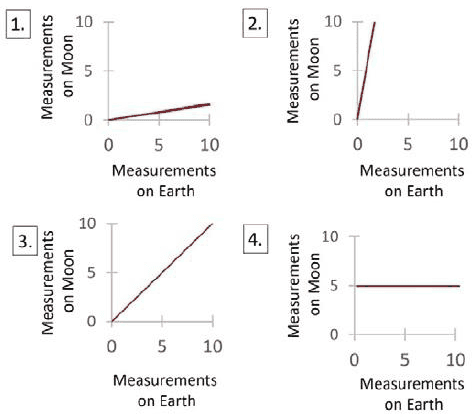
- 1Graph 1
- 2Graph 2
- 3Graph 3
- 4Graph 4
Show answer and solution
A two-pan balance compares an object with standard masses, and gravity pulls equally on both pans. Weaker lunar gravity does not change the result: every object reads the same on the Moon as on Earth, so the plot is the straight line y = x (graph 3). A spring balance would read about one-sixth on the Moon.
In the fictional country of Petreversia, which of the following provinces is the odd one out?
- 1TANGODIN
- 2PATACAHON
- 3BACCANEH
- 4HORVITHA
Show answer and solution
Read each name backwards. TANGODIN gives NIDOGNAT (dog, gnat). PATACAHON gives NOHACATAP (cat). BACCANEH gives HENACCAB (hen). HORVITHA gives AHTIVROH, which hides no animal, so it is the odd one out.
A boy in a family says “I have twice as many sisters as I have brothers” but one of his sisters claims that she has the same number of brothers and sisters. The numbers of girls and boys in that family are, respectively
- 14 and 2
- 23 and 2
- 33 and 4
- 44 and 3
Show answer and solution
Let there be g girls and b boys. The boy has b − 1 brothers, so g = 2(b − 1). The girl has g − 1 sisters, so b = g − 1. Solving: g = 2(g − 2), so g = 4 and b = 3.
The geometric mean of squares of two positive integers is 10. The smallest possible sum of these two integers is
- 17
- 28
- 311
- 410
Show answer and solution
√(a2b2) = ab = 10. The positive integer pairs are (1, 10), sum 11, and (2, 5), sum 7. The smallest sum is 7.
The given figure shows a line fit using least squares method between profit in chocolate business and mean temperature (T) data for a city. The correlation coefficient obtained from this data is r. Which one of the following statements is INCORRECT?
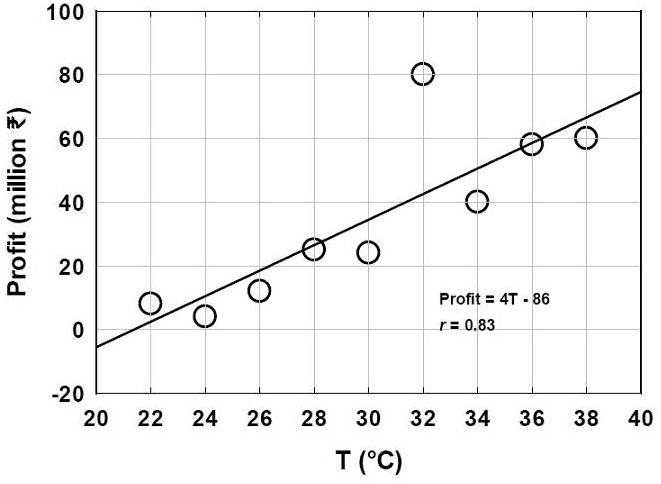
- 1The sum of the squared differences between the observed and estimated values of profit is minimum.
- 2About 69% of the variation in profit is explained by the variation in temperature.
- 3At 30°C, estimated profit is 34 million ₹.
- 4Data point (32, 80) is anomalous and therefore must be discarded.
Show answer and solution
With r = 0.83, r2 ≈ 0.69, so about 69% of the variation is explained (statement 2 true). Least squares minimises the squared residuals (statement 1 true). At 30 °C, profit = 4 × 30 − 86 = 34 (statement 3 true). (32, 80) is an outlier, but nothing justifies throwing it away. Statement 4 is the incorrect one.
A cube is coloured on each face by one of yellow, orange, red, blue, green and pink colours. Orange is opposite to yellow. Pink is between orange and yellow. Red is alongside of Pink. Green is between red and blue. Orange is at top. What is opposite to blue?
- 1Red
- 2Green
- 3Pink
- 4Yellow
Show answer and solution
Orange is on top and yellow at the bottom, so the other four faces form a ring. Going round it: pink, then red next to pink, then green between red and blue, then blue. In a ring of four, opposite faces are pink–green and red–blue, so red is opposite blue.
How many 4-digit numbers can be generated from the digits 1, 2, 3, 4, 5 and 6 such that 123 always appear as a string? No digit appears more than once.
- 18
- 24
- 36
- 412
Show answer and solution
The block “123” plus one more digit from 4, 5 or 6 (3 choices) makes the four-digit number. The extra digit can go before or after the block (2 positions): 3 × 2 = 6.
An item in a shop is priced at ₹ 375 excluding tax. The shopkeeper offers a discount of 15%, however there is a tax of 12% before discount on the item. The selling price of the item is:
- 1₹ 318.75
- 2₹ 420
- 3₹ 357
- 4₹ 382.5
Show answer and solution
The 12% tax is added first: 375 × 1.12 = ₹420. The 15% discount then applies: 420 × 0.85 = ₹357.
Five girls are standing in a line. Out of them, Henna is to the left of Agatha, between Agatha and Dipti there are 3 places, and Shabnam has both Lata and Dipti as neighbours. Then,
- 1Lata is to the right of Agatha
- 2Henna is at the extreme Left
- 3there are exactly two places between Henna & Dipti
- 4there is exactly one place between Shabnam & Agatha
Show answer and solution
With three places between Agatha and Dipti, they stand at the two ends. Shabnam must stand next to both Lata and Dipti, so Dipti, Shabnam and Lata fill one end, and Henna must be left of Agatha. The only arrangement is Dipti, Shabnam, Lata, Henna, Agatha, which puts exactly two places between Henna and Dipti.
A 6-digit security code is made using digits from 0 to 9. The first and the last digits are known. If the remaining four digits are known to be primes, at the most how many trials are required to determine the code?
- 1100
- 22560
- 3256
- 410000
Show answer and solution
The prime digits are 2, 3, 5 and 7. Each of the four unknown positions has 4 choices: 44 = 256 trials at most.
A fair coin is tossed two times independently and X denotes the number of heads. Then a fair 6-faced die is thrown at random (independently of the tosses) and Y denotes the number on the top of the die. What is the probability that the value of X+Y is 4?
- 11/2
- 21/3
- 31/4
- 41/6
Show answer and solution
X = 0, 1 or 2 with probabilities 1/4, 1/2 and 1/4. For X + Y = 4 the die must show 4, 3 or 2, each with probability 1/6. Total = (1/4 + 1/2 + 1/4) × 1/6 = 1/6.
If the words FAST, SLOW and TONE are written as 3475, 2913 and 1648 but not necessarily in the same order, then using the same code how the word NEAT would be written?
- 17513
- 27953
- 37593
- 41537
Show answer and solution
Letters shared between the words must share digits. Matching them gives FAST = 2913, SLOW = 1648 and TONE = 3475, read letter by letter. So N = 7, E = 5, A = 9 and T = 3, and NEAT = 7593.
Let A: export, B: rainfall, C: harvest, D: godown storage
Which one of the following sequences is correct?
- 1C, A, B, D
- 2B, C, D, A
- 3C, B, A, D
- 4D, C, B, A
Show answer and solution
The logical order is rainfall, then harvest, then storage in godowns, then export: B, C, D, A.
Fifteen distinct points are randomly placed on the circumference of a circle. At most how many triangles can be formed using these points?
- 1105
- 2455
- 32730
- 430
Show answer and solution
No three points on a circle are collinear, so any three points make a triangle: 15C3 = (15 × 14 × 13)/6 = 455.
√(0.99 × 0.99 × 0.99) is closest to
- 10.99 × 0.33
- 20.33 × 0.33 × 0.33
- 30.99 × 0.99 × 0.99
- 40.33
Show answer and solution
√(0.993) = 0.991.5 ≈ 0.985. Among the options, 0.99 × 0.99 × 0.99 = 0.970 is by far the closest. The others are about 0.33 or smaller.
The sum of the digits of a four-digit number ‘abcd’ is subtracted from the number. Then the result of this will be always divisible by
- 19
- 211
- 313
- 414
Show answer and solution
abcd − (a + b + c + d) = 1000a + 100b + 10c + d − a − b − c − d = 999a + 99b + 9c, which is always divisible by 9.
If you add liquid soap in the centre of a bowl of water, which has black pepper flakes floating in it, the pepper flakes will
- 1start dissolving
- 2move away from the centre
- 3settle down
- 4not move
Show answer and solution
Soap lowers the surface tension where it is added. The higher surface tension of the surrounding water pulls the surface outward (the Marangoni effect), carrying the floating pepper away from the centre towards the rim.
A cylinder has two concentric identical metal plates placed on each other that have identical circular holes as shown in the figure (shaded area). The plate A rotates in clockwise direction at 15° per second. The plate B rotates in anti-clockwise direction at 5° per second. If the starting positions of the plates as seen from the top of the cylinder are as shown below, the first instance when both the shaded regions completely coincide happens at:

- 111.25 seconds
- 23.25 seconds
- 36.75 seconds
- 48.35 seconds
Show answer and solution
Plate A’s hole starts at the top and plate B’s at the lower left, 225° ahead of A in A’s clockwise direction. They turn towards each other, A clockwise at 15°/s and B anticlockwise at 5°/s, so the gap closes at 20°/s. Time = 225/20 = 11.25 s.
A rectangular sheet of 31.4 cm × 10 cm size is rolled across its length to make a cylinder without overlap. What will be the approximate volume of the cylinder?
- 1785 cm3
- 21570 cm3
- 33140 cm3
- 46280 cm3
Show answer and solution
Rolling along the 31.4 cm length makes that the circumference: 2πr = 31.4, so r = 5 cm, and the height is 10 cm. Volume = π × 52 × 10 ≈ 785 cm3.
Choose the option to fill in the blank that will make the following statement logically correct:
COUNTING WITH PRECISION THE NUMBER OF OCCURRENCES OF THE LETTER “I” IN THIS SENTENCE YIELDS ________.
- 1SEVEN
- 2EIGHT
- 3NINE
- 4TEN
Show answer and solution
Count the I’s: COUNTING 1, WITH 1, PRECISION 2, “I” 1, IN 1, THIS 1, YIELDS 1. That is 8 so far. The filler word adds its own: NINE has one I, making 9, so the sentence is true. SEVEN, EIGHT and TEN would make it false.
Part B: Life Sciences (Q21–70)
50 questions; answer any 35. Each carries 2 marks, and a wrong answer costs 0.5.
Which one of the following is the most significant factor that explains the evolution of iteroparity in animals?
- 1Slower developmental rates over their lifespan
- 2Predictable environmental conditions
- 3Low adult survival rates
- 4Cost per reproductive event is high
Show answer and solution
Iteroparity (breeding repeatedly) pays when adults can expect to survive from one breeding season to the next and conditions are reliable enough to make waiting worthwhile. NTA’s key gives predictable environmental conditions. Low adult survival and a very high cost per breeding attempt favour semelparity instead.
In a population with the ABO blood group system, if the frequency of the allele IA is 0.3, the frequency of the allele IB is 0.2, and the frequency of the allele i is 0.5, what would be the expected percentage of population with blood group A, considering that the population is under Hardy-Weinberg equilibrium?
- 19%
- 224%
- 339%
- 442%
Show answer and solution
Group A is IAIA plus IAi: p2 + 2pr = 0.09 + 2 × 0.3 × 0.5 = 0.39 = 39%.
Hormone pregnancy tests work by detecting the presence of the hormone, human chorionic gonadotropin (hCG) using immunoassay. Which types of cells will develop to produce hCG in pregnant females?
- 1Pluripotent stem cells
- 2Trophoblast cells
- 3Endometrial cells
- 4Granulosa cells
Show answer and solution
hCG is made by the trophoblast, the outer layer of the blastocyst that becomes the syncytiotrophoblast of the placenta. It keeps the corpus luteum making progesterone in early pregnancy.
Match the columns:
| Column X: E. coli genes involved in replication | Column Y: Functional eukaryotic orthologues |
|---|---|
| A. DnaB | i. Polα/ primase |
| B. DnaC | ii. cdc6 |
| C. β clamp | iii. PCNA |
| D. DnaG | iv. MCM complex |
Which one of the following options represents all correct matches between Column X and Column Y?
- 1A (i), B (ii), C (iii), D (iv)
- 2A (iv), B (i), C (ii), D (iii)
- 3A (iv), B (ii), C (iii), D (i)
- 4A (ii), B (iv), C (iii), D (i)
Show answer and solution
E. coli DnaB, the replicative helicase, corresponds to MCM2–7 (A–iv). DnaC, the helicase loader, corresponds to Cdc6 (B–ii). The β clamp corresponds to PCNA (C–iii). DnaG, the primase, corresponds to Pol α/primase (D–i).
The regeneration of a severed Axolotl limb is mediated by which one of the following cellular responses to injury?
- 1Blastema formation
- 2Transdifferentiation
- 3Induced pluripotency
- 4Stem cell dedifferentiation
Show answer and solution
After amputation, cells near the wound lose their specialised features and multiply to form a blastema, a mass of progenitor cells under the wound epidermis that rebuilds the missing limb. Each cell type mostly stays in its own lineage.
A transmembrane receptor protein (X) and a transmembrane protein bound to the actin cytoskeleton (Y) with fluorescent tags were expressed in a cell. A fluorescence recovery after photobleaching (FRAP) experiment was performed on these proteins. Which one of the following options represents the most likely outcome of this experiment?
- 1Fluorescence of both proteins will be recovered at the same rate.
- 2Fluorescence of X will be recovered later than Y.
- 3Fluorescence of Y will be recovered later than X.
- 4Being membrane proteins, no recovery of fluorescence is expected.
Show answer and solution
Fluorescence recovers as unbleached molecules diffuse into the bleached patch. Receptor X diffuses freely in the bilayer and recovers quickly. Protein Y is tethered to the actin cytoskeleton, so it moves slowly and recovers later, and less completely.
Dynein is a microtubule-dependent motor protein essential for cellular processes. Which one of the following statements related to dynein function is INCORRECT?
- 1It helps in cilia and flagella beating.
- 2It transports organelles in anterograde direction.
- 3It participates in spindle assembly and positioning.
- 4It interacts with dynactin for efficient transport.
Show answer and solution
Cytoplasmic dynein walks towards microtubule minus ends, which is retrograde transport in axons. Anterograde (plus-end) transport is done by kinesins. Dynein does power ciliary beating, position the spindle and work with dynactin.
Which of the following molecular marker techniques uses a single primer in a PCR reaction for identifying polymorphisms between genotypes?
- 1SSR (Simple sequence repeats)
- 2AFLP (Amplified fragment length polymorphism)
- 3RAPD (Randomly amplified polymorphic DNA)
- 4SCAR (Sequence characterized amplified regions)
Show answer and solution
RAPD uses a single short (about 10-nt) arbitrary primer. Bands form wherever the primer binds on both strands close together, and differences in these sites between genotypes show up as polymorphic bands. SSR and SCAR use specific primer pairs, and AFLP uses adaptor primers.
Which one of the following statements with regard to glyoxylate cycle is INCORRECT?
- 1It is absent in humans.
- 2It occurs in specialized microsomes called glyoxysomes.
- 3This cycle allows for the synthesis of sugars from fatty acids.
- 4It involves enzymes of both the glyoxysome and the mitochondrion.
Show answer and solution
Glyoxysomes are specialised peroxisomes in germinating oilseeds, not microsomes, so statement 2 is the incorrect one. The others are true. The cycle is absent in humans, lets plants make sugar from fat, and shares steps with mitochondria.
Which one of the following statements regarding cytoskeleton proteins is INCORRECT?
- 1Actin and tubulin proteins appear to have arisen from single-copy genes, present before multicellular eukaryotes diverged.
- 2Tubulin specifically binds ATP, while actin binds preferentially to GTP.
- 3FtsZ, a tubulin relative, forms a filamentous ring needed to affect cell division in certain prokaryotic species.
- 4MreB, an actin relative, forms filaments required for the cell shape in certain prokaryotic species.
Show answer and solution
It is the other way round: tubulin binds GTP and actin binds ATP, so statement 2 is the incorrect one. FtsZ (a tubulin relative) forms the bacterial division ring, and MreB (an actin relative) maintains rod shape.
A novel organism synthesizes proteins using ribosomes from the C-terminal end to the N-terminal end rather than the usual direction (N- to C-terminus). Which main chain atom will be the nucleophile for the reaction to form peptide bonds?
- 1Nitrogen of the amine group
- 2Carbon of the carboxyl group
- 3Oxygen of the carboxyl group
- 4Alpha-carbon (Cα)
Show answer and solution
A peptide bond always forms when an amino nitrogen attacks an activated carbonyl carbon. If synthesis ran C→N, the free amine of the growing chain would attack the activated carboxyl of the incoming amino acid. The nucleophile is still the amine nitrogen; only the side the activation sits on changes.
Many marine mammals communicate over several kilometres in the ocean. This is due to
- 1their ability to communicate using ultrasound.
- 2the higher density of water compared to air.
- 3lower oxygen levels in the open ocean.
- 4water filtering out high-frequency sounds.
Show answer and solution
Sound travels about 4.5 times faster in water than in air and loses far less energy, because water is denser and less compressible. Low-frequency whale calls can therefore carry for kilometres, even ocean basins, especially along the deep sound (SOFAR) channel.
A mutation in a Drosophila gene causes a reduction in eye size, if animals are grown at 29°C but not at 18°C. This happens even if the animals bear a single copy of this mutation. Based on this information, this mutation can be described as:
- 1Temperature insensitive, dominant
- 2Temperature sensitive, recessive
- 3Temperature insensitive, recessive
- 4Temperature sensitive, dominant
Show answer and solution
The eye defect appears at 29 °C but not at 18 °C, so it is temperature-sensitive. It shows with a single copy, so it is dominant.
The majority of modifications on histone molecules happen at their ______
- 1N-terminal tail.
- 2C-terminal tail.
- 3Globular core.
- 4Spread equally throughout the polypeptide.
Show answer and solution
Most histone modifications (acetylation, methylation, phosphorylation and ubiquitination of lysines, arginines and serines) fall on the flexible N-terminal tails that stick out of the nucleosome core. There they are reachable by modifying enzymes and reader proteins.
Within a broadly distributed taxonomic clade, populations and species of larger size are generally found in colder environments, while populations and species of smaller size are typically found in warmer regions. This observation is commonly referred to as:
- 1Allen’s rule
- 2Bergman’s rule
- 3Gause’s rule
- 4Gloger’s rule
Show answer and solution
Bergmann’s rule: within a widespread clade of endotherms, larger forms live in colder climates, because a large body loses less heat per unit mass. Allen’s rule concerns appendage length and Gloger’s rule pigmentation.
The CaM Kinase II acts as a molecular memory device as well as a frequency decoder of Ca2+ oscillation. Which one of the following statements regarding CaM Kinase II is INCORRECT?
- 1CaM Kinase II activity increases as a function of Ca2+ pulse frequency.
- 2CaM Kinase II requires Ca2+ and Calmodulin to remain in an active state.
- 3A brain-specific CaM Kinase II knockout mouse will have difficulty in remembering where things are.
- 4The molecular memory function is lost in an autophosphorylation defective CaM Kinase II.
Show answer and solution
Statement 2 is the incorrect one. Once subunits of the holoenzyme autophosphorylate on Thr286, CaMKII stays partly active after Ca2+/calmodulin is gone. That is its memory, and it is lost in autophosphorylation mutants. Activity also rises with Ca2+ pulse frequency, and knockout mice have spatial-memory defects.
Which one of the following acetylcholine receptors is located in the nodal tissue of heart?
- 1M5
- 2NM
- 3M2
- 4M4
Show answer and solution
The SA and AV nodes carry M2 muscarinic receptors. Through Gi, vagal acetylcholine opens GIRK channels and lowers cAMP, which slows the heart. NM receptors are found at the skeletal neuromuscular junction.
Cleaner fish remove parasites from larger fish. Which evolutionary mechanism most likely maintains this interaction?
- 1Kin selection
- 2Mutualism
- 3Direct competition
- 4Character displacement
Show answer and solution
Cleaner fish get food and the client fish gets rid of parasites. Both gain, so the relationship is kept going by mutualism, reinforced by clients choosing honest cleaners. Kin selection does not apply between different species.
Which one of the following microbes is an obligate biotroph?
- 1Botrytis cinerea
- 2Phytophthora infestans
- 3Puccinia graminis
- 4Trichoderma harzianum
Show answer and solution
An obligate biotroph grows only on living host tissue. Puccinia graminis, the stem rust fungus, is the classic example. Botrytis is a necrotroph, Phytophthora infestans a hemibiotroph, and Trichoderma a free-living saprophyte.
Saara hardwickii, a spiny-tailed lizard, is a diurnal, ground-dwelling species currently known from the Indian subcontinent. It is endemic to which one of the following habitats?
- 1Rainforests of Eastern Himalayas
- 2Dry deciduous forests of central India
- 3Moist deciduous forests of Western Ghats
- 4Thar desert of India
Show answer and solution
The Indian spiny-tailed lizard, Saara hardwickii, lives in burrows in the arid sandy and gravel plains of the Thar desert of Rajasthan and Gujarat, eating mainly plants. It is under pressure from habitat loss and hunting.
Which one of the following is generated in skeletal muscle cells by the single quanta of acetylcholine released from the motor nerve terminals?
- 1Inhibitory post-synaptic potential
- 2Inhibitory junction potential
- 3Endplate potential
- 4Miniature endplate potential
Show answer and solution
One vesicle releases one quantum of acetylcholine, giving a tiny (about 0.5 mV) miniature end-plate potential. A nerve impulse releases hundreds of quanta, which add up to the full end-plate potential.
Which one of the following statements about human chorionic gonadotropin is INCORRECT?
- 1It contains galactose and hexosamine.
- 2Its α-subunit is identical in TSH.
- 3Its β-subunit is smaller than α-subunit in size.
- 4It is primarily luteinizing in nature.
Show answer and solution
hCG is a glycoprotein (with galactose and hexosamines) whose α-subunit is shared with LH, FSH and TSH, and which acts mainly like LH. Its β-subunit (145 amino acids) is larger than the α-subunit (92 amino acids), so statement 3 is the incorrect one.
Which one of the following is NOT a major phospholipid in mammalian plasma membrane?
- 1Phosphatidylinositol
- 2Phosphatidylserine
- 3Sphingomyelin
- 4Cholesterol
Show answer and solution
The major plasma-membrane phospholipids are phosphatidylcholine, phosphatidylethanolamine, phosphatidylserine and sphingomyelin. Phosphatidylinositol makes up only a few percent of membrane lipid, which is why NTA’s key gives option 1. (Cholesterol is a major membrane lipid, but a sterol rather than a phospholipid.)
Which experiment would best validate the bioremediation potential of a microbial strain degrading oil spills in seawater?
- 1Using seawater without oil contamination to monitor microbial growth.
- 2Testing microbial growth in seawater with added nutrients but no oil.
- 3Monitoring oil concentration in a system inoculated with microbes versus an uninoculated system.
- 4Comparing microbial growth in aerated versus non-aerated seawater samples.
Show answer and solution
To show a strain removes oil you need a controlled comparison: oil-contaminated seawater with the microbe against the same system without it, while measuring the oil itself. Growth without oil, or with nutrients alone, says nothing about breaking down oil.
UV mutagenesis was performed to isolate mutants of the lacZ gene. The mutation rate of this gene is 1 × 10⁻⁴ per cell division. Assuming that an E. coli culture was initiated from a culture density of 1 × 10² cells and grown to a density of 1 × 10⁶ cells, how many lacZ mutants are expected in this population?
- 1~ 1
- 2~ 10
- 3~ 100
- 4~ 1000
Show answer and solution
Growing from 102 to 106 cells takes about 106 divisions. At 10−4 mutations per division, about 106 × 10−4 = 100 lacZ mutants are expected.
Fill in the blanks:
Glioblastomas, oligodendrogliomas, and astrocytomas harbour mutations in isocitrate dehydrogenase (IDH). The IDH mutations found in these cancers cause the enzyme to convert isocitrate into the oncometabolite, ______, which accumulates in cancer cells. This oncometabolite works by inhibiting several enzymes that require ______ for their function.
- 12-hydroxyglutarate, succinate
- 22-hydroxybutyrate, α-ketoglutarate
- 32-hydroxyglutarate, 2-hydroxybutyrate
- 42-hydroxyglutarate, α-ketoglutarate
Show answer and solution
Mutant IDH1/2 reduces α-ketoglutarate to the oncometabolite 2-hydroxyglutarate. 2-HG is a structural mimic of α-ketoglutarate and competitively inhibits α-ketoglutarate-dependent dioxygenases (TET DNA demethylases, JmjC histone demethylases), changing the epigenome.
The order Psilotales can be identified by which one of the following characteristics?
- 1Leafless and rootless body with a dichotomously branching stem
- 2Very large fronds, some reaching 4.5 m or more in length
- 3Scale leaves that are borne in whorls at the node
- 4A plant body that consists of microphylls and roots only
Show answer and solution
Psilotales (Psilotum, Tmesipteris) have a rootless, essentially leafless, dichotomously branching stem bearing only small enations. Giant fronds belong to tree ferns and Marattiales, whorled scale leaves to Equisetum, and microphylls with roots to lycophytes.
Which one of the following techniques can identify acetylation on a lysine residue of a protein?
- 1Mass spectrometry
- 2SDS-PAGE
- 3Light scattering
- 4CD spectroscopy
Show answer and solution
Acetylation adds 42 Da to a lysine, a mass shift that mass spectrometry, usually tandem MS of a digest, can detect and pin to a residue. SDS-PAGE, light scattering and CD cannot detect such a small change at a single site.
Which one of the following blood cell types is formed from megakaryocyte during development of blood cells from bone marrow?
- 1Monocytes
- 2Neutrophils
- 3Eosinophils
- 4Platelets
Show answer and solution
Megakaryocytes in the bone marrow extend proplatelet processes into the blood vessels and shed fragments of cytoplasm as platelets, about a thousand or more per cell. Monocytes, neutrophils and eosinophils come from other myeloid progenitors.
Which one of the following modifications in their native system does NOT lead to translation inhibition?
- 1Nucleotide addition resulting in incorporation of a stem-loop structure in the mRNA upstream of the Shine-Dalgarno sequence.
- 2Nucleotide addition resulting in the Shine-Dalgarno sequence being a part of a stem-loop structure in the mRNA.
- 3Expression of an eIF2 mutant that mimics its phosphorylated state.
- 4Mutation that leads to decrease in the processivity of capping enzyme that leaves numerous mRNAs devoid of CAP structure.
Show answer and solution
A hairpin upstream of the Shine–Dalgarno sequence leaves the ribosome-binding site and start codon exposed, so translation goes on. A hairpin that buries the SD blocks initiation. Phospho-mimetic eIF2 (eIF2α-P) blocks recycling of the ternary complex, and uncapped mRNAs cannot recruit eIF4F.
Which one of the following statements about peripheral lymph nodes is INCORRECT?
- 1They contain fibroblast reticular cells that form a conduit system to guide cell movement within the node.
- 2They are responsible for immune responses to blood-borne pathogens.
- 3T cells encounter antigen presented on dendritic cells in the paracortex of lymph nodes.
- 4They contain B cells in special areas called follicles.
Show answer and solution
Lymph nodes filter lymph and respond to antigens arriving from tissues. Blood-borne pathogens are dealt with mainly in the spleen, so statement 2 is the incorrect one. The others are true: FRC conduits, T-cell priming in the paracortex, B-cell follicles.
As per the India State of Forest Report 2021, the percentage cover of ‘very dense forests’ as a component of the country’s total geographical area is:
- 13.04
- 29.33
- 39.44
- 421.71
Show answer and solution
The India State of Forest Report 2021 gives very dense forest (canopy density of 70% or more) as about 99,779 km2, or 3.04% of the country’s area. Total forest cover is 21.71%.
Which one of the following morphological characters can help you differentiate Leptosporangiate ferns from the Eusporangiate ferns?
- 1Presence and absence of sporangium
- 2Ploidy of the spores
- 3The number of cells from which the sporangium is formed
- 4The total number of alternations of generations recorded in a single life cycle
Show answer and solution
A leptosporangium develops from a single initial cell and has a one-cell-thick wall. A eusporangium arises from several initial cells and has a multi-layered wall. Both kinds of fern produce haploid spores and have the same life cycle.
Which one of the following statements about RNA polymerase in eukaryotes is INCORRECT?
- 1RNA polymerase I synthesizes 18S, 5.8S and 28S rRNAs.
- 2RNA polymerase II synthesizes messenger RNA (mRNA).
- 3RNA polymerase II requires a sigma factor (σ) to initiate transcription.
- 4RNA polymerase III synthesizes 5S rRNA and tRNA.
Show answer and solution
Sigma factors belong to bacterial RNA polymerase. Eukaryotic Pol II instead depends on general transcription factors (TFIID with TBP, TFIIB, TFIIF and others), so statement 3 is the incorrect one. Pol I makes 28S, 18S and 5.8S rRNA, Pol II mRNA, and Pol III tRNA and 5S rRNA.
Which one of the following is likely to enter a pure phospholipid bilayer?
- 1CO2 and Diethyl urea
- 2Water and Glucose
- 3Lysine and Ethanol
- 4Urea and Chloride ions
Show answer and solution
A pure lipid bilayer lets small, uncharged, fairly hydrophobic molecules through. CO2 crosses freely, and the more hydrophobic diethylurea crosses far faster than urea. Glucose, lysine and Cl− are too polar or charged.
The citric acid cycle (TCA) operates only in the presence of molecular oxygen (O2). This is because
- 1O2 activates enzymatic dehydrogenation reactions in the cycle.
- 2O2 accepts electrons from electron transport chain, allowing reoxidation of NADH to NAD+.
- 3O2 removes toxic by-products of the TCA cycle.
- 4O2 activates ATP synthase.
Show answer and solution
O2 is not used in the TCA cycle itself. But the cycle’s dehydrogenases need NAD+ and FAD, which are regenerated only when the electron transport chain passes electrons to O2. Without oxygen, NADH builds up and the cycle stops.
Two types of mutant E. coli were identified: in the hypermethylation mutant (type A), DNA is methylated at the GATC sequences as soon as daughter DNA is synthesized; and in the second type, GATC sequences are never methylated (type B).
Which mutant will have a greater effect on the MMR system, leading to the accumulation of spontaneous mutations?
- 1Type A > Type B
- 2Type B > Type A
- 3Type A = Type B
- 4Type B mutants will not accumulate spontaneous mutations
Show answer and solution
Mismatch repair recognises the new strand because it is briefly unmethylated at GATC. If methylation is immediate (type A), MutH can never nick the new strand, so MMR effectively fails. If GATC is never methylated (type B), MutH nicks either strand at random, so half the repairs still restore the correct base. Type A causes more mutations.
Which one of the following statements regarding mutations in the mitochondria during aging is INCORRECT?
- 1Mutations in mitochondrial genome lead to defects in energy production.
- 2The mutation rate in mitochondria is much higher than that in the nucleus.
- 3Mutations reduce ROS production since electron transport is faulty.
- 4There is an enhanced rate of apoptosis in cells with mutant mitochondria.
Show answer and solution
A faulty respiratory chain leaks more electrons to O2, so mitochondrial mutations raise ROS production, which damages mtDNA further. Statement 3 is the incorrect one. Higher mtDNA mutation rates, energy defects and more apoptosis are all real features of ageing.
Live vaccines are generally used to protect against which one of the following viruses?
- 1Hepatitis A
- 2Hepatitis B
- 3Rabies
- 4Smallpox
Show answer and solution
The smallpox vaccine is live vaccinia virus. Hepatitis A and rabies vaccines are inactivated virus, and the hepatitis B vaccine is a recombinant subunit (HBsAg).
Which one of the following is an example of character displacement?
- 1Two sympatric lizards with similar morphologies consume the same insects.
- 2Two sympatric birds evolve distinct beak shapes to consume seeds of different plants.
- 3A predator evolves higher visual acuity to catch camouflaged prey.
- 4Two plant species have similar flower shapes to attract the same pollinators.
Show answer and solution
Character displacement is the divergence of traits between competing species where they live together, which reduces competition. Two sympatric birds evolving different beak shapes for different seeds is the classic case, as in Darwin’s finches. Option 4 describes convergence.
The disease phenylketonuria is caused by the null allele of the gene phenylalanine hydroxylase (PAH). This is an example of a recessive mutation. Which one of the following terms is the best description of the wild type allele of PAH?
- 1Gain-of-function
- 2Haplosufficient
- 3Epistatic
- 4Allele with additive effect
Show answer and solution
PKU is recessive because one working PAH allele makes enough enzyme for a normal phenotype. The wild-type allele is therefore haplosufficient.
Which is the correct hierarchy of gene activity in early Drosophila segmentation?
- 1Gap, pair-rule, segment polarity, maternal
- 2Maternal, gap, pair-rule, segment polarity
- 3Maternal, pair-rule, gap, segment polarity
- 4Segment polarity, pair-rule, gap, maternal
Show answer and solution
Maternal gradients (Bicoid, Nanos) set the gap genes, gap proteins set the seven pair-rule stripes, and pair-rule proteins set the fourteen segment-polarity stripes.
The epigenetic regulators DEMETER (DME) and MEDEA (MEA) act synergistically to repress endosperm development in the absence of double fertilization during seed development in Arabidopsis. Which one of the following options is the correct enzymatic function of DME and MEA?
- 1DME is a DNA glycosylase; MEA is a DNA methyl transferase.
- 2DME is a DNA methyl transferase; MEA is a histone methyl transferase.
- 3DME is a histone methyl transferase; MEA is a DNA methyl transferase.
- 4DME is a DNA glycosylase; MEA is a histone methyl transferase.
Show answer and solution
DEMETER is a 5-methylcytosine DNA glycosylase that actively removes DNA methylation. MEDEA is the plant E(z) homologue, a Polycomb (PRC2) histone methyltransferase that deposits H3K27me3. Together they control imprinting and repress endosperm growth until fertilisation.
The dominant and recessive alleles of a gene are ‘A’ and ‘a’, respectively. In 1000 offspring, if 500 are ‘aa’ and 500 are of the other genotypes, which one of the following is the most likely combination of parental genotypes?
- 1Aa and Aa
- 2AA and Aa
- 3Aa and aa
- 4AA and aa
Show answer and solution
A 1:1 ratio of aa to the rest is a test cross, Aa × aa. Aa × Aa would give 25% aa, and any cross with AA gives none.
What type of invertebrate fossils, commonly found in the Spiti Valley of India, are characteristic of the Cambrian era?
- 1Ammonites
- 2Trilobites
- 3Mosquitoes
- 4Glossopteris
Show answer and solution
The Cambrian rocks of the Spiti valley (Parahio section) of Himachal Pradesh are famous for trilobites, the typical Cambrian arthropods. Ammonites are Mesozoic (Spiti also has Jurassic ammonites), and Glossopteris is a Permian plant.
Which one of the following types of interactions will be predominantly contributing to the stability of a nucleosome?
- 1Hydrogen bonds between DNA base pairs and serine / threonine residues of histones.
- 2van der Waal’s interactions between DNA base pairs and hydrophobic residues of histones.
- 3Hydrogen bonds between DNA phosphate backbone and the main chain atoms of histones.
- 4Electrostatic interactions involving DNA phosphate backbone and lysine residues of histones.
Show answer and solution
DNA wraps the histone octamer mainly through electrostatic attraction between its negatively charged phosphate backbone and the many positively charged lysine and arginine residues of the histones, together with backbone hydrogen bonds. Very few contacts involve the bases, which is why nucleosomes form on almost any sequence.
Which one of the following statements is true regarding β-oxidation of fatty acids?
- 1It occurs in the intermembrane space (IMS) region of mitochondria.
- 2All the reactions are same for the saturated and unsaturated fatty acids.
- 3Fatty acids are oxidized at C-3 position to remove a two-carbon unit.
- 4Lipoprotein lipase catalyzes the first step.
Show answer and solution
Each round of β-oxidation oxidises the C-3 (β) carbon to a ketone, so thiolase can cut off acetyl-CoA. It happens in the mitochondrial matrix, not the intermembrane space, and unsaturated fatty acids need extra isomerase and reductase steps. Lipoprotein lipase acts outside cells.
Which one of the following events occurs during the light reaction of photosynthesis and directly contributes to the formation of ATP?
- 1Splitting of water molecules into oxygen, protons, and electrons
- 2Transfer of electrons from Photosystem I to NADP+ to form NADPH
- 3Carbon fixation by the enzyme RuBisCO in the stroma
- 4Establishment of a proton gradient across the thylakoid membrane
Show answer and solution
ATP synthase is driven directly by the proton gradient across the thylakoid membrane, built by water splitting in the lumen, the cytochrome b6f Q-cycle and NADP+ reduction. Water splitting and NADPH formation contribute only indirectly, and carbon fixation uses ATP.
Which of the following Vitamin B complex derivatives constitute the chromophore of the blue light photoreceptor cryptochrome in plants?
- 1B3 and B12
- 2B2 and B9
- 3B2 and B12
- 4B3 and B9
Show answer and solution
Cryptochromes carry two chromophores: FAD, made from riboflavin (vitamin B2), and the antenna pigment MTHF (methenyltetrahydrofolate), made from folate (vitamin B9).
Tectonic uplift can alter the drainage patterns of rivers, thereby isolating populations of many species. Population isolation of this kind results from which one of the following processes?
- 1Dispersal
- 2Vicariance
- 3Range expansion
- 4Competitive exclusion
Show answer and solution
When a new barrier such as a mountain uplift or a change in river course splits a once-continuous population, the separation is vicariance. Dispersal is the opposite: organisms crossing a barrier that already exists.
Part C: Life Sciences, analytical (Q71–145)
75 questions; answer any 25. Each carries 4 marks, and a wrong answer costs 1.
The table below shows types of chemical mutagens and names of mutagens.
| Column X: Types of chemical mutagens | Column Y: Names of mutagens |
|---|---|
| A. Base analogs | i. Nitrous acid |
| B. Intercalating agents | ii. Ethyl Methane Sulphonate |
| C. Deaminating agents | iii. Ethidium Bromide |
| D. Alkylating agents | iv. 5-Bromouracil |
Which one of the following options shows the correct match between Column X and Column Y?
- 1A : iv, B : iii, C : i, D : ii
- 2A : i, B : iv, C : iii, D : ii
- 3A : ii, B : iii, C : iv, D : i
- 4A : iii, B : ii, C : i, D : iv
Show answer and solution
5-Bromouracil is a base analogue of thymine (A–iv). Ethidium bromide intercalates between base pairs (B–iii). Nitrous acid deaminates bases, for example C to U and A to hypoxanthine (C–i). EMS is an alkylating agent that ethylates guanine (D–ii).
At what range of substrate concentration will an enzyme with a kcat of 30 s−1 and a Km of 0.005 M show one-quarter of its maximum rate?
- 13.0 × 10⁻³ M to 3.1 × 10⁻³ M
- 20.65 × 10⁻³ M to 0.75 × 10⁻³ M
- 31.65 × 10⁻³ M to 1.75 × 10⁻³ M
- 42.7 × 10⁻³ M to 2.8 × 10⁻³ M
Show answer and solution
v = Vmax/4 means [S]/(Km + [S]) = 1/4, so 4[S] = Km + [S] and [S] = Km/3 = 0.005/3 = 1.67 × 10⁻³ M. The kcat value is not needed.
A cytoplasmic monomeric protein containing a single non-surface exposed cysteine residue precipitates upon mutation of the Cys to ‘Ile’. However, the mutation of Cys to ‘Ala’ leads to a soluble and functional protein equivalent to the native form. Which one of the following statements explains the above observations?
- 1Cys mutated to ‘Ile’ alters the net charge of the protein, while mutation to ‘Ala’ does not.
- 2Cys mutated to ‘Ala’ alters the net charge of the protein, while mutation to ‘Ile’ does not.
- 3Cys mutated to ‘Ala’ causes steric hindrance in the core of the protein, while mutation to ‘Ile’ does not.
- 4Cys mutated to ‘Ile’ causes steric hindrance in the core of the protein, while mutation to ‘Ala’ does not.
Show answer and solution
The cysteine is buried in the hydrophobic core. Alanine is smaller than cysteine and fits. Isoleucine is a bulky, branched side chain that cannot be packed into the space, so it causes steric clashes in the core, misfolding and aggregation. None of these substitutions changes the net charge.
Given below are a few statements about intracellular protein transport.
- A. Proteins that are destined for the lysosome are tagged with a mannose-6-phosphate (M6P) group in the Golgi apparatus, which is recognized by the M6P receptor in the trans-Golgi network.
- B. Signal recognition particle directly mediates the insertion of proteins into the mitochondrial membrane.
- C. The KDEL receptor in the ER and Golgi apparatus works by retrieving soluble ER resident proteins that have accidentally moved to the Golgi.
- D. Cargo proteins that need to be exported from the ER are packaged into COPII vesicles based on the presence of an ER export signal in their cytosolic tail.
- E. Clathrin-coated vesicles are primarily involved in vesicle trafficking between the Golgi apparatus and the ER.
Choose the option that has all correct statements.
- 1A, C and D
- 2A, B and E
- 3A and D only
- 4C and E
Show answer and solution
A is true: lysosomal enzymes carry mannose-6-phosphate, read by M6P receptors in the trans-Golgi network. C is true: the KDEL receptor retrieves escaped ER proteins. D is true: COPII picks up cargo through export signals. B is false: SRP targets proteins to the ER, not mitochondria. E is false: ER–Golgi traffic uses COPII and COPI, while clathrin works at the TGN and plasma membrane.
The following statements are made regarding the role of cadherins in cell junctions.
- A. Cadherins are calcium-dependent adhesion molecules that mediate cell to cell adhesion by forming homophilic interactions.
- B. Cadherins function in tight junctions, sealing the space between adjacent cells.
- C. N-cadherins are primarily found in epithelial cells and mediate adhesion to the basal lamina.
- D. Cadherins are involved in the formation of focal adhesions, linking the cell cytoskeleton to the ECM.
- E. Cadherins interact with the actin cytoskeleton through associated proteins like catenins.
Which one of the following options represents all correct statements?
- 1B, C and E
- 2A, B and D
- 3A and D only
- 4A and E only
Show answer and solution
Cadherins are Ca2+-dependent, homophilic adhesion proteins of adherens junctions and desmosomes (A), linked to actin through catenins (E). Tight junctions are made by claudins and occludin (B false). E-cadherin is the epithelial cadherin, and N-cadherin is neural and not a basal-lamina adhesin (C false). Focal adhesions use integrins (D false).
Given below are components that facilitate transfer of molecules across phospholipid bilayers (Column X) and the properties of these components (Column Y).
| Column X: Membrane component | Column Y: Activity |
|---|---|
| A. ATP powered pumps | I. Movement of molecules against concentration gradient coupled to another molecule moving down the concentration gradient |
| B. Uniporter | II. Free diffusion of hydrophilic molecules |
| C. Channels | III. Movement of molecules against a concentration gradient and/or electric potential |
| D. Symporter | IV. Transport of hydrophilic molecules down their concentration gradients |
Choose the option that correctly matches the components with their properties.
- 1A (IV), B (II), C (I), D (III)
- 2A (II), B (III), C (IV), D (I)
- 3A (III), B (IV), C (I), D (II)
- 4A (III), B (IV), C (II), D (I)
Show answer and solution
ATP-powered pumps move solutes against concentration or electrical gradients (A–III). Uniporters carry a single solute down its gradient (B–IV). Channels let hydrophilic solutes diffuse through freely (C–II). Symporters drive one solute uphill by coupling it to another moving downhill (D–I).
The following table shows forest floor litter pool and aboveground litterfall data for three forest types.
| Forest Type | Forest floor litter pool (gC/m2) | Aboveground litterfall (gC/m2/yr) |
|---|---|---|
| A. | 5000 | 50 |
| B. | 1500 | 300 |
| C. | 600 | 600 |
Based on the provided information, which one of the following options accurately identifies the various forest types?
- 1A- Tropical forest, B- Temperate deciduous forest, C- Temperate coniferous forest
- 2A- Temperate coniferous forest, B- Temperate deciduous forest, C- Tropical forest
- 3A- Temperate coniferous forest, B- Tropical forest, C- Temperate deciduous forest
- 4A- Tropical forest, B- Temperate coniferous forest, C- Temperate deciduous forest
Show answer and solution
Litter that builds up (a large pool) with little new litterfall means slow decomposition: cold temperate coniferous forest with acidic needle litter (A). A tiny pool despite heavy litterfall means very fast turnover: tropical forest (C). Temperate deciduous forest lies in between (B).
Quantitative Trait Loci (QTLs) can be identified using two main approaches: bi-parental matings (BPM) and Genome-Wide Association Studies (GWAS). Below are some descriptors related to these strategies:
- A. Large sample size
- B. Small sample size
- C. Population derived from controlled crosses
- D. Random mating populations
- E. Limited to two alleles per locus
F. Multiple alleles per locus
G. Linkage-based mapping
H. Linkage disequilibrium-based mapping
The table below presents four incomplete statements regarding BPM and GWAS. Each statement can be completed using the above descriptors.
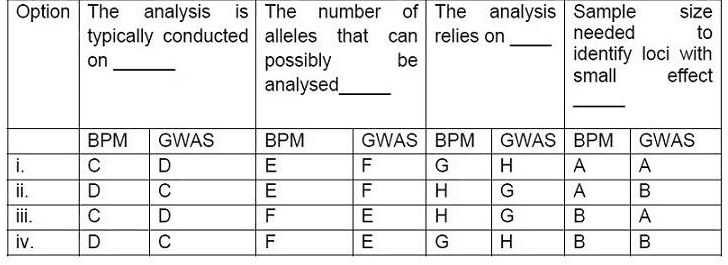
Which one of the following options correctly completes all statements?
- 1i
- 2ii
- 3iii
- 4iv
Show answer and solution
Bi-parental mapping uses populations from controlled crosses (C), tests at most two alleles per locus (E) and relies on linkage (G). GWAS uses randomly mating populations (D), samples many alleles (F) and relies on linkage disequilibrium (H). Both need large samples to detect small-effect loci (A, A). That is option i.
The table below shows different developmental processes and associated signaling molecules/pathways.
| Developmental Process | Signaling molecules/pathways |
|---|---|
| A. Dorsal/ventral axis specification in amphibian embryo | Wnt/β-catenin; BMP4; Activin/Nodal |
| B. Dorsal/ventral axis specification in mammalian limb | Engrailed; Wnt/β-catenin; BMP |
| C. Dorsal/ventral axis specification in Drosophila oocyte | FGF; Hh; Dpp |
| D. Anterior/posterior axis specification in mammalian limb | Shh; FGF; Notch |
Which one of the following options represents the correct association of developmental processes and signaling molecules?
- 1A and B
- 2B and D
- 3A and C
- 4C and D
Show answer and solution
A is correct: amphibian dorso-ventral patterning uses Wnt/β-catenin, BMP4 and Nodal/activin. B is correct: limb dorso-ventral patterning uses Wnt7a dorsally, Engrailed-1 ventrally, and BMP. C is wrong: the Drosophila oocyte uses Gurken/EGFR, not FGF or Hh. D is wrong: the limb anterior–posterior axis uses Shh and FGF, not Notch.
The mRNA of the E. coli lac operon contains the open reading frames for lacZ, lacY, and lacA genes from a single cistron. It is observed that lacZ is translated more frequently than lacY or lacA. Which one of the following statements best describes the reason for this observation?
- 1The Shine-Dalgarno sequence is present upstream of lacZ, but not lacY or lacA, affecting translation initiation rates.
- 2Inhibitory RNA structures are present upstream of the AUG codon of lacY and lacA, but not lacZ, affecting translation initiation rates.
- 3Variations in the Shine-Dalgarno sequence upstream of lacZ, lacY, and lacA have different affinities for the ribosome, affecting translation initiation rates.
- 4Inhibitory RNA structures are present in the lacY and lacA coding sequence but not lacZ, affecting translation elongation rates.
Show answer and solution
Each cistron of the polycistronic lac mRNA has its own ribosome-binding site. Their Shine–Dalgarno sequences differ in how well they pair with 16S rRNA, so initiation rates differ: lacZ is translated most often, and LacZ:LacY:LacA come out at roughly 10:5:2.
Match the animal in Column X with its characteristic in Column Y.
| Column X | Column Y |
|---|---|
| A. Snakes | I. Lateral Line |
| B. Spiders | II. Heat sensing pits |
| C. Fishes | III. Echolocation |
| D. Dolphins | IV. Spinnerets |
Which one of the following options represents all correct matches between Column X and Column Y?
- 1A-II, B-IV, C-I, D-III
- 2A-I, B-II, C-III, D-IV
- 3A-III, B-I, C-II, D-IV
- 4A-II, B-III, C-IV, D-I
Show answer and solution
Pit vipers and boas sense infrared with heat-sensing pits (A–II). Spiders spin silk from spinnerets (B–IV). Fishes detect water movement with the lateral line (C–I). Dolphins hunt by echolocation (D–III).
Which one of the following statements is NOT part of the neutral paradigm in ecology?
- 1All individuals in the community have equal fitness and competitive ability.
- 2Loss of competing species to extinction is through a slow, random process.
- 3Diversity is maintained by speciation rates counteracting extinction rates.
- 4Ecological drift results in stable coexistence of a given set of species.
Show answer and solution
Hubbell’s neutral theory assumes individuals are ecologically equivalent, extinction happens through slow random drift, and diversity is a balance of speciation and extinction. Drift makes species wander towards loss. It never gives stable coexistence, so statement 4 is not part of the theory.
An enzyme has been found to efficiently catalyse the following reaction:
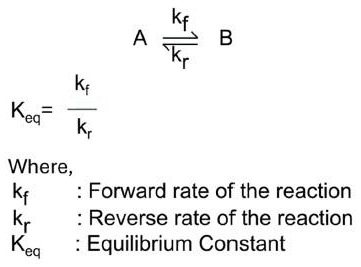
Which one of the following parameters will be increased over the uncatalyzed reaction by the enzyme?
- 1kr
- 2Keq
- 31/kr
- 41/Keq
Show answer and solution
An enzyme lowers the activation energy for the reaction in both directions, speeding up kf and kr by the same factor. The ratio Keq = kf/kr is unchanged. Of the options, only kr increases.
The figure below depicts the feedback regulation in the biosynthesis pathway of three branched-chain amino acids (BCAA) – Leu, Val, and Ile, acting at three major steps catalyzed by enzymes AHAS, IPMS, and TD. The activity of AHAS is feedback regulated by the synergistic combination of Leu and Val. IPMS activity is regulated exclusively by Leu. Ile regulates TD activity while Val can relax this feedback regulation on TD by Ile.
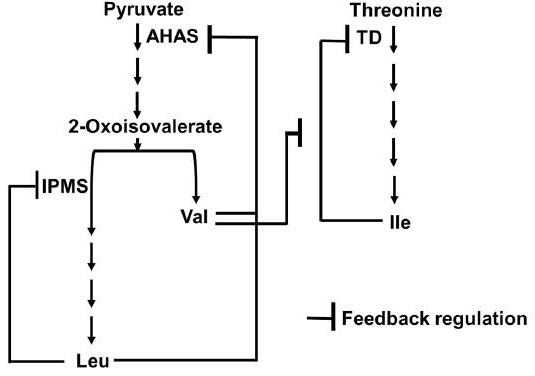
Which one of the following possibilities of BCAA pools is likely to occur in the RNAi knockdown of IPMS?
- 1Both Leu and Val will decrease.
- 2Leu will decrease, and Val remains unchanged.
- 3Leu will decrease and both Val and Ile will increase.
- 4Only Leu will decrease.
Show answer and solution
Knocking down IPMS cuts leucine synthesis. Less leucine relaxes the Leu–Val inhibition of AHAS, so more carbon flows into the shared pathway and valine rises. More valine relieves isoleucine’s inhibition of threonine deaminase, so isoleucine also rises.
The following statements are made regarding apoptosis in the nematode, C. elegans:
- A. The human ortholog of C. elegans, CED-9 is overexpressed in a B-cell lymphoma.
- B. A ced-9(gain-of-function);ced-3(loss-of-function) double mutant will have more than 947 non-gonadal cells.
- C. If purified EGL-1 is added to a CED-9/CED-4 complex in vitro, the autocleavage of CED-3 does not occur.
- D. CED-8 is a multi-spanning plasma membrane protein that is required for externalization of phosphatidylserine.
Which one of the following options represents all correct statements?
- 1A, B, C and D
- 2A and B only
- 3A, B and D only
- 4B, C and D only
Show answer and solution
A is true: CED-9’s human orthologue Bcl-2 is overexpressed in follicular B-cell lymphoma. B is true: blocking cell death leaves extra surviving cells, more than the normal count. D is true: CED-8, an XK-family protein, is needed to expose phosphatidylserine. C is false: EGL-1 binds CED-9 and releases CED-4, which then drives CED-3 activation.
The following statements describe change in allele frequencies over time.
- A. Fixation of an allele is purely by chance, while other alleles are lost.
- B. Genetic drift can lead to the loss of certain alleles over time, reducing genetic diversity within the population.
- C. Changes in allele frequencies are due to positive selection.
- D. There is a pronounced effect in small populations, where random events can drastically alter allele frequencies.
Which one of the following options represents the combination of all correct statements if allele frequencies change purely due to genetic drift?
- 1A, B and C
- 2A, B and D
- 3B, C and D
- 4A, C and D
Show answer and solution
Under pure drift, allele frequencies wander at random: alleles are fixed or lost by chance (A), diversity is lost over time (B), and the effect is strongest in small populations (D). Positive selection (C) is not drift.
The figure given below represents the same data in six different ways. “A” represents the scatter plot of all data points and “B” is its corresponding box and whisker plot. “C” to “F” represent the same dataset with different measures of central tendency alongside various measures of variation (SEM – Standard Error of Mean, SD – Standard Deviation, CI – 95% confidence interval).

Which one of the following options is a correct representation of the data?
- 1C = Mean ± quartiles; D = Median ± SEM; E = Median ± CI
- 2D = Mean ± SD; E = Mean ± CI; F = Mean ± SEM
- 3C = Median with quartiles; D = Mean ± SEM; E = Mean with CI
- 4D = Mean ± SEM; E = Mean ± CI; F = Mean ± SD
Show answer and solution
C runs about 7.6–13.8 around a centre near 10: the median with the interquartile range. D has the widest bars (mean ± SD), E narrower ones (mean with the 95% CI), and F the narrowest (mean ± SEM). For a sample of 20, SD > 95% CI half-width > SEM, which fits option 2.
The following statements were made regarding regulation of aging in C. elegans:
- A. In most cells, p53 remains bound to a repressor protein to keep it inactive, which is activated under oxidative stress when DNA damage separates p53 from its repressor.
- B. DAF-2 functions as an insulin-like growth factor receptor to block Forkhead transcription factor and increases the life span.
- C. When DAF-2 is not active, cells reduce the production of DNA repair enzymes.
- D. Dietary restriction increases mTORC1 activity, enhancing functional stem cells and longevity.
Which one of the following options has the combination of all correct statements?
- 1A and B
- 2B and C
- 3C and D
- 4A and D
Show answer and solution
A is true: p53 is held inactive by a repressor (Mdm2) and released by DNA damage. NTA also counts B as correct, reading it as the DAF-2 insulin/IGF receptor pathway that holds back the FOXO factor DAF-16, where reducing DAF-2 signalling extends lifespan. C is false: low DAF-2 activity increases stress-resistance and repair genes. D is false: dietary restriction lowers mTORC1 activity.
In an experiment, FITC-CD4 and PE-CD8 were used to stain thymocytes. The cells were then run through a flow cytometer and the data were plotted as CD4 vs CD8. The results are shown in the figure below and following statements are made:
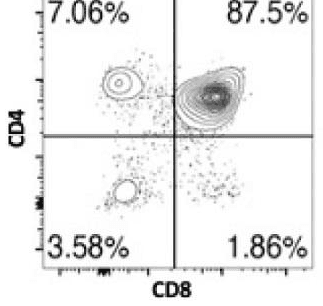
- A. Rearrangement of TCR-β locus is initiated in cells included in the quadrant containing 3.58% of the population.
- B. TCR-α locus rearrangement occurs in cells included in the quadrant containing 87.5% population.
- C. FITC-CD4 and PE-CD8 cannot stain the same cells.
- D. Rearranged TCR-γδ receptor is expressed on 7.06% population of cells.
Which one of the following options represents the combination of all correct statements?
- 1A and B only
- 2A and D
- 3A, B and C
- 4B only
Show answer and solution
Double-negative thymocytes (3.58%) start TCRβ rearrangement (A true). After β-selection, the large double-positive population (87.5%) rearranges TCRα (B true). C is false: the double positives are stained by both antibodies. D is false: the 7.06% population is CD4 single positive, not γδ T cells, which are mostly double negative. A and B.
Men suffering from enlarged prostate disease were prescribed drugs that would specifically target the androgen receptor (AR). While developing the drug, the following considerations were deliberated on:
- A. Drugs should target the N-terminal domain of the AR.
- B. Drugs should not target the NLS domain of the AR.
- C. The drug should bind to the ligand-binding domain of the AR.
- D. The drug should activate CYP17A1 to facilitate conversion of pregnenolone to DHEA.
Which one of the following combinations of considerations will develop the best drug for treatment of enlarged prostate?
- 1A and B
- 2B and C
- 3C and D
- 4A and C
Show answer and solution
Androgen-receptor drugs can block the ligand-binding domain (antiandrogens such as enzalutamide) or the N-terminal transactivation domain (as EPI compounds do), which also hits splice variants that lack the LBD. Activating CYP17A1 would make more androgen; abiraterone inhibits it. A and C.
The helicase activity of E. coli DnaB was investigated using the following two substrates (I and II) under various conditions, followed by gel electrophoresis and autoradiography. The results of these experiments are depicted below:
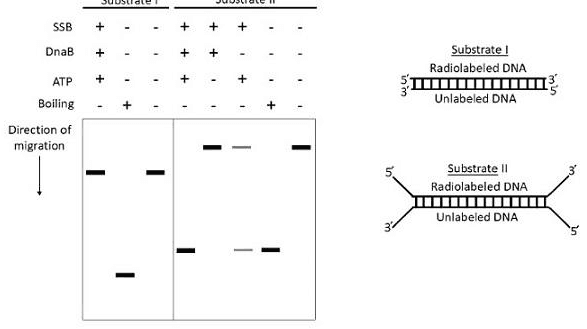
The following statements are made purely from the results shown above:
- A. DnaB can unwind only a partially unwound DNA.
- B. SSB inhibits the unwinding activity of DnaB.
- C. DnaB unwinds DNA in the 5′ to 3′ direction.
- D. DnaB requires ATP for DNA unwinding.
Which one of the following options represents the combination of all correct statements?
- 1A, B and D
- 2A, C and D
- 3C and D only
- 4A and D only
Show answer and solution
The blunt duplex (substrate I) is never unwound. The forked substrate II is unwound with DnaB + ATP, best with SSB, and not without ATP. So DnaB needs a single-stranded fork to load (A) and needs ATP (D). SSB helps rather than inhibits (B false), and a fork open at both ends cannot show direction (C).
Two closely related sympatric ladybird beetle species in a rainforest have evolved to specialise on different insect prey. Which one of the following statements does NOT explain the speciation process in these beetle species?
- 1Populations exploited different diets in the rainforests.
- 2Over time, natural selection favoured traits that allowed the consumption of distinct diets.
- 3Diverging populations developed differences in diet. However, it did not lead to reproductive isolation.
- 4Temporal differentiation in their foraging activity led to their distinct diets.
Show answer and solution
Speciation requires reproductive isolation. Statement 3 says diet divergence did not lead to reproductive isolation, so it cannot explain how two species arose. The other statements describe ecological divergence that could drive sympatric speciation.
Given below are a few statements regarding gene actions observed in plants.
- A. In terms of pollination, self-pollinated species often exhibit additive gene action.
- B. Non-additive gene action is less prevalent in cross-pollinated species.
- C. Simply inherited (qualitative, oligogenic) traits predominantly exhibit non-additive and epistatic gene action.
- D. Genetic fixation of superior genes will be more difficult with dominance gene action.
Which one of the following options represents the combination of all correct statements?
- 1A, B and C
- 2A, C and D
- 3B, C and D
- 4A and B only
Show answer and solution
In self-pollinated crops genetic variance is mainly additive (A true). Cross-pollinated species show more dominance and heterosis, so B is false. C is true per NTA’s key: simply inherited traits often show non-additive and epistatic action. D is true: dominance hides alleles in heterozygotes, which makes fixing superior genes harder. A, C and D.
The table given below provides a comprehensive list of selected plant diseases (Column X) and possible causal pathogens (Column Y).
| Column X: Plant Disease | Column Y: Pathogen |
|---|---|
| A. Apple scab | I. Claviceps purpurea |
| B. Ergot of cereals | II. Erwinia amylovora |
| C. Fire blight | III. Meloidogyne spp. |
| D. Root-Knot | IV. Venturia inaequalis |
Which one of the following options represents all correct matches between Column X and Column Y?
- 1A-IV, B-II, C-III, D-I
- 2A-II, B-I, C-IV, D-III
- 3A-I, B-IV, C-III, D-II
- 4A-IV, B-I, C-II, D-III
Show answer and solution
Apple scab: Venturia inaequalis (A–IV). Ergot: Claviceps purpurea (B–I). Fire blight of apple and pear: the bacterium Erwinia amylovora (C–II). Root-knot: the nematode Meloidogyne (D–III).
A researcher obtained a loss-of-function mutant of plasmodesmata protein synaptotagmin (SYTA) in Arabidopsis and infected the plants with cabbage leaf curl virus (CaLCuV). The following statements represent possible outcomes of the above experiment.
- A. The CaLCuV infection will be slower in the mutant plants.
- B. The mutant plants will be completely resistant to the viral infection.
- C. The endocytic recycling pathway in the infected cells will be compromised in the mutant plants.
- D. The disease symptoms will be more severe in the mutant plants.
Which one of the following options represents all correct statement(s)?
- 1A and C
- 2B and C
- 3B only
- 4D
Show answer and solution
SYTA regulates endocytic recycling at the plasma membrane and plasmodesmata, and geminiviral movement proteins hijack it for cell-to-cell spread. In syta mutants the endocytic recycling pathway is impaired (C) and CaLCuV spreads more slowly (A). The plants are not fully resistant, and symptoms are milder, not worse.
If a 0.1 M solution of glucose 1-phosphate is incubated with a catalytic amount of phosphoglucomutase, the glucose 1-phosphate is transformed to glucose 6-phosphate. At equilibrium, the concentrations of the reaction components are:
Glucose 1-phosphate (4.5 × 10⁻³ M) ⇌ Glucose 6-phosphate (9.6 × 10⁻² M)
What would be the calculated values for K′eq and ΔG°′ for this reaction at 25°C?
- 1(0.0045 to 0.096) and (−0.7 to −0.8) kJ/mol
- 2(21 to 22) and (−7.5 to −7.7) kJ/mol
- 3(0.1 to 0.2) and (−17.6 to −17.7) kJ/mol
- 4(21 to 22) and (−27.7 to −27.8) kJ/mol
Show answer and solution
K′eq = [G6P]/[G1P] = 0.096/0.0045 ≈ 21.3. ΔG°′ = −RT ln K′eq = −(8.315 × 298) × ln 21.3 = −2.48 × 3.06 ≈ −7.6 kJ/mol.
A purified 150 kDa protein species from gel filtration column was run on a 2-dimensional SDS-PAGE as shown below:

What is the likely form of the 150 kDa protein species from this observation?
- 1There are at least two proteins that are linked through non-covalent interactions.
- 2There are at least two proteins in the complex that are linked through covalent bonds.
- 3There are two proteins in the mixture without forming a complex.
- 4There is only one protein that has a disulfide bond.
Show answer and solution
In diagonal 2D SDS-PAGE (non-reducing, then reducing), proteins without disulfides fall on the diagonal. Spots that drop below it were joined by disulfides. Here the single 150 kDa species splits into two spots after DTT: at least two different chains joined covalently by disulfide bonds. NTA also accepted option 4.
Given below are different types of genetic manipulations of E. coli trp operon (Column X) and their consequences on its transcription (Column Y) under high tryptophan concentration.

| Column X | Column Y |
|---|---|
| A. Inserting bases between the leader peptide gene and sequence 2 | i. Complete attenuation |
| B. Inserting bases between sequences 2 and 3 | ii. Less attenuation |
| C. Deleting sequence 4 | iii. More attenuation |
| D. Elimination of ribosome-binding site for the leader peptide | iv. No attenuation |
Which one of the following options represents all correct matches between Column X and Column Y?
- 1A (i), B (ii), C (iii), D (iv)
- 2A (i), B (iii), C (ii), D (iv)
- 3A (iv), B (ii), C (iii), D (i)
- 4A (ii), B (iii), C (iv), D (i)
Show answer and solution
Attenuation needs the ribosome on the leader peptide to sit over sequence 2 at high Trp, so 3:4 can form the terminator. A: inserting bases between the leader peptide and region 2 means the ribosome no longer covers region 2, so 2:3 forms and there is less attenuation (ii). B: separating 2 and 3 hinders the 2:3 antiterminator, so more attenuation (iii). C: no region 4 means no terminator, so no attenuation (iv). D: with no ribosome on the leader, 1:2 then 3:4 form every time, so attenuation is complete (i).
Lethally irradiated mice were split into 4 groups and experiments were conducted as described below:
Group 1 was not given any cells.
Group 2 was given thymus-derived cells from a syngeneic donor, and two months later, immunized with a polysaccharide antigen.
Group 3 was given bone marrow cells from a syngeneic donor, and two months later, immunized with a polysaccharide antigen.
Group 4 was given bone marrow cells from a syngeneic donor, and two months later, immunized with a T-dependent antigen.
Four possible outcomes, listed below, were suggested.
- A. Group 1 mice are unlikely to survive.
- B. Group 2 mice are likely to produce antibodies in response to polysaccharide antigens.
- C. Group 3 mice are likely to produce antibodies in response to polysaccharide antigens.
- D. Group 4 mice are likely to produce antibodies in response to T-dependent antigens.
Which one of the following options represents the combination of all correct statements?
- 1A and B only
- 2A, B and D
- 3A and C only
- 4A, C and D
Show answer and solution
Group 1 has no haematopoietic cells and dies (A). Bone-marrow grafts restore B cells, and T cells develop in the host’s own thymus, so group 3 responds to polysaccharide (T-independent) antigens (C) and group 4 to T-dependent ones (D). Thymocytes alone (group 2) give no B cells, so no antibody (B false).
Which statement about studies on succession is INCORRECT?
- 1Succession studies can reveal the effects of non-native species on the ecological structures and functions of a community.
- 2Studies of succession can indicate threshold conditions for the ‘invasion window’.
- 3Non-native invasion can divert succession by out-competing existing species.
- 4Succession studies show that coevolved native species always outcompete invasive species.
Show answer and solution
Succession studies show invasive species can establish, divert succession and reveal “invasion windows”. They certainly do not show that natives always outcompete invaders, as countless invasions prove. Statement 4 is the incorrect one.
Two newly identified proteins, X and Y, are tested for sequence-specific DNA binding activity. The results of an electrophoretic mobility shift assay (EMSA) with a labeled DNA fragment and proteins X and Y in various combinations are shown below.
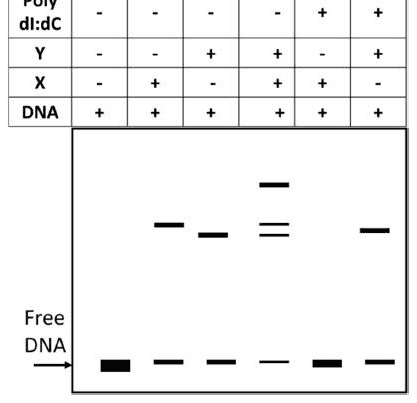
Poly dI:dC is a DNA duplex of polyinosine and polycytosine. Which one of the following options represents the correct interpretation of the results obtained?
- 1Both X and Y are sequence-specific DNA binding proteins.
- 2X does not bind to DNA and Y binds to specific sequence.
- 3Both proteins bind to DNA but Y binds in a sequence-specific manner.
- 4X competes with Y to bind the same sequence.
Show answer and solution
X shifts the probe, but the shift disappears when non-specific competitor DNA (poly dI:dC) is added, so X binds DNA non-specifically. Y’s shift survives the competitor, so Y binds a specific sequence. Together they form a larger complex rather than competing. Option 3.
The following statements are about parental care and variance in reproductive success in a bird species.
- A. If females provide more parental care than males, the variance in male reproductive success is significantly greater than that of females.
- B. Where only males provide parental care, the variance in female reproductive success is significantly higher than that of males.
- C. In the case of biparental care, the variance in male reproductive success is significantly greater than that of females.
- D. In the case of biparental care, the variance in female reproductive success is significantly greater than that of males.
Select the option that identifies the combination of all correct statements.
- 1A and B
- 2A and C
- 3B and D
- 4C and D
Show answer and solution
The sex that invests less in parental care can compete for more mates, so its reproductive success varies more. If females care more, males vary more (A). If only males care, females vary more (B). With biparental care neither sex necessarily varies significantly more (C and D are false).
A student used four 20-mer oligos to amplify DNA (using a regular Taq DNA polymerase) from a wild type (WT), a homozygous mutant having a deletion of the gene (del), and from the heterozygous mutant (het), as shown in the figure below.

Agarose gel electrophoresis profiles, using all four primers simultaneously, on each template are shown below. Which one of the options given below represents the correct profile?
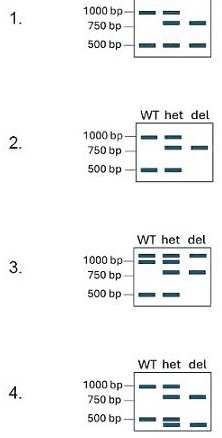
- 1Profile 1
- 2Profile 2
- 3Profile 3
- 4Profile 4
Show answer and solution
Primer D lies inside the 15 kb region, so it amplifies only from the intact allele, together with each forward primer. Across the deletion, the forward primer to R would be over 15 kb in the wild type, too long for ordinary Taq, but short in the deleted allele. So WT shows only the D products, the deletion only the junction product, and the heterozygote both. That is profile 2.
The table below lists selected bird species (Column X) and their possible habitats (Column Y).
| Column X | Column Y |
|---|---|
| A. Bugun liocichla (Liocichla bugunorum) | I. High altitude Western Himalayas |
| B. Grey-headed Bulbul (Pycnonotus priocephalus) | II. Northeast India |
| C. Brooks’s leaf-Warbler (Phylloscopus subviridis) | III. Western Ghats |
| IV. Andaman and Nicobar Islands |
Which one of the following options represents all correct matches between Column X and Column Y?
- 1A-I, B-II, C-III
- 2A-III, B-I, C-IV
- 3A-IV, B-II, C-III
- 4A-II, B-III, C-I
Show answer and solution
The Bugun liocichla, discovered in 2006, lives only in the Eaglenest area of Arunachal Pradesh, north-east India (A–II). The grey-headed bulbul is endemic to the Western Ghats (B–III). Brooks’s leaf warbler breeds in the high western Himalaya (C–I).
Shown in the table below are the enzymes (Column X) involved in the biosynthesis of listed phytohormones (Column Y).
| Column X | Column Y |
|---|---|
| A. Carotenoid cleavage dioxygenase | i. Brassinosteroid |
| B. ER localized cytochrome P450 monooxygenase | ii. Strigolactone |
| C. ACC oxidase | iii. Abscisic acid |
| D. 9-cis-epoxycarotenoid dioxygenase | iv. Ethylene |
Which one of the following options represents all correct matches between Column X and Column Y?
- 1A (ii), B (i), C (iii), D (iv)
- 2A (i), B (ii), C (iv), D (iii)
- 3A (iv), B (ii), C (iii), D (i)
- 4A (ii), B (i), C (iv), D (iii)
Show answer and solution
Carotenoid cleavage dioxygenases (CCD7 and CCD8) make strigolactones (A–ii). ER-bound P450s (DWF4, CPD) catalyse brassinosteroid steps (B–i). ACC oxidase makes ethylene (C–iv). NCED is the committed step of ABA synthesis (D–iii).
Three strands of a beta-sheet of 4 peptides are hydrogen bonded with the orientation of the strands (parallel or antiparallel denoted by the arrowheads) as shown in the figure. Each strand consists of identical residues, where N and C represent terminal residues of the peptide. The three strands of each peptide are linked by amino acid sequences of the smallest length possible.
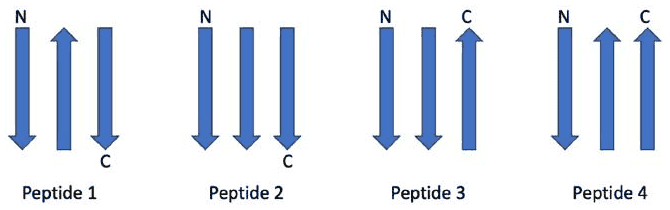
Which one of the following options is correct regarding the length of the peptides 1 to 4?
- 1(Peptide 1 = Peptide 2) < Peptide 3 < Peptide 4
- 2Peptide 1 < (Peptide 3 = Peptide 4) < Peptide 2
- 3Peptide 1 < Peptide 3 < Peptide 4 < Peptide 2
- 4Peptide 1 < Peptide 2 < Peptide 3 < Peptide 4
Show answer and solution
Adjacent antiparallel strands can be joined by a short hairpin turn. Adjacent parallel strands need a long crossover connection that runs back across the sheet. Peptide 1 (↓↑↓) has two hairpins and is the shortest. Peptides 3 and 4 each have one hairpin and one crossover, so they are equal. Peptide 2 (↓↓↓) needs two crossovers and is the longest.
The magnetic field generated from an electromagnet is used in the transcranial magnetic stimulation (TMS) of the brain. The following statements suggest some features of TMS:
- A. The magnetic field generated in TMS induces an electrical field in the underlying brain area.
- B. The electrical field in the brain area alters the membrane potential of the neurons in that locality causing them to depolarize synchronously, which in turn, may change the probability of the firing of neurons.
- C. In cognitive neuroscience research, TMS may be used as a tool to induce a ‘virtual lesion’ in a selected region of the cerebral cortex.
- D. TMS is safe and non-invasive but the neuronal activity of the stimulated area is disrupted for a long period of time.
Which one of the following options represents the combination of all correct statements?
- 1A, B and C
- 2B, C and D
- 3C and D only
- 4A only
Show answer and solution
TMS works by electromagnetic induction: a brief magnetic pulse induces an electric field in the cortex below (A). That field depolarises neurons and changes their firing (B). It can temporarily disrupt a region, a “virtual lesion” (C). The disruption is short-lived, not long-lasting, so D is false.
The table below gives the avian community composition of three communities (X, Y, Z), where ‘1’ indicates the presence of the species in the community and ‘0’ indicates its absence.
| Species | X | Y | Z |
|---|---|---|---|
| Red-vented bulbul | 1 | 0 | 1 |
| Purple sunbird | 0 | 0 | 1 |
| Common Babbler | 0 | 1 | 1 |
| Rufous treepie | 1 | 1 | 1 |
| Red-naped Ibis | 1 | 1 | 0 |
| Scarlet minivet | 0 | 0 | 1 |
| Spotted Owlet | 0 | 1 | 0 |
Select the option that lists the correct order of similarity between pairs of communities based on Sorensen’s coefficient of similarity.
- 1(X,Y) > (Y,Z) > (X,Z)
- 2(X,Y) > (X,Z) > (Y,Z)
- 3(Y,Z) > (X,Z) > (X,Y)
- 4(X,Y) = (X,Z) = (Y,Z)
Show answer and solution
Sorensen’s index = 2c/(a + b). X has 3 species, Y 4 and Z 5. X and Y share 2 species: 4/7 = 0.57. X and Z share 2: 4/8 = 0.50. Y and Z share 2: 4/9 = 0.44. Order: (X,Y) > (X,Z) > (Y,Z).
In Drosophila melanogaster, a cross was performed, and the resulting progeny are indicated below.
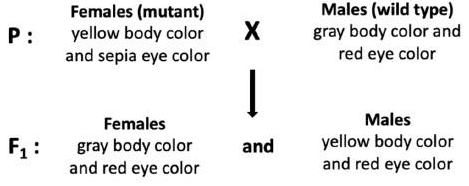
The F1 progeny were sib-mated and the F2 progeny were analysed. The following statements were made based on the above crosses and analysis of the progeny:
- A. The mutation leading to sepia eye color is located on an autosome.
- B. Yellow body is a dominant phenotype.
- C. One fourth of the F2 progeny will be males with yellow body color.
- D. In this dihybrid cross, as the F2 progeny do not show a 9:3:3:1 typical Mendelian ratio, the two genes can be assumed to be linked.
Which one of the following options correctly identifies each statement as True (T) or False (F) from A to D, respectively?
- 1T, F, T, F
- 2F, T, T, F
- 3T, T, F, F
- 4F, F, T, T
Show answer and solution
All F1 sons are yellow like their mother and all daughters grey: a criss-cross pattern, so yellow is X-linked recessive (B false). Sepia disappears in both sexes of the F1, so it is autosomal recessive (A true). F2 sons get the X from XyX+ mothers, so half of them are yellow, which is 1/4 of all F2 (C true). The ratio departs from 9:3:3:1 because of sex linkage, not linkage between the genes (D false).
A researcher placed plant cells in a hypertonic solution to cause the cells to shrink. The following statements are made regarding the plasmolysed cells.
- A. Microtubules are lost in the plasmolysed cells.
- B. Protoplasts are retracted in the plasmolysed cells.
- C. Hechtian strands are lost during plasmolysis.
- D. Patches of plasma membrane remain affixed to the wall.
Which one of the following options represents the combination of all correct statements?
- 1A, B and C
- 2B and C only
- 3A, C and D
- 4B and D
Show answer and solution
In a hypertonic solution the protoplast shrinks away from the wall (B). It stays attached at points, leaving patches of plasma membrane on the wall (D), joined to the protoplast by Hechtian strands, which form during plasmolysis (C false). Microtubules are not lost (A false).
Gradient formation of Fgf8 is governed by both diffusion from a localized source and removal of Fgf8 ligand through endocytosis. Both Rab5C and dynamin promote endocytosis. What would happen to the Fgf8 concentration gradient when Rab5C is overexpressed or dynamin is inhibited?
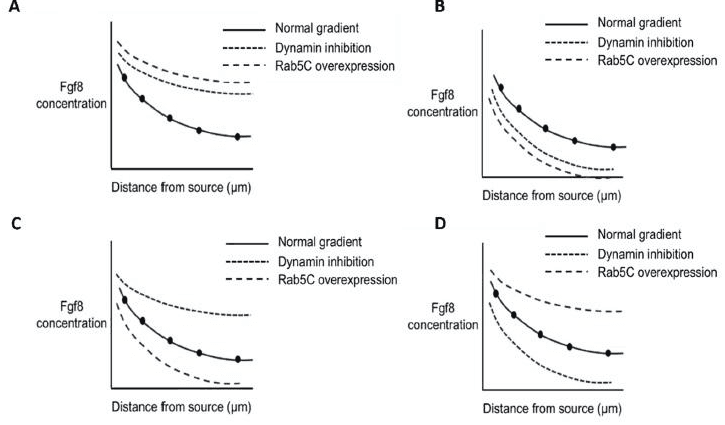
- 1A
- 2B
- 3C
- 4D
Show answer and solution
Endocytosis removes Fgf8 as it spreads. More endocytosis (Rab5C overexpression) lowers the concentration and makes the gradient fall off more steeply. Blocking endocytosis (dynamin inhibition) lets Fgf8 build up and spread farther, giving a higher, flatter gradient. Graph C shows exactly this.
Given below are some statements regarding growth hormone (GH) secretion in humans.
- A. Fasting increases GH secretion.
- B. REM sleep decreases GH secretion.
- C. Cortisol increases GH secretion.
- D. Hypoglycemia decreases GH secretion.
Which one of the options given below represents both correct statements?
- 1A and B
- 2B and C
- 3C and D
- 4A and D
Show answer and solution
GH secretion rises in fasting, hypoglycaemia, exercise and deep slow-wave sleep. It is lower in REM sleep, and glucocorticoids such as cortisol suppress it. So A and B are true, while C (cortisol increases GH) and D (hypoglycaemia decreases it) are false.
A parasitoid infects a host to complete its life cycle. Which of the following life-history traits typically characterizes this parasitoid, assuming that only one parasitoid infects one host?
- 1Intrinsic rate of population growth faster than hosts; Eventually fatal for the host
- 2Intrinsic rate of population growth slower than hosts; Immediately fatal for the host
- 3Intrinsic rate of population growth comparable to hosts; Eventually fatal for the host
- 4Intrinsic rate of population growth faster than hosts; Immediately fatal for the host
Show answer and solution
A parasitoid develops in a single host and kills it only when its development is complete: eventually fatal, not at once. Its population dynamics are tightly coupled to its host’s, so its intrinsic rate of increase is comparable to the host’s, as in classic Nicholson–Bailey host–parasitoid models.
When blood is forced into aorta from left ventricle during systole, a pressure wave is set up in aorta which is called pulse. Some features of the pulse are proposed in the following statements:
- A. The rate of travel of the pulse wave is lower than the velocity of blood flow in arteries.
- B. The pulse wave moves slower with advancing age as the arteries become more rigid.
- C. The pulse wave is strong when the stroke volume is large as in exercise.
- D. The strength of the pulse depends on the magnitude of pulse pressure and not on the mean arterial pressure.
Which one of the following options represents the combination of correct statements?
- 1A, B, C and D
- 2B, C and D only
- 3C and D only
- 4A only
Show answer and solution
The pulse wave travels at 4–10 m/s, much faster than the blood itself (A false). It travels faster still in stiff, aged arteries (B false). A large stroke volume, as in exercise, gives a strong pulse (C true). Pulse strength reflects pulse pressure, not mean pressure (D true). C and D.
The statements below are made about some animal pathogens that may evade innate and inflammatory responses by the following mechanisms:
- A. The flagellin of Proteobacteria has a mutation that prevents it from being recognized by Toll-like receptors (TLRs).
- B. The lipopolysaccharides of Helicobacter have mutations that prevent it from being recognized by TLRs.
- C. M. tuberculosis escapes from the phagosome to the cytosol, thereby avoiding degradation by lysosomal enzymes.
- D. Influenza virus produces Yop protein that inhibits inflammasome activity.
- E. S. typhi encodes a protein that binds Type I IFNs and prevents them from binding to the IFN receptor.
Which one of the following options represents the combination of all correct statements?
- 1B and C
- 2A and C
- 3D and E
- 4A and B
Show answer and solution
Some bacteria avoid innate detection by altering their pattern molecules: flagellin variants that TLR5 cannot recognise (A), and the poorly recognised LPS of Helicobacter (B). C is false: M. tuberculosis mainly survives by blocking phagosome–lysosome fusion. D is false: Yop proteins come from Yersinia, not influenza. E is false: S. Typhi does not encode an IFN-binding decoy. A and B.
A lac-lambda hybrid system is developed to study the λ-repressor protein, in which the λ CI gene is under the control of E. coli lac promoter and operator, and the lacZ gene is under the control of λ-PRM promoter and OR operator of λ-phage. Both the plasmids are introduced in E. coli and the concentrations of the proteins are determined upon the addition of IPTG.
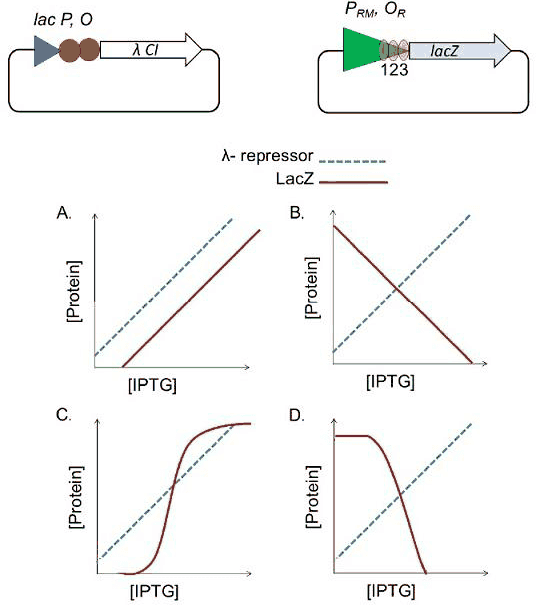
Which graph correctly represents the expected results?
- 1A
- 2B
- 3C
- 4D
Show answer and solution
IPTG switches on cI, so the λ repressor rises steadily. CI binds OR1 and OR2 cooperatively and activates PRM, so lacZ stays off at low CI and then rises steeply, a sigmoidal switch, before levelling off. Graph C shows this.
Actin dynamics in cells is dependent on several actin-binding proteins. Given below are actin-binding proteins in Column X and their typical function in Column Y.
| Column X | Column Y |
|---|---|
| A. Formin | I. nucleates assembly to form a branched network |
| B. Arp2/3 complex | II. stabilizes filament, modulates binding of other accessory proteins |
| C. Cofilin | III. nucleates assembly and remains associated with the growing plus end |
| D. Tropomyosin | IV. binds ADP-actin filaments, accelerates disassembly |
Which one of the following options represents all correct matches between Column X and Column Y?
- 1A-(I), B-(II), C-(IV), D-(III)
- 2A-(III), B-(I), C-(IV), D-(II)
- 3A-(III), B-(II), C-(IV), D-(I)
- 4A-(II), B-(I), C-(IV), D-(III)
Show answer and solution
Formin nucleates unbranched filaments and rides on the growing plus end (A–III). The Arp2/3 complex nucleates branches from existing filaments (B–I). Cofilin binds ADP-actin and severs and depolymerises filaments (C–IV). Tropomyosin stabilises filaments and controls access of other proteins (D–II).
A researcher needs to identify if Protein A is localized in the ER in a human cell line. The cell has an RFP-tagged protein that marks the ER in this cell. Following are the proposed experiments.
- A. Express Protein A fused to GFP at the N-terminus in the cells, followed by microscopy to check for colocalization with RFP.
- B. Express Protein A fused to GFP at the C-terminus in the cells, followed by microscopy to check for colocalization with RFP.
- C. Immunofluorescence staining of A, followed by microscopy to check for colocalization with RFP.
- D. Isolating the ER by differential centrifugation and checking for co-purification of Protein A with RFP.
Which one of the following options represents experiments that would most likely identify localization of Protein A in the ER?
- 1A and D
- 2B, C and D
- 3A and C
- 4B and C only
Show answer and solution
An N-terminal GFP would hide the ER signal sequence and could block targeting, so A is unreliable. A C-terminal GFP fusion (B), immunostaining of the native protein (C) and co-fractionation with the ER marker (D) all report its true location. B, C and D.
Urine volume is increased in osmotic diuresis which may be experimentally produced by the intravenous administration of mannitol that is filtered in the glomerulus but not reabsorbed in the renal tubule. The following statements suggest some of the physiological mechanisms of osmotic diuresis.
- A. In the proximal tubule, water reabsorption falls due to presence of mannitol in tubular fluid and concentration of Na+ is decreased in this fluid.
- B. In the descending loop of Henle, reabsorption of water is increased as medullary hypertonicity is decreased in osmotic diuresis.
- C. In the thin ascending loop of Henle, reabsorption of Na+ is increased as the concentration gradient for Na+ is decreased.
- D. In the collecting duct, reabsorption of water is less because of decrease in osmotic gradient along the medullary pyramid in osmotic diuresis.
Which one of the following options represents the combination of all correct statements?
- 1A and B
- 2B and C
- 3C and D
- 4A and D
Show answer and solution
Mannitol is filtered but not reabsorbed, so it holds water in the tubule. Less water is reabsorbed in the proximal tubule and the tubular Na+ concentration falls (A true). The faster flow washes out the medullary solute gradient, so water reabsorption in the collecting duct falls (D true). B and C describe the opposite of what happens.
Given below are different types of bacterial growth curves.
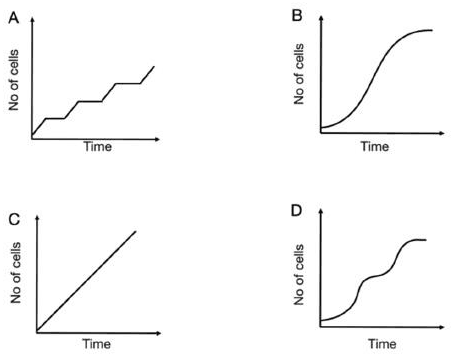
Which one of the following options represents all correct matches between the growth curves and the type of culture?
- 1A: Continuous; B: Asynchronous; C: Synchronous; D: Diauxic
- 2A: Synchronous; B: Continuous; C: Asynchronous; D: Diauxic
- 3A: Continuous; B: Asynchronous; C: Diauxic; D: Synchronous
- 4A: Synchronous; B: Asynchronous; C: Continuous; D: Diauxic
Show answer and solution
A rises in steps: all cells divide together, a synchronous culture. B is the ordinary sigmoid of an asynchronous batch culture. C keeps rising steadily as fresh medium is supplied, a continuous culture. D has two growth phases separated by a lag: diauxic growth, as when glucose runs out and lactose takes over.
Protein X can be extracted from disrupted erythrocyte plasma membranes with high salt concentrations. Treatment of intact erythrocytes with protease followed by extraction led to intact protein X. Treatment of disrupted erythrocyte plasma membranes with protease followed by extraction led to fragmented protein X.
The following interpretations were made:
- A. Protein X is a peripheral membrane protein
- B. Protein X is an integral membrane protein
- C. Protein X is on the extracellular matrix face of the plasma membrane
- D. Protein X is on the cytosolic face of the plasma membrane
Which one of the following options best represents the combination of all correct interpretations?
- 1A and C
- 2A and D
- 3B and C
- 4B and D
Show answer and solution
Removal by high salt means X is held only by ionic interactions: a peripheral protein (A). Protease cannot reach it in intact cells but cuts it once the membranes are opened, so it sits on the cytosolic face (D). Spectrin and ankyrin are real examples.
The muscle spindles are the stretch receptors that initiate stretch reflex in skeletal muscles. The following statements are proposed to describe the structural and functional characteristics of the different components of a muscle spindle.
- A. The specialized intrafusal fibers in muscle spindles have non-contractile polar ends and a contractile centre.
- B. The intrafusal fibers do not contribute to the overall contractile force of the muscle.
- C. The primary sensory ending in a muscle spindle is formed by group Ia afferent fibers.
- D. The axons of α-motor neurons having a diameter of 12-20 μm innervate the muscle spindles as the motor nerve.
Which one of the following options represents the combination of correct statements?
- 1A and B
- 2B and C
- 3C and D
- 4A and D
Show answer and solution
Intrafusal fibres have contractile polar ends and a non-contractile central sensory region (A false). They add essentially nothing to muscle force (B true). The primary (annulospiral) ending is formed by group Ia afferents (C true). They are innervated by thin γ motor neurons, not α (D false). B and C.
Pollen tube growth in the transmission tract (TT) of the style and its attraction to the embryo sac are directed by chemical cues in plants, as discovered in Lily and Torenia. Which one of the following statements about the proteins/peptides secreted in the process is correct?
- 1TT epidermis secretes cysteine-rich defensin-like peptides, whereas synergids (SY) secrete cysteine-rich adhesins.
- 2TT epidermis secretes cysteine-rich adhesins, whereas SY secrete cysteine-rich defensin-like peptides.
- 3TT epidermis secretes proline- and hydroxyproline-rich glycoproteins, whereas SY secrete cysteine-rich adhesin and chemocyanin.
- 4TT epidermis secretes arabinogalactan proteins and chemocyanin, whereas the central cell of the embryo sac secretes cysteine-rich LURE peptides.
Show answer and solution
In lily, the transmitting-tract epidermis secretes the small cysteine-rich protein SCA (stigma/style cysteine-rich adhesin), which with pectin guides pollen tube adhesion. In Torenia, the synergids secrete LURE peptides, defensin-like cysteine-rich attractants that pull the tube to the embryo sac. That is option 2.
A researcher simultaneously inhibited the activities of Triose-Phosphate Translocator (TPT) and Xylulose 5-Phosphate Translocator (XPT) in a plant and made the following assumptions:
- A. Triose phosphate will be accumulated more in the chloroplast.
- B. Triose phosphate will be accumulated more in the cytosol.
- C. Xylulose 5-phosphate will be accumulated more in the chloroplast.
- D. Xylulose 5-phosphate will be accumulated more in the cytosol.
Which one of the following combinations of the above assumptions is correct?
- 1A and C
- 2A and D
- 3B and C
- 4B and D
Show answer and solution
The triose phosphate translocator exports triose-P from the chloroplast, so blocking it leaves triose-P to build up inside the chloroplast (A). The xylulose-5-phosphate translocator brings xylulose-5-P from the cytosol into the plastid, so blocking it makes xylulose-5-P build up in the cytosol (D).
Following statements are made regarding methyl erythritol phosphate (MEP) and mevalonate pathways for plant terpenoid biosynthesis.
- A. The MEP pathway occurs in plastids whereas mevalonate pathway occurs in cytosol.
- B. The mevalonate pathway supplies most of the C5 units of terpenoids for the biosynthesis of monoterpenes and diterpenes.
- C. The MEP pathway supplies most of the C5 units of terpenoids for the biosynthesis of sesquiterpenes.
- D. Certain genes of the plant MEP pathway are believed to have been acquired from the cyanobacterial symbiont.
Which one of the following options represents a combination of all correct statements?
- 1A, B and C
- 2B, C and D
- 3C and D only
- 4A and D
Show answer and solution
The MEP pathway runs in plastids and the mevalonate pathway in the cytosol (A true). MEP supplies mono-, di- and tetraterpenes, while mevalonate supplies sesquiterpenes, triterpenes and sterols, so B and C are reversed. Several MEP genes were inherited from the cyanobacterial ancestor of plastids (D true).
A student studying tree species diversity uses a large number of sampling quadrats (each of 1-hectare area) to cover >50% of the area of a 200-hectare tropical forest patch. Consider the statements in the options below:
- A. Species numbers increase with sampling area following a power-law relationship with exponent >0 and <1.
- B. The log of species numbers increases linearly with the log of the sampling area.
- C. Species numbers increase with sampling area following a power-law relationship with exponent >1.
- D. Species numbers increase linearly with the log of the sampling area.
Which combination of the statements above describes the expected pattern?
- 1A and B
- 2C only
- 3B and C
- 4A and D
Show answer and solution
Species accumulate with area as S = cAz with 0 < z < 1, typically 0.15–0.35 (A). Taking logs, log S = log c + z log A, which is a straight line on log–log axes (B).
The following statements describe a few basic features of the interferometric reflectance imaging sensor used as a biosensing platform:
- A. This biosensing platform is capable of high-throughput multiplexing of protein-protein, protein-DNA and DNA-DNA interactions.
- B. The sensing surface is prepared by robotic spotting of biological probes that are immobilized on functionalised Si/SiO2 substrate.
- C. As biomass accumulates on the substrate surface, a change in the interferometric signature occurs and the change can be correlated to a quantifiable mass.
- D. Using this technique, picometer changes in biomass may be detected.
Which one of the following options represents the combination of all correct statements?
- 1A, B and C
- 2B, C and D
- 3C and D only
- 4A only
Show answer and solution
Interferometric reflectance imaging sensors (IRIS) use DNA or protein probes spotted robotically onto Si/SiO2 chips (B). They read binding as a change in the optical path length of reflected light, which can be converted to bound mass (C), and they handle many protein–protein, protein–DNA and DNA–DNA interactions at once (A). NTA’s key does not accept D.
A researcher uses taxon weighting and complementarity as criteria to prioritise communities for biodiversity conservation. The diagram below shows the distributions of five taxa (A to E) among four regions (R1–R4). Column W represents the weightage given to these five taxa based on their taxonomic uniqueness.
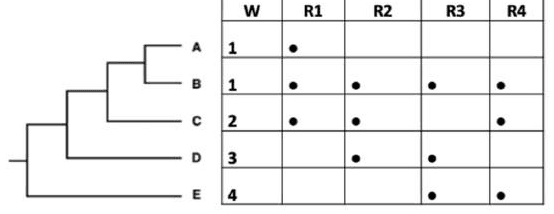
Select the option that lists the appropriate order of regions that should be prioritised (from highest to lowest) for conservation.
- 1R1 > R3 > R4 > R2
- 2R2 > R1 > R3 > R4
- 3R3 > R1 > R4 > R2
- 4R4 > R2 > R1 > R3
Show answer and solution
Weighted taxon scores: R1 = A + B + C = 4, R2 = B + C + D = 6, R3 = B + D + E = 8, R4 = B + C + E = 7. Choose R3 first. By complementarity, R1 adds the most new weight (A + C = 3), so it comes next, and together they hold every taxon. The rest are ranked by their totals, R4 (7) then R2 (6). R3 > R1 > R4 > R2.
The following statements were made regarding the roles of histone modifications in transcriptional regulation.
- A. Acetylation of histones is generally associated with transcriptional repression by making the chromatin more compact.
- B. Methylation of histones can either activate or repress transcription depending on the specific residue modified.
- C. Phosphorylation of histones occurs in response to DNA damage and can influence gene expression.
- D. Histone modifications influence the recruitment of RNA polymerase complex but not transcription factors.
Which one of the following options represents the combination of all correct statements?
- 1A and D only
- 2B and C only
- 3B, C, and D
- 4A, B, and D
Show answer and solution
Acetylation opens chromatin and activates transcription (A false). Methylation can activate (H3K4me3) or repress (H3K9me3, H3K27me3) depending on the residue (B true). H2AX phosphorylation (γH2AX) marks DNA damage, and H3S10 phosphorylation affects gene activity (C true). Modifications recruit transcription factors and chromatin remodellers as well as polymerase (D false).
The evolution of algal lineages is closely linked to endosymbiotic events. Which of the following statements best explains the origin and diversification of plastids in different algal groups?
- 1Primary plastids originated from a eukaryotic host cell engulfing a red algal ancestor, followed by secondary endosymbiosis leading to the diversification of green and brown algal lineages.
- 2Primary plastids evolved through the engulfment of a cyanobacterium by a eukaryotic host, while secondary and tertiary endosymbiosis involving red and green algae gave rise to plastids in diverse algal lineages such as diatoms and dinoflagellates.
- 3All algal lineages acquired plastids through multiple independent primary endosymbiosis events, with cyanobacteria being engulfed by both red and green algal ancestors.
- 4Secondary endosymbiosis was responsible for the origin of primary plastids in green algae, while tertiary endosymbiosis involving diatoms led to the evolution of plastids in red algae.
Show answer and solution
Primary plastids, in glaucophytes, red algae and green algae with land plants, came from a eukaryote engulfing a cyanobacterium. Later, secondary and tertiary endosymbioses of red or green algae gave plastids to diatoms, brown algae, dinoflagellates, euglenids and others.
Given below are two columns depicting structural features (Column X) and the DNA/RNA conformation (Column Y).
| Column X: Structural features | Column Y: DNA/RNA conformation |
|---|---|
| A. Left-handed | i. A form |
| B. Number of base pairs per turn is 10 | ii. B form |
| C. The base pairs are off-centered | iii. Z form |
| D. RNA double helix |
Which one of the following options represents all correct matches between Column X and Column Y?
- 1A (iii), B (ii), C (i), D (i)
- 2A (i), B (iii), C (ii), D (i)
- 3A (ii), B (ii), C (i), D (iii)
- 4A (iii), B (i), C (iii), D (ii)
Show answer and solution
Z-DNA is left-handed (A–iii). B-DNA has about 10–10.5 bp per turn (B–ii). In A-form helices the base pairs sit off the axis, tilted (C–i), and double-stranded RNA adopts the A form (D–i).
The statements given below describe an angiosperm flower.
- A. A flower develops in the axils of bracts like axillary shoots.
- B. The floral pedicel is the elongated node and the axis is condensed, like in a shoot.
- C. Floral parts like calyx, corolla, androecium and gynoecium are modified leaves.
- D. Floral buds may sometimes get modified into vegetative buds or bulbils.
Select the option with all correct statements that support the idea that a flower is a modified shoot.
- 1A, B and C
- 2A, B and D
- 3B, C and D
- 4A, C and D
Show answer and solution
A flower arises in the axil of a bract, like a lateral shoot (A). Its parts are modified leaves (C). Floral buds sometimes turn into vegetative buds or bulbils (D). All three support the flower being a modified shoot. B is wrong: the pedicel is an internode, and it is the floral axis (the thalamus) that is condensed.
The pedigree (Fig A) represents the inheritance of a monogenic disorder, caused by a defective enzyme encoded by a mutant allele. The functional and defective enzymes can be resolved by PAGE. The allozyme pattern observed in some of the individuals in the family is represented in Fig B. The frequency of the mutant allele in the population is 0.04.
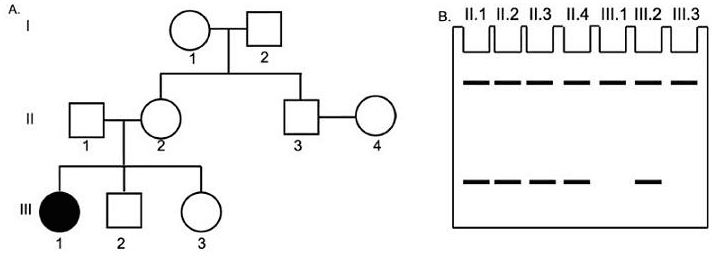
Based on the above information, the following statements were made:
- A. The allele encoding the functional enzyme is haplo-sufficient.
- B. The trait shows 100% penetrance.
- C. The probability that a child born to individuals II.3 and II.4 will be homozygous for the gene is 1/4.
- D. Both individuals I.1 and I.2 are necessarily heterozygous for the gene.
Which one of the following options correctly identifies each statement as True (T) or False (F) from A to D, respectively?
- 1T, F, F, F
- 2T, F, T, F
- 3F, T, T, F
- 4F, F, F, T
Show answer and solution
Everyone shows the upper band, and the lower band appears only in some, so the lower band is the functional enzyme. Heterozygotes are healthy, so the functional allele is haplosufficient (A true). III.3 has only the mutant band but is unaffected, so penetrance is incomplete (B false). II.3 × II.4, both heterozygous, give homozygotes (AA or aa) with probability 1/2, not 1/4 (C false). I.1 and I.2 need not both be heterozygous (D false).
The insulin receptor is a receptor tyrosine kinase that engages the PI3 kinase pathway to regulate a FOXO transcription factor. A student uses qRT-PCR to determine the expression of a direct FOXO target gene (GeneX) in a mammalian cell line under different conditions and makes the following observations.
- A. Treating the cells with a PTEN inhibitor increases GeneX expression.
- B. A cell line with an AKT (S308A) mutation has increased GeneX expression.
- C. Change in GeneX expression due to a ligand-binding defective insulin receptor is partly reversed by a PTEN inhibitor.
- D. Phosphorylation of FOXO by PDK1 creates a phosphoserine binding site for 14-3-3 protein, reducing GeneX expression.
Which one of the following options represents all correct statements?
- 1A, B and C
- 2A and C only
- 3B and C only
- 4A, C and D
Show answer and solution
Akt phosphorylates FOXO and excludes it from the nucleus, so anything that weakens Akt raises FOXO target genes. An Akt phospho-site mutant cannot be activated, so GeneX rises (B true). A ligand-blind insulin receptor also raises GeneX, and a PTEN inhibitor partly restores PIP3 and Akt, partly reversing it (C true). A PTEN inhibitor alone would lower GeneX (A false). FOXO is phosphorylated by Akt, not PDK1 (D false).
Following statements are made with respect to the production of transgenic plants.
- A. Auxin can be used as a negative selection marker in plant transgenesis as it can be lethal to germinating seedlings at higher concentrations.
- B. Agrobacterium inserts T-DNA at random locations in the plant genome and thus, it cannot be targeted to a desired location.
- C. The antibiotic kanamycin interferes with the cytoplasmic ribosomal protein synthesis machinery, thereby acting as a positive selection marker.
- D. Gene transfer by biolistic/particle gun bombardment usually results in lower transgene copy number and less DNA rearrangement than Agrobacterium-mediated transformation.
Which one of the following options represents all INCORRECT statements?
- 1A, C and D
- 2C and D only
- 3A and B
- 4B, C and D
Show answer and solution
B is correct: Agrobacterium integrates T-DNA at essentially random sites. The other three are incorrect. Auxin is not a standard negative selection marker (A). Kanamycin inhibits the 70S ribosomes of plastids and mitochondria, not cytoplasmic ribosomes, and it is the nptII gene that serves as the positive marker (C). Biolistics usually gives more copies and more rearrangement than Agrobacterium (D). A, C and D.
Spindle assembly in animal cells requires nuclear envelope breakdown (NEBD). NEBD is a multistep process, which begins when Cdk1/cyclinB phosphorylates multiple components of the nuclear envelope. Given below are some components that are directly phosphorylated by Cdk1/cyclinB:
- A. Nuclear Pore Complexes
- B. Nuclear lamina
- C. Greatwall kinase
- D. Histone H3
Choose the option with correct Cdk1/cyclinB substrate/s that are directly associated with NEBD.
- 1B only
- 2A, B and D
- 3A and B only
- 4B, C and D
Show answer and solution
At NEBD, Cdk1–cyclin B directly phosphorylates nucleoporins, which disassembles nuclear pore complexes, and lamins, which depolymerises the lamina. Greatwall is a Cdk1 target, but it controls PP2A–B55 rather than the envelope. Histone H3 is phosphorylated by Aurora B.
Which one of the following is INCORRECT regarding Hill numbers (q), a family of diversity indices?
- 1As q increases, the index puts increasing weight on the most common species in the assemblage, with the contribution of rare species gradually reducing in the summation.
- 2As q increases, the index puts increasing weight on the rare species in the assemblage, with the contribution of common species gradually reducing in the summation.
- 3As q increases, the diversity index decreases, unless all species are equally abundant.
- 4Once q ≳ 5, Hill numbers rapidly converge to the inverse of the relative abundance of the most common species.
Show answer and solution
Hill numbers of order q weight species by abundance raised to the power q. As q increases, the common species dominate the sum and rare species count for less (statement 1 true, statement 2 false). Diversity falls as q rises unless all species are equally abundant. At large q it approaches 1/pmax, the Berger–Parker index.
The following statements are made about hematopoiesis in humans.
- A. Bone marrow stem cells are not the source of osteoclast and mast cells.
- B. Normally, three fourths of the cells in the marrow cavities mature to white blood cells and one fourth to red blood cells.
- C. In adults, blood cells are not actively produced in the marrow cavities of all the bones.
- D. Hematopoietic stem cells are derived from committed cells.
Which one of the following options represents all correct statements?
- 1A and B
- 2B and C
- 3C and D
- 4A and D
Show answer and solution
Marrow production is about three-quarters white cells and one-quarter red cells (the myeloid:erythroid ratio of about 3:1), even though red cells far outnumber white cells in blood because they live longer (B). In adults active marrow is confined mainly to the axial skeleton and the ends of long bones (C). Osteoclasts and mast cells do come from marrow stem cells (A false), and stem cells give rise to committed cells, not the reverse (D false).
Cells have both reversible and non-reversible post-translational modifications. The following statements were made regarding the reversibility of post-translational modifications.
- A. Ubiquitination of proteins is reversible, but ADP-ribosylation of DNA is irreversible.
- B. Ubiquitination of proteins is reversible, but myristoylation of proteins is irreversible.
- C. Ubiquitination of proteins is irreversible, but ADP-ribosylation of DNA is reversible.
- D. Both ADP-ribosylation of DNA and prenylation of proteins are reversible.
- E. Both prenylation and myristoylation of proteins are irreversible.
Which one of the following options represents the combination of all correct statements?
- 1A and B
- 2A, D and E
- 3C and E
- 4B and E
Show answer and solution
Ubiquitin is removed by deubiquitinases, so ubiquitination is reversible. ADP-ribose on DNA is removed by PARG and TARG, so that is reversible too. Myristoylation (an amide bond) and prenylation (a thioether bond) are essentially irreversible. So B and E are correct.
RuBisCO enzyme catalyzes carboxylation or oxygenation of RuBP in five steps. Following are certain statements regarding the catalysis carried out by RuBisCO:
- A. The first step of catalysis is enolization of RuBP.
- B. The carbon-carbon bond between C3 and C4 of RuBP is cleaved.
- C. Carboxylase activity produces only one molecule of 3-phosphoglycerate.
- D. Oxygenase activity produces one molecule of 3-phosphoglycerate and one molecule of 2-phosphoglycolate.
Which one of the following options represents the combination of all correct statements?
- 1A, B and D
- 2B, C and D
- 3B and C only
- 4A and D only
Show answer and solution
RuBisCO first converts RuBP to its enediolate (A true), which reacts with CO2 or O2. The intermediate is then cut between C2 and C3, not C3 and C4 (B false). Carboxylation gives two 3-phosphoglycerates (C false), and oxygenation gives one 3-PGA and one 2-phosphoglycolate (D true).
The Marginal Value Theorem describes the behaviour of an animal foraging in a habitat where resources occur in patches. A major prediction of the theorem is how long an animal must stay in a patch to optimize the energy extracted, depending on its travel time to reach the patch, which is depicted in the figure below.
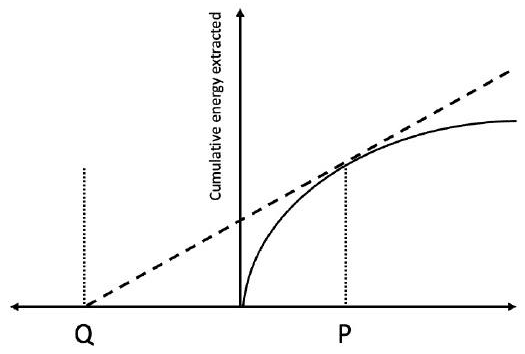
Based on this information, choose the option that correctly describes what both P and Q represent.
- 1P = Optimum cumulative energy extracted; Q = Optimum patch residence time
- 2P = Time taken to travel between patches; Q = Optimum cumulative energy extracted
- 3P = Optimum cumulative energy extracted; Q = Time taken to travel between patches
- 4P = Optimum patch residence time; Q = Time taken to travel between patches
Show answer and solution
In the marginal value theorem, a tangent drawn from the travel time (plotted to the left of the origin) to the gain curve touches it where the long-term rate of gain is highest. Q is the travel time between patches and P is the optimal time to stay in a patch. Longer travel means staying longer.
Embryos of a species display conditional specification at 16-cell stage, and gastrulation begins at a later stage. In the 16-cell embryo, the prospective fate of vegetal blastomere is endoderm, while that of animal pole blastomere is ectoderm. In a 16-cell stage, a vegetal pole blastomere was grafted to the animal pole.
Which one of the following outcomes is true for the grafted cell?
- 1It organizes the surrounding tissue to generate a secondary body axis.
- 2It completely disrupts development.
- 3It develops into endoderm.
- 4It develops into ectoderm.
Show answer and solution
In conditional specification a cell’s fate depends on its neighbours. A vegetal blastomere moved to the animal pole at the 16-cell stage takes on its new surroundings’ fate and becomes ectoderm. An autonomously specified cell would keep its endodermal fate, and an organiser-like cell would induce a second axis.
Six mutant yeast haploids (His1-6) requiring histidine supplementation for viability were fused in pair-wise combinations to form diploids. Requirement for histidine was tested for the diploids. The results are shown below where ‘+’ indicates diploid combinations yielding histidine prototrophs.
| His1 | His2 | His3 | His4 | His5 | His6 | |
|---|---|---|---|---|---|---|
| His1 | − | + | − | + | + | − |
| His2 | + | − | + | − | − | + |
| His3 | − | + | − | + | + | − |
| His4 | + | − | + | − | − | + |
| His5 | + | − | + | − | − | + |
| His6 | − | + | − | + | + | − |
How many different histidine biosynthesis genes are represented among the six mutants?
- 1One
- 2Two
- 3Three
- 4Four
Show answer and solution
Diploids are prototrophic (+) only when the two mutations are in different genes. His1, His3 and His6 fail to complement one another, and so do His2, His4 and His5, while every cross between the two groups complements. So there are two complementation groups, meaning two genes.
Synonymous mutations (solid black circle) and non-synonymous mutations (different symbols) are plotted on two hypothetical phylogenies (A and B) given below.
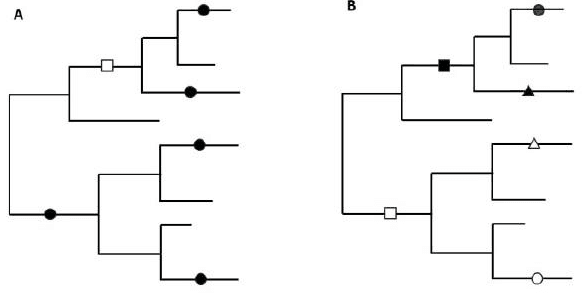
The phylogenies above may represent the following types of selection – positive, negative or neutral. Which one of the options given below gives the correct combination of the types of selection observed in phylogenies A and B?
- 1A shows negative selection, B shows positive selection.
- 2A shows positive selection, B shows negative selection.
- 3A shows neutral selection, B shows positive selection.
- 4A shows positive selection, B shows neutral selection.
Show answer and solution
In tree A almost all changes are synonymous (filled circles), with a single non-synonymous change, so changes to the protein are being weeded out: negative (purifying) selection. In tree B many different non-synonymous changes have built up along the lineages: positive selection on the protein.
Given below are the outcomes of transplantation experiments.
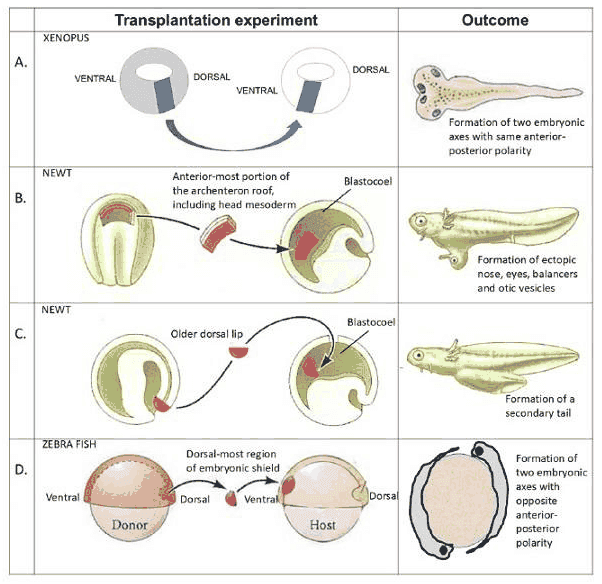
Which one of the following options correctly depicts the outcome of the transplantation experiments?
- 1A and C
- 2B and C
- 3C and D
- 4B and D
Show answer and solution
A: grafting dorsal tissue to the ventral side of a Xenopus embryo gives a second axis with the same polarity. C: an older dorsal lip induces trunk and tail, giving a secondary tail. D is wrong: a grafted zebrafish shield gives a second axis with the same, not opposite, polarity. NTA’s key gives A and C. (By Mangold’s classic result, B’s anterior archenteron roof does induce head structures, but the key does not include it.)
Changes in NTA’s final answer key
Two options accepted: Q97. Every other question has the single answer shown.
How to revise from this paper
- Attempt it in one 3-hour sittingAnswer 15 in Part A, 35 in Part B and 25 in Part C, as in the real exam, before you check any answers.
- Score it with negative markingAdd 2 or 4 marks for each correct answer and subtract 0.5 or 1 for each wrong one. That is the number to track.
- Sort your mistakes by unitUse the unit tag on each question. Two or three wrong answers in the same unit tell you where to revise first.
- Repeat with a fresh paperTake a full-length mock a week later and compare your unit-wise mistakes.
Keep going