

All 145 questions from the CSIR-NET Life Sciences December 2024 paper (Shift 2), typed out in full, with NTA’s final answer key, a worked solution for every question and every diagram.
The Joint CSIR-UGC NET December 2024 Life Sciences exam was held on 1 March 2025 in two shifts. This page covers the afternoon shift (Shift 2, 3 pm to 6 pm). Below you will find every question from Part A (General Aptitude), Part B and Part C, in the order they appeared, each tagged with its syllabus unit. Tap Show answer and solution under any question to check the official answer and see how to reach it.
Marking scheme
| Part | Questions | Answer | Marks each | Wrong answer | Max marks |
|---|---|---|---|---|---|
| A: General Aptitude | Q1–20 | 15 | 2 | −0.5 | 30 |
| B: Life Sciences | Q21–70 | 35 | 2 | −0.5 | 70 |
| C: Life Sciences | Q71–145 | 25 | 4 | −1 | 100 |
| Total | 145 | 75 | 200 |
Which units this paper tested
We tagged each of the 125 Part B and Part C questions with its CSIR-NET syllabus unit. In this paper, Evolution and Behavior, Cellular Organization and Ecological Principles carried the most questions.
Practise any unit across all 11 papers, with every question linked to a worked solution:
Jump to a question
Part A: General Aptitude (Q1–20)
20 questions; answer any 15. Each carries 2 marks, and a wrong answer costs 0.5.
(2025)2025 − (2025)2024 is NOT divisible by
- 18
- 213
- 323
- 433
Show answer and solution
20252025 − 20252024 = 20252024 × 2024. Since 2024 = 23 × 11 × 23 and 2025 = 34 × 52, the number is divisible by 8, 23 and 33 (= 3 × 11), but not by 13.
Choose the arrangement in the increasing order of size for an average human being:
A: arm, B: toe, C: head, D: heart.
- 1A, B, C, D
- 2B, D, C, A
- 3A, B, D, C
- 4B, C, D, A
Show answer and solution
For an average adult: a toe (a few cm) is smaller than the heart (about a fist), which is smaller than the head, which is smaller than an arm. Increasing order: toe, heart, head, arm (B, D, C, A).
Three positive integers a, b, c, have a sum of 15. Then the minimum value of (a−2)2 + (b−2)2 + (c−2)2 would be
- 125
- 227
- 329
- 431
Show answer and solution
Put x = a − 2 and so on: x + y + z = 15 − 6 = 9. A sum of squares with a fixed total is smallest when the parts are equal, 3 each, giving 32 × 3 = 27 (at a = b = c = 5).
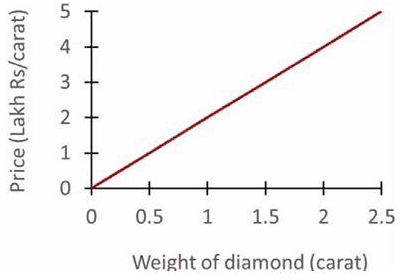
The diagram shows the rate of diamonds of different sizes. Of what size is the largest diamond that can be purchased for Rs. 4.5 lakh?
- 11.5 carat
- 22.25 carat
- 32.5 carat
- 44.5 carat
Show answer and solution
The graph gives price per carat = 2 × weight (lakh/carat), so a stone of w carats costs 2w × w = 2w2 lakh. Setting 2w2 = 4.5 gives w2 = 2.25 and w = 1.5 carat.
How quickly must Rajesh drive the remaining distance to reach the city at an average speed of 100 km/h if he travels halfway there at 50 km/h?
- 1150 km/h
- 2100 km/h
- 3125 km/h
- 4Average speed of 100 km/h is not possible in this case.
Show answer and solution
Call the distance 2d. At 100 km/h overall the whole trip may take 2d/100 = d/50 hours. But the first half at 50 km/h already takes d/50 hours, so no time is left for the second half: an average of 100 km/h is impossible.
Square of 5% is closest to
- 10.25%
- 225%
- 32.5%
- 41.25%
Show answer and solution
5% = 0.05, and 0.052 = 0.0025 = 0.25%.
Any 9 papers printed on both sides are drawn from a book. The sum of their page numbers CAN NEVER be ______.
- 1199
- 2219
- 3235
- 4256
Show answer and solution
A leaf carries pages 2k − 1 and 2k, which sum to 4k − 1, so nine leaves sum to (a multiple of 4) − 9. Every possible total is therefore 3 more than a multiple of 4. 199, 219 and 235 fit that pattern. 256, a multiple of 4, cannot occur.
The masses and weights of some objects on the Moon were plotted against the same quantities on the Earth. The two graphs would appear as
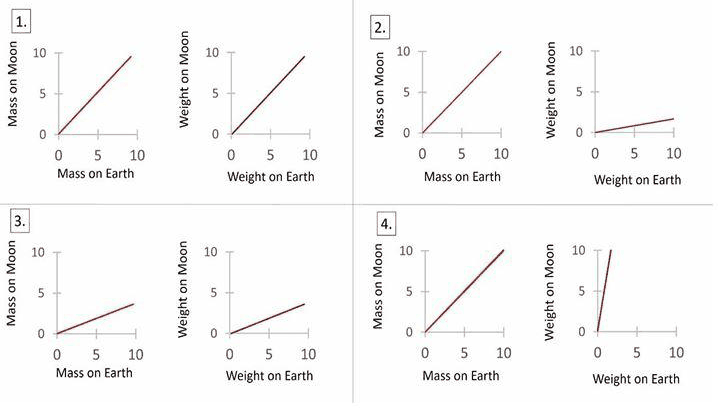
- 1Graph pair 1
- 2Graph pair 2
- 3Graph pair 3
- 4Graph pair 4
Show answer and solution
Mass is a property of the object and does not change, so mass on the Moon equals mass on Earth (slope 1). Weight is mass × g, and lunar g is about 1/6 of Earth’s, so the weight line has a slope of about 1/6. That is pair 2.
A rectangular sheet 31.4 cm × 10 cm is rolled across its length to make a cylinder and both ends of the cylinder are covered with additional circular sheets. What will be the total surface area of the covered cylinder approximately?
- 1314 cm2
- 2392.5 cm2
- 3471 cm2
- 4785 cm2
Show answer and solution
Rolling along 31.4 cm makes that the circumference, so r = 5 cm and h = 10 cm. Curved surface = 31.4 × 10 = 314 cm2, and the two end discs = 2 × π × 25 ≈ 157 cm2. Total ≈ 471 cm2.
A person covers 1/10, 1/6, and 1/5 of the total distance at speeds of 3 km/h, 5 km/h and 6 km/h, respectively. The remaining 16 km she covers at a speed of 16 km/h. How long does she take to travel the total distance?
- 11 hour
- 23 hours
- 34 hours
- 45 hours
Show answer and solution
The listed fractions add to 1/10 + 1/6 + 1/5 = 14/30, so the remaining 16/30 of the distance is 16 km and the total is 30 km. The legs are 3 km at 3 km/h, 5 km at 5, 6 km at 6 and 16 km at 16: one hour each, 4 hours in all.
To frame a portrait photo of 50 cm × 30 cm size, a 3 cm wide wooden strip is to be fixed all around the photo such that the inner periphery of the wooden strip touches the boundary of the photo. What is the total length of the wooden strip required?
- 1150 cm
- 2172 cm
- 3180 cm
- 4184 cm
Show answer and solution
Measured along the centre line of the 3 cm strip, the frame is (50 + 3) by (30 + 3) cm. Length = 2 × (53 + 33) = 172 cm.
In a square land of 200 m × 200 m size, saplings are to be planted such that the distance between the saplings as well as the distance of saplings from the boundary of the land are not less than 20 m. What is the maximum number of saplings that can be planted in the land?
- 164
- 281
- 390
- 4100
Show answer and solution
Saplings may stand anywhere from 20 m to 180 m from a side, at least 20 m apart: 20, 40, …, 180, which is 9 positions along each direction. A square grid gives 9 × 9 = 81.
The bubble plot shows the relationship of Crop yield with precipitation and temperature. The size of the bubble is proportional to temperature. Which one of the following inferences CANNOT be drawn from the given plot?

- 1Crop yield is inversely related to temperature
- 2Precipitation and temperature are inversely related
- 3Crop yield and precipitation are positively related
- 4Precipitation and temperature are positively related
Show answer and solution
The bubbles rise to the right (yield increases with precipitation) and shrink as they go (temperature falls as yield and precipitation rise). So yield is inversely related to temperature, and precipitation and temperature are inversely related. A positive precipitation–temperature relationship cannot be inferred.
In the fictional country of Vegereversia, which of the following provinces is the odd one out?
- 1PANGOTATOP
- 2SULTORRAC
- 3HIABIGOHON
- 4SINNEGABBAC
Show answer and solution
In “Vegereversia”, read each name backwards to find a vegetable. PANGOTATOP gives POTATOGNAP (potato). SULTORRAC gives CARROTLUS (carrot). SINNEGABBAC gives CABBAGENNIS (cabbage). HIABIGOHON gives NOHOGIBAIH, which contains no vegetable, so it is the odd one out.
A person orders a 12-inch circular pizza online. The restaurant calls her back and says that they ran out of 12-inch pizzas and instead offers the following choices in circular pizzas. Which of them gives the best value for her money?
- 1Six 4-inch pizzas
- 2Four 6-inch pizzas
- 3Seven 3-inch pizzas
- 4Five 5-inch pizzas
Show answer and solution
Pizza area is proportional to diameter squared. Six 4-inch: 6 × 16 = 96. Four 6-inch: 4 × 36 = 144. Seven 3-inch: 63. Five 5-inch: 125. A 12-inch pizza would be 144, so four 6-inch pizzas match it and give the most pizza.
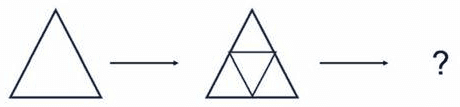
Starting with a single triangle, every iteration adds smaller triangles at each of the vertices inside the previous triangle as shown in the figure. The number of vertices in the next iteration is:
- 115
- 242
- 360
- 418
Show answer and solution
This is the Sierpinski construction. A triangle has 3 vertices. One iteration adds the 3 midpoints, making 6. The next splits each of the three corner triangles in the same way, adding 3 × 3 = 9 new midpoints, so 6 + 9 = 15.
The average of 10 distinct nonnegative integers is 14.5. The average of the maximum and the minimum of these numbers is less than 15. Which of the following is the maximum possible value of the minimum?
- 18
- 29
- 310
- 411
Show answer and solution
The ten numbers sum to 145, and min + max < 30, so max ≤ 29 − min. With min = 10, the max can be at most 19, and 10, 11, …, 19 are ten distinct numbers summing to exactly 145. With min = 11, the max is at most 18, leaving only 8 distinct values. So the largest possible minimum is 10.
On a spherical balloon of radius 10 cm, two dots are put at a distance of 25 units. If the balloon is uniformly expanded to a sphere of radius 50 cm, the distance between the two dots in the same units would be
- 1100
- 2125
- 3150
- 4175
Show answer and solution
Uniform expansion scales every length on the surface by the ratio of the radii, 50/10 = 5. 25 × 5 = 125.
How many 4-digit numbers can be generated from the digits 1, 2, 3, 4, 5, 6 and 7 such that no digit appears more than once, and ‘123’ always appear as a string?
- 18
- 24
- 36
- 412
Show answer and solution
The block “123” plus one of the four remaining digits (4, 5, 6 or 7), placed before or after the block: 4 × 2 = 8 numbers.
Waters having three different colours (Red-R, Green-G, Blue-B) and temperatures: 4°C (R), 8°C (G) & 2°C (B), are put in a jar. How would these colours appear in the jar initially? (Each option lists the layers from top to bottom.)
- 1R, G, B
- 2G, B, R
- 3B, G, R
- 4G, R, B
Show answer and solution
Water is densest at about 4 °C, so the red 4 °C water sinks to the bottom. Between the others, 2 °C water is slightly denser than 8 °C water. From the top: G (8 °C), B (2 °C), R (4 °C).
Part B: Life Sciences (Q21–70)
50 questions; answer any 35. Each carries 2 marks, and a wrong answer costs 0.5.
Which one of the following properties is NOT responsible for the self-sealing nature of ruptured biological membranes?
- 1The amphipathic character of the lipids
- 2A hydrophobic interaction between lipid molecules
- 3Hydrogen bonding between the head groups of the lipids and water
- 4Covalent interactions among lipid molecules
Show answer and solution
Bilayers reseal on their own because amphipathic lipids hide their tails from water (the hydrophobic effect) while their heads hydrogen-bond with it. Exposed edges are unfavourable, so the sheet closes up. Lipids are not covalently linked to each other, which is why the membrane is fluid and can reseal.
Haploinsufficiency in tumor suppressor genes can be caused by all of the following mechanisms EXCEPT
- 1deletion of one allele of a gene.
- 2a missense mutation leading to increased expression of one allele.
- 3nonsense mutation in one allele leading to truncated protein.
- 4epigenetic silencing of one allele.
Show answer and solution
Haploinsufficiency means one working copy is not enough, so the gene’s output falls by half. Deleting, truncating or epigenetically silencing one allele all do that. A mutation that increases expression of one allele does not reduce the gene’s output.
Which one of the following statements defines a monophyletic group?
- 1A group of organisms that share a common ancestor and all of its descendants.
- 2A group of organisms that includes species from unrelated lineages.
- 3A group of organisms that lack a common ancestor.
- 4A group of organisms that always lack apomorphic characters.
Show answer and solution
A monophyletic group (clade) is an ancestor together with all of its descendants. Groups that leave some descendants out are paraphyletic, and groups of unrelated lineages are polyphyletic.
Which one of the following bonds support the three intertwined polypeptide strands in the triple helical structure of collagen?
- 1Disulfide bonds
- 2Hydrogen bonds
- 3Co-ordinate bonds
- 4Ionic bonds
Show answer and solution
The three collagen chains are held together by interchain hydrogen bonds. The N–H of each glycine (every third residue) bonds to a C=O on a neighbouring chain, helped by water bridges to hydroxyproline. Covalent lysine-derived cross-links form later, between triple helices.
Which one of the following phenomena describes the evolution of wings in bats, birds, and insects?
- 1Homoplasy
- 2Common ancestry
- 3Pleiomorphy
- 4Symplesiomorphy
Show answer and solution
Bats, birds and insects evolved wings independently from wingless ancestors. A similarity that does not come from common ancestry is homoplasy (convergent evolution).
What is the correct order of enzyme actions during the long-patch base excision repair in humans?
- 1Glycosylase, Lyase, AP endonuclease 1, DNA Polβ, DNA Ligase 3
- 2Glycosylase, AP endonuclease 1, DNA Polδε, Flap endonuclease 1, DNA Ligase 1
- 3Glycosylase, AP endonuclease 1, DNA Polβ, Flap endonuclease 1, DNA Ligase 1
- 4Glycosylase, AP endonuclease 1, DNA Polδε, Flap endonuclease 1, DNA Ligase 3
Show answer and solution
Long-patch BER: a glycosylase removes the base, APE1 nicks the abasic site, Pol δ/ε (with PCNA) displaces a 2–10-nucleotide flap, FEN1 cuts the flap off, and ligase I seals the nick. Short-patch BER uses Pol β and ligase III.
Which of the following is true for a monocot root?
- 1Vascular bundles often polyarch; Pith large and well-developed
- 2Vascular bundles always hexarch; Pith large and well-developed
- 3Vascular bundles always diarch; Pith small or absent
- 4Vascular bundles often polyarch; Pith absent
Show answer and solution
Monocot roots usually have many xylem and phloem strands (polyarch), arranged around a large, well-developed pith. Dicot roots have few strands (diarch to hexarch) and little or no pith.
A researcher captured 60 bivalves from a habitat on day 1 and tagged all of them. On day 2, she caught 40 bivalves out of which 20 were already tagged. She then estimated the population size of bivalves in the lake using this information. Which one of the options represents the percentage of the bivalve population that were marked on day 1?
- 110
- 250
- 360
- 420
Show answer and solution
Lincoln–Petersen: N = 60 × 40/20 = 120. The 60 tagged animals are 60/120 = 50% of the population, which matches the 20 out of 40 recaptured animals that carried tags.
Which one of the following correctly describes how a mutagen induces a specific type of base change in DNA?
- 1UV radiation typically creates thymine dimers causing G-C to A-T transition.
- 2Nitrous acid deaminates adenine, leading to an A-T to G-C transition.
- 3Ethidium bromide intercalates into DNA, causing specific base substitutions like A-T to C-G transversions.
- 4EMS is a base analogue, causing G-C to A-T transitions.
Show answer and solution
Nitrous acid deaminates adenine to hypoxanthine, which pairs with cytosine. After two rounds of replication an A–T pair has become G–C. EMS is an alkylating agent, not a base analogue. Ethidium causes frameshifts. UV mainly causes C→T changes at pyrimidine dimers.
Select the correct set of 8-mer primer pair to PCR amplify a DNA fragment containing the region shown in upper case letters below:
5′ – gagatcaggacttaGATTACAGATTACAGATTACAGATTACAggccaagtc – 3′
- 15′ – AGGACTTA – 3′ and 5′ – GGCCAAGT – 3′
- 25′ – TAAGTCCT – 3′ and 5′ – ACTTGGCC – 3′
- 35′ – AGGACTTA – 3′ and 5′ – ACTTGGCC – 3′
- 45′ – AGGACTTA – 3′ and 5′ – AGATTACA – 3′
Show answer and solution
The forward primer copies the top strand just upstream of the target: AGGACTTA. The reverse primer is the reverse complement of the top-strand sequence just downstream (ggccaagt): ACTTGGCC. Both must point inwards across the GATTACA repeats.
Which one of the following options suggests indirect selection in a population?
- 1Survival rate
- 2Reproductive rate
- 3Selection via kin associations
- 4Selection via deleterious mutations
Show answer and solution
Indirect selection acts on an individual’s genes through the survival and reproduction of its relatives (kin selection), the indirect component of inclusive fitness. Survival and reproductive rates measure direct fitness.
Which one of the following statements regarding the cadherin superfamily proteins is correct?
- 1Non-classical cadherins Fat and Flamingo, regulate epithelial growth and cell polarity, respectively.
- 2In an early mouse embryo, anti-N cadherin antibody prevents compaction.
- 3P-cadherins lack transmembrane domain and are anchored to the membrane by GPI anchors.
- 4Loss of the non-classical cadherin desmoglein causes skin blistering due to increased keratinocyte cell-to-cell adhesion.
Show answer and solution
The non-classical cadherins Fat (growth control, Hippo pathway) and Flamingo/CELSR (planar cell polarity) are correctly described. Compaction is blocked by anti-E-cadherin, not N-cadherin. It is T-cadherin, not P-cadherin, that is GPI-anchored. Desmoglein loss reduces adhesion, which is what causes blistering.
Which one of the following is NOT called secondary bile acid?
- 1Deoxycholic acid
- 2Lithocholic acid
- 3Chenodeoxycholic acid
- 4Ursodeoxycholic acid
Show answer and solution
The liver makes the primary bile acids, cholic and chenodeoxycholic acid. Gut bacteria convert them to the secondary bile acids, deoxycholic, lithocholic and ursodeoxycholic acid.
Match the following:
| Column X: Eukaryotic DNA polymerase | Column Y: Function |
|---|---|
| A. δ | i. Base excision repair |
| B. ε | ii. Thymine dimer bypass |
| C. β | iii. Lagging strand |
| D. η | iv. Leading strand |
Which one of the following options represents all correct matches between Column X and Column Y?
- 1A (iii), B (iv), C (i), D (ii)
- 2A (iv), B (iii), C (i), D (ii)
- 3A (iv), B (iii), C (ii), D (i)
- 4A (iii), B (iv), C (ii), D (i)
Show answer and solution
Pol δ synthesises the lagging strand (A–iii) and Pol ε the leading strand (B–iv). Pol β fills single-nucleotide gaps in base excision repair (C–i). Pol η copies past thymine dimers accurately (D–ii); its loss causes xeroderma pigmentosum variant.
Which one of the following statements best describes the functions of the SNARE protein complex in vesicular transport?
- 1It catalyzes the hydrolysis of GTP to GDP during vesicle movement.
- 2It provides structural support to the microtubule network.
- 3It facilitates the fusion of vesicles with target membranes.
- 4It transports cargo along actin filaments via motor proteins.
Show answer and solution
v-SNAREs on the vesicle and t-SNAREs on the target membrane zip into a four-helix bundle that pulls the two membranes together and drives fusion. GTP hydrolysis belongs to Rab and Arf proteins, and transport along filaments to motor proteins.
The presence and abundance of a species in a local community is dependent on multiple processes. Which one of these processes is UNLIKELY to depend on intra- or inter-specific interactions?
- 1Dispersal
- 2Niche differentiation
- 3Demographic stochasticity
- 4Resource competition
Show answer and solution
Demographic stochasticity is chance variation in births and deaths among individuals, which matters most in small populations whatever the neighbours are doing. Dispersal, niche differentiation and resource competition are all shaped by interactions within and between species.
Skeletal muscle cells need to convert pyruvate to lactate while sustaining anaerobic respiration to
- 1facilitate TCA cycle.
- 2maintain the acidic extracellular environment.
- 3recycle NADH.
- 4generate more ATPs from the NADH.
Show answer and solution
Without oxygen, glycolysis can continue only if the NADH made at glyceraldehyde-3-phosphate dehydrogenase is turned back into NAD+. Lactate dehydrogenase does this by reducing pyruvate to lactate, recycling NADH so that glycolysis keeps making ATP.
Which one of the following features distinguishes Echinoderms from Cnidarians?
- 1The absence of sexual reproduction.
- 2The presence of radial symmetry.
- 3The total number of germ layers present.
- 4The presence of a network of water-filled tubes for movement.
Show answer and solution
Echinoderms are triploblastic coelomates while cnidarians are diploblastic, and only echinoderms have a water vascular system with tube feet. Both are features that separate them, and NTA accepted options 3 and 4. Both groups reproduce sexually, and both can be radially symmetrical.
Which one of the following statements is INCORRECT about lectotype designation, following ICBN rules?
- 1A syntype is preferred over an isotype.
- 2An isotype must be chosen over a syntype.
- 3If syntype or isosyntype and isotype are not available, a paratype can be chosen.
- 4In the absence of any type material, a lectotype can be chosen among the uncited specimens of any original material.
Show answer and solution
Under the ICN, when choosing a lectotype an isotype must be preferred to a syntype where one exists. If neither isotypes nor syntypes survive, a paratype may be chosen, and if no type material is left, any uncited original material. Statement 1 reverses the order of preference.
Column X lists Pattern Recognition Receptors (PRRs) and Column Y lists the ligands that bind to the PRRs.
| Column X | Column Y |
|---|---|
| A. TLR5 | i. Profilin |
| B. TLR3 | ii. Unmethylated CpG DNA |
| C. TLR12 | iii. Flagellin |
| D. TLR9 | iv. dsRNA |
| E. TLR4 | v. ssRNA |
| F. TLR7 | vi. LPS |
Which one of the following options represents all correct matches between Column X and Column Y?
- 1A-iii, B-v, C-i
- 2A-iii, D-ii, F-v
- 3C-i, D-ii, F-iv
- 4B-iv, E-vi, F-i
Show answer and solution
TLR5 recognises flagellin (A–iii), TLR9 unmethylated CpG DNA (D–ii) and TLR7 single-stranded RNA (F–v). The other pairings are TLR3 with dsRNA, TLR4 with LPS and TLR12 (mouse) with Toxoplasma profilin. Only option 2 lists three correct matches.
Which experiment would be most effective in assessing the synergistic role of mycorrhizal fungi and plants in phytoremediation?
- 1Comparing pollutant uptake in plants with and without fungal inoculation under identical soil conditions.
- 2Analysing fungal growth rates in polluted versus unpolluted soil.
- 3Measuring the root-to-shoot ratio of plants grown in polluted soil with fungal inoculation.
- 4Assessing photosynthetic rates in inoculated versus uninoculated plants.
Show answer and solution
To show that the fungus increases the plant’s clean-up ability, compare pollutant uptake by plants with and without mycorrhizal inoculation in the same contaminated soil. Fungal growth alone, root:shoot ratio or photosynthesis say nothing about pollutant removal.
Which of the following enzymes is used for conversion of blood glucose to gluconolactone in commercially available blood glucometer?
- 1Glucose oxidase
- 2Glucose reductase
- 3Glucose dehydrogenase
- 4Gluconolactonase
Show answer and solution
Most glucometer strips use glucose oxidase (with FAD) to oxidise glucose to gluconolactone. Electrons pass to the electrode through a mediator or H2O2, giving a current proportional to the glucose level.
In life history theory, the concept of ‘cost of reproduction’ refers to:
- 1reduced future reproductive output or survival due to current reproduction.
- 2reduced current reproductive output to conserve energy for future reproduction.
- 3trade-offs between foraging rates and reproduction.
- 4trade-offs between mating and territorial defense.
Show answer and solution
The cost of reproduction is the loss of future survival or reproduction caused by spending resources on reproducing now. Experiments that enlarge broods or clutches show it: parents given extra young survive less well or breed less the next season.
Sheep RBCs (SRBCs) were added in wells 1-10 of a micro-titre plate as shown in the figure below. Next, serum from a mouse that had been immunized with SRBCs was diluted 1/50 in a tube and then added in serial two-fold dilutions from wells 1-9.
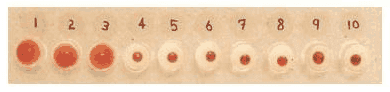
Which of the following statements is correct about titre of anti-SRBC antibodies in the serum sample?
- 1The titre is 1/400.
- 2The titre is 1/6.
- 3The titre is 1/800.
- 4The titre is 1/8.
Show answer and solution
Agglutinated red cells form a spread mat, while unagglutinated cells settle into a tight button. Wells 1–3 show mats. The serum was 1/50 and then diluted two-fold, so well 1 is 1/100, well 2 1/200 and well 3 1/400. The titre is the highest dilution that still agglutinates: 1/400.
Which one of the following statements is INCORRECT regarding pattern formation during embryogenesis in Arabidopsis?
- 1The zygote is unpolarized with respect to its intracellular composition.
- 2The two daughter cells that arise from the first mitotic division of zygote has distinct developmental fates.
- 3The cells derived from the basal quartet of the apical cell give rise to the apical regions of the root meristem.
- 4The hypophysis derived from the uppermost cell of the suspensor gives rise to the quiescent center of the root apical meristem.
Show answer and solution
The Arabidopsis zygote is clearly polarised before it divides: it elongates, with a large vacuole at the basal end and the nucleus towards the apical end. Its asymmetric first division produces an apical cell (the embryo) and a basal cell (the suspensor) with different fates. So statement 1 is the incorrect one.
During the most common form of protein glycosylation in the ER, a preformed precursor oligosaccharide which is transferred as a complete unit to the asparagine residue in a protein is:
- 13 N-acetylglucosamines, 10 mannoses and 4 glucoses
- 22 N-acetylglucosamines, 9 mannoses and 3 glucoses
- 33 N-acetylglucosamines, 9 mannoses and 3 glucoses
- 42 N-acetylglucosamines, 8 mannoses and 3 glucoses
Show answer and solution
N-linked glycosylation transfers Glc3Man9GlcNAc2 (3 glucoses, 9 mannoses, 2 GlcNAc), built on dolichol pyrophosphate, as a single unit onto asparagine in an Asn–X–Ser/Thr sequence.
Which one of the following statements is true about cellular senescence?
- 1Insulin signaling activates FoxO, and FoxO promotes senescence.
- 2Insulin signaling inhibits FoxO, and FoxO protects cells from senescence.
- 3Insulin signaling activates FoxO, and FoxO protects cells from senescence.
- 4Insulin signaling inhibits FoxO, and FoxO promotes senescence.
Show answer and solution
Insulin/IGF signalling activates Akt, which phosphorylates FoxO and keeps it out of the nucleus, inhibiting it. When active, FoxO switches on antioxidant, DNA-repair and quiescence genes that protect against senescence, which is why reduced insulin signalling extends lifespan.
A grassland has five sympatric species of grasshoppers. Males sing species-specific songs to attract conspecific females. The song represents which mode(s) of reproductive isolation?
- 1postmating and prezygotic
- 2postzygotic
- 3premating and postzygotic
- 4premating
Show answer and solution
A species-specific courtship song stops individuals of different species from mating at all. That is a premating (behavioural) barrier, one kind of prezygotic isolation.
Which one of the following statements about DNA packaging in chromosomes is INCORRECT?
- 1Condensin I creates loops of nucleosomal chromatin for packaging in mitosis.
- 2Histone H1 is required for higher order packaging of mammalian chromosomes.
- 3Histones form hydrogen bonds with the sugar-phosphate backbone of DNA.
- 4Histone modification is not required for mitotic chromosome condensation; it is mainly required for epigenetic control of gene repression in interphase.
Show answer and solution
Mitotic condensation does depend on histone changes, such as H3 Ser10 phosphorylation by Aurora B and H4K16 deacetylation, alongside condensins. So statement 4 is the incorrect one. Condensins making loops, H1 helping higher-order packing, and histone contacts with the DNA backbone are all correct.
Which one of the following is NOT a true effect of aldosterone on the principal cells of distal tubule and the collecting duct to increase the reabsorption of Na+?
- 1Stimulation of CAP1 levels
- 2Decrease in the serum and glucocorticoid-regulated kinase 1 (Sgk1) levels
- 3Increase in the expression of ENaC in the apical membrane
- 4Increase in the amount of Na+, K+-ATPase in the basolateral membrane
Show answer and solution
Aldosterone increases Sgk1, which blocks Nedd4-2 and so keeps more ENaC in the membrane. It also induces CAP1 (prostasin), which activates ENaC, and it increases apical ENaC and basolateral Na+/K+-ATPase. A decrease in Sgk1 is not one of its effects.
Which one of the following does NOT increase airways resistance in lungs?
- 1Norepinephrine
- 2Thromboxane A2
- 3Histamine
- 4Leukotriene B4
Show answer and solution
Thromboxane A2, histamine and leukotrienes constrict the bronchi and raise airway resistance. Noradrenaline, through β2-adrenergic receptors on airway smooth muscle, relaxes it and widens the airways, so it does not increase resistance.
For expression of a gene of interest (Goi) and a green fluorescent protein (GFP) in mammalian cells, Goi and GFP must be expressed in a single mRNA, but translated independently. Which one of the following would be the structure of the expression construct?
(Pro – promoter; Enh – enhancer; IRES – internal ribosome entry site; pA – poly adenylation signal sequence)
- 1Pro – Enh – Goi – IRES – GFP – pA
- 2Enh – Pro – Goi – GFP – IRES – pA
- 3Pro – Enh – Goi – GFP – IRES – pA
- 4Enh – Pro – Goi – IRES – GFP – pA
Show answer and solution
In the standard layout, the enhancer and promoter drive one transcript containing the first gene, then an IRES that lets ribosomes start again internally on the second gene (GFP), followed by the poly(A) signal. One mRNA is made and two proteins are translated independently. That is option 4.
Which one of the following is NOT required for isotype switching from IgM to IgE?
- 1VDJ recombination
- 2Double stranded break repair
- 3Cell division
- 4T cell cytokines
Show answer and solution
Switching from IgM to IgE needs T-cell help (IL-4 and CD40L), cell division, and AID-induced double-strand breaks in the switch regions, repaired by NHEJ. V(D)J recombination had already happened during B-cell development, and switching keeps the same VDJ.
Acetohydroxy acid synthase (AHAS), an enzyme involved in branched-chain amino acid biosynthesis, is inhibited by all the following classes of herbicides, EXCEPT
- 1Imidazolinones
- 2L-phosphinothricin
- 3Sulfonylureas
- 4Triazolopyrimidines
Show answer and solution
AHAS (acetolactate synthase) is the target of imidazolinones, sulfonylureas and triazolopyrimidines. L-phosphinothricin (glufosinate) inhibits glutamine synthetase instead.
A desert annual plant with long-duration seed dormancy germinates only after heavy rainfall. What life history trait does this illustrate?
- 1Bet-hedging strategy
- 2K strategy
- 3Frequency-dependent reproduction
- 4Density-dependent reproduction
Show answer and solution
Long seed dormancy, with germination only after heavy rain, spreads the risk of failure across years. Only some seeds germinate in any one year, so no single bad season wipes out a generation. That is bet-hedging.
Ten bacterial cells are inoculated into 10 ml of Luria broth and grown for 10 hours with shaking at 37°C. What will be the approximate number of bacteria in the flask at the end of 10-hour incubation? (Note: the doubling time of this bacterium in Luria broth is approximately 20 min).
- 1106
- 2108
- 3109
- 41010
Show answer and solution
10 hours at 20 minutes per doubling is 30 doublings: 10 × 230 ≈ 10 × 1.07 × 109 ≈ 1010 cells. That is about the most a 10 mL LB culture can hold at saturation.
Which one of the following statements is INCORRECT regarding seasonality and sex in aphids?
- 1An egg hatched in the spring gives rise to several generations of parthenogenetically reproducing females.
- 2During autumn, a particular type of female is produced whose eggs can give rise to only asexual males.
- 3After winter, when eggs hatch, each one gives rise to an asexual female.
- 4The juvenile hormone controls the parthenogenetic/sexual switch and also inhibits the formation of wings.
Show answer and solution
In autumn, aphids produce sexual females and males, which mate and lay overwintering eggs. Statement 2, that females lay eggs producing only asexual males, is the incorrect one. The other statements are true: spring stem mothers start parthenogenetic generations, winter eggs hatch into asexual females, and juvenile hormone controls the switch and wing formation.
In a population, the frequency of allele ‘a’ is 0.2 and that of allele ‘b’ is 0.1. Consider that there are two alleles for each of the genes. What would be the expected percentage of population with genotype AaBb, considering that the population is under Hardy-Weinberg equilibrium?
- 11.44 %
- 22.88 %
- 350 %
- 457.6 %
Show answer and solution
NTA dropped this question, so everyone received its marks. For two independent genes at Hardy–Weinberg, P(AaBb) = 2(0.8)(0.2) × 2(0.9)(0.1) = 0.32 × 0.18 = 5.76%, which is not among the options (57.6% is ten times too large).
Which one of the following plants has a bisporic type of embryo sac development?
- 1Allium
- 2Oenothera
- 3Plumbago
- 4Polygonum
Show answer and solution
In bisporic (Allium-type) development, the megaspore mother cell’s first meiotic division gives a dyad, one cell of which degenerates. The surviving cell, with two meiotic nuclei, forms the eight-nucleate embryo sac. Polygonum and Oenothera are monosporic, and Plumbago tetrasporic.
Which one of the following plant pathogens has the most prolonged symptomless infection phase?
- 1Phytophthora infestans
- 2Magnaporthe oryzae
- 3Botrytis cinerea
- 4Mycosphaerella fijiensis
Show answer and solution
Mycosphaerella fijiensis, cause of black Sigatoka of banana, is a hemibiotroph with a very long latent phase: weeks of symptomless growth in the leaf before streaks appear. Botrytis kills tissue quickly, and the biotrophic phases of Phytophthora and Magnaporthe last only a few days.
Which one of the following translation systems is inhibited by cycloheximide?
- 170S ribosome-associated bacterial translation system
- 280S ribosome-associated eukaryotic cytosolic translation system
- 374S ribosome-associated mitochondrial translation system
- 470S ribosome-associated chloroplast translation system
Show answer and solution
Cycloheximide blocks translocation on the 60S subunit of 80S cytosolic ribosomes. Bacterial, mitochondrial and chloroplast ribosomes are resistant, and are inhibited by chloramphenicol instead.
Which one of the following statements is correct?
- 1The ALS selection marker gene used for development and selection of transgenic plants confers resistance to the antibiotic, ampicillin.
- 2A T0 transgenic plant containing two tightly linked copies of a transgene expression cassette would show segregation of the transgenic phenotype in a 15:1 ratio in the T1 generation obtained by self-pollination.
- 3Non-conditional, negative selection marker genes cannot be expressed under a constitutive promoter for selection of transgenic plants.
- 4Transgenic plants containing multiple copies of the T-DNA are preferred for field studies as they would always show increased expression levels of the transgene across multiple generations.
Show answer and solution
A negative selection gene that is always on (non-conditional) would kill every transformed cell, so it cannot be driven by a constitutive promoter (statement 3 true). ALS markers confer herbicide resistance, not ampicillin resistance. Two tightly linked copies segregate like one locus, giving 3:1, not 15:1. Multi-copy lines are often silenced.
Which one of the following statements is correct?
- 1A population of a diploid species can possess only two allelic forms of a gene.
- 2In codominance, the phenotype of the heterozygote lies in the range between the phenotypes of individuals that are homozygous for either allele involved.
- 3Penetrance is the frequency with which a genotype manifests itself in individuals in a given population.
- 4Expressivity is the type or degree of phenotypic manifestation of a penetrant allele or genotype in a particular individual and is not influenced by the environment.
Show answer and solution
Penetrance is the proportion of individuals with a genotype who actually show the expected phenotype (statement 3). A population can carry many alleles of a gene. In codominance the heterozygote shows both phenotypes rather than something in between. Expressivity can be affected by the environment.
Which of the following phytohormone signaling pathways are evolutionarily related to bacterial two-component regulatory systems?
- 1Cytokinin and ethylene
- 2Brassinosteroid and auxin
- 3Auxin and cytokinin
- 4Brassinosteroid and strigolactone
Show answer and solution
Cytokinin receptors (AHK2/3/4) are histidine kinases that start a His–Asp phosphorelay through AHPs to ARRs. The ethylene receptors (ETR1 and others) also descend from bacterial histidine kinases. Both are therefore derived from two-component systems.
The pKa of an amino acid side chain was measured in aqueous solution. Which one of the following is the correct arrangement of the amino acids in the decreasing order of their side chain pKa?
- 1Serine > Lysine > Histidine > Aspartate
- 2Lysine > Histidine > Aspartate > Serine
- 3Aspartate > Histidine > Lysine > Serine
- 4Serine > Histidine > Lysine > Aspartate
Show answer and solution
Approximate side-chain pKa values: serine about 13, lysine about 10.5, histidine about 6.0 and aspartate about 3.9. Decreasing order: Ser > Lys > His > Asp.
Which one of the following statements best illustrates a dominant negative mutation?
- 1A mutation in a growth factor receptor gene leads to an overactive receptor that signals constantly, even in the absence of a signal.
- 2A mutation in an enzyme-coding gene decreases its activity, but enough enzyme activity remains in heterozygotes to maintain normal metabolic function.
- 3A mutation in a transcription factor gene reduces its ability to bind DNA, but there is no effect on gene expression unless both alleles are mutated.
- 4A mutation in a structural protein gene produces an altered protein that can interact with its wild type counterpart and disrupt its function.
Show answer and solution
A dominant-negative protein still interacts with the normal one but spoils its function, for example by joining a multimer and inactivating it. A single copy is enough to disable most of the activity. Option 1 is a gain of function, and options 2 and 3 are recessive loss of function.
In a developing Drosophila embryo, which one of the following is the correct order of Hox gene expression from the anterior-to-posterior axis?
- 1Antennapedia, Ultrabithorax, Abdominal A
- 2Abdominal A, Ultrabithorax, Antennapedia
- 3Antennapedia, Abdominal A, Ultrabithorax
- 4Ultrabithorax, Antennapedia, Abdominal A
Show answer and solution
Drosophila Hox genes are expressed from anterior to posterior in the same order as they lie on the chromosome. Antp is expressed in the thorax, Ubx in T3 and A1, and abd-A in the middle abdominal segments: Antp, Ubx, abd-A.
Which one of the following is NOT a vitamin K-dependent blood clotting factor?
- 1Factor II
- 2Factor V
- 3Factor IX
- 4Factor X
Show answer and solution
Vitamin K is needed to make Ca2+-binding Gla residues on factors II, VII, IX and X (and proteins C and S). Factor V is a cofactor without a Gla domain, so it does not depend on vitamin K.
Which one of the following statements represents correct sequence of events during electron transport chain from P680 to P700 in a light reaction of photosynthesis in a typical plant?
- 1Plastocyanin – Plastoquinone A – Plastoquinone B – Cytochrome b6f complex – Pheophytin
- 2Plastocyanin – Cytochrome b6f complex – Plastoquinone A – Plastoquinone B – Pheophytin
- 3Pheophytin – Plastoquinone A – Plastoquinone B – Cytochrome b6f complex – Plastocyanin
- 4Pheophytin – Cytochrome b6f complex – Plastoquinone A – Plastoquinone B – Plastocyanin
Show answer and solution
From P680, electrons go to pheophytin, then the plastoquinones QA and QB, then the cytochrome b6f complex, then plastocyanin, which reduces P700+.
In the context of gene expression, what is the primary function of the mediator complex in eukaryotes?
- 1To modify histones to promote transcription
- 2To facilitate the interaction between transcription factors and RNA polymerase II
- 3To promote helicase activity to unwind DNA during transcription initiation
- 4To degrade mRNA after transcription
Show answer and solution
Mediator is a large co-activator complex that bridges gene-specific transcription factors (activators bound at enhancers) and RNA polymerase II at the promoter, passing regulatory signals to the polymerase and helping to assemble the pre-initiation complex.
Part C: Life Sciences, analytical (Q71–145)
75 questions; answer any 25. Each carries 4 marks, and a wrong answer costs 1.
The figure below depicts the allosteric regulation in the biosynthesis of three aromatic amino acids- Phe, Tyr and Trp, acting at four major steps catalyzed by enzymes, CM, AS, ADT and ADH. The feedback regulation and relaxation of enzyme activities by the end-product amino acids are marked.
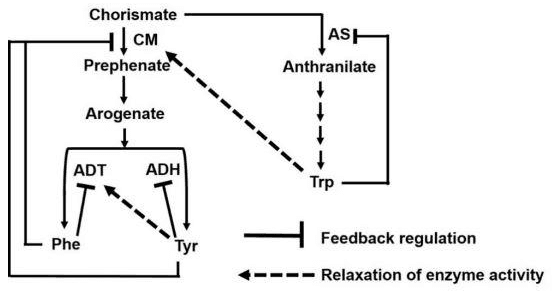
Following assumptions are made regarding the pool of aromatic amino acids in the feedback-insensitive mutants of these allosteric enzymes.
- A. The feedback-insensitive mutant of CM will show higher pool of Phe and Tyr.
- B. The feedback-insensitive mutant of AS will increase only Trp pool.
- C. The feedback-insensitive mutant of AS will show higher pool of Trp, Phe and Tyr.
- D. In feedback-insensitive mutant of ADH, only Tyr pool is decreased.
- E. In feedback-insensitive mutant of ADH, both Tyr and Phe pools are increased transiently.
Which one of the following options represents a combination of all correct assumptions?
- 1A, B and D
- 2A, C and E
- 3B, C and E
- 4C, D and E
Show answer and solution
A feedback-blind CM keeps making prephenate, so Phe and Tyr rise (A). A feedback-blind AS makes more Trp, and Trp also relaxes CM, so Trp, Phe and Tyr all rise (C, so B is false). A feedback-blind ADH makes more Tyr, which relaxes ADT, so Tyr and Phe rise for a time (E, so D is false). A, C and E.
The graph below shows the plot of 1/v vs 1/[S] for an enzymatic reaction, with the solid and dashed lines representing the reactions without and with an inhibitor, respectively. The concentration of the inhibitor is 1 μM.
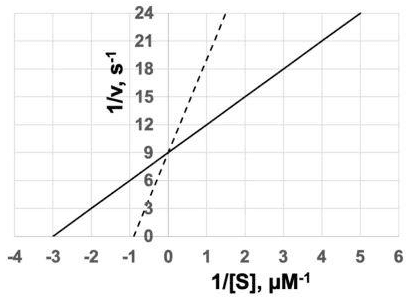
Which one of the following will be the KI of the inhibitor?
- 10.33
- 21.0
- 30.50
- 42.0
Show answer and solution
Both lines meet the 1/v axis at the same point, so Vmax is unchanged: competitive inhibition. From the x-intercepts, Km = 1/3 µM without inhibitor and 1 µM with it, so α = 3 = 1 + [I]/KI. With [I] = 1 µM, KI = 0.5 µM.
A region of a mouse chromosome was subjected to micrococcal nuclease hypersensitivity analysis over stages of development. In early stages, the region had regularly spaced nucleosomes. In later stages, the nucleosomes were irregularly spaced with several nucleosome free regions detected.
Based on the above observations, which one of the following is the best possible inference?
- 1The chromatin region is a facultative heterochromatin.
- 2The region is highly expressed in early stages.
- 3Nucleosomes are not made efficiently in the late developmental stages.
- 4The nucleosomal arrangements cannot be used to infer potential expression states.
Show answer and solution
Regularly spaced nucleosomes early on suggest packed, silent chromatin. Later the region opens up, with nucleosome-free regions typical of active promoters and enhancers. A region that is silent at one developmental stage and opened at another is facultative heterochromatin.
Dorsal-ventral patterning in the oocyte of Drosophila depends on the expression of Gurken. The following events occur during generation of dorsal-ventral polarity.
- A. The oocyte nucleus travels to the anterior dorsal side of the oocyte where it localizes gurken mRNA.
- B. Gurken protein reaches only those follicle cells closest to the oocyte nucleus.
- C. The protein product forms an anterior-posterior gradient along dorsal surface of the oocyte.
What would happen if maternal deficiency of gurken occurs?
- 1Dorsal-ventral polarity occurs in the follicle cell layer surrounding the growing oocytes.
- 2Dorsalized follicle cells initiate the formation of dorsal-ventral axis of the embryo.
- 3Absence of gurken leads to repression of the pipe protein in ventral cells.
- 4Ventralization of the embryo would occur.
Show answer and solution
Gurken from the oocyte signals through EGFR to the nearby follicle cells, making them dorsal and repressing pipe there. Without Gurken, all follicle cells take a ventral fate and express pipe, so Dorsal enters every nucleus and the embryo is ventralised.
ΔG0 of a reaction shows the following temperature dependence.
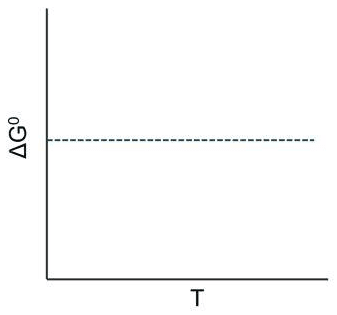
What is the expected dependence of Keq of the reaction on the temperature, where C is a temperature-independent constant?
- 1Keq = C
- 2Keq = C × e1/T
- 3Keq = C × e−T
- 4Keq = − RT ln(C)
Show answer and solution
The plot shows ΔG° constant with temperature. Since Keq = e−ΔG°/RT, ln Keq varies as 1/T: Keq depends exponentially on 1/T. NTA’s key gives this as Keq = C × e1/T.
The circular dichroism spectra for near-UV and far-UV regions of a polypeptide chain are given below.
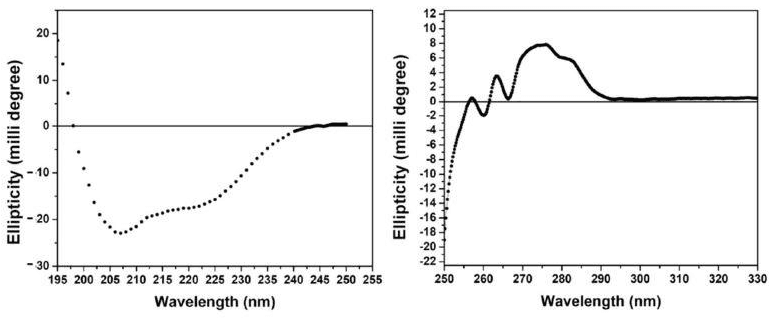
Which one of the following options represents a correct inference about the polypeptide fold based on the above data?
- 1It contains only β sheets.
- 2It has to be an alternate α/β fold.
- 3It has to be a mixed α+β fold.
- 4It belongs to either alternate α/β or mixed α+β fold.
Show answer and solution
The far-UV spectrum has minima near 208 and 222 nm, the signature of α-helix, but the band shape suggests β-structure too. The near-UV signal (250–300 nm) shows a well-packed tertiary structure. CD cannot tell how helices and strands are arranged, so the protein could be either α/β or α+β.
Sturtevant introduced the concept of recombination frequency-based genetic maps. Since genetic distances between genes may be underestimated due to the occurrence of double crossovers, other mapping functions were developed to provide more accurate estimates. Haldane’s mapping function assumes no interference between crossovers, while Kosambi’s mapping function accounts for interference. The following graph presents the relationship between recombination frequency and map distance (cM) as proposed by Sturtevant and after corrections using either Haldane’s or Kosambi’s mapping functions.
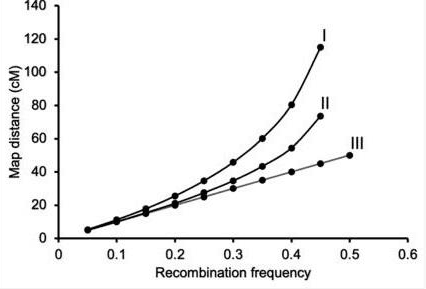
The following statements were made about genetic maps.
- A. Line I in the above plot represents relationship between recombination frequency and map distance based on Kosambi function.
- B. The chance of underestimation of map distance increases with increase in recombination frequency.
- C. Genetic mapping proposed by Sturtevant assumes complete interference.
Which one of the following options correctly identifies each statement as True (T) or False (F) from A to C, respectively?
- 1T, T, T
- 2T, T, F
- 3T, F, T
- 4F, T, T
Show answer and solution
Map distance in cM rises above the observed recombination frequency because double crossovers are missed. Line III is Sturtevant’s linear map (no correction, as if interference were complete, so C is true). Line I, the largest correction, is Haldane (no interference), and Line II is Kosambi, so A is false. The underestimate grows with recombination frequency (B true). F, T, T.
A putative mitochondrial signal peptide was attached to the N-terminus of the DHFR protein and expressed in mammalian cells. Mitochondria were isolated, and a fraction was osmotically shocked briefly. Both osmotically shocked and untreated pools of mitochondria were treated with protease. It was observed that the DHFR was intact in both cases.
Which of the following statements best describes the function of the signal peptide?
- 1It targets DHFR to the mitochondrial outer membrane, facing the cytosol.
- 2It targets DHFR to the mitochondrial inner membrane, facing the intermembrane space.
- 3It targets DHFR to the mitochondrial outer membrane, facing the intermembrane space.
- 4It targets DHFR to the mitochondrial matrix.
Show answer and solution
If DHFR were on the outer surface, protease would cut it in intact mitochondria. If it were in the intermembrane space, it would be cut once the outer membrane was broken by osmotic shock. It survived both treatments, so it must be behind the inner membrane, in the matrix. That is the typical result for a matrix-targeting presequence.
Breast cancer stem cells may be identified by analyzing the CD24/CD44 phenotype of a breast tumor. CD24/CD44 stained cells were analyzed by flow cytometry and the analysis is shown below.

Further analyses of the sorted cells from different quadrants (Q1 to Q4) by immunoblotting revealed the following results. The dotted lines represent lanes with negligible signal.
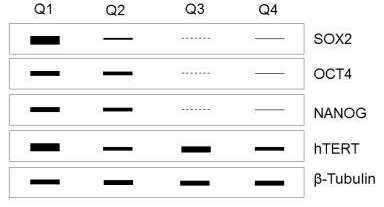
Based on the above results, which phenotype is associated with the maximum number of breast cancer stem cells?
- 1CD24−/CD44−
- 2CD24+/CD44+
- 3CD24−/CD44+
- 4CD24+/CD44−
Show answer and solution
The stemness factors SOX2, OCT4 and NANOG are strongest in cells sorted from Q1, which is CD44 high and CD24 low or negative, the classic breast cancer stem cell phenotype (Al-Hajj and colleagues, 2003). Q3 (CD24−/CD44−) has almost none.
Two closely related individuals, suffering from a congenital disease, have several children. A genetic counselor constructs the following pedigree of the family and concluded that this disease is caused by mutations in at least two genes.

Further, based on this information, the following statements were made:
- A. At least one of the children will not carry any mutations linked to this condition.
- B. The mutations causing this disease are recessive.
- C. At least one of the mutant genes is on the Y chromosome.
- D. Simultaneous heterozygous mutations in the involved genes can cause the disease.
Which one of the following options is the combination of all correct statements?
- 1A and B
- 2B and C
- 3A and D
- 4A and C
Show answer and solution
Two affected parents have several unaffected children, so the disease cannot be recessive at a single gene. It behaves as dominant, with each parent carrying a mutation in a different gene. Children who inherit neither mutation are unaffected and carry nothing (A true), and a single heterozygous mutation is enough to cause disease (D true). Affected daughters rule out a Y-linked cause.
Given below are leaf lengths (in cm) measured from a sample of 15 Dipterocarp trees
5, 6, 7, 7, 8, 8, 8, 9, 9, 10, 10, 11, 11, 12, 13
What are the mean, median, and mode of the leaf lengths?
- 1Mean – 7.93, Median – 7, Mode – 10
- 2Mean – 8.93, Median – 9, Mode – 8
- 3Mean – 7.93, Median – 9, Mode – 8
- 4Mean – 8.93, Median – 9, Mode – 9
Show answer and solution
The 15 lengths sum to 134, so the mean is 134/15 = 8.93. The median, the 8th value in order, is 9. The mode, the most frequent value, is 8, which appears three times.
In an experiment, while screening for loss-of-function mutants, a student found a mutation in the gene encoding caspase-9 in the intrinsic pathway of apoptosis. The following are the possible consequences for this mutant cell:
- A. Loss of mitochondrial membrane potential and release of cytochrome C.
- B. Reduced formation of the apoptosome and defective initiation of apoptosis.
- C. Inability to activate the death receptors.
- D. Become resistant to UV irradiation-induced cell death.
Which one of the following options represents all correct statements?
- 1A, B and D
- 2B, C and D
- 3B and D only
- 4A and B only
Show answer and solution
Caspase-9 acts after mitochondrial outer membrane permeabilisation and cytochrome c release, as the initiator caspase of the apoptosome. Without it, the apoptosome cannot activate downstream caspases (B), and intrinsic triggers such as UV damage fail to kill the cell (D). Mitochondrial events are upstream and unaffected, and death receptors belong to the extrinsic pathway (caspase-8).
Given below are four metabolic intermediates (i-iv) listed against amino acids (A-E):

- A. i – serine, glycine, cysteine
- B. iv – alanine, valine, leucine
- C. iii – glutamate, glutamine, proline
- D. ii – methionine, threonine, lysine
- E. i – histidine
Which one of the following options correctly pairs the metabolic intermediates with their corresponding amino acid end product(s)?
- 1A and E
- 2B and D
- 3A and C
- 4C and E
Show answer and solution
Intermediate iv is pyruvate, the precursor of alanine, valine and leucine (B). Intermediate ii is oxaloacetate, which gives aspartate and from it methionine, threonine and lysine (D). Intermediate i is citrate, which is not a direct precursor of serine or histidine, and serine and histidine come from 3-phosphoglycerate and ribose-5-phosphate.
Populations of two species (A and B) follow logistic growth. The parameter values for the logistic growth equation are given in the table below.
| Species | Intrinsic growth rate (r) | Carrying capacity (K) |
|---|---|---|
| A | 2.5 | 500 |
| B | 0.8 | 1000 |
Select the option that correctly gives the population growth rate at N = 100 for both species.
- 1Species A = 150; Species B = 82
- 2Species A = 200; Species B = 72
- 3Species A = 250, Species B = 46
- 4Species A = 300, Species B = 68
Show answer and solution
From dN/dt = rN(1 − N/K): species A gives 2.5 × 100 × (1 − 100/500) = 200. Species B gives 0.8 × 100 × (1 − 100/1000) = 72.
The following statements are made regarding root-knot nematode infection in plants.
- A. Chemical signals released by the plant roots can induce hatching of the juvenile nematodes.
- B. Mitosis coupled with cytokinesis and DNA endoreduplication is induced during root-knot nematode infection.
- C. Nematodes form syncytial feeding structures by recruiting plant cells.
- D. Nematode infections suppress cortical cell growth in plants.
Which one of the following options represents the combination of all correct statements?
- 1A and B
- 2A and C
- 3B and C
- 4B and D
Show answer and solution
Root exudates stimulate juvenile nematodes to hatch (A true). The nematodes then turn root cells into enlarged, multinucleate feeding cells, which NTA counts as syncytial feeding structures (C). B is false: the nuclei divide without cytokinesis, alongside endoreduplication. D is false: infection causes swelling and galling of the cortex rather than suppressing it. A and C.
Cholera toxin activates the chloride channel in the epithelial cells of intestine leading to loss of Cl−, and consequent loss of water leading to dehydration. Successful oral rehydration therapy involves supplementing water with glucose and salt and not just salt. This is
- 1to replenish the energy lost by dehydration and replace chloride.
- 2to create an osmotic gradient with Na+ and glucose to allow water to move from intestinal lumen to blood via epithelial cells.
- 3because the epithelial antiporter pumps water inside the epithelium in the presence of salt and glucose and eventually into blood.
- 4because sodium chloride will release Cl− for replacing lost chloride along with water in the intestinal lumen.
Show answer and solution
Cholera toxin does not affect the Na+–glucose co-transporter SGLT1. Giving glucose with salt makes SGLT1 carry Na+ and glucose into enterocytes, and water follows osmotically from the gut into the blood. That is why oral rehydration solution must contain both.
The following statements suggest the physiological characteristics of the dead space in respiratory system, alveolar ventilation (the amount of air reaching alveoli per minute) and respiratory minute volume (RMV) in healthy individuals.
- A. The alveolar ventilation is less than RMV.
- B. The anatomic dead space can be estimated by the body weight of the individual.
- C. At rest, the anatomic dead space and physiological dead space are identical.
- D. The alveolar ventilation is higher in rapid shallow breathing than that of the slow deep breathing at the same RMV.
Which one of the following options represents the combination of correct statements?
- 1A, B and C
- 2B, C and D
- 3C and D only
- 4A only
Show answer and solution
Part of each breath fills the dead space, so alveolar ventilation is less than minute volume (A). Anatomic dead space is about 1 mL per pound of body weight, about 150 mL (B). In healthy people at rest, anatomic and physiological dead space are almost the same (C). Rapid shallow breathing wastes more on dead space, so alveolar ventilation is lower (D false). A, B and C.
A tetraploid plant (4X = 60 chromosomes) reproduces by obligate apomixis. However, fertilization of the central cell is required for its proper endosperm development (pseudogamy). The male meiosis in this plant is normal, giving rise to reduced gametes. What will be the chromosome numbers in the embryo and endosperm of the apomictic seeds resulting from pseudogamy?
- 1Embryo = 30; endosperm = 90
- 2Embryo = 60; endosperm = 150
- 3Embryo = 60; endosperm = 90
- 4Embryo = 60; endosperm = 120
Show answer and solution
In apomixis the embryo forms from an unreduced egg, so it keeps the full 60 chromosomes. In pseudogamy the central cell, with two unreduced polar nuclei (60 + 60), is fertilised by a reduced sperm (30), giving an endosperm of 150.
A molecule absorbs light at ‘X’ nm wavelength and emits light as fluorescence at ‘Y’ nm wavelength. Typically, there is a shift in the wavelength (Y>X). E is the energy transferred to the solvent during reorganization of the excited state, ‘h‘ is the Planck’s constant, and ‘c’ is the speed of light.
E is equal to:
- 1h(Y−X)
- 2hc(Y−X) / XY
- 3c(Y−X) / h
- 4c / (Y−X)
Show answer and solution
Photon energy is hc/λ. The energy lost between absorption at X and emission at the longer wavelength Y (the Stokes shift) is hc/X − hc/Y = hc(Y − X)/XY.
If planaria is cut in transverse, active Wnt signaling in the posterior side of the head piece is essential for the regeneration of a tail. Students were investigating the role of gene abc in this process. They find that overexpressing abc in the head piece blocks tail regeneration. However, overexpressing constitutively active β-catenin along with abc in the severed head piece allows tail formation.
Which one of the following pathways correctly depicts the role of abc and β-catenin in planarian tail regeneration?
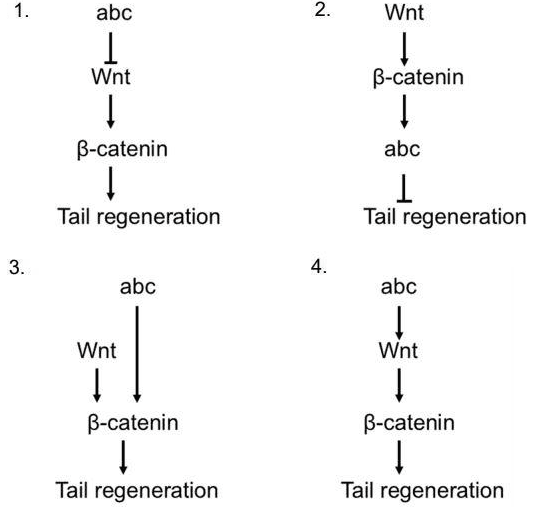
- 1abc ⊣ Wnt → β-catenin → Tail regeneration
- 2Wnt → β-catenin → abc ⊣ Tail regeneration
- 3Wnt → β-catenin and abc → β-catenin; β-catenin → Tail regeneration
- 4abc → Wnt → β-catenin → Tail regeneration
Show answer and solution
Overexpressing abc blocks tail regeneration, but constitutively active β-catenin bypasses the block. So abc acts upstream of β-catenin and inhibits Wnt signalling: abc ⊣ Wnt → β-catenin → tail regeneration.
Consider the following statements on patterns in global biogeography.
- A. The endemicity of terrestrial mammal families in biogeographic realms is greater than plant families.
- B. There are fewer mammalian fruit eaters, omnivores, and carnivore species in Australia compared to other biogeographic realms.
- C. Major diversification of modern mammals started only 65-55 million years ago.
- D. On an average, plant species have dispersed much better than mammalian species across biogeographic realms.
Which one of the options given below contains the correct set of True/False statements, based on well-established patterns in global biogeography?
- 1A: True, B: False, C: True, D: False
- 2A: True, B: True, C: True, D: True
- 3A: False, B: True, C: True, D: False
- 4A: False, B: False, C: True, D: True
Show answer and solution
Mammal families are more confined to single realms than plant families, because plants disperse better (A and D true). Australia’s marsupial-dominated fauna has comparatively few fruit-eating, omnivorous and carnivorous mammal species (B true). Modern mammal orders diversified mainly after the K–Pg extinction, about 65–55 million years ago (C true). All four statements are true.
After synchronizing mammalian cells in culture with a double thymidine block (cell cycle duration of 24h), cells are released into fresh medium. After 6h, cells are split into 4 sets and each is treated with a) nothing, b) proteasome inhibitor, c) myosin II inhibitor, d) nocodazole.
From the options given below, choose the one that has the most likely outcome of the experiment.
- 1a: synchronously dividing cells; b: binucleate cells; c: metaphase arrested; d: prometaphase arrested
- 2a: synchronously dividing cells; b: prometaphase arrested; c: binucleate cells; d: metaphase arrested
- 3a: binucleate cells; b: prometaphase arrested; c: synchronously dividing cells; d: anaphase arrested
- 4a: synchronously dividing cells; b: metaphase arrested; c: binucleate cells; d: pro-metaphase arrested
Show answer and solution
Six hours after release from a double thymidine block the cells are in late S/G2, heading into mitosis together. Untreated, they divide synchronously. A proteasome inhibitor stops cyclin B and securin from being degraded, so they arrest at metaphase. A myosin II inhibitor blocks cytokinesis, giving binucleate cells. Nocodazole depolymerises microtubules, so the spindle checkpoint holds them in prometaphase.
The table below lists unique structural modifications (Column X) found in various plant genera (Column Y).
| Column X | Column Y |
|---|---|
| A. Phylloclade | I. Acacia |
| B. Cladode | II. Euphorbia |
| C. Phyllode | III. Pistia |
| D. Inflated petiole | IV. Opuntia |
Select the option that correctly matches column X with column Y.
- 1A-I, B-II, C-III, D-IV
- 2A-II, B-III, C-I, D-IV
- 3A-II, B-IV, C-I, D-III
- 4A-III, B-IV, C-II, D-I
Show answer and solution
A phylloclade is a flattened, green, photosynthetic stem of many internodes, as in Euphorbia species (A–II) and also Opuntia. A cladode is a similar stem of one or two internodes (B–IV in NTA’s key). A phyllode is a flattened petiole replacing the leaf blade in Australian Acacia (C–I). An inflated, spongy petiole helps Pistia float (D–III).
In order to determine the origin of replication of a circular DNA, isolated DNA from the actively replicating cells were digested with different restriction enzymes (as indicated), followed by electrophoresis in a two-dimensional gel. Southern hybridization was performed with a DNA probe as indicated.
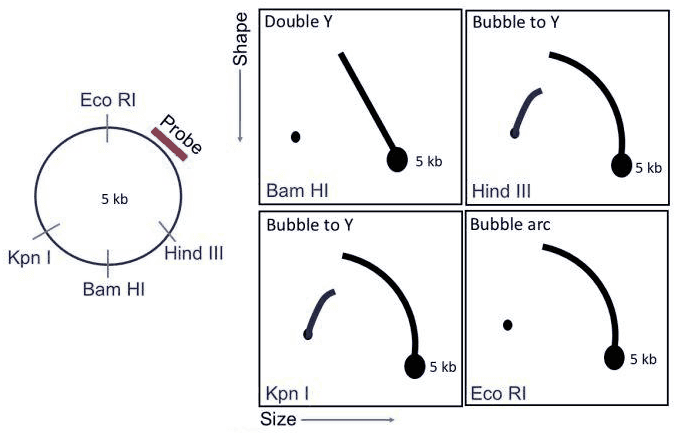
Based on the results of the Southern blots, indicate which of the following options best describes the location of the origin of replication?
- 1Near the EcoRI site
- 2Near the BamHI site
- 3Near the HindIII site
- 4Near the KpnI site
Show answer and solution
In two-dimensional gels, a bubble arc means the origin lies near the middle of the fragment, and a double-Y means the terminus is near the middle. EcoRI linearises the circle with a bubble arc, so the origin lies roughly opposite the EcoRI site. BamHI gives a double-Y, so the terminus lies opposite the BamHI site. With bidirectional replication the origin sits opposite the terminus, which is near the BamHI site.
Which one of the following scenarios is likely to produce the highest beta diversity for tree species in a forested landscape?
- 1High gamma diversity, strong dispersal limitation, high habitat heterogeneity
- 2High gamma diversity, weak dispersal limitation, uniform habitat
- 3High alpha diversity, low gamma diversity, strong dispersal limitation
- 4High alpha diversity, low gamma diversity, weak dispersal limitation
Show answer and solution
β-diversity, the turnover of species between sites, is highest when the regional pool (γ) is large and each site holds a different subset. Strong dispersal limitation stops species spreading everywhere, and habitat heterogeneity filters different species into different places.
The following statements are made regarding the role of tumour microenvironment directly contributing to the metastatic process:
- A. Hypoxia in primary tumours can induce the expression of VEGF and matrix metalloproteinases (MMPs) to promote metastasis.
- B. Tumour-associated macrophages (TAMs) always inhibit metastasis through immune surveillance.
- C. Cancer-associated fibroblasts (CAFs) provide structural support and secrete factors that promote metastasis.
- D. The acidic pH of the tumour microenvironment impedes cancer cell migration.
Which one of the following options represents all correct statements?
- 1A, C and D
- 2B and D only
- 3B, C and D
- 4A and C only
Show answer and solution
Hypoxia induces HIF-1, VEGF and MMPs, which drive angiogenesis and invasion (A). Cancer-associated fibroblasts remodel the matrix and secrete pro-metastatic factors (C). TAMs usually promote metastasis, and they certainly do not always inhibit it (B false). An acidic microenvironment helps invasion (D false). A and C.
A mutation in a plant gene is female gametophyte lethal. This mutant allele can be normally transmitted through pollen. However, when transmitted through egg, the embryos abort, resulting in inviable seeds irrespective of the male allele. A student harvested the seeds from a heterozygous mutant plant and grew a total of 100 plants. What is the expected number of homozygous plants in this population?
- 125
- 250
- 366
- 475
Show answer and solution
Eggs carrying the mutant allele abort, so every viable seed came from a wild-type egg. The pollen carries wild-type and mutant alleles 1:1, so the seeds are half +/+ and half +/m. Of 100 plants, about 50 are homozygous (+/+). No m/m plants can occur.
Leaves can alter the intracellular distribution of their chloroplasts in response to changing light conditions. Shown below are schematic diagram of chloroplast distribution patterns in palisade cells of Arabidopsis, in response to different light intensities, grown in a growth chamber having light source from the top.
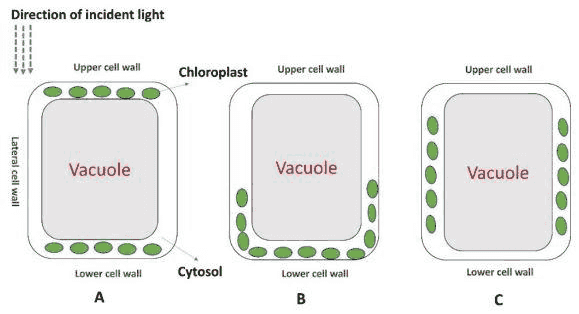
Which one of the following combinations correctly matches the chloroplast distribution with its corresponding light intensity?
- 1A = High light; B = Darkness; C = Low light
- 2A = Darkness; B = High light; C = Low light
- 3A = Low light; B = Darkness; C = High light
- 4A = High light; B = Low light; C = Darkness
Show answer and solution
In low light, chloroplasts gather on the walls facing the light (upper and lower), maximising capture (A). In darkness they settle at the bottom of the cell (B). In high light they move to the side walls, parallel to the light, to avoid damage (C).
The table below lists the food reserves (Column X) found in different algal groups (Column Y).
| Column X | Column Y |
|---|---|
| A. Paramylon | I. Bacillariophyceae |
| B. Starch | II. Phaeophyceae |
| C. Laminarin | III. Charophyceae |
| D. Chrysolaminarin | IV. Euglenophyceae |
Select the option that correctly matches column X with column Y.
- 1A-II, B-III, C-I, D-IV
- 2A-IV, B-III, C-II, D-I
- 3A-III, B-II, C-I, D-IV
- 4A-I, B-IV, C-III, D-II
Show answer and solution
Paramylon, a β-1,3-glucan, is the reserve of euglenoids (A–IV). Starch is stored by green algae, including charophytes (B–III). Laminarin is the brown-algal reserve (C–II). Chrysolaminarin is stored by diatoms (D–I).
In a paper wasp, a worker helps to raise 4 full-sisters instead of producing 4 offspring of her own. According to Hamilton’s rule, will selection favour this altruistic behaviour in terms of genetic units?
- 1Yes, because 3.0 genetic units are gained and 2.0 genetic units are lost.
- 2Yes, because 2.0 genetic units are gained and 1.0 genetic unit is lost.
- 3No, because 2.0 genetic units are gained and 3.0 genetic units are lost.
- 4No, because 2.0 genetic units are gained and 4.0 genetic units are lost.
Show answer and solution
In haplodiploid wasps, full sisters share r = 0.75, while a mother shares 0.5 with her offspring. Helping 4 sisters gains 4 × 0.75 = 3.0 units. Forgoing 4 offspring loses 4 × 0.5 = 2.0. Since rB > C, Hamilton’s rule favours helping.
Wnt/β-catenin signaling plays essential roles during development. The following statements are made about the Wnt/β-catenin signaling pathway:
- A. In the absence of Wnt ligands, β-catenin is phosphorylated by the APC/Axin/GSK-3β complex, leading to its degradation.
- B. The β-catenin/TCF complex acts as a repressor of gene expression upon activation of Wnt signaling.
- C. The Wnt/β-catenin pathway is initiated by binding of Wnt ligands to receptor tyrosine kinases (RTKs).
- D. β-catenin is involved in both cell-to-cell adhesion and transcriptional regulation.
Which one of the following options represents all correct statements?
- 1A, B and C
- 2A, B and D
- 3A and D only
- 4A and C only
Show answer and solution
Without Wnt, the APC/Axin/GSK-3β destruction complex phosphorylates β-catenin and marks it for degradation (A true). β-catenin also links cadherins to actin at adherens junctions (D true). B is false: β-catenin with TCF activates target genes. C is false: Wnt binds Frizzled and LRP5/6, not receptor tyrosine kinases. A and D.
In the classical metapopulation model articulated by Richard Levins (1969, 1970), the metapopulation is considered to be a collection of subpopulations occupying different patches. In this model, we consider the following conditions:
- A. Individual subpopulations have realistic chances of both extinction and recolonization.
- B. The dynamics of the various subpopulations should be largely independent.
- C. Recolonization of a patch after extinction is mainly through dispersal from the mainland patch.
- D. Population dynamics in the patches of a metapopulation should be highly synchronous.
Which one of the options given below includes conditions that should be met for a population to be considered a metapopulation?
- 1A and B
- 2B and C
- 3C and D
- 4A and D
Show answer and solution
In the Levins model, every patch has a real chance of going extinct and being recolonised (A), and patch dynamics are largely independent (B). If they were synchronised, the whole metapopulation could go extinct at once. A mainland source belongs to the mainland–island model.
Given below are some statements about thyroid hormone biosynthesis in thyroid gland.
- A. An antiporter transports two Na+ ions and one I− ion across the thyroid follicular cells.
- B. Pendrin, a Cl−/I− symporter helps I− entry into the colloid.
- C. Pendrin, a Cl−/I− exchanger helps I− entry into the colloid.
- D. Iodination of tyrosine residue takes place first on the 3rd position in the thyroglobulin protein.
Which one of the following options represents the combination of correct statements?
- 1A and B
- 2B and C
- 3C and D
- 4A and D
Show answer and solution
Iodide enters follicular cells through NIS, a 2 Na+/1 I− symporter, so A, which calls it an antiporter, is false. Pendrin is an anion exchanger (Cl−/I−) that moves I− into the colloid (C true, B false). Thyroperoxidase iodinates tyrosine first at position 3, making MIT (D true). C and D.
In a typical experiment, 15 mL of an aqueous solution containing an unknown quantity of acetylcholine had a pH of 7.65. When the solution is incubated with acetylcholinesterase, the pH of the solution decreased to 6.87. Assuming that there was no buffer in the reaction mixture, determine the number of moles of acetylcholine in the 15 mL solution.
- 11.65 × 10⁻⁹ mol to 1.75 × 10⁻⁹ mol
- 22.65 × 10⁻⁹ mol to 2.75 × 10⁻⁹ mol
- 30.65 × 10⁻⁹ mol to 0.75 × 10⁻⁹ mol
- 43.30 × 10⁻⁹ mol to 3.40 × 10⁻⁹ mol
Show answer and solution
Acetylcholinesterase releases acetic acid, which is fully ionised at this pH, one H+ per acetylcholine. [H+] rises from 10−7.65 = 2.24 × 10⁻⁸ to 10−6.87 = 1.35 × 10⁻⁷ M, an increase of 1.12 × 10⁻⁷ M. In 0.015 L that is 1.69 × 10⁻⁹ mol.
The following table presents soil formation processes (Column X) and climatic conditions in which they occur (Column Y).
| Column X | Column Y |
|---|---|
| A. Gleization | I. Low rainfall arid climates |
| B. Laterization | II. High rainfall or low-lying areas associated with poor drainage |
| C. Podzolization | III. Humid environments in the tropical and subtropical regions |
| IV. Cool, moist climates of the mid-latitude regions |
Which one of the following options represents all correct matches between Column X and Column Y?
- 1A-I, B-III, C-II
- 2A-III, B-II, C-IV
- 3A-I, B-IV, C-III
- 4A-II, B-III, C-IV
Show answer and solution
Gleization occurs in waterlogged, poorly drained or low-lying ground (A–II). Laterization happens under hot, humid tropical leaching, leaving iron and aluminium oxides (B–III). Podzolization occurs in cool, moist mid-latitude climates under conifers (C–IV).
Following statements are made with respect to polar auxin transport in plants.
- A. It proceeds via symplast.
- B. Its velocity is faster than the phloem translocation rates.
- C. It is specific for active auxins, both natural and synthetic.
- D. It is mediated by protein carriers on the plasma membrane.
Which one of the following options represents the combination of all correct statements?
- 1A and B only
- 2C and D only
- 3B, C and D
- 4A, B and D
Show answer and solution
Polar auxin transport moves cell to cell through the apoplast using PIN efflux carriers and AUX1/LAX influx carriers on the plasma membrane (D). It carries only active auxins, natural or synthetic (C). It is slow, about 1 cm/h, far slower than phloem flow, and does not use the symplast. C and D.
In sesame, the seed coat color is of two types: white or brown. True breeding white- and brown-seeded plants were reciprocally crossed and the results are given below.
| Cross | Parents (female × male) | F1 generation | F2 generation |
|---|---|---|---|
| 1 | White × Brown | 100% White | 100% Brown |
| 2 | Brown × White | 100% Brown | 100% Brown |
Which one of the following types of inheritance explains the depicted transmission of seed color in sesame?
- 1Plastid/mitochondrial gene-mediated maternal/cytoplasmic inheritance
- 2Nuclear gene-mediated maternal effect
- 3Polar overdominance
- 4Incomplete maternal inheritance
Show answer and solution
Every F1 seed has its mother’s colour, but all F2 seeds are brown, whatever the cross. The seed coat is maternal tissue, so its colour follows the genotype of the mother plant. Each F1 plant is heterozygous, so brown is dominant and every F2 seed is brown. This is a nuclear maternal effect, not cytoplasmic inheritance.
The descending phase of the nerve action potential is caused by:
- A. delayed opening of voltage-gated K+ ion channels.
- B. rapid opening of voltage-gated Na+ ion channels.
- C. closing of voltage-gated Na+ ion channels.
- D. leaky K+ ion channels.
Which one of the following options represents the combination of correct statements?
- 1A and B
- 2A and C
- 3B and C
- 4B and D
Show answer and solution
Repolarisation happens because voltage-gated Na+ channels close (inactivate) while slower voltage-gated K+ channels open, letting K+ out. Rapid Na+ channel opening drives the rising phase, and leak channels set the resting potential.
Adding mRNA that encodes a eukaryotic secretory protein to a cell-free translation system initiates protein translation. Signal recognition particle in low concentration and endoplasmic reticulum (ER) treated with 1% Triton X-100 were sequentially added to the cell free translation system.
Which of the following outcomes is the most likely?
- 1Protein synthesis will begin but terminate prematurely, leading to shorter products.
- 2The protein will be fully synthesized and incorporated into ER.
- 3The protein will be fully synthesized, and its signal sequence will be removed without being incorporated into the ER
- 4The protein will be fully synthesized but not incorporated into ER.
Show answer and solution
SRP binds the signal sequence as it emerges and pauses elongation until the ribosome docks on the SRP receptor in an ER membrane. Triton X-100 has destroyed the ER membranes, so there is nowhere to dock. The arrest is never relieved, so synthesis stops early and gives truncated products.
Given below are a few statements about vesicular transport.
- A. Clathrin-mediated endocytosis requires the recruitment of adaptors to the cytosolic face of the plasma membrane.
- B. The low-pH environment of early endosomes leads to the dissociation of cargo from its receptor, allowing for the recycling of receptors to the plasma membrane.
- C. The late endosomes, which mature into the lysosomes, are directly involved in the recycling of synaptic vesicle proteins in neurons.
- D. The multivesicular body pathway involves the formation of intraluminal vesicles, which sort cargo for degradation in the lysosomes.
Which one of the following options has all correct statements about endocytosis?
- 1A and B only
- 2B and D only
- 3B, C and D
- 4A, B and D
Show answer and solution
A is true: clathrin endocytosis needs adaptors such as AP2 at the membrane. B is true: the low pH of early endosomes releases ligands so receptors can recycle. D is true: multivesicular bodies sort cargo into intraluminal vesicles for lysosomal degradation. C is false: synaptic vesicles recycle locally through endocytosis and early endosomes, not late endosomes. A, B and D.
Normal yeast cells grow at 42°C. Five yeast haploid strains, with independent alleles of YFG1 having impaired cell growth at 42°C, were isolated and labeled as yfg1ts1 to yfg1ts5. A haploid (yfg1ts1) carrying a spontaneously generated mutation (sup1) at an independent locus was isolated, which can grow at 42°C. Using pairwise crossing, sup1 was introduced into strains carrying yfg1ts2 to yfg1ts5 alleles. All these haploids grew at 42°C.
Based on this data, the following statements were made to describe the Sup1–Yfg1 molecular/genetic interaction.
- A. Sup1 codes for a protein which, when over-expressed, stabilized mutant yfg1ts proteins.
- B. Sup1 codes for a protein that physically interacts with Yfg1 protein.
- C. Sup1 protein upregulates an alternate pathway.
- D. Sup1 is a nonsense suppressor that restores protein translation in cells carrying yfg1ts allele.
Which one of the following options represents the combination of all correct statements?
- 1A and B only
- 2B, C and D only
- 3A, B and C only
- 4A, B, C and D
Show answer and solution
sup1 rescues all five independent ts alleles, so it does not depend on a particular mutation. It could act by stabilising the mutant proteins when overproduced (A), by binding Yfg1 directly (B), or by switching on a bypass pathway (C). The ts alleles are missense mutations that make the protein temperature-sensitive, so a nonsense suppressor would not help (D false). A, B and C.
A student performed an ELISA to detect anti-ovalbumin IgG in a serum sample. The experiment involved the following sequential steps: coating plates with ovalbumin, blocking with BSA, adding serum sample, adding anti-mouse-IgG-HRP, adding H2O2 + o-Phenylenediamine dihydrochloride (OPD), and adding H2SO4. The student made the following statements:
- A. If the plates are not blocked with BSA, the specificity of the assay decreases.
- B. If the plates are not washed between addition of serum sample and addition of anti-mouse IgG-HRP, the sensitivity of the assay decreases.
- C. If the plates are not washed between addition of anti-mouse IgG-HRP and addition of H2O2 + OPD, the specificity of the assay decreases.
- D. OPD is the substrate for the enzyme.
- E. Without H2SO4, no colour is developed.
Which one of the following options represents the combination of all correct statements?
- 1A and B only
- 2B and C only
- 3A, B and C
- 4A, C, D and E
Show answer and solution
Without BSA blocking, antibodies stick to the plastic itself, so specificity falls (A). If serum is not washed away, free serum IgG mops up the secondary antibody, so sensitivity falls (B). If unbound HRP conjugate is not washed away, it colours every well, so specificity falls (C). HRP’s substrate is H2O2, with OPD as the chromogen, and colour develops before H2SO4 is added to stop the reaction. A, B and C.
The table below shows the outcomes of surgical experiments in chick embryos.
| Surgical experiments | Outcomes | |
|---|---|---|
| A. | Early wing bud progress zone is transplanted to a late wing bud after the formation of zeugopod | An extra set of ulna and radius is formed |
| B. | An extra ZPA is transplanted to anterior limb bud mesoderm after the formation of stylopod | Pattern duplication of ulna, radius and digits occurs |
| C. | Late wing bud progress zone, after the formation of zeugopod, is transplanted to an early wing bud that has just formed stylopod | Formation of autopod will be affected |
| D. | Early leg mesenchyma is transplanted just beneath the wing AER after the formation of stylopod | Distal leg structures develop at the end of the wing |
Which one of the following options represents a combination of all correct outcomes?
- 1A and B
- 2B and D
- 3A and C
- 4A and D
Show answer and solution
A progress zone carries its own timing. An early zone grafted onto a late bud still makes proximal elements, giving an extra ulna and radius (A true). Early leg mesenchyme under a wing AER forms leg structures such as toes, because identity comes from the mesoderm (D true). A late zone on an early bud deletes middle elements, not the autopod (C false). By NTA’s key, B is false. A and D.
Based on homology, a protein, CG2024, functions as a homotetramer. The function of each unit within the tetramer is essential for its catalytic activity. CG2024 protein has three domains. Domain ‘a’ is essential for tetramerization, domain ‘b’ is essential for catalytic activity and domain ‘c’ does not contribute to CG2024 function at all. Three mutations, a*, b* and c* in the ‘a’, ‘b’ and ‘c’ domains of CG2024, respectively, have been identified. The a* and b* disrupt the function of their respective domains.
Based on this information, which one of the following options correctly describes the nature of mutations a*, b* and c* (in the same order)?
- 1Dominant, recessive, amorphic
- 2Dominant, dominant, amorphic
- 3Recessive, dominant, recessive
- 4Recessive, recessive, dominant.
Show answer and solution
If a* cannot tetramerise, mutant subunits simply stay out of the complex, and the wild-type subunits still form working tetramers: recessive. If b* is catalytically dead but still assembles, it poisons any tetramer it joins: dominant (dominant negative). c* changes a domain with no function, so it has no effect and behaves as recessive. Recessive, dominant, recessive.
The figure below represents a bipartite network of species interactions between two trophic levels. Each link represents an interaction between a species in the higher trophic level (A to H) and a species in the lower trophic level (I to P).

Given below are a few statements describing potential conclusions that can be drawn from the network:
- A. If the network represents predator species (A-H) and prey species (I-P), then D is an apex predator.
- B. If the network represents plant species (I-P) and pollinator species (A-H), then species I is more likely to experience local extinction than K.
- C. The network is more stable if D is removed and the population size of O increases.
- D. If the network represents frugivore species (A-H) and plant species (I-P), then M is a keystone species.
Which one of the options given below represents all correct statement/s that can be inferred from the network above?
- 1A and B only
- 2A, B and C
- 3B, C and D
- 4B only
Show answer and solution
Species I is linked to only one higher-level species, while K is linked to several. If the network shows pollination, I depends on a single pollinator and is more likely to go locally extinct (B). A bipartite diagram does not show who is an apex predator, and it cannot tell us stability after removals or which species is a keystone. B only.
Phosphoenolpyruvate carboxylase (PEPCase) is an important enzyme involved in both C4 and CAM photosynthesis. Given below are a few statements regarding PEPCase in C4 and CAM plants.
- A. Light activates PEPCase kinase in C4 plants.
- B. Phosphorylation inactivates PEPCase in C4 plants while it activates the enzyme in CAM plants.
- C. PEPCase kinase gets activated by light in CAM plants.
- D. Phosphorylated PEPCase is less sensitive to malate.
Which one of the following options is the combination of all correct statements?
- 1A, B and C
- 2A and D
- 3B, C and D
- 4C and D only
Show answer and solution
Light activates PEPCase kinase in C4 leaves (A true). Phosphorylation activates PEPCase in both C4 and CAM plants, making it less sensitive to malate inhibition (D true, B false). In CAM plants the kinase is active at night, when PEPCase fixes CO2, not in the light (C false). A and D.
A researcher studying the mating systems in birds (operational sex ratio 1:1) uses the number of successful matings as a measure of male reproductive fitness and female reproductive fitness, as depicted in the figure below.
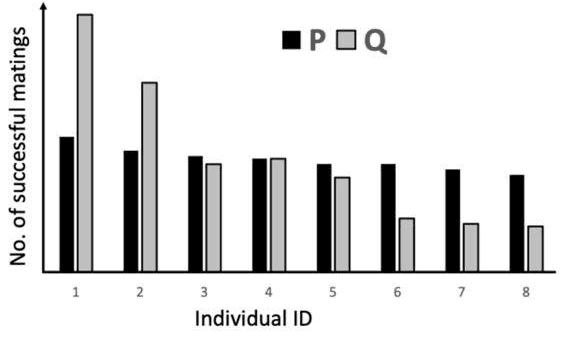
Which one of the following options correctly matches P and Q with the correct sex for different mating systems?
- 1Polygyny: P, male, Q, female; Polyandry: Q, male, P, female
- 2Polygyny: Q, male, P, female; Polyandry: P, male, Q, female
- 3Polygyny: P, male, Q, female; Polyandry: P, male, P, female
- 4Polygyny: Q, male, P, female; Polyandry: Q, male, Q, female
Show answer and solution
The sex with the greater variance in mating success is the one competing for mates. Series Q varies widely and P is even. In polygyny, males vary most (Q = male, P = female). In polyandry, females vary most (P = male, Q = female).
Given below are a few statements.
- A. Codominant molecular markers ___(i)___ be used for identification of heterozygotes.
- B. Genome wide association studies (GWAS) ___(ii)___ be performed on germplasm with high genetic diversity.
- C. An F2 mapping population ___(iii)___ be used as an immortal population for genetic mapping studies in plants.
- D. Bulk segregant analysis (BSA) ___(iv)___ be used for mapping of monogenic qualitative traits.
Which one of the following options represents the correct sequence of terms to fill in the blanks in the above statements so that all the statements are true?
- 1(i) cannot, (ii) can, (iii) can, (iv) can
- 2(i) can, (ii) cannot, (iii) cannot, (iv) cannot
- 3(i) can, (ii) can, (iii) can, (iv) cannot
- 4(i) can, (ii) can, (iii) cannot, (iv) can
Show answer and solution
Codominant markers can identify heterozygotes. GWAS can, and should, use diverse germplasm. An F2 population cannot be immortal, because its plants are still heterozygous and segregating. Bulk segregant analysis can map simple monogenic traits.
The following statements are made about the involvement of the type III protein secretion system (T3SS) during bacterial pathogenesis in plants and animals.
- A. It involves a protein complex that spans both the inner and outer bacterial membranes.
- B. T3SS mostly secretes Avr effector proteins directly into plant apoplast.
- C. The genes encoding conserved components of the T3SS of plant and animal pathogenic bacteria are referred to as Hrp (hypersensitive response and pathogenicity cluster).
- D. Once Avr effectors are delivered inside the plant cell, Hrp proteins are not needed for the activation of the defence response.
Which one of the following options represents the combination of all correct statements?
- 1A and C
- 2B and C
- 3A and D
- 4B and D
Show answer and solution
The T3SS is a needle complex spanning both bacterial membranes (A true). In plant pathogens its genes are the hrp clusters, conserved with animal-pathogen T3SS genes, which NTA counts as correct (C). Avr effectors are injected into the host cytoplasm, not the apoplast (B false). A and C.
The interconversion of fructose 6-phosphate to fructose 1,6-bisphosphate is a critical step in central metabolism in plants. Followings are certain statements regarding this interconversion.
- A. Phosphofructokinase catalyzes the C6 phosphorylation of fructose 6-phosphate.
- B. Plastid phosphofructokinase is activated by Pi while cytosolic phosphofructokinase is activated by phosphenolpyruvate.
- C. Cytosolic fructose 1,6-bisphosphatase is strongly inhibited by fructose 2,6-bisphosphate.
- D. Pyrophosphate-dependent phosphofructokinase catalyzes a reversible reaction of interconversion of fructose 6-phosphate to fructose 1,6-bisphosphate.
Which one of the following options is a combination of all correct statements?
- 1A and B
- 2B and D
- 3A and C
- 4C and D
Show answer and solution
Phosphofructokinase phosphorylates fructose 6-phosphate at C-1, not C-6 (A false). Cytosolic FBPase is strongly inhibited by fructose 2,6-bisphosphate, the signal that controls sucrose synthesis (C true). PFP, the PPi-dependent PFK, works reversibly near equilibrium (D true). B is false. C and D.
The following statements were made about the alternative pathway of Complement activation in the immune system:
- A. The pathway is initiated when antibodies bind to pathogen.
- B. The pathway is initiated by spontaneous hydrolysis of serum Complement.
- C. The pathway uses the same C3- and C5-convertases as the lectin pathway.
- D. The pathway can be initiated by properdin and thrombin.
Which one of the following options represents the combination of all correct statements?
- 1A and C
- 2A and D
- 3B and D
- 4C and D
Show answer and solution
The alternative pathway starts with slow spontaneous hydrolysis of C3 (“tick-over”) and needs no antibody (B true, A false). Properdin stabilises its convertase, and thrombin can cleave C3 and C5 directly (D true). Its convertases are C3bBb and C3bBb3b, not the lectin pathway’s C4b2a (C false). B and D.
To study different DNA double-strand break (DSB) repair pathways, a construct is developed that contains a neomycin selectable marker gene flanked by two inactive GFP genes: the first one is inactivated by the insertion of an I-SceI recognition sequence, and the other one has a 99 bp deletion at the 5′ end of the gene. The induction of the I-SceI endonuclease will create a DSB in the first GFP sequence.
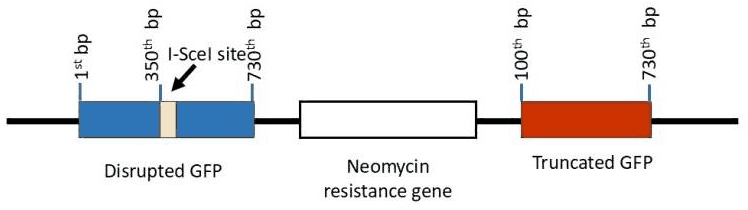
The following expected outcomes have been proposed:
- A. If the DSB is repaired by the gene conversion (GC) pathway, cells will be GFP-positive and neomycin-resistant.
- B. If the DSB is repaired by the GC pathway, cells will be GFP-positive but neomycin-sensitive.
- C. If the DSB is repaired by the single-strand annealing (SSA) pathway, cells will be GFP-positive and neomycin resistant.
- D. If the DSB is repaired by the non-homologous end joining (NHEJ) pathway, cells will be GFP-negative and neomycin resistant.
Which one of the following options represents the combination of all correct statements?
- 1A, C and D
- 2B, C and D
- 3A and C only
- 4A and D only
Show answer and solution
Gene conversion copies the missing sequence from the truncated GFP into the broken one, restoring a working GFP while keeping neo: GFP-positive and neomycin-resistant (A true, B false). Single-strand annealing between the two GFP repeats deletes the neo gene between them (C false). NHEJ rejoins the ends with small errors, leaving GFP broken but neo intact (D true). A and D.
Presence of E-cadherin activates the Hippo pathway in the inner cell mass (ICM). Experimentally eliminating E-cadherin disrupts both apicobasal polarity and specification of the ICM and trophoectoderm lineages. Which one of the following schemes leads to pluripotency?

- 1Scheme 1
- 2Scheme 2
- 3Scheme 3
- 4Scheme 4
Show answer and solution
NTA’s key gives scheme 1: E-cadherin junctions between inner cells, with YAP/TAZ active in the ICM, sustaining Oct4 expression and pluripotency. The question stresses that E-cadherin-based polarity and adhesion are needed for the ICM and trophectoderm lineages to separate, and schemes 2 and 4 lack those junctions.
Some of the following statements describe nomenclature rules in the International Code of Zoological Nomenclature (ICZN).
- A. If the generic name is of masculine gender, the species name should be of feminine gender.
- B. A name is to be rejected if it is a tautonym or inappropriately describes a taxon’s character.
- C. The name of an animal taxon cannot be rejected because it is identical with the name of another taxon which is not an animal.
- D. Even if the taxon concerned is no longer classified as an animal, its name remains available.
Select the option that includes all statements representing currently accepted nomenclature rules of the ICZN.
- 1A, B and D
- 2B, C and D
- 3A and B only
- 4C and D only
Show answer and solution
Under the ICZN, a name is not rejected just because the same name exists outside the animal kingdom (C). A name stays available even if the organism is later reclassified as non-animal (D). A is false: species names must agree in gender with the genus. B is false: zoology allows tautonyms (e.g. Gorilla gorilla) and does not reject unsuitable names.
The following table shows a list of migratory birds coming to India (Column X) and the region from where they migrate (Column Y).
| Column X | Column Y |
|---|---|
| A. Black-tailed Godwit | I. Arctic Tundra |
| B. Comb Duck | II. Iceland or Russia |
| C. Ruff | III. Madagascar and South Asia |
| D. Spotted Redshank | IV. Scandinavia |
Which one of the following options represents all correct matches between Column X and Column Y?
- 1A-III, B-IV, C-I, D-II
- 2A-II, B-III, C-I, D-IV
- 3A-I, B-II, C-III, D-IV
- 4A-II, B-III, C-IV, D-I
Show answer and solution
NTA’s matches: the black-tailed godwit winters in India from breeding grounds such as Iceland and Russia (A–II). The comb (knob-billed) duck lives in Madagascar and South Asia (B–III). The ruff comes from northern Europe, including Scandinavia (C–IV). The spotted redshank breeds in the Arctic tundra (D–I).
Angiotensin converting enzyme (ACE) converts angiotensin I into angiotensin II. ACE inhibitors should not be given to a person with severe loss of blood because:
- A. these will increase renal tubular K+ excretion.
- B. these will relax smooth muscles in the arteries.
- C. these will reduce aldosterone secretion and thereby prevent water retention.
- D. these will decrease renal tubular NaCl and water excretion.
Which one of the following options represents the combination of correct reasons?
- 1A and C
- 2A and D
- 3B and C
- 4B and D
Show answer and solution
After heavy blood loss, angiotensin II is vital: it constricts arterioles to hold up blood pressure, and through aldosterone it keeps Na+ and water in the body. ACE inhibitors would relax arterial smooth muscle (B) and reduce aldosterone, preventing water retention (C). Both would make hypotension worse.
The mechanisms of action of calcitropic hormones are important for understanding the molecular basis of disease states related to calcium homeostasis.
- A. Calcium binding (transport) protein (CaBP) enhances the movement of calcium from the brush border into the cytoplasm.
- B. Receptors for calcitonin are present in the osteoclasts where they increase cAMP production.
- C. Parathormone essentially works independently to mobilize bone mineral, and never in concert with vitamin D.
- D. The major calcitropic hormone, calcitriol, regulates intestinal calcium absorption.
Which one of the following options is INCORRECT in maintaining calcium homeostasis?
- 1A and B
- 2Only B
- 3Only C
- 4C and D
Show answer and solution
Statement C is the incorrect one. PTH works with vitamin D: it stimulates renal 1α-hydroxylase to make calcitriol, and calcitriol helps PTH mobilise bone mineral. The other statements are true: calbindin aids Ca2+ absorption, calcitonin raises osteoclast cAMP, and calcitriol controls intestinal Ca2+ uptake.
Match the following ribose sugar pucker in nucleic acids (labeled A, B, C, D) with their corresponding conformational states. The black circle denotes the base of the nucleotide.

- 1A – C2′-exo; B – O4′-exo; C – C3′-endo; D – O4′-endo
- 2A – C2′-endo; B – O4′-endo; C – C3′-endo; D – O4′-exo
- 3A – C2′-endo; B – O4′-exo; C – C3′-exo; D – O4′-exo
- 4A – C2′-exo; B – O4′-endo; C – C3′-exo; D – O4′-endo
Show answer and solution
Ribose pucker is named by which ring atom lies out of the plane, on the same side as C5′ (endo) or the opposite side (exo). NTA’s key: A = C2′-endo, the B-DNA pucker; B = O4′-endo; C = C3′-endo, the A-form and RNA pucker; D = O4′-exo.
The lipid composition of the two monolayers of the plasma membrane is quite different. This lipid asymmetry is functionally relevant, especially in converting extracellular signals into intracellular ones. Given below are a few membrane lipids:
- A. Phosphatidylserine
- B. Phosphatidylinositol 4-phosphate
- C. Phosphatidylcholine
- D. Sphingomyelin
Choose the option that correctly defines all the lipids involved in signaling and are restricted to the cytosolic face of the plasma membrane.
- 1A only
- 2A and B
- 3C and D
- 4C only
Show answer and solution
Phosphatidylserine and the phosphoinositides (PI, PI4P, PI(4,5)P2) are kept on the cytosolic leaflet, where they recruit and activate signalling proteins such as PKC and PLC. Phosphatidylcholine and sphingomyelin are mostly in the outer leaflet.
Given below is a list of microbes or their components (Column X) and specific stains (Column Y) used for their identification.
| Column X | Column Y |
|---|---|
| A. Bacillus subtilis | i. Albert stain |
| B. Mycobacterium leprae | ii. Malachite green |
| C. Pseudomonas flagella | iii. Lactophenol cotton blue |
| D. Volutin granules of C. diphtheriae | iv. Gram stain |
| E. Cultured fungi | v. Silver stain |
| F. Klebsiella capsule | vi. Ziehl Neelsen stain |
| G. Clostridium endospore | vii. India ink |
Which one of the following options represents the combination of all correct matches?
- 1A-iv, C-iii, E-v
- 2B-vi, F-ii, A-i
- 3A-i, B-vi, F-vii
- 4E-iii, C-v, D-i
Show answer and solution
Cultured fungi are stained with lactophenol cotton blue (E–iii), bacterial flagella with silver stains (C–v), and the volutin granules of C. diphtheriae with Albert’s stain (D–i). All three are correct, so option 4. (For completeness: Bacillus takes the Gram stain, M. leprae Ziehl–Neelsen, capsules India ink, and spores malachite green.)
With reference to the origin of multicellularity in different life forms, which one of the following statements is INCORRECT?
- 1The ‘snowflake yeast’ experiment demonstrated the evolution of multicellularity through cell adhesion and programmed cell death.
- 2The syncytial theory states that multicellular organisms arose through the aggregation of free-living unicellular forms.
- 3Cadherin-based adhesion pathways played an important role in the evolution of multicellularity in plants.
- 4Co-option of existing functions is hypothesized to have driven the evolutionary transition from undifferentiated multicellular clusters to differentiated tissues.
Show answer and solution
The syncytial theory holds that animals arose from a multinucleate protist that later partitioned into separate cells, not from aggregation of free-living cells (aggregation is the colonial theory). So statement 2 is the incorrect one, and it is NTA’s answer. (Statement 3 is also doubtful, because cadherins are an animal invention.)
The absorbance values of a dye measured at 600 nm were plotted against its corresponding concentrations, as given below.
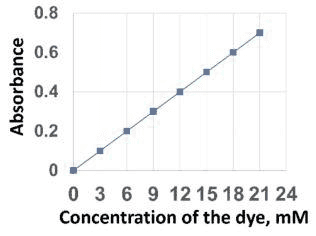
Which of the following will be the best estimate of the extinction coefficient of the compound in M−1cm−1 units? The path length of the cuvette used for the measurement is 1 cm.
- 10.1
- 20.033
- 333.3
- 4100
Show answer and solution
From Beer–Lambert, the slope of absorbance against concentration (for a 1 cm path) is ε. The line rises 0.1 per 3 mM, so ε = 0.1/0.003 M = 33.3 M−1 cm−1.
The phylogeny given below depicts the evolutionary relationships and branch lengths of species found in three spider communities, X, Y, and Z, along with a table showing their absence (0) and presence (1) in these communities.
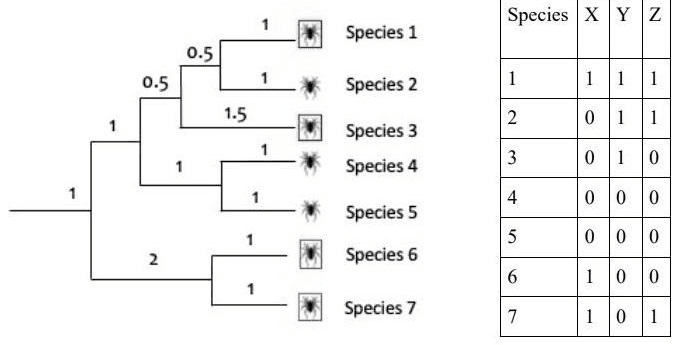
Which one of the following options gives the correct values of phylogenetic diversity for these communities?
- 1X=7.0, Y=4.5, Z=8.0
- 2X=8.0, Y=6.0, Z=7.0
- 3X=7.0, Y=4.0, Z=7.0
- 4X=7.0, Y=3.5, Z=6.0
Show answer and solution
Phylogenetic diversity (PD) is the total branch length linking a community’s species, measured here from their most recent common ancestor. X (1, 6, 7) spans the root: (1 + 0.5 + 0.5 + 1) + (2 + 1 + 1) = 7. Y (1, 2, 3) shares an ancestor near the top: 0.5 + 1 + 1 + 1.5 = 4. Z (1, 2, 7): (1 + 0.5 + 0.5 + 1 + 1) + (2 + 1) = 7.
Evolution by natural selection may produce organisms that are adapted to their environment. Given below are four statements regarding adaptation by natural selection.
- A. Adaptation implies that organisms are perfectly matched to their current environment.
- B. Adaptive traits have been shaped by natural selection to past environments.
- C. Natural selection is the only process by which adaptive traits evolve.
- D. Adaptation to current environments may be constrained by adaptation to past environments.
Which one of the following options gives the correct combination of True/False statements?
- 1A: True, B: False, C: True, D: False
- 2A: True, B: True, C: True, D: False
- 3A: False, B: True, C: False, D: True
- 4A: False, B: False, C: False, D: True
Show answer and solution
Adaptations are never perfect (A false). They were shaped by past environments (B true). Other processes such as drift and genetic correlation can also produce trait change (C false). Earlier adaptations can constrain how well organisms fit today’s conditions (D true).
Given below are recognition sites of some restriction enzymes with the sites of restriction marked with a ‘^’ symbol.
EcoRV : GAT^ATC; HindIII : A^AGCTT; SmaI : CCC^GGG; AvaI : C^YCGRG; SalI : G^TCGAC; XbaI : T^CTAGA
Which one of the following options represents all enzyme-treated vector (V) and insert (I) fragment combinations that would generate compatible ends for ligation without any other intermediate enzymatic treatment?
- 1HindIII (V) – SalI (I); SmaI (V) – EcoRV (I)
- 2SmaI (V) – XbaI (I); EcoRV (V) – HindIII (I)
- 3HindIII (V) – SalI (I); XbaI (V) – AvaI (I)
- 4EcoRV (V) – SmaI (I); AvaI (V) – SalI (I)
Show answer and solution
EcoRV and SmaI both leave blunt ends, which ligate to each other. AvaI (C^YCGRG) can leave a 5′-TCGA overhang, when the site is CTCGAG, and that matches SalI’s TCGA overhang. HindIII (AGCT) and SalI (TCGA) are not compatible, and nor are XbaI and AvaI.
T cell precursors that exit the bone marrow undergo positive and negative selection in the thymus before emerging as mature T cells. These processes are controlled by cellular interactions of the thymocyte with stromal cells in the thymus. The following statements are made regarding the selection process:
- A. The selection process involves negative selection of auto-reactive cells in the cortex followed by their migration to the medulla.
- B. The selection process relies on the transcription factor ‘Aire’.
- C. The selection process can lead to the generation of CD4 cells that can interact with dendritic cells (DCs) as well as B cells.
- D. The selection process can lead to the generation of regulatory CD4 T cells.
Which one of the following options represents the combination of all correct answers?
- 1A and B only
- 2B and C only
- 3B, C and D
- 4A, B and D
Show answer and solution
B is true: AIRE in medullary epithelial cells displays tissue-restricted self-antigens for negative selection. C is true: selection produces CD4 T cells that recognise MHC II on dendritic cells and B cells. D is true: selection also produces regulatory T cells. A is false: positive selection is in the cortex, and most negative selection happens after migration to the medulla.
Match the following bacterial gene expression mechanisms:
| Column X | Column Y |
|---|---|
| A. Translated protein acts as a repressor (translational feedback) | i. Stringent response |
| B. Production of ppGpp in response to amino acid starvation, which in turn regulates transcription by binding to β subunit of RNA polymerase | ii. Ribosomal protein operon regulation |
| C. Regulation of bacterial mRNA translation in cis | iii. sRNA (small RNA) and chaperone require pairing with mRNA |
| D. Regulation of bacterial mRNA translation in trans | iv. Riboswitches that bind a ligand |
Which one of the following options represents all correct matches between Column X and Column Y?
- 1A (iv), B (i), C (ii), D (iii)
- 2A (i), B (iv), C (ii), D (iii)
- 3A (iv), B (ii), C (i), D (iii)
- 4A (ii), B (i), C (iv), D (iii)
Show answer and solution
Ribosomal-protein operons are regulated by translational feedback: an r-protein binds its own mRNA (A–ii). ppGpp made during amino acid starvation is the stringent response (B–i). Riboswitches act in cis within the mRNA (C–iv). sRNAs working with Hfq act in trans (D–iii).
Match the insects (Column X) to the insect orders (Column Y)
| Column X | Column Y |
|---|---|
| A. Thrips | i. Blattodea |
| B. Lacewings | ii. Dermaptera |
| C. Termites | iii. Phasmatodea |
| D. Earwigs | iv. Thysanoptera |
| E. Stick insects | v. Neuroptera |
Select the option that correctly matches column X with column Y.
- 1A-ii, B-iii, C-iv, D-v, E-i
- 2A-iii, B-i, C-v, D-iv, E-ii
- 3A-i, B-iv, C-ii, D-iii, E-v
- 4A-iv, B-v, C-i, D-ii, E-iii
Show answer and solution
Thrips belong to Thysanoptera, lacewings to Neuroptera, termites to Blattodea (with cockroaches), earwigs to Dermaptera, and stick insects to Phasmatodea.
Consider a predator that can forage on two prey types, where Prey1 is the more profitable prey and Prey2 is the less profitable prey. While searching for Prey1, if it encounters Prey2, the decision to capture Prey2 or ignore it and continue to search for Prey1 is given by the predictions of the Optimal Foraging Theory (OFT). The table below gives various parameters that may be used as per OFT by the predator in making this foraging decision.
| Prey type | Energy gained | Handling time | Search time |
|---|---|---|---|
| Prey1 | E1 | h1 | S1 |
| Prey2 | E2 | h2 | S2 |
Which one of the following statements predicts correctly when the predator should eat Prey2, given the conditions above?
- 1Only when S1 < [(E1h2) / E2] − h1
- 2Only when S1 > [(E1h2) / E2] − h1
- 3Whenever S2 < [(E1h2) / E2] − h1
- 4Whenever S2 > [(E1h2) / E2] − h1
Show answer and solution
Taking Prey2 pays when its profitability is higher than the rate available from continuing to search for Prey1: E2/h2 > E1/(S1 + h1). Rearranging gives S1 > E1h2/E2 − h1. Including Prey2 depends only on how scarce the better prey is, not on how common Prey2 is.
A purified 150 kDa species obtained from a gel filtration column was run on a 2-dimensional SDS-PAGE as shown below:

What is the likely form of the 150 kDa species from this observation?
- 1There are at least two proteins that are linked through non-covalent interactions.
- 2There are at least two proteins in the complex that are linked through covalent bonds.
- 3There are two proteins in the mixture without forming a complex.
- 4There is only one protein and it has a disulfide bond.
Show answer and solution
The two spots already separate in the first, non-reducing dimension and lie on the diagonal after reduction, so no disulfide bonds are involved. The 150 kDa species from gel filtration was therefore a complex of at least two proteins held together non-covalently, which SDS pulled apart.
Given below are a few ion transport proteins present on the membrane of pancreatic duct cells.
- A. Cystic fibrosis transmembrane conductance regulator (CFTR)
- B. Sodium-bicarbonate cotransporter (NBC)
- C. K+ channel
- D. Cl−/HCO3− exchanger
Which one of the following options represents the correct combinations of proteins located on the basolateral membrane of pancreatic duct cells?
- 1A and B
- 2B and C
- 3C and D
- 4A and D
Show answer and solution
Pancreatic duct cells bring HCO3− in across the basolateral membrane through the Na+–HCO3− cotransporter (NBC). K+ channels there keep the membrane potential steady. CFTR and the Cl−/HCO3− exchanger are on the apical side, secreting into the duct.
Below is a table with the list of post-translational modifications on proteins and amino acid residues that are correspondingly modified.
| Post-translational modification | Amino acid residue(s) | |
|---|---|---|
| A. | Phosphorylation | Histidine |
| B. | Ubiquitination | Lysine, N-terminal Methionine |
| C. | O-linked glycosylation | Asparagine |
| D. | Hydroxylation | Proline, Cysteine |
Which post-translational modifications are correctly matched with the amino acid residues they typically modify?
- 1A, B, and C
- 2B, C, and D
- 3C and D only
- 4A and B only
Show answer and solution
Histidine phosphorylation is real, in two-component systems and some mammalian proteins (A true). Ubiquitin attaches to lysines and to the N-terminal amino group, as in linear (M1) chains (B true). O-linked glycosylation is on Ser/Thr, not Asn, which carries N-linked sugars (C false). Hydroxylation is on Pro and Lys, not Cys (D false). A and B.
In a study, researchers replaced the natural promoter of a gene with a synthetic promoter that contains a point mutation in the TATA box that prevents binding of the TATA-binding protein (TBP). The following outcomes would most likely result from this modification.
- A. An mRNA will be generated with an alternate reading frame.
- B. The mRNA will be transcribed by RNA polymerase I instead of RNA polymerase II.
- C. Transcription may occur with a reduced efficiency.
- D. Transcription may occur but will always result in the formation of a non-functional mRNA.
Which one of the following options represents the combination of all INCORRECT statements?
- 1A and C only
- 2A, B and D
- 3A, C and D
- 4B and D only
Show answer and solution
Without a functional TATA box, TBP cannot bind well, but Pol II can still start from TATA-less signals at lower efficiency (C is correct). The other statements are wrong: the promoter does not change the reading frame (A), does not switch the gene to Pol I (B), and does not necessarily give non-functional mRNA (D). The incorrect ones are A, B and D.
An ecologist calculates the Shannon-Wiener diversity index for an ecosystem with high species diversity. Which one of the following statements about this diversity index is INCORRECT?
- 1It increases as species richness increases.
- 2It is maximized when all species have equal abundances.
- 3It is unaffected by the evenness of species abundances.
- 4A low index value indicates dominance of one or a few species.
Show answer and solution
The Shannon index rises with both richness and evenness, and for a given number of species it is maximal when all are equally abundant. Saying it is unaffected by evenness (statement 3) is therefore incorrect. Low values mean one or a few species dominate.
The figure below shows the genes (a, b, c, d, f, l, m, n) that are expressed in cell types 1, 2, and 3 because of the concentration of morphogen signaling received by these cells.
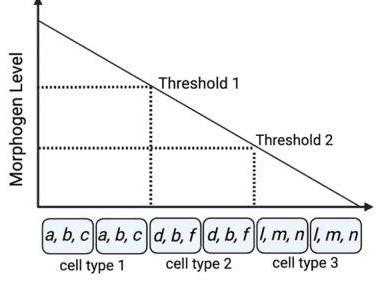
Which one of the following statements is correct about the pattern of gene expression induced by the morphogen?
The transcription factor activated by the morphogen has:
- 1higher affinity for regulatory region of a than that of d.
- 2higher affinity for regulatory region of f than that of c.
- 3same affinity for regulatory regions of a and b.
- 4lower affinity for regulatory region of m than that of c.
Show answer and solution
Genes switched on only at high morphogen levels (cell type 1) have low-affinity regulatory sites, while genes also switched on at intermediate levels have higher-affinity sites. f is on at the intermediate level and c only at the high level, so the factor binds f’s regulatory region more tightly than c’s.
Changes in NTA’s final answer key
Dropped: Q58 (marks given to everyone). Two options accepted: Q38. Every other question has the single answer shown.
How to revise from this paper
- Attempt it in one 3-hour sittingAnswer 15 in Part A, 35 in Part B and 25 in Part C, as in the real exam, before you check any answers.
- Score it with negative markingAdd 2 or 4 marks for each correct answer and subtract 0.5 or 1 for each wrong one. That is the number to track.
- Sort your mistakes by unitUse the unit tag on each question. Two or three wrong answers in the same unit tell you where to revise first.
- Repeat with a fresh paperTake a full-length mock a week later and compare your unit-wise mistakes.
Keep going