

All 145 questions from the CSIR-NET Life Sciences December 2023 paper (Shift 1), typed out in full, with NTA’s final answer key, a worked solution for every question and every diagram.
The Joint CSIR-UGC NET December 2023 Life Sciences exam was held on 26 December 2023 in two shifts. This page covers the morning shift (Shift 1, 9 am to 12 pm). Below you will find every question from Part A (General Aptitude), Part B and Part C, in the order they appeared, each tagged with its syllabus unit. Tap Show answer and solution under any question to check the official answer and see how to reach it.
Marking scheme
| Part | Questions | Answer | Marks each | Wrong answer | Max marks |
|---|---|---|---|---|---|
| A: General Aptitude | Q1–20 | 15 | 2 | −0.5 | 30 |
| B: Life Sciences | Q21–70 | 35 | 2 | −0.5 | 70 |
| C: Life Sciences | Q71–145 | 25 | 4 | −1 | 100 |
| Total | 145 | 75 | 200 |
Which units this paper tested
We tagged each of the 125 Part B and Part C questions with its CSIR-NET syllabus unit. In this paper, Ecological Principles, Molecules and their Interaction Relevant to Biology and Inheritance Biology carried the most questions.
Practise any unit across all 11 papers, with every question linked to a worked solution:
Jump to a question
Part A: General Aptitude (Q1–20)
20 questions; answer any 15. Each carries 2 marks, and a wrong answer costs 0.5.
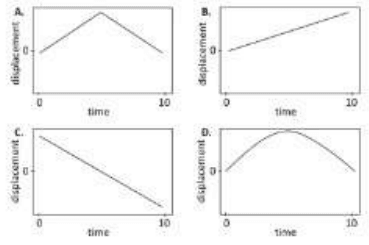
Which one of the following graphs represents the displacement vs time relation for the motion of a ball thrown upward and returning toward the ground, remaining in air for 10 seconds? (Ignore air resistance.)
- 1A
- 2B
- 3C
- 4D
Show answer and solution
Under constant gravity, height = ut − ½gt2, a downward-opening parabola. It rises from zero, peaks at 5 s and returns to zero at 10 s. Graph D shows this. A straight-line peak (A) would need an instant reversal of velocity.
The number 68132 − 31932 is divisible by
- 1both 362 and 1000
- 2362 but not 1000
- 31000 but not 362
- 4neither 362 nor 1000
Show answer and solution
a32 − b32 is divisible by both a − b and a + b (it factorises through a2 − b2). Here a − b = 681 − 319 = 362 and a + b = 1000, so it is divisible by both 362 and 1000.
In an examination 3 medals were awarded for each of 5 subjects. If three candidates won exactly four medals each, and no candidate won just one medal, the total number of medal winners
- 1was exactly 4
- 2was exactly 5
- 3could be either 5 or 6
- 4was exactly 6
Show answer and solution
15 medals were given in all. Three candidates took 12, leaving 3. No one may have exactly one medal, so the remaining 3 cannot be split as 2 + 1 or 1 + 1 + 1, and must all go to one person. That makes 4 medal winners.
Suppose each of my brothers has the same number of children as I have sisters, each of the sister having the same number of children as I have brothers. If my siblings have a total of 12 children, none of them an only child, the number of my siblings is
- 13
- 25
- 36
- 47
Show answer and solution
If I have b brothers and s sisters, the children total b·s + s·b = 2bs = 12, so bs = 6. No one is an only child, so each sibling has at least 2 children, which means s, b ≥ 2. Then (b, s) = (2, 3) or (3, 2), and I have 5 siblings.
In a grid puzzle, each row and column in the 9×9 grid, as well as each 3×3 sub-grid shown with heavy borders, must contain all the digits 1—9.
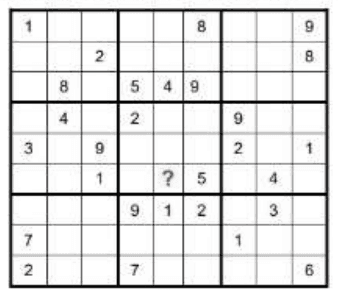
In the given partially filled grid, the digit in the square marked “?” is
- 13
- 29
- 38
- 47
Show answer and solution
Rows 4 and 5 already contain a 9 (in columns 7 and 3), so in the centre box the 9 must go in row 6. Columns 4 and 6 already have a 9 (in rows 7 and 3), so the only free cell is column 5, the “?”. So ? = 9.
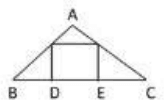
In the given triangle ABC, a square is drawn as shown. Given, ∠BAC = 90°, BC = a, BD = x and EC = y; which of the following is the area of the square?
- 1(a − x)y
- 2(a − y)x
- 3(a − x)(a − y)
- 4xy
Show answer and solution
The square’s corners cut off two small right triangles, BDG and FEC, each similar to ABC. If the square’s side is s, similarity gives x/s = s/y, so s2 = xy.
What is the difference, 11 hours after synchronisation, in the time shown by a standard watch and a watch whose hour and minute hands coincide every 64 minutes?
- 111 min
- 216 min
- 322 min
- 444 min
Show answer and solution
A correct clock’s hands coincide every 720/11 ≈ 65.45 minutes, 11 times in 12 hours. This watch’s hands coincide every 64 minutes, so it completes those 11 coincidences in 11 × 64 = 704 minutes instead of 720. Taken over the 11 coincidence intervals, it is 16 minutes off, which is NTA’s answer.
Six years ago, the ages of three persons were in ratio 3:5:8. If the sum of their ages 8 years from now would be 122, what are their present ages (in years)?
- 115, 25, 40
- 221, 31, 46
- 315, 25, 30
- 421, 26, 37
Show answer and solution
Six years ago the ages were 3k, 5k and 8k. Eight years from now they are 14 years older each: 16k + 42 = 122, so k = 5. Present ages = 15 + 6, 25 + 6 and 40 + 6 = 21, 31, 46.
A test consists of 20 questions. A correct answer fetches 4 marks and a wrong answer is penalised by deducting 1 mark. Unattempted questions fetch nothing. If a candidate with a few wrong answers secures 44 marks, how many questions were attempted?
- 115
- 216
- 317
- 418
Show answer and solution
With c right and w wrong, 4c − w = 44 and c + w ≤ 20. The candidate got a few wrong, so w > 0, and w must be a multiple of 4. w = 4 gives c = 12 (16 attempted), while w = 8 would need 21 questions. So 16 were attempted.
If ab = 5, bc = 7 and ca = 11, which of the following identities is valid?
- 17a = 11b = 5c
- 2√35 a = √55 b = √77 c
- 3√(7/5) a = √(5/11) b = √(11/7) c
- 4√(5/11) a = √(11/7) b = √(7/5) c
Show answer and solution
From ab = 5, bc = 7 and ca = 11, (abc)2 = 385. So a = abc/7, b = abc/11 and c = abc/5, which gives 7a = 11b = 5c = √385.
The shape of a country on a map is approximated by a kite with diagonals of length 300 km each. The minimum possible length of its boundary will be closest to
- 11696 km
- 21131 km
- 3848 km
- 4600 km
Show answer and solution
For a kite whose two diagonals are both 300 km, the perimeter is smallest when it is a square, with the diagonals bisecting each other. Each side = 300/√2 ≈ 212.1 km, so the perimeter ≈ 848 km.
A rectangular paper of sides in the ratio 3:4 is folded in half across the longer side. The process is repeated several times. After how many foldings will the ratio of the sides be 3:4? (Ignore the finite thickness of the paper.)
- 1Never
- 2Every second fold
- 3Every third fold
- 4Every fifth fold
Show answer and solution
Folding a 3 × 4 sheet across the longer side gives 3 × 2, a ratio of 2:3. Folding again across the longer side (3) gives 1.5 × 2, which is 3:4 again. The ratio returns every second fold.
The sum of squares of four integers
- 1can never be divisible by 13
- 2can never be divisible by 15
- 3can be divisible by 17
- 4can never be divisible by 19
Show answer and solution
17 = 42 + 12 + 02 + 02, so a sum of four squares can be divisible by 17. Every positive integer is a sum of four squares (Lagrange), so the “never” options are all false: for example 13 = 9 + 4, 15 = 9 + 4 + 1 + 1 and 19 = 9 + 9 + 1.
Four students Adil, Billy, Ramesh and Diana joined a college in 1991, 1992, 1993 and 1994 but not necessarily in that order. Each student joined one of the four departments, viz. Physics, Chemistry, Mathematics and Biology. No two students joined the same department. One of those who joined the college before 1993 joined Chemistry. No one joined the college after Ramesh. Diana joined Physics. Adil joined one year after Diana but didn’t join Chemistry. Who joined the college in the year 1993?
- 1Adil
- 2Billy
- 3Ramesh
- 4Diana
Show answer and solution
Nobody joined after Ramesh, so he joined in 1994. Diana took physics, and Adil, a year after her, did not take chemistry, so Billy took chemistry before 1993. If Billy joined in 1991, Diana joined in 1992 and Adil in 1993. If Billy joined in 1992, Diana and Adil cannot be consecutive.
In the following finite sequence of integers, how many 9s are divisible by the integers immediately preceding them?
8,3,4,9,3,5,9,5,9,9,4,5,9,5,6,3,3,5,7,2,3,9,9,8,9,3,9,1,9,4
- 13
- 24
- 35
- 46
Show answer and solution
A 9 counts when the integer just before it is 1, 3 or 9. In the sequence as printed, 9s preceded by 9, 3, 9, 3 and 1 qualify, which gives 5. NTA’s key gives 6 (option 4), so the original paper probably differs slightly from this printed sequence.
Vehicle number plates have two letters out of the 26 letters of the English alphabet followed by four decimal digits. How many different number plates are possible if repetition of letters and digits is allowed?
- 126 × 25 × 10 × 9 × 8 × 7
- 226 × 26 × 10 × 10 × 10 × 10
- 3(26 × 25 × 24 × 23 × 10 × 9)/(4 × 3 × 2 × 2)
- 426 × 25 × 24 × 23 × 10 × 9
Show answer and solution
Repetition is allowed, so each of the two letters has 26 choices and each of the four digits 10: 26 × 26 × 10 × 10 × 10 × 10.
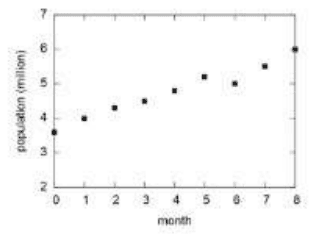
The population of a species (y) changes with the month (x) as shown in the graph. Which of the following equations best describes the population curve?
- 1y = 3x + 3.2
- 2y = 0.96 (x − 4)
- 3y = 0.3x2 + x + 3.6
- 4y = 0.3x + 3.6
Show answer and solution
The points rise almost in a straight line from about 3.6 at month 0 to about 6 at month 8, a slope of about 0.3 per month. y = 0.3x + 3.6 fits. The quadratic would rise far too steeply.
Symbols ⊖, ⊗, ⊘ represent mathematical operations (out of +, −, ÷, ×) which respect the relations
8 ⊘ 5 ⊖ 9 = 53
9 ⊖ 3 ⊗ 2 = 25
What is the value of 2 ⊗ 13 ⊘ 7?
- 1−4
- 28
- 3−89
- 419
Show answer and solution
Try the operations: 8 + 5 × 9 = 53, so ⊘ = + and ⊖ = ×. Then 9 × 3 − 2 = 25, so ⊗ = −. So 2 ⊗ 13 ⊘ 7 = 2 − 13 + 7 = −4.
A circular disk of unit radius rolls along a straight line from P to Q.

Which of the following figures shows the orientation of the disk at Q?
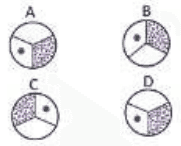
- 1A
- 2B
- 3C
- 4D
Show answer and solution
A unit disk travels 2π per turn without slipping, so 9π is 4.5 turns. Four full turns change nothing, and the extra half turn rotates the pattern by 180°, which gives figure C.
On day 1, a boy puts one coin in his piggy bank. On successive days he adds coins so as to double the number of coins. In another piggy bank, a girl puts 2 coins on day 1 but adds coins on every alternate day so as to double the number of coins. On which day will they put the same number of coins in their piggy banks?
- 1Day 2
- 2Day 3
- 3Day 5
- 4on no day
Show answer and solution
The boy’s bank holds 1, 2, 4 coins on days 1, 2, 3, so he adds 1 on day 2 and 2 on day 3. The girl starts with 2 and doubles on alternate days, so on day 3 she also adds 2. On day 3 they put in the same number, and both banks hold 4.
Part B: Life Sciences (Q21–70)
50 questions; answer any 35. Each carries 2 marks, and a wrong answer costs 0.5.
Which one of the following enzymes does NOT catalyze the oxidation of substrate by reducing the electron acceptor, NAD+?
- 1Lactate dehydrogenase
- 2Pyruvate dehydrogenase
- 3Succinate dehydrogenase
- 4Isocitrate dehydrogenase
Show answer and solution
Succinate dehydrogenase (complex II) oxidises succinate to fumarate using FAD, not NAD+, and passes the electrons to ubiquinone. Lactate, pyruvate and isocitrate dehydrogenases all reduce NAD+.
The pH of endocytic vesicles is 5.2, and the pH of gastric juice is 2.0. The endocytic vesicle has a [H+] that is
- 115.85 times lower than that of gastric juice.
- 20.1585 times lower than that of gastric juice.
- 3158.5 times lower than that of gastric juice.
- 41585 times lower than that of gastric juice.
Show answer and solution
A pH difference of 5.2 − 2.0 = 3.2 units means a 103.2 ≈ 1,585-fold difference in [H+].
One strand of a palindromic dsDNA is composed of 5′-CCGCGGCGG-3′. Which one of the following forms of nucleic acid structures will be adopted in water if sense and antisense strands are mixed in equal proportion followed by annealing?
- 1A-form of double-stranded nucleic acid
- 2B-form of double-stranded nucleic acid
- 3Z-form of double-stranded nucleic acid
- 4Both will remain as single strands
Show answer and solution
The palindromic GC-rich sequence anneals with its complement into a duplex. In ordinary aqueous solution, without high salt or the strict alternating purine–pyrimidine pattern Z-DNA needs, DNA takes the standard B form.
Which one of the following pairs of metabolic intermediates does NOT provide a backbone carbon skeleton for the synthesis of amino acids?
- 1Succinate and citrate
- 23-phosphoglycerate and phosphoenolpyruvate
- 3Ribose 5-phosphate and erythrose 4-phosphate
- 4α-ketoglutarate and oxaloacetate
Show answer and solution
Amino acid skeletons come from 3-phosphoglycerate, PEP, pyruvate, ribose-5-phosphate, erythrose-4-phosphate, α-ketoglutarate and oxaloacetate. Succinate and citrate are not direct precursors.
Fifteen spontaneous Ara− mutants of E. coli that were not able to utilize arabinose as a sole carbon source in minimal synthetic medium at 42°C were isolated. However, interestingly all these mutants were able to use arabinose as the sole carbon source at 30°C. Based on the above information, which one of the following options represents the most likely type of the mutations?
- 1Deletions
- 2Inversions
- 3Frameshift mutations
- 4Mis-sense mutations
Show answer and solution
All 15 mutants work at 30 °C but fail at 42 °C. A temperature-sensitive protein results from missense mutations that destabilise its fold. Deletions, frameshifts and inversions would destroy function at every temperature.
Which one of the following statements about distribution of chromosomes within the interphase nucleus of a mammalian cell is correct?
- 1Chromosomes are randomly distributed within the nuclear volume.
- 2The gene-poor chromosomes tend to locate towards the nuclear envelope.
- 3The larger chromosomes tend to locate at the nuclear periphery.
- 4Centromeric region of all the chromosomes tend to concentrate at the center of the nucleus.
Show answer and solution
Chromosomes occupy defined territories. Gene-poor chromosomes, such as human 18, sit towards the nuclear periphery near the lamina, and gene-rich ones, such as 19, sit towards the interior. The arrangement is not random.
Which cell cycle phase is typically the shortest in mammalian cells?
- 1G0 phase
- 2G1 phase
- 3G2 phase
- 4Mitosis
Show answer and solution
In a typical 24-hour cycle, M phase takes about an hour, much shorter than G1, S or G2. G0 is a resting state outside the cycle.
Porins, which are normally present on the outer mitochondrial membrane, reach their destination by
- 1direct synthesis of porins on mitochondria membrane by the mitochondrial protein synthesis machinery.
- 2synthesis on the ER and transport via vesicles to the mitochondria.
- 3synthesis in the cytosol, import by TOM complex and insertion from the inter-mitochondrial membrane space.
- 4synthesis in the cytosol, import by TIM complex and insertion in the membrane.
Show answer and solution
Porin (VDAC) is made in the cytosol, enters through the TOM complex, and is passed by small TIM chaperones to the SAM complex, which inserts it into the outer membrane from the intermembrane-space side.
During replication, over-winding of DNA is caused by ____ and removed by ____.
- 1primase, topoisomerase
- 2primase, single stranded binding protein
- 3helicase, gyrase
- 4helicase, DNA polymerase
Show answer and solution
Unwinding by helicase builds up positive supercoils (over-winding) ahead of the fork. DNA gyrase (topoisomerase II) removes them.
P-bodies are discrete cytoplasmic collections of RNAs and proteins that are involved in:
- 1Deadenylation, decapping and mRNA degradation
- 2Deadenylation and mRNA degradation only
- 3Deadenylation and decapping only
- 4Decapping and mRNA degradation only
Show answer and solution
P-bodies contain the 5′→3′ decay machinery: deadenylases (CCR4–NOT), the decapping enzymes (Dcp1/2) and the exonuclease Xrn1 for degradation. They also store translationally repressed mRNAs.
Which one of the following functions is NOT facilitated by a tmRNA?
- 1Addition of a stop codon at the 3′ end of a defective and/or truncated mRNA.
- 2Addition of a proteolysis-inducing tag at carboxyl terminus of unfinished polypeptide.
- 3Release of defective and/or truncated mRNA from the ribosome.
- 4Recycling of the stalled ribosomes.
Show answer and solution
tmRNA rescues stalled bacterial ribosomes. It acts as a tRNA and then as an mRNA, adding an SsrA degradation tag to the nascent chain, releasing the faulty mRNA and freeing the ribosome. It does not add a stop codon to the broken mRNA; the ribosome switches to the tmRNA’s own reading frame.
RNA polymerase is an enzyme that transcribes DNA sequences into RNA. Which one of the following is NOT a property of the RNA polymerase?
- 1RNA polymerases initiate RNA synthesis without primers that provide a free 3′OH group
- 2RNA polymerases have high fidelity due to the action of proof-reading endonuclease activity
- 3In eukaryotes, RNA that encodes ribosomal proteins is transcribed by RNA polymerase II
- 4RNA polymerases initiate RNA synthesis from defined regions of DNA
Show answer and solution
RNA polymerases start without primers, at defined promoters, and Pol II makes mRNAs for ribosomal proteins. Statement 2 is the incorrect one: RNA polymerases have only limited proofreading (pyrophosphorolytic and hydrolytic editing) and much lower fidelity than DNA polymerases, with no dedicated proofreading endonuclease.
Choose the INCORRECT statement:
- 1Tetanospasmin is associated with Tetanus
- 2Tetanospasmin is a neurotoxin
- 3Tetanospasmin facilitates the release of gamma-aminobutyric acid at synapses
- 4Immunization with toxoids is used for the prevention of tetanus.
Show answer and solution
Tetanus toxin is a neurotoxin that cleaves synaptobrevin in inhibitory interneurons, blocking the release of GABA and glycine and causing spastic paralysis. It does not facilitate GABA release, so statement 3 is the incorrect one. Toxoid vaccines prevent tetanus.
Phosphatidylinositol (PI) is unusual among membrane lipids because it can undergo reversible phosphorylation at multiple sites on the inositol head to generate a variety of phosphorylated PI lipids called phosphoinositides. In a cell signaling event, the enzyme that directly converts PI(4,5)P2 to PI(3,4,5)P3 is:
- 1PI3-Kinase
- 2PLCβ
- 3PTEN
- 4Protein Kinase B
Show answer and solution
Class I PI3-kinase phosphorylates the 3-position of PI(4,5)P2 to make PIP3, which recruits Akt and PDK1. PTEN reverses this, and PLCβ cleaves PIP2 instead.
Column X represents the type of junctions and column Y represents the proteins associated with the junctions.
| Column X | Column Y | ||
|---|---|---|---|
| A | Anchoring junction | i. | Claudins |
| B | Occluding junction | ii. | Delta-Notch |
| C | Channel-forming junction | iii. | Desmoglein |
| D | Signal-relaying junction | iv. | Connexin |
Which one of the following options is a correct match between terms of Columns X and Y?
- 1A-iii, B-i, C-iv, D-ii
- 2A-iv, B-i, C-iv, D-iii
- 3A-iii, B-ii, C-iv, D-i
- 4A-ii, B-iii, C-i, D-iv
Show answer and solution
Anchoring junctions (desmosomes) use desmogleins (A–iii). Occluding (tight) junctions use claudins (B–i). Channel-forming gap junctions use connexins (C–iv). Signal-relaying contacts include Delta–Notch (D–ii).
Kaposi’s sarcoma is caused by
- 1Epstein-Barr virus
- 2HIV and HHV-8
- 3HTLV type1
- 4HPV
Show answer and solution
Kaposi’s sarcoma is caused by HHV-8 (KSHV), mostly in people immunosuppressed by HIV, which is why NTA’s answer names both.
Sperm ____, which helps in penetration of the egg during fertilization in mammals, contains ____.
- 1lysin, hyaluronidase
- 2fertilizin, hyaluronidase
- 3lysin, hyaluronic acid
- 4fertilizin, hyaluronic acid
Show answer and solution
Sperm lysins, the acrosomal enzymes, include hyaluronidase, which disperses the hyaluronic acid between the cumulus cells, and acrosin, which digests the zona.
Which one of the following statements regarding the developmental potential of cells in embryo is INCORRECT?
- 1The cells of the 4-cell stage mouse embryo are totipotent.
- 2The cells of inner cell mass of the mouse blastocyst differentiate into trophectoderm, mesoderm and endoderm.
- 3Spermatogonial stem cells in testis are unipotent.
- 4Haematopoietic stem cells which can differentiate into blood cells are multipotent.
Show answer and solution
Inner cell mass cells form the epiblast and primitive endoderm, and from the epiblast come all three germ layers, but they do not form trophectoderm, which has already separated. So statement 2 is the incorrect one. Four-cell blastomeres are totipotent, spermatogonial stem cells unipotent, and HSCs multipotent.
Which one of the following statements is correct for dosage compensation in human?
- 1X-chromosome inactivation in female occurs in a zygote immediately after fertilization.
- 2X-chromosome inactivation is non-random, in some individuals maternal X is inactivated while in others paternal X-chromosome is inactivated.
- 3Y-chromosome of males is seen as Barr body.
- 4The body of female is a mosaic of cells, some having paternal X- and others having maternal X-inactivated.
Show answer and solution
X-inactivation happens after implantation, not in the zygote. It is random in each cell and then inherited by its descendants, so a female is a mosaic of cells with either the maternal or the paternal X silenced. The Barr body is the inactive X.
Which one of the following floral homeotic genes is transcribed in all four whorls during flower development?
- 1AP1
- 2AP2
- 3AP3/PI
- 4AG
Show answer and solution
APETALA2 is transcribed in all four whorls. Its protein is restricted to whorls 1 and 2 by miR172. AP1, AP3/PI and AG are each transcribed only in their own whorls.
Which one of the following statements is INCORRECT regarding plant phytochrome (PHY), cyanobacterial phytochrome1 (Cph1) and bacterial phytochrome like protein (BphP)?
- 1PHY has two PRD domains in the C-terminal moiety.
- 2Cph1 and BphP has histidine kinase domains at the N-terminal moiety.
- 3GAF domain is present in N-terminal moiety of PHY, Cph1 and BphP.
- 4The cysteine residue that forms the linkage is located in the GAF domain in canonical phytochromes such as PHY and Cph1.
Show answer and solution
In Cph1 and bacteriophytochromes the histidine-kinase output domain is at the C-terminal end, as in plant phytochromes, where the HKRD and PRD repeats are C-terminal. So statement 2 is the incorrect one. The chromophore-binding GAF domain is N-terminal.
Which one of the following is referred to as tuberonic acid?
- 1Methyl jasmonate
- 2cis-jasmone
- 3Jasmonoyl-1-β-glucose
- 412-Hydroxy-(+)-7-isojasmonate
Show answer and solution
Tuberonic acid is 12-hydroxy-jasmonic acid (12-OH-JA), which induces tuber formation in potato.
The defect in a major semi-dwarfing gene of rice, sd-1, leads to cultivar with short, thick culms and improved lodging resistance. The gene is related to which one of the following phytohormones?
- 1Gibberellins
- 2Abscisic acid
- 3Jasmonic Acid
- 4Salicylic acid
Show answer and solution
sd-1, the rice “green revolution” dwarfing gene, encodes GA 20-oxidase 2, an enzyme of gibberellin biosynthesis. Lower GA gives short, sturdy culms.
In the model plant Arabidopsis thaliana, methionine is a precursor amino acid in the biosynthesis of
- 1Alkaloids
- 2Glucosinolates
- 3Phenolics
- 4Terpenoids
Show answer and solution
In Arabidopsis, chain-elongated methionine is the precursor of the aliphatic glucosinolates.
How much hemoglobin is present approximately in each normal human red blood cell?
- 119 pg
- 229 pg
- 339 pg
- 449 pg
Show answer and solution
Mean corpuscular haemoglobin is about 27–32 pg per red cell, so about 29 pg.
Which one of the following is involved in the pinching-off of the neck of invaginating coated pit to form endocytotic vesicle at the pre-synaptic terminal?
- 1Synaptojanin
- 2AP2
- 3Clathrin
- 4Dynamin
Show answer and solution
Clathrin and AP2 shape the coated pit. The GTPase dynamin forms a ring around the neck and, by hydrolysing GTP, pinches the vesicle off. At synapses this allows rapid vesicle recycling.
Aldosterone is synthesized exclusively in zona glomerulosa due to the presence of ________ enzyme in addition to a dehydrogenase.
- 111 β-hydroxylase
- 217 α-hydroxylase
- 318-hydroxylase
- 421-hydroxylase
Show answer and solution
Only zona glomerulosa cells express aldosterone synthase (CYP11B2), which carries out the 11β- and 18-hydroxylation and the 18-oxidation that turn corticosterone into aldosterone.
Which one of the following hormones has no supply store in the cells where it is synthesized?
- 1Catecholamines
- 2Insulin
- 3T3 and T4
- 4Steroids
Show answer and solution
Steroid hormones are lipid-soluble and diffuse out as soon as they are made, so they are produced on demand and not stored. Catecholamines and insulin are stored in granules, and T3/T4 are stored in thyroglobulin in the colloid.
Which one of the following is true for Genome-wide association study (GWAS)?
- 1There is a need to make controlled crosses or work with human families with known parent-offspring relationship.
- 2All alleles in the population are assayed at the same time.
- 3Single nucleotide polymorphisms (SNPs) cannot be used for such studies.
- 4Knowledge about candidate genes is essential.
Show answer and solution
GWAS tests SNPs across the genome in many unrelated individuals, so it surveys all the alleles segregating in the population at once and exploits historical recombination. It needs no controlled crosses or families and no prior candidate genes.
Which one of the following options contains only those types of mapping populations that are characterized by ‘true-breeding’ individuals?
- 1RILs and F2 populations
- 2F2 populations and BC1F2
- 3Doubled haploid populations and BC1F2
- 4Doubled haploid populations and RILs
Show answer and solution
Doubled haploids are completely homozygous in one step, and RILs become nearly homozygous after repeated selfing. Both are true-breeding. F2 and BC1F2 plants are still segregating.
In a family, the father has an X-linked mutation causing a late-onset lethal disorder and the mother is not a carrier. Based on the above information, which one of the following statements about the children the couple may have is correct?
- 1There is a 50% chance that the son will show the disorder.
- 2No children will show the disorder.
- 3The probability that the parents have a daughter carrying a mutant allele is 25%.
- 4All daughters will carry the mutant allele.
Show answer and solution
An affected father passes his X to every daughter and his Y to every son. So all daughters carry the mutant allele, and sons are unaffected because their mother is not a carrier.
In a mutagenesis experiment, the following pedigree was obtained. All progeny had the same phenotype.
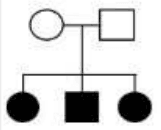
The mutation is most likely to have occurred
- 1during maturation of the egg cell.
- 2in the maternal somatic cell.
- 3in the mother in the precursor to all germ cells.
- 4in the embryo during development.
Show answer and solution
Normal parents had children who all show the new phenotype. The mutation must be in the mother’s germ-line precursor, before her germ cells divided, so every egg carries it (germ-line mosaicism). A mutation during maturation of a single egg would affect only one child.
Which one of the following statements is NOT correct about collenchyma?
- 1Collenchyma cell walls are thick and they require more glucose for their production.
- 2Collenchyma cells are rigid.
- 3Collenchyma is usually produced in shoot tips and young petioles.
- 4Collenchyma is generally not present in subterranean shoots and roots.
Show answer and solution
Collenchyma has unevenly thickened but flexible, plastic primary walls. It supports growing organs while still letting them elongate, so it is not rigid. Rigid support comes from sclerenchyma.
Which one of the following terms describes the biological classification system based on common ancestry?
- 1Linnean taxonomy
- 2Binomial nomenclature
- 3Phylogenetic classification
- 4Rank based classification
Show answer and solution
A phylogenetic (cladistic) classification groups organisms by common ancestry, so every named group is a clade. Linnaean ranks and binomial names are naming conventions.
Select the species that was thought to be extinct because of climate change and habitat loss, but was recently rediscovered in the year 2022.
- 1Nicobar Wart Frog
- 2Harlequin Frog
- 3Nilgiri Cricket Frog
- 4Lemur Leaf Frog
Show answer and solution
NTA’s answer is the harlequin frog (Atelopus), one of a group of Neotropical toads devastated by chytrid fungus and climate change, several species of which were rediscovered after decades presumed extinct.
Which one of the following four plant families has the largest number of species?
- 1Brassicaceae
- 2Cucurbitaceae
- 3Cactaceae
- 4Rosaceae
Show answer and solution
Among the options, Rosaceae has the most species (about 4,800). Brassicaceae has about 4,000, Cactaceae about 1,800 and Cucurbitaceae about 1,000.
Which one of the following correctly shows the total estimated biomass of the lifeforms on Earth given here, in increasing order?
- 1Bacteria < Viruses < Fungi
- 2Bacteria < Fungi < Viruses
- 3Viruses < Fungi < Bacteria
- 4Fungi < Viruses < Bacteria
Show answer and solution
Global biomass estimates (Bar-On and colleagues, 2018) are roughly viruses 0.2, fungi 12 and bacteria 70 gigatonnes of carbon. Increasing order: viruses < fungi < bacteria.
Which one of the following options lists landmasses that were all a part of the ancient Gondwana supercontinent?
- 1Australia, New Zealand, and North America
- 2Africa, Europe, India, New Zealand, and South America
- 3Africa, Europe, India, Madagascar, and North America
- 4Africa, Australia, Antarctica, India, Madagascar, and South America
Show answer and solution
Gondwana comprised Africa, South America, Antarctica, Australia, India and Madagascar, with New Zealand and Arabia. Europe and North America belonged to Laurasia.
Which one of the following anthropogenic activities contributes the most nitrogen to the global nitrogen cycle?
- 1Industrial production of fertilizers
- 2NOx production due to combustion of fossil fuels
- 3Nitrogen fixation by soyabean farming
- 4Nitrogen fixation by cultivation of legumes (excluding soyabean)
Show answer and solution
Industrial (Haber–Bosch) fertiliser production fixes about 120 million tonnes of nitrogen a year, the largest human input, more than legume cultivation (about 40) or NOx from combustion (about 30).
In which of the following ecosystems would the largest percentage of Net Primary Productivity (NPP) be taken up by the grazing food chain?
- 1Tropical rainforest
- 2Temperate deciduous forest
- 3Algal seabed
- 4Open ocean
Show answer and solution
In the open ocean, NPP comes from tiny, nutritious phytoplankton that zooplankton eat, so a large share (often over 40%) goes to grazers. In forests most NPP is wood and litter that goes to decomposers.
Which one of the following geological events in the Cretaceous had a massive impact on the climate and biodiversity of India?
- 1Origin of Tibetan plateau
- 2Deccan Trap volcanic activity
- 3Formation of Lonar Lake
- 4Origin of Himalayan mountains
Show answer and solution
The Deccan Traps, massive basalt eruptions at the Cretaceous–Paleogene boundary (about 66 million years ago), changed climate and biodiversity in India and possibly worldwide, alongside the Chicxulub impact.
Monogamy in sexually reproducing animals is seemingly paradoxical given that males must maximise their number of matings for higher fitness. Yet, many birds are known to be monogamous. Which one of the following statements represents a scenario where monogamy in birds is LEAST likely to evolve?
- 1Poor quality of habitat wherein resources are hard to find
- 2Males guard females after mating with them
- 3Mates are scattered and hard to find
- 4Offspring do not require elaborate parental care
Show answer and solution
Monogamy evolves when males gain more by staying: when offspring need care from both parents, when mates are scarce and scattered, or when guarding a mate pays. If offspring need little care, males do better seeking more matings, so monogamy is least likely.
Sometimes similar traits or characteristics evolve in two distinct lineages independently, such as venoms in scorpions and snakes. This process can be described as:
- 1Convergent evolution
- 2Microevolution
- 3Macroevolution
- 4Divergent evolution
Show answer and solution
Independent evolution of similar traits in unrelated lineages, such as venom in scorpions and snakes, is convergent evolution.
During animal cell culture, which one of the following cell types would NOT require trypsin for passaging?
- 1Epithelial cells
- 2Hematopoietic cells
- 3Fibroblasts
- 4Myoblasts
Show answer and solution
Haematopoietic cells grow in suspension, so they are passaged by simple dilution. Adherent cells such as epithelial cells, fibroblasts and myoblasts need trypsin to detach.
In the production of alcohol by fermentation, in the absence of oxygen, yeasts convert glucose to pyruvate and pyruvate to ethanol. Fermentation promotes glycolysis by
- 1Converting acetaldehyde to alcohol to prevent feed-back inhibition
- 2Generating NADH for mitochondrial ATP generation
- 3Preventing toxicity of acetaldehyde
- 4Generating NAD+ for glycolysis
Show answer and solution
Reducing acetaldehyde to ethanol uses NADH and regenerates NAD+, which glycolysis needs at glyceraldehyde-3-phosphate dehydrogenase to keep making ATP without oxygen.
Which one of the following is NOT required in the blood glucose biosensor?
- 1Glucose oxidase as biologically active component
- 2Electrode as electrochemical transducer
- 3Piezoelectric crystal as sensor
- 4FAD as coenzyme of glucose oxidase
Show answer and solution
A glucose biosensor needs glucose oxidase with its FAD cofactor and an electrochemical electrode transducer. A piezoelectric crystal belongs to mass-sensing biosensors, not glucometers.
Which one of the following combinations of excitation light and objectives gives the best lateral resolution in a fluorescence microscope?
- 1480nm, 63X, 1.4NA
- 2650nm, 63X, 1.4NA
- 3550nm, 100X, 1NA
- 4480nm, 100X, 1.1NA
Show answer and solution
Resolution d = 0.61λ/NA, so the shortest wavelength with the highest NA wins: 480 nm with NA 1.4 gives about 209 nm. Magnification does not change resolution.
Which one of the following techniques allows the study of all three types of interactions namely, protein:protein, protein:DNA, and protein:RNA?
- 1Differential display
- 2Phage display
- 3ChIP assay
- 4Southwestern blotting
Show answer and solution
Phage display shows peptides or proteins on phage surfaces and selects binders from libraries against any target: proteins, DNA or RNA. ChIP studies protein–DNA binding only, and South-western blots protein–DNA.
What type of electromagnetic radiation is used in biomolecular NMR spectroscopy?
- 1Radio waves
- 2Beta emissions
- 3X-ray waves
- 4Microwaves
Show answer and solution
NMR detects transitions between nuclear spin states in a strong magnet, which absorb radio-frequency energy (hundreds of MHz).
Which one of the following statistical methods compares the means of the populations?
- 1t-test
- 2Chi-square test
- 3Analysis of Variance
- 4Principal Component Analysis
Show answer and solution
The t-test compares two means, and ANOVA compares two or more. NTA accepted both. Chi-square compares frequencies, and PCA reduces dimensions.
Part C: Life Sciences, analytical (Q71–145)
75 questions; answer any 25. Each carries 4 marks, and a wrong answer costs 1.
The central rod domain of keratin protein is 300 amino acids in length. What is the approximate length (in Å) of the rod domain if the peptide consists of
(i) distorted α-helix
(ii) true α-helix
(iii) anti-parallel β-sheet
- 1(i) 425 Å; (ii) 450 Å; (iii) 1041 Å
- 2(i) 450 Å; (ii) 450 Å; (iii) 840 Å
- 3(i) 425 Å; (ii) 425 Å; (iii) 1004 Å
- 4(i) 340 Å; (ii) 425 Å; (iii) 104 Å
Show answer and solution
At about 1.42 Å per residue in a coiled coil, 300 residues give about 425 Å. At 1.5 Å in a true α-helix, 450 Å. At about 3.47 Å in an antiparallel β-strand, about 1,041 Å.
Which one of the following nucleic acids with same concentrations in water, will form a stable stem-loop structure upon annealing by heating and flash cooling on ice?
- 15′-GGCUUAUUUUCUUCGG-3′
- 25′-CCGAACUUUUAUUCGG-3′
- 35′-AUGCCAUUUUCGGCUU-3′
- 45′-AGAGCGUUUUAUUCGG-3′
Show answer and solution
A stable hairpin needs a 5′ segment complementary to the 3′ end. In 5′-CCGAACUUUUAUUCGG-3′, CCGAA pairs perfectly with UUCGG (its reverse complement), forming a GC-rich stem around a loop. Flash cooling favours this intramolecular hairpin over duplexes.
The amino acid sequence of tetrapeptides (P, Q, R) is shown below.
P) Asp-Gly-Asp-Ser Q) Gly-Ser-Arg-Gly R) Gly-Lys-Arg-Ala
(i) Calculate the net charge on the above tetrapeptides at pH 7.0
(ii) If the mixture of the above tetrapeptides is separated on a cation-exchange column at pH 7.0, which tetrapeptide will elute last?
Choose the correct answer given below.
- 1(i) P, −2; Q, +1; R, +2 and (ii) R
- 2(i) P, −3; Q, +2; R, +3 and (ii) Q
- 3(i) P, −1; Q, +1; R, +1 and (ii) P
- 4(i) P, −1; Q, +0; R, +1 and (ii) R
Show answer and solution
At pH 7, each peptide has N-terminus +1 and C-terminus −1. P (Asp, Asp) = −2. Q (Arg) = +1. R (Lys, Arg) = +2. A cation exchanger holds the most positive peptide longest, so R elutes last.
In a mammalian cell undergoing active glycolysis, what would be the effect of a sudden increase in the concentration of metabolites, AMP, citrate, ATP, and glucose-6-phosphate?
- A. Increased ATP inhibits glycolysis.
- B. Increased AMP stimulates glycolysis.
- C. Increased citrate and glucose-6-phosphate stimulate glycolysis.
- D. Increased AMP and citrate inhibits glycolysis.
Which one of the following represents the combination of all correct statements?
- 1C and D
- 2B and D
- 3A and B
- 4A and C
Show answer and solution
High ATP inhibits PFK (A true), and AMP relieves that inhibition and stimulates glycolysis (B true). Citrate and glucose-6-phosphate inhibit glycolysis (PFK and hexokinase), so C and D are false.
You have purified an enzyme that has a molecular weight of 60 kDa. You run this protein on an SDS-PAGE gel and get the following results.
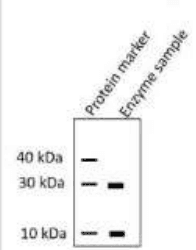
Which of the following statements is valid for the quaternary structure of this enzyme?
- 1Two subunits of 30 kDa
- 2One subunit of 30 kDa and three subunits of 10 kDa
- 3Six subunits of 10
- 4Three subunits of 30 kDa and one subunit of 10 kDa
Show answer and solution
On SDS-PAGE the 60 kDa enzyme gives bands at 30 and 10 kDa. The only subunit set that adds up to 60 and includes both sizes is one 30 kDa subunit plus three 10 kDa subunits.
What is the V0/Vmax ratio for an enzymatic reaction when [S] = 3 Km and 9 Km, respectively?
- 10.65 and 0.83
- 20.55 and 1.0
- 30.93 and 1.2
- 40.75 and 0.9
Show answer and solution
V0/Vmax = [S]/(Km + [S]). At 3Km: 3/4 = 0.75. At 9Km: 9/10 = 0.90.
P. aeruginosa makes a blue-green pigment called pyocyanin. To understand the pyocyanin biosynthetic pathway, mutants which cannot make pyocyanin were isolated. Six such mutants are crossed with each other and the data is given below:
| Mutant | 1 | 2 | 3 | 4 | 5 | 6 |
|---|---|---|---|---|---|---|
| 1 | − | + | + | + | + | − |
| 2 | + | − | + | + | + | + |
| 3 | + | + | − | + | + | + |
| 4 | + | + | + | − | + | + |
| 5 | + | + | + | + | − | + |
| 6 | − | + | + | + | + | − |
− is pyocyanin negative; + pyocyanin positive
Based on this data, can you predict how many genes are responsible for the pyocyanin production?
- 1One
- 2Two
- 3Five
- 4Six
Show answer and solution
Pairs that restore pigment (+) complement each other, so they are in different genes. Mutants 1 and 6 fail to complement each other, so they share a gene. Everything else complements. Groups: {1, 6}, 2, 3, 4 and 5: five genes.
Iron (Fe) is taken up by cells via receptor-mediated endocytosis utilizing transferrin and transferrin receptor. In a cell line with a mutation in the transferrin receptor that is unable to interact with transferrin at pH (4-6), which one of the following steps will be first affected in this pathway?
- 1Binding of transferrin to iron in plasma.
- 2Association of iron bound transferrin with transferrin receptor on the plasma membrane.
- 3Release of iron in the endosomes.
- 4Recycling of transferrin to the plasma membrane.
Show answer and solution
In the endosome at pH 5–6, iron is released but apo-transferrin stays bound to its receptor and recycles to the surface, where neutral pH releases it. A receptor that cannot hold transferrin at acidic pH loses apo-transferrin in the endosome, so transferrin recycling fails first.
In yeast, temperature-sensitive mutants of cell cycle regulators, cdc2 (the key cyclin-dependent kinase), cdc13 (required for telomeric DNA replication), and cdc13 rad9 (that carries an additional mutation in the DNA damage sensor) were isolated. When grown in non-permissive temperature for a few hours, different phenotypes were observed in these mutants. Choose the option that correctly describes the most likely phenotype for all of these mutants.
- 1The cdc2 mutants will arrest in G1/S, cdc13 in M and cdc13 rad9 in S-phase.
- 2The cdc2 mutants will arrest after a few divisions in G1, cdc13 in M and cdc13 rad9 in S-phase.
- 3The cdc2 mutants will arrest in G1/S, G2 and M, cdc13 in G2 and cdc13 rad9 will continue to divide for a few generations.
- 4The cdc2 mutants will arrest in G1/S, G2 and M, cdc13 in G1 and M and cdc13 rad9 in all phases of the cell cycle.
Show answer and solution
cdc2 encodes Cdk1, needed at both G1/S and G2/M, so mutants arrest at those points. cdc13 leaves damaged, uncapped telomeres, so the Rad9 checkpoint arrests cells in G2. Without rad9 there is no checkpoint, so cdc13 rad9 cells keep dividing for a few generations, and die.
The statements below attempt to describe a few characteristics of Alu repeats found in the human genome
- A. Alu elements are a class of short interspersed elements (SINEs).
- B. SINEs are autonomous transposons.
- C. Alu repeat originated from cDNA copies of 7SL RNA.
- D. Alu repeats have a relatively high AT content.
- E. They are preferentially located in the gene-poor G chromosome bands.
Which one of the following options shows combination of all correct statements?
- 1A, B and E
- 2B, C and D
- 3A and C only
- 4C and E only
Show answer and solution
Alu elements are primate SINEs (A) derived from 7SL RNA (C). They are non-autonomous, relying on LINE-1 machinery, are GC-rich, and are concentrated in gene-rich R bands, so B, D and E are false.
In C. elegans, PAR proteins segregate at the cell cortex in the zygote to establish cell polarity. This is dependent on the regulation of the cortical actin cytoskeleton by RhoA. An investigator sought to directly inhibit actin polymerization to analyze the impact of this inhibition on PAR protein localization. Which one of the following chemicals would be the most suitable?
- 1Taxol
- 2Colchicine
- 3Latrunculin
- 4LY294002
Show answer and solution
Latrunculin binds actin monomers and blocks polymerisation. Taxol and colchicine act on microtubules, and LY294002 inhibits PI3-kinase.
Researcher plans to study protein trafficking into the endoplasmic reticulum (ER). For this purpose, they plan different experimental conditions shown below:
- A. The cytosol is mixed with mRNA that codes for a secreted protein, followed by western blotting with antibodies against secreted protein.
- B. The cytosol is mixed with mRNA that codes for a secreted protein and rough microsomes, followed by western blotting with antibodies against secreted protein.
- C. The cytosol is mixed with mRNA that codes for a secreted protein and rough microsomes followed by protease treatment. Subsequently, western blotting with antibodies against secreted protein is done.
Consider that mRNA that codes for a secreted protein is added in abundant amount, which experimental control/s would be the best to confirm the polypeptide entry into the ER?
- 1A and B only
- 2B only
- 3C only
- 4A, B and C
Show answer and solution
To show entry into the ER you need all three. Mixture A, without microsomes, shows the size of the full-length precursor. Mixture B, with microsomes, shows the smaller, signal-cleaved form. Mixture C, protease after microsomes, shows the protein is protected inside the vesicles. A, B and C.
Following statements were made about mRNA splicing:
- A. Involvement of a cis-acting branchpoint site (or branchpoint sequence) present near 3′ end of each exon is essential for splicing.
- B. In the first step of splicing reaction, 2′-OH of the conserved U at the branch-site acts as a nucleophile to attack the phosphoryl group of the conserved G in the 5′ splice site.
- C. The newly liberated intron adapts shape of a lariat due to joining of the 5′ end of the intron to the branchpoint.
- D. During the splicing process, there is no net gain in the number of chemical bonds.
- E. Prp22 (a DEAD-box helicase) is required for stripping the spliced mRNA from the spliceosome.
Which one of the following options shows combination of all correct statements?
- 1B, C, D
- 2C, D, E
- 3A and E only
- 4B and D only
Show answer and solution
C, D and E are correct: the intron is released as a lariat, splicing is two transesterifications with no net gain in bonds, and Prp22 releases the mRNA. A is wrong: the branch point is in the intron, near its 3′ end. B is wrong: the nucleophile is the 2′-OH of the branch-point A.
Given below is the structure of a gene whose transcription is terminated in a Rho-independent manner. When the terminator is operational, the short transcript of 150 bases is formed and when it is not operational, a longer transcript of 200 bases is formed. A researcher generated several mutations in the terminator region and examined the transcripts obtained.

The manipulations done are:
- A. Three nucleotides of the string of 8Ts were replaced by GCC.
- B. The 8T sequence was transferred to the template strand.
- C. The sequences that generate the paired stem were altered to disrupt pairing.
- D. The sequences that generate the paired stem were altered to disrupt pairing, followed by introduction of compensatory mutations to restore pairing.
Choose the option that correctly predicts the potential transcript size in each of these cases.
- 1Short transcript in A and D; long in B and C
- 2Long transcript in A, B and D; short in C
- 3Short transcript in B and D; long in A and C
- 4Long transcript in A, B and C; short in D
Show answer and solution
An intrinsic terminator needs a GC-rich hairpin followed by a run of U’s in the RNA. Weakening the U-tract (A), moving it to the template strand (B) or breaking the stem (C) all stop termination, giving the long transcript. Compensatory changes that restore the stem (D) restore termination, giving the short one.
Following statements were made about initiation of translation in eukaryotes.
- A. The eIF2 facilitates correct recognition and binding of ribosomal subunits.
- B. The eIF2B activates eIF2 by replacing its GDP with GTP.
- C. The eIF3 binds to the 60S ribosomal subunit and inhibits its reassociation with the 40S subunit.
- D. eIF5 promotes association between the 60S ribosomal subunit and the 48S complex.
- E. The eIF6 binds to the 60S ribosomal subunit and blocks reassociation with the 40S subunit.
Which one of the following options shows combination of all correct statements?
- 1A, B, D
- 2B, D, E
- 3B, C, E
- 4A, C, D
Show answer and solution
B is true: eIF2B exchanges GDP for GTP on eIF2. D is true: eIF5 and eIF5B drive 60S joining. E is true: eIF6 keeps 60S subunits from joining 40S prematurely. A is wrong: eIF2’s job is to deliver Met-tRNAi. C is wrong: eIF3 binds the 40S subunit.
Following statements were made about rolling circle mechanism of replication.
- A. It occurs unidirectionally, with only one replicating fork.
- B. The E. coli ΦX174 phage uses this mechanism to replicate double-stranded circular genome.
- C. E. coli utilizes this mechanism to replicate its double-stranded DNA genome.
- D. In λ, the progeny DNA may range several genomes long before it is packaged.
- E. The lagging strand is not formed in rolling circle mechanism of replication.
Which one of the following options shows the combination of all correct statements?
- 1A and C
- 2A and D
- 3B and C
- 4D and E
Show answer and solution
Rolling-circle replication has a single fork moving one way (A). Late in λ infection it makes concatemers several genomes long for packaging (D). The φX174 genome is single-stranded, E. coli replicates its chromosome by θ replication, and a lagging strand does form, so B, C and E are false.
A portion of an mRNA encoding a protein is shown below, with the start codon underlined.
5′…CCUCAAACAGACACCAUGUUGCACCUGACUCCU…3′
Which one of the following tRNAs is most likely used for translating the second codon in the open reading frame of the protein?
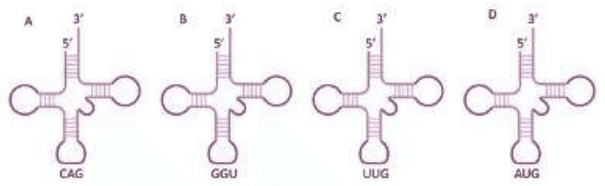
- 1A
- 2B
- 3C
- 4D
Show answer and solution
The second codon after AUG is UUG (leucine). NTA’s key picks tRNA A, a leucine tRNA (anticodon CAG), choosing by amino-acid identity. By strict pairing, UUG would be read by an anticodon CAA or UAA.
The table below represents some protein modifications in Column X and their functions in Column Y.
| Column X: Protein modification | Column Y: Function | ||
|---|---|---|---|
| a | Palmitoylation | i. | Protein degradation |
| b | polySUMOylation | ii. | Membrane anchoring |
| c | Glycosylphosphatidylinositol | iii. | Lysosomal targeting |
| d | Mannose-6-phosphate | iv. | Protein folding |
Which one of the following options represents all correct matches between Column X and Column Y?
- 1a-ii; b-i; c-iv; d-iii
- 2a-i; b-iv; c-ii; d-iii
- 3a-ii; b-i; c-ii; d-iii
- 4a-iv; b-iv; c-ii; d-i
Show answer and solution
Palmitoylation anchors proteins to membranes (a–ii). PolySUMO chains recruit SUMO-targeted ubiquitin ligases, which leads to degradation (b–i). A GPI anchor tethers proteins to the outer leaflet (c–ii). Mannose-6-phosphate targets enzymes to lysosomes (d–iii).
Bacteria employ various mechanisms to invade or enter host cells, which are either phagocytic or non-phagocytic in nature. Given below are some of the mechanisms which are generally used for carrying out this process.
- A. Some bacteria express a protein called invasin that is recognized by host-cell β1 integrins.
- B. Actin polymerization along with assembly of clathrin coat results in the internalization of bacteria by zipper mechanism.
- C. Some bacteria, including Salmonella enterica, use trigger mechanism to inject a set of effector molecules in the cytosol through type III secretion system.
- D. Some bacteria attach to host cell surface receptors inducing local elevation of Ca2+ in cell cytosol, leading to the fusion of lysosomes with bacteria containing plasma membrane vesicles.
Which one of the following represents the combination of correct mechanisms for invading non-phagocytic cells?
- 1A, B and C
- 2B, C and D
- 3A, B and D
- 4A, C and D
Show answer and solution
Yersinia invasin binds β1 integrins (A). Listeria enters by a zipper mechanism that uses actin and the clathrin machinery (B). Salmonella uses the trigger mechanism, injecting effectors through its type III system to ruffle the membrane (C). All three are entry routes into non-phagocytic cells.
The cAMP-PKA-CREB pathway regulates many important biological processes, from hormone synthesis to inducing long-term memory in the brain. The following statements describe the effects of mutations in the components of the pathway on gene transcription by CREB.
- A. Loss of function mutation in a cAMP binding site of the PKA regulatory subunit leads to the inactivation of gene expression.
- B. Activating mutation in the GTP-binding domain of the α subunit of Gs leads to the activation of gene expression.
- C. Inactivating mutation that prevents the regulatory subunit of PKA to bind the catalytic subunit leads to the activation of gene expression.
- D. Inactivating mutation in the PKA phosphorylation site of CREB leads to the activation of gene expression.
Which one of the following statements is INCORRECT?
- 1Only A
- 2A and D
- 3Only D
- 4B and D
Show answer and solution
CREB must be phosphorylated by PKA (Ser133) to recruit CBP. A CREB that cannot be phosphorylated cannot activate genes, so statement D (“leads to activation”) is the incorrect one. A, B and C correctly describe loss or gain of cAMP and PKA signalling.
Extracellular matrix comprises of various proteins and polysaccharides that assemble into an organized meshwork. This associates with the cells that produce them. Given below are a few statements regarding different components of the matrix.
- A. Collagen is the major protein of the extracellular matrix and is a long, and triple-stranded helical structure.
- B. Hyaluronan which is produced in large quantities during wound healing is a type of glycosaminoglycan (GAG) that contains sulfated sugar and is covalently linked to the core protein.
- C. Syndecans are plasma membrane proteoglycans that interact with the actin cytoskeleton and signaling molecules of the cell cortex.
- D. Decorin is a small proteoglycan secreted by fibroblasts and contains 1-10 GAG chains.
Which one of the following options represents INCORRECT statement/s?
- 1C and D only
- 2B, C and D
- 3A and B
- 4B only
Show answer and solution
Hyaluronan is the one glycosaminoglycan that is not sulfated and not attached to a core protein, so statement B is incorrect. It is spun out directly at the plasma membrane. Collagen and syndecans are correctly described.
Synchronous cultures of MCF7 breast cancer cells were grown and treated with the following: (i) buffer (plate was named MCF7), (ii) an inhibitor of Cyclin D (plate was named MCF7.1), and (iii) siRNA designed against Cyclin B1 (plate was named MCF7.2). Following this, the cells were stained and sorted using flow cytometry. The relative amount of DNA in each of the three phases of the cell cycle (G1, S, G2/M in arbitrary units) were plotted against the number of cells, as shown below.
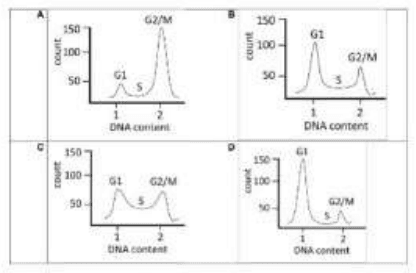
Which one of the following options correctly represents all the cell cycle states of MCF7, MCF7.1 and MCF7.2?
- 1MCF7-C; MCF7.1-D; MCF7.2-A
- 2MCF7-C; MCF7.1-A; MCF7.2-D
- 3MCF7-B; MCF7.1-D; MCF7.2-A
- 4MCF7-B; MCF7.1-A; MCF7.2-D
Show answer and solution
NTA dropped this question, so everyone received its marks.
Apoptosis refers to programmed cell death that is triggered by specialized intracellular proteases called caspases. The intrinsic pathway of apoptosis
- A. depends on the activation of Fas domain by the Fas ligand, which activates the DISC.
- B. is regulated by the Bcl2 family of proteins.
- C. consists of a key regulatory protein Apaf1 which is a water-soluble component of the electron transport chain.
- D. recruits procaspase 9 into the apoptosome, and once activated, caspase 9 cleaves and activates downstream executioner caspases.
Which of the following combinations represents all correct statements?
- 1A, B and D
- 2B, C and D
- 3C and D only
- 4B and D only
Show answer and solution
The intrinsic pathway is controlled by Bcl-2 family proteins at the mitochondrion (B). Released cytochrome c joins Apaf-1 to form the apoptosome, which activates caspase-9, and caspase-9 then activates executioner caspases (D). Fas and DISC belong to the extrinsic pathway, and Apaf-1 is a cytosolic adaptor, not part of the electron transport chain.
In an experiment using nude mice, the population is divided into two groups, A and B. Group A mice are injected with T cells from normal mice and Group B mice are left untreated. Both the groups are then immunized with LPS. Which one of the following statements regarding antibody production in groups A and B is most likely to be true?
- 1Both groups of mice will have very similar levels of antibody against LPS as it is a thymus-independent antigen.
- 2No immune response will be generated in both groups of mice as they lack thymus.
- 3Only Group A mice will have antibodies as T-independent antigens are dependent on T-cell activation.
- 4Only Group B mice will have antibodies, because in group A mice, the presence of T cells will interfere with the production of antibodies against T-independent antigen.
Show answer and solution
LPS is a T-independent (type 1) antigen that activates B cells directly. Nude mice lack T cells but have B cells, so both groups make similar anti-LPS antibody, mainly IgM.
Several extracellular mechanisms lead to intracellular changes to regulate stem cell behavior during development. Based on this, which one of the following statements is NOT true?
- 1Structural and adhesion factors in the extracellular matrix support cellular architecture of the stem cell niche.
- 2Different patterns of chromatin accessibility influence gene expression related to stem cell behavior.
- 3Partitioning of cytoplasmic determinants distributes factors determining cell fate evenly into daughter cells during asymmetric division.
- 4Secreted proteins from surrounding cells by autocrine, paracrine or juxtacrine mechanisms often maintain stem cells in an uncommitted state.
Show answer and solution
In asymmetric division, cytoplasmic fate determinants are partitioned unequally, so the two daughters adopt different fates. Statement 3, which says they are distributed evenly, is not true. The other statements describe real niche and chromatin mechanisms.
By expressing the EGF-like ligand LIN-3, the C. elegans anchor cell (AC) directly triggers vulval development. LIN-3 acts at a distance and has a graded action. The levels of LIN-3 can be controlled by using various genetic techniques.
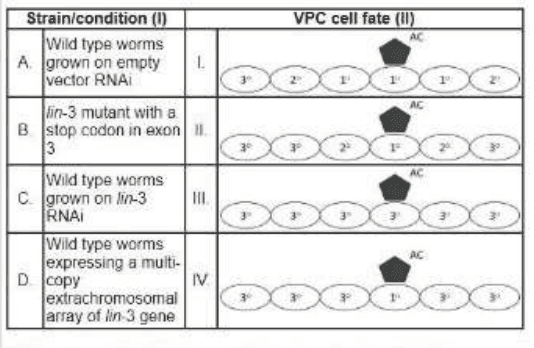
Which one of the following options is a correct match between column I and column II?
- 1a-ii, b-iii, c-iv, d-i
- 2a-ii, b-iv, c-i, d-iii
- 3a-iv, b-i, c-ii, d-iii
- 4a-iii, b-iv, c-i, d-ii
Show answer and solution
LIN-3 from the anchor cell sets vulval fates by dose. Wild type gives the normal 3°–3°–2°–1°–2°–3° pattern (A–II). A null lin-3 allele gives no induction, so all cells are 3° (B–III). Partial loss by RNAi lets only the nearest cell reach 1° (C–IV). Extra copies over-induce, making more 1° and 2° cells (D–I).
Given below are statements about development in different model organisms.
- A. Xenopus egg has yolk and hence undergoes meroblastic cleavage.
- B. Embryonically transcribed beta-catenin in the blastomeres of sea urchin embryos regulates the autonomous specification of micromeres.
- C. The sodium pump activity in the trophoblast helps in the formation of blastocoel of a mammalian blastocyst.
- D. Prevention of tubal pregnancy is one of the major functions of zona pellucida in humans.
Which combination of the statements is true?
- 1A and B
- 2A and C
- 3B and D
- 4C and D
Show answer and solution
C is true: the trophectoderm’s Na+/K+-ATPase pumps ions into the embryo and water follows, forming the blastocoel. D is true: the zona pellucida stops the embryo implanting early, in the oviduct. A is false: Xenopus cleavage is holoblastic, although unequal. B is false: β-catenin in sea urchin micromeres is maternally supplied.
The following statements pertain to limb development in chick. Each statement describes an experiment and the expected outcome.
- A. Targeted loss of retinoic acid synthesis in the forelimb causes a reduction of Tbx4 expression and the failure to form forelimbs.
- B. When Fgf10 secreting beads are placed at a somite level that induced limb bud expressing Tbx5 in the anterior and Tbx4 in the posterior part, a chimeric limb can be formed.
- C. Constitutive activation of FGF receptors results in the loss of forelimb field, demonstrating that expression of Fgf8 functions to inhibit forelimb development.
Which one of the following option(s) is/are correct?
- 1A only
- 2B only
- 3A and B
- 4B and C
Show answer and solution
Fgf10 beads placed at somite levels where both Tbx5 (forelimb) and Tbx4 (hindlimb) are expressed induce an extra limb with mixed wing and leg character (B). NTA accepted options 2 and 4. A is wrong: forelimb identity depends on Tbx5, not Tbx4.
Mechanism of primary sex determination is best known in Drosophila and mammals. Given below are statements in regard of sex determination in these two model systems.
- A. In Drosophila, if sry gene product is present, it may block beta-catenin signaling and along with SF1, activate the sox9 gene.
- B. In mammals, an alternate splicing of Sxl transcript that removes a stop codon and allows formation of a functional protein, is responsible for initiating the female sex determination.
- C. A trans-splicing event in Tra transcript results in formation of functional Tra protein in Drosophila.
- D. XO individuals in Drosophila are males while, XXY individuals are females.
Which of the above statements are correct?
- 1A, B and C
- 2D only
- 3C and D
- 4B only
Show answer and solution
Only D is right. In Drosophila sex depends on the X:autosome ratio, not the Y, so XO flies are male and XXY flies female. Sry, Sox9 and SF1 belong to mammals, not Drosophila (A wrong). Sex-lethal splicing belongs to Drosophila, not mammals (B wrong). tra is regulated by alternative cis-splicing, not trans-splicing (C wrong).
The following statements describe the developmental processes during different modes of reproduction in angiosperms:
- A. In double fertilization, one sperm fuses with the egg and other with the central cell to form the zygote and endosperm, respectively.
- B. In sporophytic apomixis, a diploid cell gives rise to the next generation thereby maintaining the maternal genotype.
- C. In gametophytic apomixis, a reduced egg cell forms apomictic embryo through parthenogenesis.
- D. In pseudogamy, the functional endosperm is formed without fertilization.
Which one of the following represents the combinations of CORRECT statements?
- 1A and B
- 2B and C
- 3B and D
- 4C and D
Show answer and solution
A is true: in double fertilisation one sperm fertilises the egg (zygote) and the other the central cell (endosperm). B is true: in sporophytic apomixis (adventitious embryony) a diploid nucellar or integument cell forms the embryo, preserving the maternal genotype. C is false: gametophytic apomixis uses an unreduced egg. D is false: pseudogamy requires fertilisation of the central cell to form endosperm.
Given below are certain statements regarding the light absorption by chlorophyll pigment molecule in a green leaf.
- A. The absorption of a photon by a pigment molecule converts it from its lower state to an excited state.
- B. Internal conversions or relaxations of pigments convert higher excited states to the lowest excited state, with a concomitant loss of energy as heat.
- C. The light reemitted from the lowest excited state of chlorophyll molecule is fluorescence.
- D. Red light absorption by chlorophyll molecule results into higher excitation state relative to the blue light absorption.
Which one of the following combinations is correct?
- 1A, B and C
- 2A, B and D
- 3B, C and D
- 4A, C and D
Show answer and solution
A, B and C are true: absorbing a photon excites the pigment; higher excited states quickly relax, as heat, to the lowest singlet state; and light re-emitted from that state is fluorescence. D is false: blue photons carry more energy and reach a higher excited state than red ones.
Photorespiration or C2 cycle takes place in three distinct organelles in the plant cells. Following are certain statements related to the C2 cycle.
- A. Reduced ferredoxin and ATP are required for photorespiration and assimilation of resulting NH3.
- B. Photosynthetic electron transport provides energy rich ATP and NAPDH for photorespiration.
- C. Glutamate is translocated from chloroplast to peroxisome, while α-ketoglutarate is translocated from peroxisome to chloroplast.
- D. The action of enzyme serine hydroxymethyl transferase takes place in peroxisome.
Which one of the following combinations has all correct statements?
- 1A and B
- 2A and C
- 3B and C
- 4B and D
Show answer and solution
Re-assimilating photorespiratory NH3 through GS/GOGAT needs ATP and reduced ferredoxin (A). Glutamate leaves the chloroplast for the peroxisome, where it donates amino groups to glyoxylate, and α-ketoglutarate returns (C). D is false: serine hydroxymethyltransferase works in the mitochondrion. NTA’s key gives A and C.
Stomata detached from the epidermis of common dayflower (Commelina communis) were treated with saturating photon fluxes of red light. After a duration of 2 hours, the same stomata, under the background of red light were also illuminated with blue light. Which one of the following statements regarding opening of stomatal apertures is true?
- 1The red light illumination will saturate stomatal opening and blue light illumination will have no effect on it.
- 2The red light illumination will not result in opening of stomata and they will open only upon perceiving blue light.
- 3The blue light illumination will increase the level of stomata opening above the saturation level of stomatal opening by red light illumination.
- 4The blue light illumination will result in closing of the stomata opened due to red light illumination.
Show answer and solution
Blue light acts through phototropins and the H+-ATPase on top of the photosynthesis-driven red-light response. Even after red light has saturated opening, blue light opens stomata further, the classic Zeiger experiment.
Apoplast phloem loading is determined by the cellular location and transport function of the membrane-bound proteins. Following are certain statements regarding these proteins.
- A. SWEETs are the sugar transporter proteins and are capable of transporting only sucrose and not glucose.
- B. Double mutants of Arabidopsis SWEET11 and SWEET12 results in carbohydrate accumulation in the source leaves and slower export of the photoassimilates.
- C. H+-symport mechanism loads sucrose or polyols into Sieve Element (SE)/Companion Cell (CC) complexes.
- D. Several clades of sucrose/H+ symporters (SUTs or SUCs) are localized to plasma membranes of minor vein SE/CCs and participate in apoplastic loading.
Which one of the following combinations is correct?
- 1A, B and C
- 2A, B and D
- 3B, C and D
- 4A, C and D
Show answer and solution
B is true: sweet11 sweet12 double mutants export less and accumulate sugar in leaves. C is true: H+ symporters load sucrose or polyols into the sieve element–companion cell complex. D is true: SUT/SUC symporters in minor-vein SE/CC membranes carry out apoplastic loading. A is false: SWEETs move sucrose and hexoses such as glucose.
A researcher had inoculated the bottom leaves of a wild-type tobacco plant with tobacco ringspot virus (TRSV) and made the following statements regarding the disease after 23 days post-inoculation.
- A. Strong ringspot symptoms develop on the lower leaves.
- B. The ringspot symptoms are higher on the upper leaves.
- C. The top leaves have no viral symptoms
- D. The top leaves are immune to secondary infection by the same virus.
Choose the option with all correct statements:
- 1A, C and D
- 2B and D only
- 3A and B only
- 4C and D only
Show answer and solution
TRSV on tobacco shows recovery. The inoculated lower leaves develop strong ringspots (A), but the newly grown upper leaves are symptom-free (C) and resist re-infection by the same virus (D), through RNA silencing.
Given below are the list of plant hormones (Column X) and their biosynthesis precursors (Column Y).
| Column X | Column Y | ||
|---|---|---|---|
| A | Auxins | i. | Geranylgeranyl diphosphate |
| B | Cytokinins | ii. | Adenosine moiety |
| C | Ethylene | iii. | Tryptophan |
| D | Gibberellins | iv. | 1-aminocyclopropane 1-carboxylic acid |
Which one of the following options represents the correct match between column X and Y?
- 1A–i; B–ii; C–iii; D–iv
- 2A–iii; B–i; C–iv; D–ii
- 3A–iii; B–ii; C–iv; D–i
- 4A–iv; B–iii; C–ii; D–i
Show answer and solution
Auxin comes from tryptophan, cytokinins from an adenosine (adenine nucleotide) moiety, ethylene from ACC, and gibberellins from geranylgeranyl diphosphate.
The structure and process of formation of different antigens in blood ABO system are given in the following statements:
- A. Galactose is added to the terminal of H-antigen by a transferase expressed in individuals with type A blood.
- B. The B antigen is formed by a transferase expressed in individuals with type B blood which adds a terminal N-acetylgalactosamine to H-antigen.
- C. The H-antigen is formed by fucose transferase that adds a terminal fucose to its precursor.
- D. The H-antigen is the precursor of both the A- and B- antigens and it is the blood group antigen in persons of type O blood.
Which one of the following options represents the correct combination of statements?
- 1A and B
- 2B and C
- 3C and D
- 4A and D
Show answer and solution
The H antigen is made by a fucosyltransferase adding fucose to the precursor (C), and it is the unmodified antigen of group O (D). A and B are swapped: the A transferase adds N-acetylgalactosamine, and the B transferase adds galactose.
The characteristic features and causes of different heart sounds during a cardiac cycle of humans are given in the following statements.
- A. The second heart sound is loud and sharp when the diastolic pressure is decreased in the aorta or pulmonary artery.
- B. Sudden closure of atrioventricular (AV) valves at the start of ventricular systole caused vibration that produces first heart sound.
- C. The second heart sound is caused by the vibration associated with the closure of aortic and pulmonary valves after the end of ventricular systole.
- D. The first heart sound is soft when heart rate is low as the ventricles are well filled with blood and the leaflets of AV valves float together before systole.
Which one of the following options represents the combination of all correct statements?
- 1A, B and C
- 2B and C only
- 3B, C and D
- 4A and D only
Show answer and solution
S1 comes from closure of the AV valves at the start of systole (B). S2 comes from closure of the aortic and pulmonary valves at the end of systole (C). S1 is soft at slow rates, because well-filled ventricles let the leaflets float together (D). S2 is loud when diastolic pressure is raised, not lowered (A false).
The sensory nerve fibers (Column X) and the sensory receptors connected to different sensory nerves (Column Y) are given below.
| Column X: Sensory nerve fibre | Column Y: Sensory receptor | ||
|---|---|---|---|
| A | Ia | i. | Muscle spindle, flower spray ending |
| B | Ib | ii. | Pain and cold receptor |
| C | II | iii. | Muscle spindle, annulo-spiral ending |
| D | III | iv. | Golgi tendon organ |
Which of the following options represents the correct match between column X and column Y?
- 1A-i, B-ii, C-iii, D-iv
- 2A-ii, B-iii, C-iv, D-i
- 3A-iii, B-iv, C-i, D-ii
- 4A-iv, B-i, C-ii, D-iii
Show answer and solution
Group Ia fibres form the primary annulospiral endings of spindles (A–iii). Ib fibres supply Golgi tendon organs (B–iv). Group II fibres form the secondary flower-spray endings (C–i). Group III (Aδ) fibres carry pain and cold (D–ii).
Certain statements are put forth on the regulation of renal blood flow and are given below.
- A. Norepinephrine dilates the renal vessels.
- B. Dopamine causes renal vasodilation and natriuresis.
- C. Angiotensin II exerts a constrictor effect.
- D. Prostaglandins decrease blood flow in the renal cortex and increase it in the medulla.
- E. Acetylcholine produces renal vasodilation.
Choose the option with the combination of all correct statements.
- 1A, B and D
- 2B, C and D
- 3B, C and E
- 4A, C and E
Show answer and solution
Dopamine dilates renal vessels and promotes natriuresis (B), angiotensin II constricts them (C), and acetylcholine dilates them (E). Noradrenaline constricts renal vessels (A false), and prostaglandins tend to increase cortical flow (D false).
The following proposed statements describe some aspects of thermoregulation.
- A. The basal metabolic rate is rapidly adjusted in the thermoneutral zone to maintain temperature homeostasis.
- B. The homeotherms who have the ability to hibernate, do not maintain normal physiological temperature range during hibernation.
- C. The thermoregulation is not regulated by hypothalamus.
- D. Warm-blooded animals require more food compared to cold-blooded animals of the same size and weight.
Which one of the following options represents combinations of all correct statements?
- 1A, B and C
- 2A, B and D
- 3B and D only
- 4A and B only
Show answer and solution
Hibernating endotherms let body temperature fall well below normal (B). Endotherms burn far more energy for heat, so they need more food than ectotherms of the same size (D). In the thermoneutral zone BMR stays at its minimum and is not adjusted (A false), and the hypothalamus is the thermoregulatory centre (C false).
Given below are statements about the Kallmann syndrome.
- A. It is a condition of hypogonadotropic hypogonadism.
- B. There is a loss of sense of smell in such individuals.
- C. This syndrome is most common in women.
- D. It happens due to mutation of the KALIG1 gene on X-chromosome that codes for an adhesion molecule necessary for the normal development of the gustatory nerve.
Which one of the following options has the combination of all correct statements?
- 1A and D
- 2B and C
- 3C and D
- 4A and B
Show answer and solution
Kallmann syndrome combines hypogonadotropic hypogonadism (A) with anosmia (B), because GnRH neurons and olfactory neurons fail to migrate together. The X-linked KAL1 form is commoner in males, and its anosmin protein guides olfactory, not gustatory, neurons.
The following represents a Southern hybridization of restricted genomic DNA, probed with a DNA fragment corresponding to gene ‘Z’. ‘Z’ is a single copy gene. The hybridization patterns of parents and their progeny have been presented.
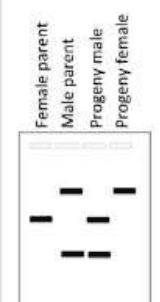
Which one of the following options is a correct interpretation of the observation?
- 1Gene ‘Z’ is present on an autosome.
- 2Gene ‘Z’ is an example of X-linked gene.
- 3In this organism the female is the heterogametic sex.
- 4Polymorphism of this gene has been studied by RAPD.
Show answer and solution
The male parent shows two bands (heterozygous) but the female parent only one, and the daughter shows just one band, from her father. That is what happens when females are hemizygous (ZW) and males homogametic (ZZ): the female is the heterogametic sex.
Epistasis is observed between different genes in flower color of sweet pea. A red variety on selfing yields red:white in ratio 9:7. The precursors and intermediates give white color. The following biochemical pathways were proposed for the above observations:
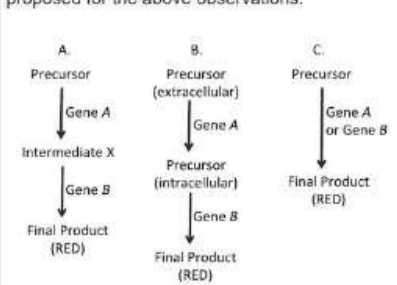
Which one of the options represents the correct pathway(s) that explains the observations?
- 1A only
- 2Both A and B
- 3Both B and C
- 4A, B and C
Show answer and solution
A 9:7 ratio means red needs a dominant allele at both genes (complementary epistasis). That fits a two-step pathway (A), or a transport step followed by a synthesis step (B): either way both enzymes are required. Pathway C, where either gene alone suffices, would give 15:1.
This is a hypothetical example. In a plant, a single gene governs flower color. The wild type color is red, while the mutant is white. It was demonstrated that insertion of a transposable element caused the white phenotype. In a PCR test, a set of primers outside the site of insertion is used to amplify the genomic DNA and the PCR products are resolved by Agarose gel electrophoresis. A geneticist made a cross between two plants. 30 progeny from the cross was analyzed by PCR. Each lane in the gel below represents analysis of one progeny.
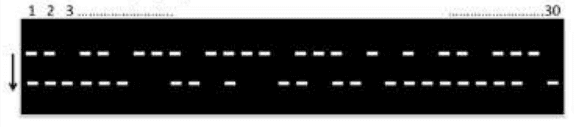
Based on the above, which one of the following statements is correct?
- 1The DNA marker is dominant.
- 2Plant 3 has white flowers.
- 3In the above cross, one of the parents was heterozygous while the other was homozygous.
- 4If the progeny from a cross between plant 1 and plant 30 is analyzed in a similar way two different kinds of banding pattern will be observed.
Show answer and solution
The primers flank the insertion site, so the insertion (white) allele gives the larger band and the wild-type allele the smaller one. Heterozygotes show both, so the marker is codominant. Progeny fall into three classes, so both parents were heterozygous. Plant 1 (heterozygous) × plant 30 (homozygous) would give two kinds of banding pattern, in a 1:1 ratio.
Shown below is the inversion product of the X chromosome of wild type Drosophila. The w+ gene coding for the red eye colour is near the telomere and another gene roughest (rst+) is close to w+ but towards the centromere. The eyes of roughest mutants have rough appearance. The inversion brings w+ near the vicinity of highly compact centromeric heterochromatin and places rst+ little farther away from the centromeric heterochromatin.
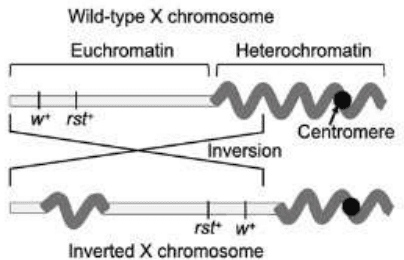
Which of the following phenotypes will NEVER be observed in the Drosophila strain with inversion?
- 1Red and smooth eyes
- 2White and smooth eyes
- 3White and rough eyes
- 4Red and rough eyes
Show answer and solution
Heterochromatin silencing spreads outward from the centromere, so the closer w+ is silenced before the more distant rst+. Eyes can be red and smooth (neither silenced), white and smooth (w only) or white and rough (both). Red and rough would need rst+ silenced while w+ stays active, which never happens.
A mutant strain of E. coli having defects in one of the DNA repair pathways was identified. To identify the pathways where mutation occurred, a researcher looks at the following parameters and identified the defect to be in base excision repair pathway.
- A. Topoisomerase II enzyme activity.
- B. AP endonuclease activity
- C. Expression of mutL and mutS
- D. DNA glycosylase activity
- E. DNA ligase activity
Based on the changes in which of the above parameters, this conclusion can be drawn?
- 1A, C, E
- 2B, D, E
- 3B, C, D
- 4A, D, E
Show answer and solution
Base excision repair uses a DNA glycosylase, an AP endonuclease, a polymerase and DNA ligase. Changes in those activities (B, D, E) point to BER. MutS and MutL belong to mismatch repair, and topoisomerase II is unrelated.
A new strain of bacteria was created by introducing an artificial operon, to allow bacterial cells to grow in the presence of iron. The Fe++ operon consisted of genes that made the cells capable of tolerating increased iron. For efficient functioning of this operon, the following desirable features were considered. Which one of the following can be used to develop this operon?
- 1A repressor protein, which is active when bound to Fe++
- 2An activator protein, which is active when not bound to Fe++
- 3A repressor protein, which is inactive when bound to Fe++
- 4A repressor protein, which is active constitutively
Show answer and solution
The tolerance genes should switch on only when iron is present. A repressor that lets go of the operator when bound to Fe2+ (inactive with iron) gives exactly that induction, like LacI with allolactose.
Consider a highly diverse community of closely related species of lizards which has evolved in a short period of time and that occupies different ecological niches in peninsular India. What type of speciation process can explain the above pattern?
- 1Non-ecological speciation
- 2Adaptive radiation
- 3Allopatric speciation
- 4Parapatric speciation
Show answer and solution
Many closely related lizard species, evolved rapidly and each filling a different ecological niche, is the pattern of adaptive radiation, as in Caribbean Anolis.
Which one of the following phylogenetic trees correctly depicts the relationship between the given orders of pteridophytes, according to the Pteridophyte Phylogeny Group 1?
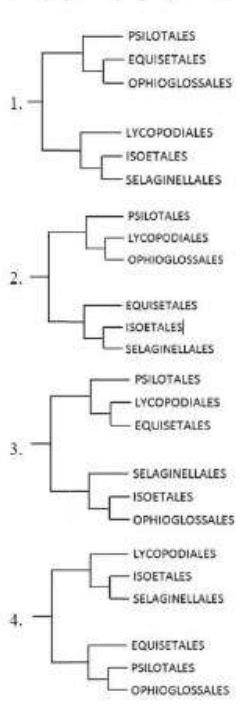
- 1Tree 1
- 2Tree 2
- 3Tree 3
- 4Tree 4
Show answer and solution
NTA’s key gives tree 4 as the PPG I (2016) arrangement. In that classification ferns (Polypodiopsida) are monophyletic, with Equisetales branching early and Psilotales grouped with Ophioglossales, followed by Marattiales and then the leptosporangiate ferns.
Selected human diseases and their vectors are listed below:
| Column X: Disease | Column Y: Vector | ||
|---|---|---|---|
| A | Chikungunya | i. | Aedes mosquito |
| B | Lyme disease | ii. | Anopheles mosquito |
| C | Lymphatic filariasis | iii. | Aquatic snails |
| D | Schistosomiasis | iv. | Ticks |
Which one of the following options represents the correct match between column X and column Y?
- 1A-ii, B-iii, C-iv, D-i
- 2A-iii, B-iv, C-i, D-ii
- 3A-i, B-ii, C-iii, D-iv
- 4A-i, B-iv, C-ii, D-iii
Show answer and solution
Chikungunya is spread by Aedes mosquitoes (A–i), Lyme disease by Ixodes ticks (B–iv), lymphatic filariasis by mosquitoes such as Culex and Anopheles (C–ii), and schistosomiasis through freshwater snails (D–iii).
Given below are species concepts (Column X) and their descriptions (Column Y):
| Column X | Column Y | ||
|---|---|---|---|
| A | Typological species concept | i. | Single lineage of ancestor–descendant populations which maintains its identity from other such lineages |
| B | Biological species concept | ii. | A species is a set of organisms that resemble one another and is distinct from other sets |
| C | Evolutionary species concept | iii. | Species are groups of interbreeding natural populations that are reproductively isolated from other such groups |
| D | Phylogenetic species concept | iv. | A group recognised by its monophyly |
Which one of the following options represents all the correct matches?
- 1A-ii, B-iii, C-i, D-iv
- 2A-i, B-ii, C-iii, D-iv
- 3A-iii, B-ii, C-i, D-iv
- 4A-iv, B-iii, C-i, D-ii
Show answer and solution
The typological concept groups organisms by resemblance (A–ii). The biological concept uses interbreeding and reproductive isolation (B–iii). The evolutionary concept uses a single lineage keeping its identity (C–i). The phylogenetic concept uses monophyly (D–iv).
In birds and mammals, 3rd, 4th and 6th aortic arches persist in adult animals with some structural modifications. Which of the following modified organization is correct?
- 1In birds, 4th aortic arch forms systemic aorta on the left.
- 2In mammals, 6th aortic arch forms pulmonary aorta.
- 3In birds, 3rd aortic arch forms systemic aorta.
- 4In mammals, 3rd aortic arch forms systemic aorta.
Show answer and solution
In mammals the 6th arch forms the pulmonary arteries, with the ductus arteriosus (option 2). The systemic arch comes from the 4th arch, on the left in mammals and the right in birds. The 3rd arches form the carotids.
The following table lists habitat type (Column X) and geographic regions (Column Y) where they can be found:
| Column X: Type of habitat | Column Y: Geographic region | ||
|---|---|---|---|
| A | Mangroves | i. | Western Ghats |
| B | Terai | ii. | Banni |
| C | Laterite plateaus | iii. | Sunderbans |
| D | Arid grasslands | iv. | Himalayan foothills |
| E | Shola |
Which of the following options represents the correct match between column X and Y?
- 1A-iii, B-iv, C-ii, D-ii, E-i
- 2A-iv, B-iii, C-ii, D-i, E-ii
- 3A-iii, B-iv, C-i, D-ii, E-i
- 4A-i, B-ii, C-iv, D-iii, E-iv
Show answer and solution
Mangroves are in the Sundarbans (A–iii), the Terai in the Himalayan foothills (B–iv), and laterite plateaus and shola in the Western Ghats (C–i, E–i). Arid grassland is found in Banni, Kutch (D–ii).
Which one of the following statements about change in temperature with elevation is correct?
- 1Adiabatic cooling of air due to increasing elevation leads to a drop of temperature by ~10°C for every 1,000 m in elevation, irrespective of water vapor or cloud formation.
- 2Adiabatic cooling of air due to increasing elevation leads to a drop of temperature by ~10°C for every 1,000 m in elevation, as long as no water vapor or cloud formation occurs.
- 3A vertical ascent of 1km from the Earth surface produces a temperature change roughly equivalent to that brought about by an increase in latitude of 1,000 km.
- 4A vertical ascent of 600 m from the Earth surface produces a temperature change roughly equivalent to that brought about by an increase in latitude of 100 km.
Show answer and solution
Rising air expands and cools at the dry adiabatic lapse rate, about 10 °C per 1,000 m, only while no water vapour condenses. Once clouds form, released latent heat lowers the rate to about 5–6 °C per km.
In a study comparing different plant communities (A to D) across a landscape, the following data were obtained:
| Community | A | B | C | D |
|---|---|---|---|---|
| No. of species in the community | 12 | 25 | 11 | 19 |
| Species common to A and … | 9 | 8 | 10 | |
| Species common to B and … | 6 | 14 | ||
| Species common to C and … | 7 |
Which one of the following options represents the pair of communities with highest similarity value when Sorenson’s coefficient is used?
- 1A and C
- 2A and D
- 3B and C
- 4B and D
Show answer and solution
Sorensen’s index = 2c/(a + b). A–C: 16/23 = 0.70. A–D: 20/31 = 0.65. B–D: 28/44 = 0.64. B–C: 12/36 = 0.33. A and C are most similar.
Phosphorus is an important essential element for living organisms. Given below are a few fluxes of the global phosphorus cycle.
- A. Internal cycling in terrestrial ecosystems
- B. Internal cycling in marine ecosystems
- C. Terrestrial runoff into oceans
- D. Natural chemical weathering in terrestrial ecosystems
Select the correct option that arranges the fluxes in an increasing order of magnitude.
- 1A < D < B < C
- 2A < B < C < D
- 3D < C < A < B
- 4D < A < C < B
Show answer and solution
In the global phosphorus cycle, natural weathering releases relatively little P each year. River runoff to the oceans is larger. Recycling within terrestrial ecosystems is larger still, and internal recycling in the oceans is the largest flux. Order: D < C < A < B.
The graph below depicts the net change in forest cover in four regions (A–D) between 1990 and 2020, according to the FAO report ‘The State of World’s Forests 2020’.

Which one of the following options correctly identifies these regions?
- 1A – Asia, B – North and Central America, C – South America, D – Europe
- 2A – North and Central America, B – Africa, C – Asia, D – South America
- 3A – Asia, B – Europe, C – South America, D – Africa
- 4A – Europe, B – South America, C – Asia, D – Africa
Show answer and solution
According to FAO’s State of the World’s Forests 2020, between 1990 and 2020 Asia and Europe had net gains in forest area, while South America and Africa had the largest net losses. That matches A = Asia, B = Europe, C = South America and D = Africa.
Based on theoretical concepts of mating systems in plants, pollen : ovule ratios are likely to be most skewed in which one of the following cases?
- 1Entomophilous dioecious species
- 2Entomophilous bisexual species
- 3Anemophilous bisexual species
- 4Anemophilous dioecious species
Show answer and solution
Wind pollination wastes most pollen, so it needs far more pollen per ovule. Dioecy makes it worse, because pollen must travel between plants. Pollen:ovule ratios are therefore highest in wind-pollinated dioecious species.
Match the names of scientists (column X) with the ecosystem concepts (column Y) they are known for:
| Column X | Column Y | ||
|---|---|---|---|
| A | Charles Elton | i. | trophic dynamics |
| B | A G Tansley | ii. | the term ecosystem |
| C | A J Lotka | iii. | pyramid structure of feeding relationships in ecosystems |
| D | Raymond Lindeman | iv. | a thermodynamic view of the ecosystem |
- 1A-i, B-ii, C-iii, D-iv
- 2A-iv, B-ii, C-iii, D-i
- 3A-iv, B-i, C-ii, D-iii
- 4A-iii, B-ii, C-iv, D-i
Show answer and solution
Elton described the pyramid of numbers (A–iii). Tansley coined “ecosystem” (B–ii). Lotka took a thermodynamic view of energy in ecosystems (C–iv). Lindeman founded trophic dynamics (D–i).
The graph given below is based on the optimal foraging theory. If the Y axis represents “Cumulative Resource Intake” following the law of diminishing returns, what do T and T′ stand for?
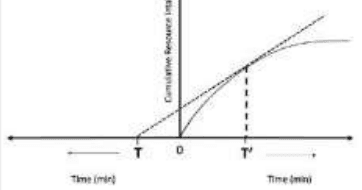
- 1T: Patch residence time, T′: Travel time to reach patch
- 2T: Search time to find prey, T′: Handling time for a prey
- 3T: Travel time to reach patch, T′: Patch residence time
- 4T: Handling time for a prey, T′: Search time to find prey
Show answer and solution
In the marginal value theorem graph, the travel time between patches, T, is plotted to the left of the origin. The tangent from it touches the gain curve at the optimal patch residence time, T′.
Defending a territory is energetically expensive and animals should invest in this only if it is profitable. A sunbird species is dependent on a plant species that contains nectar-rich flowers, making it an important resource for the sunbird. Males may defend territories containing these plants against other males, while allowing females to access the flowers. In this way they keep competitors out and get access to the females.
The columns below (P to S) represent characteristics of the resources and their variants (i and ii).
| Column P: Abundance of flowers in the habitat | Column Q: Distribution of flowers in the habitat | Column R: Nectar depletion rate of flowers | Column S: Nectar renewal rate of flowers |
|---|---|---|---|
| i. High | i. Uniform | i. High | i. High |
| ii. Low | ii. Patchy | ii. Low | ii. Low |
From the given options, choose the combination of plant characteristics that makes defending a territory most profitable for males.
- 1P-i, Q-i, R-ii, S-i
- 2P-i, Q-ii, R-ii, S-i
- 3P-ii, Q-i, R-i, S-ii
- 4P-ii, Q-ii, R-i, S-ii
Show answer and solution
Defending is worth it when flowers are common (P-i) but patchy (Q-ii), so a small area holds many. Nectar should be depleted slowly (R-ii) and renewed quickly (S-i), so the defended patch keeps paying off.
Given below are statements related to different types of natural selection models.
- A. Directional selection changes the average value of a trait.
- B. Stabilizing selection increases variation in a trait.
- C. Disruptive selection reduces variation in a trait.
- D. Balancing selection maintains variation in a trait.
Select the correct option that represents the combinations of statements that are NOT true about natural selection.
- 1A and B
- 2B and C
- 3C and D
- 4A and C
Show answer and solution
Directional selection shifts the mean (A true), and balancing selection keeps variation (D true). B and C are reversed: stabilising selection reduces variation, and disruptive selection increases it, so they are NOT true.
Which one of the following Newick trees represents the correct relationship between apes.
- 1((((Orangutan, Gibbons), Gorillas), Chimpanzees), Humans)
- 2((((Humans, Chimpanzees), Gorillas), Orangutan), Gibbons)
- 3((((Humans, Gorillas), Chimpanzees), Gibbons), Orangutan)
- 4((((Humans, Chimpanzees), Gibbons), Orangutan), Gorillas)
Show answer and solution
Humans and chimpanzees are sister groups, then gorillas join, then orangutans, with gibbons branching earliest: ((((Humans, Chimpanzees), Gorillas), Orangutan), Gibbons).
The table below lists phylogenetic reconstruction methods and the description of these methods, which includes both algorithmic and optimality-based methods or criteria.
| Method (Column X) | Description (Column Y) | ||
|---|---|---|---|
| A | Maximum parsimony | i. | Tree length, that is sum of branch lengths, often estimated by least squares |
| B | Minimum evolution | ii. | Minimum number of changes, minimised over ancestral states |
| C | Bayesian | iii. | Cluster algorithms to arrive at a single tree |
| D | Neighbour Joining | iv. | Posterior probability, calculated by integrating it over branch lengths and substitution parameters |
Select the option that best matches the tree reconstruction method (Column X) with its correct description in Column Y.
- 1A-ii, B-i, C-iv, D-iii
- 2A-iv, B-iii, C-i, D-ii
- 3A-i, B-ii, C-iv, D-iii
- 4A-i, B-iii, C-ii, D-iv
Show answer and solution
Maximum parsimony minimises the number of changes (A–ii). Minimum evolution minimises total tree length, often fitted by least squares (B–i). Bayesian methods use posterior probabilities integrated over parameters (C–iv). Neighbour joining is a clustering algorithm that gives one tree (D–iii).
In Bayesian statistics, A and A′ correspond to different hypotheses, H1 and H2, and D corresponds to the observed data (X).
An equation for hypothesis H1 can be given as P(H1|D) = P(H1) × P(X|H1) / P(X)
Given below are statements related to the above equation:
- A. The equation represents the conditional probability of hypothesis H1, given the data.
- B. The equation represents the probability of the data, given the hypothesis.
- C. P(X|H1) is called a prior probability, which is assigned to the hypothesis before the data is observed or analysed.
- D. P(X|H1) represents the likelihood under the hypothesis H1.
Select the option that represents all correct statements with respect to the equation above.
- 1A and C
- 2A and D
- 3B and C
- 4B and D
Show answer and solution
P(H1|D) is the posterior: the probability of hypothesis H1 given the data (A). P(X|H1) is the likelihood of the data under H1 (D). The prior is P(H1).
Unknown antigens can be detected or measured by a sandwich ELISA whereas Elispot assays measure the number of cells capable of secreting particular molecules such as cytokines which is considered as antigens. Which of the following is true for both assays?
- 1Reaction products in both the assays are soluble.
- 2Reaction products in both the assays are insoluble.
- 3Reaction products in sandwich ELISA are insoluble whereas those in Elispot assays are soluble.
- 4Reaction products in sandwich ELISA are soluble whereas those in Elispot assays are insoluble.
Show answer and solution
In a sandwich ELISA the enzyme turns its substrate into a soluble coloured product read in solution. In ELISpot the product precipitates as an insoluble spot where each secreting cell sat.
A transgenic line was developed in mustard. The T0 transgenic line was selfed and the insertion of transgene was analyzed in the parental (P) and progeny lines (1 to 5). The T-DNA region (between left (LB) and right (RB) borders) used for transformation is outlined in Figure A. The pattern following Southern hybridization using probes A and B is represented in Figure B. Genomic DNA was digested with EcoRI (E). The thickness of band indicates the intensity of hybridization.
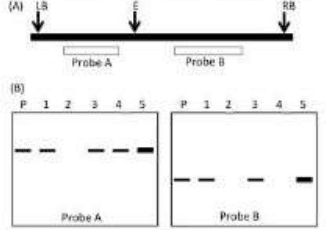
The following statements were made based on the above observation:
- A. The developed transgenic line has a single copy of T-DNA.
- B. The absence of band in progeny 4 is due to incomplete transfer of the T-DNA during transformation.
- C. Progeny 2 is homozygous at the site of insertion.
- D. All selfed progeny of line 5 is expected to show hybridization with both probes A and B.
Which one of the following options has all of the correct statements?
- 1D only
- 2A and D only
- 3B and C only
- 4A, C and D
Show answer and solution
Line 5 shows both bands strongly, as a homozygote would, so all its selfed progeny will hybridise with both probes (D). Progeny 4 shows only the probe A band, so it carries a separate, partial insertion. The line therefore has more than one insertion, and A is false. Progeny 2 shows no bands, so it is a null segregant, not homozygous. NTA’s key gives D only.
The Cre-LoxP system was used to knock-out the p53 gene from the mice lungs. An immunoblot analysis was carried out as shown below.
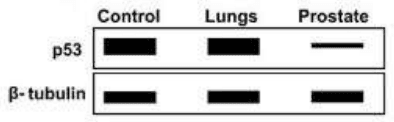
The following assumptions were made.
- A. The LoxP system did not work since the recombinase was not functional.
- B. The Lox P sites were introduced under a promoter specific for lungs.
- C. The tissue-specified promoter selected was of the prostate gland.
- D. The mice died because of being knocked out of p53.
- E. The knocked-out mice developed mutagen-induced tumours in their prostate gland more rapidly than in their lungs.
Which one of the following is correct combination of above assumption?
- 1A and D
- 2B and C
- 3C and E
- 4A and E
Show answer and solution
p53 was lost in the prostate rather than the lung, so the Cre driver must have used a prostate-specific promoter (C). Without p53, the prostate would develop mutagen-induced tumours faster than the lungs (E). Cre was clearly functional, since p53 was lost somewhere.
The figure below depicts the reflectance curves of different features found in an urban ecosystem.
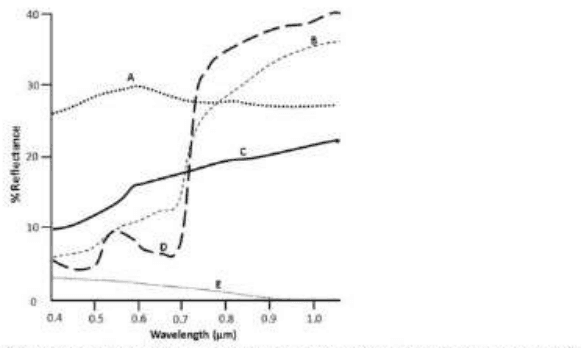
Which one of the options below correctly identifies the reflectance curves?
- 1A – Concrete road; B – Dry grass lawn; C – Asphalt road; E – waterbody
- 2A – Waterbody; B – Live grass lawn; C – Dry grass; E – Asphalt road
- 3A – Asphalt road; B – Dry grass lawn; C – Waterbody; D – Live grass lawn
- 4B – Asphalt road; C – Concrete Road; D – Live grass lawn; E – Concrete road
Show answer and solution
Reflectance signatures: a concrete road is bright across the spectrum (A). Dry grass rises steadily toward the near-infrared (B). An asphalt road is dark and flat (C). Water reflects little and almost nothing in the near-infrared (E).
Figure A represents the sites for NcoI (N) in a binary vector pCSIR2023. The vector is 16500 bp in size. Figure B represents the fragments observed when the vector is either digested with NcoI (N) or double digested with HindIII and NcoI (H+N). The intensity of fluorescence of the 453 bp fragment is double that of the 516 bp fragment.
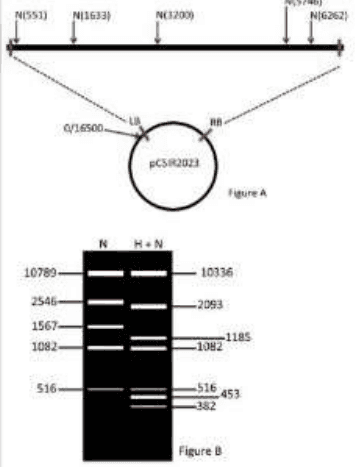
Which one of the following statements regarding the numbers and location(s) of HindIII site is correct?
- 1There are two sites of HindIII, one of which is located in the ~11Kb fragment generated by NcoI digestion.
- 2There are three sites of HindIII, one of which is located in the ~1.6Kb fragment generated by NcoI digestion.
- 3There are three sites of HindIII, one of which is definitely at 2015 position.
- 4There are four sites of HindIII, one of which is at 2015 position.
Show answer and solution
Adding HindIII splits three NcoI fragments: 10,789 into 10,336 + 453; 2,546 into 2,093 + 453 (which is why the 453 bp band is twice as bright); and 1,567 into 1,185 + 382. So there are three HindIII sites, one of them in the ~1.6 kb NcoI fragment.
Following are marker enzymes that would be used to identify correct sub-cellular fractions.
| Column X: Enzyme | Column Y: Fraction | ||
|---|---|---|---|
| A | Lactate dehydrogenase | i. | Lysosomes |
| B | Acid phosphatase | ii. | Microsomes |
| C | Glucose-6-phosphatase | iii. | Cytosol |
| D | Catalase | iv. | Peroxisomes |
Which one of the following options correctly pairs the enzymes with the subcellular fractions?
- 1A-i, B-ii, C-iii, D-iv
- 2A-iv, B-iii, C-i, D-ii
- 3A-iii, B-i, C-ii, D-iv
- 4A-ii, B-iv, C-iii, D-i
Show answer and solution
Classic marker enzymes: lactate dehydrogenase for the cytosol (A–iii), acid phosphatase for lysosomes (B–i), glucose-6-phosphatase for microsomes, that is ER (C–ii), and catalase for peroxisomes (D–iv).
The following statements are suggested regarding the principle and uses of positron emission tomography (PET):
- A. The PET scanner is a positron ray detector.
- B. The PET scanner cannot determine the location of collision between positron and electron in the brain.
- C. The typical PET activation studies can measure the absolute metabolic activity of brain.
- D. In PET, a radioactive isotope is introduced into blood as ‘tracer’ that rapidly decays by emitting a positron from their atomic nuclei.
Which one of the following options represents the combination of correct statement(s)?
- 1A, B, and C
- 2B only
- 3C and D
- 4D only
Show answer and solution
In PET, a positron-emitting tracer is injected (D). Each positron annihilates with an electron, giving two 511 keV gamma rays that travel in opposite directions. The scanner detects those gamma photons and locates where the event happened, and activation studies show relative, not absolute, activity.
In DNA foot-printing,
- A. The DNA is labelled by random priming so that the entire DNA is labelled and one does not miss out any region that binds with the given protein.
- B. The DNA is end-labelled so that the bands get organized from higher to lower size after electrophoresis and autoradiography.
- C. A sequencing polyacrylamide gel is used to resolve all the fragments distinctly.
- D. A higher concentration of agarose gel is used to resolve the finer bands.
Which one of the following options has the combination of all correct statements?
- 1A only
- 2B and D
- 3B and C
- 4D only
Show answer and solution
Footprinting uses DNA labelled at one end only, so each band’s size gives the distance of the cut from that end (B). The fragments are separated on a high-resolution sequencing polyacrylamide gel (C). Uniform labelling or agarose gels would blur the ladder.
An oligopeptide is subjected to amino acid analysis and found to have the following composition.
Tyr, Phe, Asp, Val, Arg, Met
The following statements represents/outline/list the results obtained after analysis:
- A. The above oligopeptide is subjected to N-terminal Edman degradation, revealing Tyrosine residue.
- B. Trypsin treatment did not affect the peptide.
- C. Cyanogen bromide treatment yielded a dipeptide, tetrapeptide, and free Arginine.
- D. Chymotrypsin treatment yielded dipeptide and tetrapeptide. The composition of tetrapeptide was Valine, Arginine, and Methionine.
Based on above observations, what is the CORRECT sequence of heptapeptide?
- 1Tyr-Asp-Phe-Met-Val-Met-Arg
- 2Tyr-Phe-Asp-Met-Met-Val-Arg
- 3Tyr-Met-Asp-Val-Met-Arg-Phe
- 4Tyr-Asp-Met-Met-Phe-Val-Arg
Show answer and solution
Edman degradation gives Tyr at the N-terminus, and trypsin does not cut, so Arg is at the C-terminus. CNBr cuts after each Met and releases a tetrapeptide, a dipeptide and free Arg. Chymotrypsin cuts after Tyr and Phe and leaves the tetrapeptide Met-Val-Met-Arg. The only consistent sequence is Tyr-Asp-Phe-Met-Val-Met-Arg.
Changes in NTA’s final answer key
Dropped: Q92 (marks given to everyone). Two options accepted: Q70, Q98. Every other question has the single answer shown.
How to revise from this paper
- Attempt it in one 3-hour sittingAnswer 15 in Part A, 35 in Part B and 25 in Part C, as in the real exam, before you check any answers.
- Score it with negative markingAdd 2 or 4 marks for each correct answer and subtract 0.5 or 1 for each wrong one. That is the number to track.
- Sort your mistakes by unitUse the unit tag on each question. Two or three wrong answers in the same unit tell you where to revise first.
- Repeat with a fresh paperTake a full-length mock a week later and compare your unit-wise mistakes.
Keep going