

All 145 questions from the CSIR-NET Life Sciences June 2024 paper (Shift 1), typed out in full, with NTA’s final answer key, a worked solution for every question and every diagram.
The Joint CSIR-UGC NET June 2024 Life Sciences exam was held on 26 July 2024 in two shifts. This page covers the morning shift (Shift 1, 9 am to 12 pm). Below you will find every question from Part A (General Aptitude), Part B and Part C, in the order they appeared, each tagged with its syllabus unit. Tap Show answer and solution under any question to check the official answer and see how to reach it.
Marking scheme
| Part | Questions | Answer | Marks each | Wrong answer | Max marks |
|---|---|---|---|---|---|
| A: General Aptitude | Q1–20 | 15 | 2 | −0.5 | 30 |
| B: Life Sciences | Q21–70 | 35 | 2 | −0.5 | 70 |
| C: Life Sciences | Q71–145 | 25 | 4 | −1 | 100 |
| Total | 145 | 75 | 200 |
Which units this paper tested
We tagged each of the 125 Part B and Part C questions with its CSIR-NET syllabus unit. In this paper, System Physiology – Plant, Ecological Principles and System Physiology – Animal carried the most questions.
Practise any unit across all 11 papers, with every question linked to a worked solution:
Jump to a question
Part A: General Aptitude (Q1–20)
20 questions; answer any 15. Each carries 2 marks, and a wrong answer costs 0.5.
In humans, if both parents are of blood group AB, then, there is a 1/4 probability that their offspring will be of blood group A, and 1/2 probability that the offspring will be of blood group AB. If the couple have three children, what is the probability that NONE of the children will be of blood group A or AB?
- 11/4
- 23/4
- 31/64
- 463/64
Show answer and solution
The only other possibility is group B, with probability 1 − 1/4 − 1/2 = 1/4. Each child is independent, so all three being group B has probability (1/4)3 = 1/64.
Every element in the central column of the matrix has a simple arithmetic relationship with the pairs on the left and right in the corresponding row.
| 17 | 12 | 1 | 19 | 23 |
|---|---|---|---|---|
| 23 | 21 | X | 18 | 20 |
| 24 | 17 | 3 | 32 | 36 |
| 35 | 28 | 2 | 19 | 24 |
What would be the value of X?
- 12
- 21
- 30
- 4−1
Show answer and solution
The centre is (left pair difference) − (right pair difference). Row 1: (17 − 12) − (23 − 19) = 5 − 4 = 1. Row 3: 7 − 4 = 3. Row 4: 7 − 5 = 2. Row 2: (23 − 21) − (20 − 18) = 2 − 2 = 0.
For any four consecutive decimal digits, the largest value of the product of the sum of any two and the sum of the other two is
- 1an even number and a perfect square
- 2an even number, but not a perfect square
- 3an odd number and a perfect square
- 4an odd number, but not a perfect square
Show answer and solution
For digits n, n+1, n+2, n+3, the product is largest when the two pair sums are as equal as possible: (n + n+3)(n+1 + n+2) = (2n+3)2. 2n+3 is odd, so the result is an odd perfect square.
A record player stylus moves along a spiral groove cut on an annular portion of a disc. A record with inner radius 4 cm and outer radius 10 cm of the annulus, turning 100 times plays for 22 minutes. During this time the stylus travels at an average linear speed that is approximately equal to
- 1100 m/h
- 2120 m/h
- 3220 m/h
- 4440 m/h
Show answer and solution
The stylus follows 100 turns at an average radius of (4 + 10)/2 = 7 cm: 100 × 2π × 7 ≈ 4,398 cm ≈ 44 m in 22 minutes. That is 44 × 60/22 ≈ 120 m/h.
Consider the first few consecutive natural numbers. The ratio of the sum of their squares to their sum can NEVER be
- 167
- 275
- 391
- 4100
Show answer and solution
For 1, 2, …, n: (sum of squares)/(sum) = [n(n+1)(2n+1)/6]/[n(n+1)/2] = (2n+1)/3. Whenever this is a whole number it is odd, so it can be 67, 75 or 91 (n = 100, 112, 136) but never 100.
If 16x2 − 25y2 + 7 = 0, x and y being positive numbers, then which of the following may hold?
- 14x + 5y + 1 = 0
- 24x + 5y + 7 = 0
- 34x − 5y + 1 = 0
- 44x − 5y − 7 = 0
Show answer and solution
16x2 − 25y2 = −7, so (4x − 5y)(4x + 5y) = −7. With x, y > 0, 4x + 5y is positive, so 4x − 5y must be negative. If 4x − 5y = −1 (option 3), then 4x + 5y = 7, giving x = 0.75 and y = 0.8. Options 1 and 2 cannot hold for positive x and y.
Among five girls standing side by side, Leela has exactly one girl to her left, Alice is just right of Prerna, and there are at least two girls between Radha and Zarina. The girl in the middle is
- 1Prerna
- 2Alice
- 3Leela
- 4Zarina
Show answer and solution
Leela is 2nd. Radha and Zarina need at least two places between them, so they take positions (1, 4), (1, 5) or (2, 5). Leela rules out (2, 5), and (1, 4) leaves no adjacent pair for Prerna and Alice. So they are at 1 and 5, Prerna at 3 and Alice at 4. Prerna is in the middle.
Suppose liars always lie and truthful persons never. In a group of 4 people A, B, C and D, A says, “We’re all liars”, B says, “Only one of us is a liar”, C says, “No, exactly two of us are liars” and D says, “I’m truthful”. Which among the following is definitely FALSE?
- 1A is a liar
- 2B is a liar
- 3C is a liar
- 4D is a liar
Show answer and solution
A must be lying, because “we are all liars” would be false if A were telling the truth. If B were truthful there would be only one liar (A), so C would also be truthful, contradicting B. So B lies. If C is truthful, the liars are A and B, and D is truthful. If C lies, D must still be truthful, or A’s statement would come true. Either way D is truthful, so “D is a liar” is definitely false.
The growth model for a population is Nt = N0 ert, where Nt is the population at time t, N0 is the initial population and r is the per capita growth rate. How long does it take for the population numbers to double?
- 1(ln 2)/r
- 22/r
- 31/(r ln 2)
- 41/r
Show answer and solution
Doubling means Nt = 2N0, so ert = 2 and t = ln 2/r (about 0.693/r).
A straight irrigation canal in a plain area has a floor at a depth of 5 m from the surface. The canal is 20 m wide at the surface. The floor of the canal is flat and the embankments have a slope of 45°. When it is completely filled, what will be the volume of water (in m3) in the canal over a length of 100m?
- 16000
- 27500
- 38000
- 49500
Show answer and solution
With 45° sides and a depth of 5 m, each side slopes inward by 5 m, so the 20 m top narrows to a 10 m floor. Cross-section = (20 + 10)/2 × 5 = 75 m2. Over 100 m: 7,500 m3.
If X > Y > 0, then X% of Y is
- 1equal to Y% of X
- 2more than Y% of X
- 3less than Y% of X
- 4(X + Y)% of (X + Y)
Show answer and solution
X% of Y = XY/100 = Y% of X. They are always equal.
A certain item of raw food contains 35% starch, 25% protein, the rest fibre. The item is cooked by boiling in water, which doubles its weight. Half of the fibre in the food becomes soluble when cooked. If the cooked item weighs 200g, the amount of soluble fibre in it is
- 115 g
- 230 g
- 320 g
- 440 g
Show answer and solution
Cooking doubles the weight, so the cooked 200 g came from 100 g of raw food. Fibre = 100 − 35 − 25 = 40% = 40 g, and half of it, 20 g, becomes soluble.
A ball starts rolling from the edge of the slope at time t = 0 as shown in the diagram.
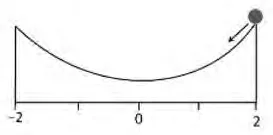
Referring to the graphs A, B, C, which of the following statements is correct?
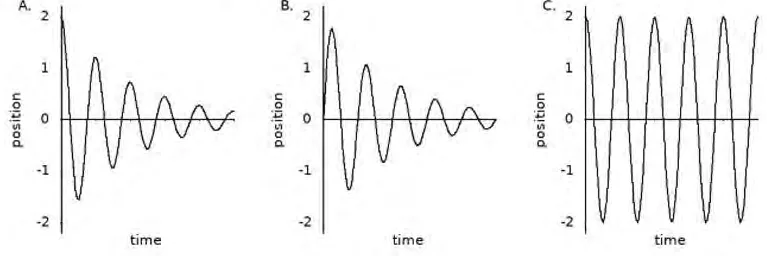
- 1A depicts motion with friction while C depicts motion without friction
- 2C depicts motion with friction while A depicts motion without friction
- 3B depicts motion with friction while A depicts motion without friction
- 4B depicts motion with friction while C depicts motion without friction
Show answer and solution
The ball starts at the top of the slope, its maximum displacement, so its position curve must start at a peak, as in A and C (B starts at zero). With friction the oscillation dies away, as in A. Without friction it keeps the same amplitude, as in C.
The graph shows average run rate (runs scored per over) by teams A and B in a twenty overs cricket match.
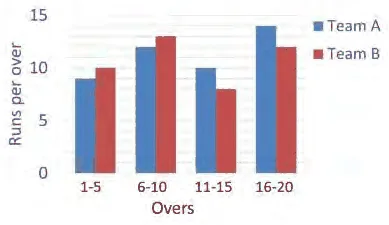
Select the INCORRECT statement.
- 1Team B scored more runs than team A in the first 10 overs.
- 2Team A scored more runs than team B in all.
- 3Team B scored more runs in overs 1–10 than in overs 11–20.
- 4Team A has a lower overall run rate than team B.
Show answer and solution
Runs = run rate × overs. Team A: 5 × (9 + 12 + 10 + 14) = 225. Team B: 5 × (10 + 13 + 8 + 12) = 215. A scored more and so has the higher overall run rate, so statement 4 is the incorrect one. B did score more in overs 1–10 (115 against 105), and more in overs 1–10 than in overs 11–20 (115 against 100).
A spherical object of radius 6 cm was melted and cast into a cylindrical bar of radius 3 cm. What would be the length (in cm) of the bar?
- 124
- 232
- 336
- 442
Show answer and solution
Sphere volume = (4/3)π × 63 = 288π. Cylinder = π × 32 × L = 9πL. So L = 288/9 = 32 cm.
The total monthly income of a family is split into expenses on food (F), house rent (H), college fees (C), entertainment (E), miscellaneous items (M), and savings (S), as shown in the pie chart.
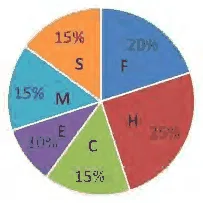
The family transfers an amount of Rs 1000/- from the head food to the head entertainment, thereby making the expenses on the two heads equal. What is the net expenditure of the family?
- 1Rs 20,000
- 2Rs 50,000
- 3Rs 37,500
- 4Rs 17,000
Show answer and solution
Food is 20% and entertainment 10% of income. Moving ₹1,000 makes them equal, so the 10% gap is ₹2,000 and the monthly income is ₹20,000. Savings (15%) are not spending, so net expenditure = 85% of 20,000 = ₹17,000.
A 1 m long rod having diameter of 12 mm weighs 880 g. What, approximately, is the density (in g/cm3) of the material of the rod?
- 16.2
- 26.6
- 37.8
- 48.8
Show answer and solution
Volume = π × (0.6 cm)2 × 100 cm ≈ 113 cm3. Density = 880/113 ≈ 7.8 g/cm3, about the density of steel.
Choose the option that will make the following statement FALSE:
A CHILD COUNTED THE NUMBER OF APPEARANCES OF THE LETTER T IN THIS SENTENCE, AND REPORTED IT CORRECTLY AS ________.
- 1TEN
- 2ELEVEN
- 3TWELVE
- 4THIRTEEN
Show answer and solution
The sentence without the blank has 11 T’s: COUNTED 1, THE 1, THE 1, LETTER 2, T 1, THIS 1, SENTENCE 1, REPORTED 1, IT 1, CORRECTLY 1. With ELEVEN (no T) the total is 11, with TWELVE (one T) 12, and with THIRTEEN (two T’s) 13, so each makes the sentence true. With TEN (one T) the total is 12, not ten, so it makes the sentence false.
The chart shows forest cover as percentages of total areas of 6 countries over the period 1990-2022 and their land areas (in million km2).
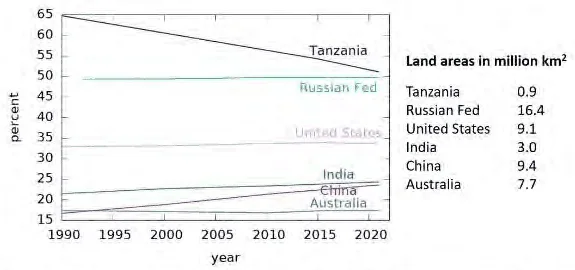
The maximum change in forest area in absolute terms among these countries took place in
- 1Tanzania
- 2Russian Federation
- 3India
- 4China
Show answer and solution
Change in forest area = change in percentage × land area. China: about 17% to 24%, +7% of 9.4 million km2 ≈ 0.66 million km2. Tanzania lost about 14% of a much smaller 0.9 million km2 (≈ 0.13), and India gained about 3% of 3.0 (≈ 0.09). China changed most.
A group of 54 boys and girls was made to stand in a queue as follows: a boy at the start was followed by a girl, then a boy followed by 2 girls, then a boy followed by 3 girls, and so on. The number of boys in the group was
- 18
- 29
- 310
- 427
Show answer and solution
Each group is one boy followed by k girls, for k = 1, 2, 3, …. With n boys, the total is n + n(n+1)/2 = 54, so n = 9 (9 + 45 = 54). 9 boys.
Part B: Life Sciences (Q21–70)
50 questions; answer any 35. Each carries 2 marks, and a wrong answer costs 0.5.
A plant is NOT watered for seven days (day 1 – day 7). Leaf and root water potential are measured every two hours starting from day 1 till day 7. Which one of the following is LEAST LIKELY to happen?
- 1Pre-dawn leaf water potential declines over the 7 days.
- 2Leaf water potential shows a diurnal cycle of highs and lows.
- 3Root water potential falls below leaf water potential at night.
- 4Root water potential fluctuates between day and night.
Show answer and solution
Water moves from roots to leaves only if root water potential is higher, less negative, than leaf water potential. At night, with stomata shut, the leaf recovers towards root and soil values but does not overshoot. Root potential falling below leaf potential is the least likely outcome. The other options are normal under drought.
Which of these traits is NOT characteristic of r-selected tree species?
- 1Mortality and reproduction are strongly dependent on population density.
- 2Tend to occupy habitats that are unpredictable and/or ephemeral.
- 3Thrive in habitats where resource competition is low.
- 4Have superior capabilities to colonize new habitats.
Show answer and solution
r-selected species live in unpredictable, uncrowded habitats where populations are kept below K, so mortality is largely density-independent. Strong density dependence of births and deaths is a K-selected trait.
Which one of the following neurotransmitters is synthesized in synaptic vesicles instead of being transported to the vesicle after its synthesis in the cytoplasm?
- 1Norepinephrine
- 2Epinephrine
- 3Acetylcholine
- 4Serotonin
Show answer and solution
Noradrenaline is made inside the vesicle. Dopamine is pumped in by VMAT, and dopamine β-hydroxylase, which sits in the vesicle, converts it there. Acetylcholine, serotonin and adrenaline are made in the cytosol (adrenaline from noradrenaline that has left the vesicle) and then loaded.
Which one of the following statements for the lac operon in E. coli is INCORRECT?
- 1The lac operon is controlled by both the Lac repressor and the activator protein, CAP.
- 2The lac operon is highly expressed only when both lactose and glucose are absent.
- 3The lac operon is highly expressed only when lactose is present and glucose is absent.
- 4In the presence of lactose, the repressor cannot bind to the operator.
Show answer and solution
The lac operon needs lactose, which inactivates LacI, and no glucose, so cAMP–CAP is active. With both sugars absent the repressor stays bound, so the operon is off. Statement 2 is the incorrect one.
Which one of the following statements about the cortical reaction in sea urchins is correct?
- 1The entry of Ca2+ ions into the egg initiates development.
- 2The exocytosed cortical granules during egg maturation contain the components of the zona pellucida.
- 3The depolarization of the plasma membrane after sperm entry helps to block polyspermy.
- 4The release of the cortical granules after sperm entry converts the vitelline membrane into the fertilization membrane which blocks polyspermy.
Show answer and solution
In sea urchins, sperm entry triggers exocytosis of cortical granules. Their contents lift the vitelline envelope off the egg and harden it into the fertilisation envelope, the slow block to polyspermy. Options 1 to 3 are wrong in their details: the Ca2+ is released from internal stores rather than entering, the zona pellucida is mammalian, and the fast block happens at sperm fusion.
Who experimentally demonstrated “Mutations occur randomly”?
- 1Alfred Hershey and Martha Chase
- 2Matthew Meselson and Franklin Stahl
- 3Salvador Luria and Max Delbrück
- 4François Jacob and Jacques Monod
Show answer and solution
The Luria–Delbrück fluctuation test (1943) found that the number of phage-resistant bacteria varied far more between parallel cultures than induced mutation would produce. Resistance mutations had arisen at random before phage exposure.
A community of woody plants is being shaped by environmental filtering. What will be the likely local species pool of this community, if the regional species pool comprises 60 species?
- 1100
- 280
- 3120
- 430
Show answer and solution
Environmental filtering allows only species whose traits suit local conditions to persist, so the local pool is a subset of the 60-species regional pool. Of the options, only 30 is smaller than 60.
Which one of the following is an example of dishonest signaling?
- 1Batesian model
- 2Batesian mimic
- 3Mullerian model
- 4Mullerian mimic
Show answer and solution
A Batesian mimic is harmless but copies the warning colours of a defended model, so its signal is dishonest. In Müllerian mimicry, all the species involved are genuinely defended, so their signals are honest.
How many amino acids are present in calcitonin, a calcium lowering hormone synthesized from C-cells of the human thyroid gland?
- 142
- 232
- 322
- 412
Show answer and solution
Human calcitonin is a 32-amino-acid peptide with a disulfide loop at the N-terminus and a proline amide at the C-terminus. It is secreted by the parafollicular C cells.
Which of the following is LEAST suited for long-distance phloem transport of photo-assimilated carbon in plants?
- 1Reducing sugars
- 2Mannitol
- 3Galactosyl-sucrose oligosaccharides
- 4Non-reducing sugars
Show answer and solution
Phloem carries non-reducing sugars: sucrose, raffinose-family oligosaccharides (galactosyl-sucrose) and sugar alcohols such as mannitol. Reducing sugars, with a free aldehyde or ketone, are too reactive for long-distance transport and are kept out of the sieve tubes.
Cell lysate in 1% TX100 was purified over an affinity column to isolate a complex with certain enzymatic activity. The purified enzyme complex was separated on a 10-50% continuous sucrose gradient. Shown below are the UV spectra using an absorbance filter at 280nm or 260nm.
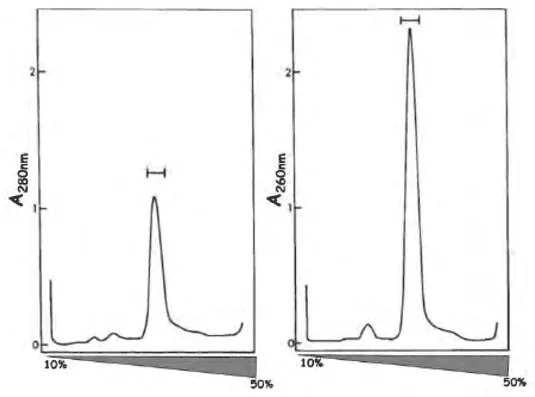
Which one of the following combinations of molecules would generate the spectra shown above?
- 1Protein-Protein
- 2Protein-RNA
- 3Protein-Lipid
- 4Protein-Cholesterol
Show answer and solution
The purified complex runs as one peak, and its absorbance at 260 nm (about 2.3) is roughly twice that at 280 nm (about 1.1). Protein absorbs mainly at 280 nm and nucleic acid strongly at 260 nm, so a single species with A260/A280 near 2 is a protein–RNA complex, a ribonucleoprotein.
A researcher overexpresses the full-length genomic sequence of rice GAPDH gene under a CaMV35S promoter in transgenic rice. Which one of the following options can be used to confirm transgenic lines using PCR?
- 1Using exon-specific primers of the GAPDH gene.
- 2Using intron-specific primers of the GAPDH gene.
- 3Amplification of the promoter region of the GAPDH gene.
- 4Using CaMV35S promoter-specific forward and GAPDH-specific reverse primer.
Show answer and solution
The plant’s own GAPDH gene is present in every rice plant, so primers inside it (exon, intron or native promoter) amplify from wild type too. A 35S-specific forward primer with a GAPDH-specific reverse primer spans the junction that exists only in the transgene.
Which one of the following is a correct combination of four carbon intermediates formed during C4 photosynthesis in plants?
- 1Malate and Aspartate
- 2Aspartate and Alanine
- 3Phosphoenolpyruvate and Oxaloacetate
- 4Alanine and Pyruvate
Show answer and solution
C4 plants fix HCO3− with PEP carboxylase into oxaloacetate, which is turned into malate (NADP-ME type) or aspartate (NAD-ME and PEPCK types) for transport to the bundle sheath. Both are C4 acids. Alanine, pyruvate and PEP have three carbons.
It was found that most people who were vaccinated with the ancestral strain of Covid-19 (Wuhan strain) were protected against the Delta variant but not against the Omicron variant. PBMCs (peripheral blood mononuclear cells) and serum were obtained from five successfully vaccinated individuals with good neutralizing antibody titres and cytotoxic (CTL) activity against the Wuhan strain-infected targets. Pooled serum was transferred into unrelated recipient “A” and pooled purified T cells were transferred into unrelated recipient “B”. Which one of the following is likely to be observed?
- 1“A” will be protected against both the ancestral strain and the Delta variant.
- 2“B” will be protected against ancestral strain but not against the Delta variant.
- 3“A” will be protected against infection with the Omicron variant.
- 4“A” will make antibodies against interferon gamma present in the donor serum.
Show answer and solution
Neutralising antibodies work in any recipient, so recipient A gets the same protection as the donors: against the ancestral strain and Delta, but not Omicron. CTLs are MHC-restricted, so donor T cells cannot protect an unrelated, MHC-mismatched recipient B. That is option 1.
Which one of the following statements regarding plasmodesmata in a plant cell is INCORRECT?
- 1They are specialized cell-to-cell junctions.
- 2They are open channels that connect the cytosol of adjacent cells.
- 3The plasma membranes of the adjacent cells extend continuously through each plasmodesma.
- 4Plasmodesmata are extensions of chloroplast that interconnects the cytosol of the adjacent cells.
Show answer and solution
Plasmodesmata are membrane-lined channels between plant cells: the plasma membrane runs continuously through them and they connect the cytosol of neighbouring cells. A strand of ER (the desmotubule) runs through the centre. They have nothing to do with chloroplasts, so statement 4 is the incorrect one.
In eukaryotes, nucleosome remodelers
- 1methylate histone H3.
- 2acetylate histone H3 and H4.
- 3create DNaseI hypersensitive sites.
- 4degrade histone subunits.
Show answer and solution
Nucleosome remodellers (SWI/SNF, ISWI, CHD, INO80) use ATP to slide, evict or restructure nucleosomes. That exposes DNA as DNase I-hypersensitive sites. They do not methylate, acetylate or degrade histones.
A pulse oximeter measures the ratio between oxyhemoglobin and hemoglobin in the pulsating condition on the finger. Which combination of wavelengths can obtain a differential absorption to measure blood oxygen saturation?
- 1Ultraviolet and Infrared
- 2Visible and Infrared
- 3Far-ultraviolet and visible
- 4Ultraviolet and far-ultraviolet
Show answer and solution
Oxy- and deoxyhaemoglobin absorb differently in visible red light (about 660 nm) and near-infrared (about 940 nm). The ratio of the pulsatile absorbance at the two wavelengths gives oxygen saturation.
Which one of the following statements regarding mammalian innate immunity is INCORRECT?
- 1Pattern recognition receptors (PRRs) are a component of innate immunity.
- 2Serum complement proteins are part of innate immunity.
- 3Innate immunity has only a narrow range of specificity.
- 4The outcome of innate immunity is the rapid recognition and phagocytosis or destruction of the pathogen.
Show answer and solution
Innate immunity recognises broad classes of conserved microbial patterns (PAMPs) through a limited set of receptors. It does not have the narrow, clone-specific specificity of lymphocytes, so statement 3 is the incorrect one.
A student counts the number of seeds produced by ten different haploid Arabidopsis plants and obtains the following data:
0, 5, 15, 25, 100, 150, 200, 600, 1500, 3000.
Which one of the following is the best measure of central tendency for summarizing the above data?
- 1Mean
- 2Median
- 3Mode
- 4Standard deviation
Show answer and solution
The counts are hugely skewed: most are small and a few run into thousands, which drags the mean upward (about 560). The median, (100 + 150)/2 = 125, describes the typical plant better. No value repeats, so there is no mode, and SD measures spread, not centre.
A DNA molecule is completely transcribed into messenger RNA by an RNA polymerase. The base composition of the DNA template strand is G = 24.1%; C = 18.5%; A = 24.6%; T = 32.8%. The base composition of the newly synthesized RNA molecule is:
- 1G = 24.1%, C = 18.5%, A = 24.6%, U = 32.8%
- 2G = 24.6%, C = 24.1%, A = 18.5%, U = 32.8%
- 3G = 18.5%, C = 24.1%, A = 32.8%, U = 24.6%
- 4G = 32.8%, C = 24.6%, A = 18.5%, U = 24.1%
Show answer and solution
RNA is complementary to the template strand. Template G gives RNA C (24.1%), C gives G (18.5%), A gives U (24.6%) and T gives A (32.8%). So the RNA is G 18.5%, C 24.1%, A 32.8% and U 24.6%.
In the representation of the di-peptide shown below, the superscript ‘-1’ denotes the atom of the previous amino acid while ‘+1’ denotes the atom of the next amino acid.
The atomic coordinates of how many AND which of the following atoms are required to uniquely define the torsion angles, ϕ and ψ of the Ramachandran plot?
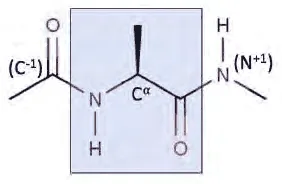
- 14 atoms; C−1, N, Cα, C for ϕ; N, Cα, C, N+1 for ψ
- 22 atoms; N and Cα for ϕ; Cα and C for ψ
- 34 atoms; H, N, Cα, C for ϕ; N, Cα, C, O for ψ
- 43 atoms; C−1, N, Cα for ϕ; Cα, C, N+1 for ψ
Show answer and solution
A torsion angle is defined by four consecutive atoms: the angle between the plane of atoms 1–2–3 and the plane of atoms 2–3–4. φ is the rotation about N–Cα, defined by C−1–N–Cα–C. ψ is the rotation about Cα–C, defined by N–Cα–C–N+1.
What is the correct order in which the following proteins are recruited during DNA double strand break repair in prokaryotes?
- 1RecA, RecBCD, Ssb, DNA Pol III, DNA Ligase
- 2Ssb, RecA, RecBCD, DNA Pol III, DNA Ligase
- 3RecBCD, RecA, Ssb, DNA Pol III, DNA Ligase
- 4RecBCD, Ssb, RecA, DNA Pol III, DNA Ligase
Show answer and solution
At a double-strand break, RecBCD binds the end and resects it until it reaches a Chi site, leaving a 3′ tail. The tail is first coated by SSB, and RecBCD then loads RecA, which displaces SSB and searches for the homologous sequence. Strand invasion is followed by synthesis by Pol III and sealing by ligase.
Retinal rod cell cGMP-phosphodiesterase is an enzyme with subunit structure as:
- 1αβγ
- 2αβγ2
- 3αβ2γ
- 4α2βγ
Show answer and solution
Rod PDE6 is a heterotetramer: catalytic α and β subunits plus two inhibitory γ subunits (αβγ2). Light-activated transducin (Gαt-GTP) removes the γ subunits, so cGMP is hydrolysed and the cGMP-gated channels close.
Which one of the following concepts can explain host-parasite co-evolution?
- 1Kin selection
- 2Red Queen hypothesis
- 3Runaway selection
- 4Handicap principle
Show answer and solution
Hosts evolve resistance and parasites evolve to overcome it, so each must keep evolving just to stay where it is. That is the Red Queen hypothesis, which also helps explain the advantage of sex.
If chimeric mouse embryos were generated using GFP-expressing embryonic stem cells and RFP-expressing induced pluripotent stem cells, which one of the following tissues from any resulting embryos will not express any fluorescent protein?
- 1Brain
- 2Heart
- 3Intestine
- 4Placenta
Show answer and solution
ES and iPS cells come from (or resemble) the inner cell mass, so they contribute to the embryo proper (brain, heart, gut) but not to the trophectoderm, which forms the placenta. The placenta comes from host cells and carries neither fluorescent label.
Which one of the following correctly describes ‘Dark Reversion’ of phytochromes?
- 1Conversion of PR to PFR
- 2Conversion of PFR to PR
- 3Export of PFR from cytosol to nucleus
- 4Export of PR from cytosol to nucleus
Show answer and solution
Phytochrome made in the dark is the red-absorbing Pr. Red light converts it to active Pfr. In darkness Pfr slowly reverts on its own, thermally, to Pr: dark reversion.
For maintaining hydraulic conductance, tree stems appear to trade-off vessel diameter with
- 1strength of the stem.
- 2stem length.
- 3heartwood volume.
- 4vessel length.
Show answer and solution
Wide vessels carry far more water (flow rises with radius to the fourth power) but make wood weaker and more prone to embolism. Trees trade vessel diameter against mechanical strength (and safety): dense wood with narrow vessels is stronger.
Andaman and Nicobar archipelago are part of which biodiversity hotspots?
- 1Andaman – Indo-Burma; Nicobar – Sundaland
- 2Andaman – Sundaland; Nicobar – Indo-Burma
- 3Andaman – Indo-Burma; Nicobar – Indo-Burma
- 4Andaman – Sundaland; Nicobar – Sundaland
Show answer and solution
The Andaman Islands belong to the Indo-Burma hotspot, and their biota is allied with Myanmar. The Nicobar Islands, south of the Ten Degree Channel, belong to Sundaland, and their biota is allied with Sumatra.
Select the statement that describes guild coevolution, also known as diffuse coevolution.
- 1One species uses the other as a resource.
- 2Two species coevolve reciprocally, but only to each other.
- 3Several species are involved in coevolutionary interactions.
- 4A species escapes association from a predator and diversifies. Later, a different predator adapts to the host and diversifies.
Show answer and solution
Diffuse (guild) coevolution means groups of species evolving together, for example a suite of pollinators with a suite of flowers, rather than a strict one-to-one pairing. Option 4 describes escape-and-radiate coevolution.
Which one of the following statements regarding the structure of water molecule is correct?
- 1The oxygen atom in water is in sp3 hybridization, with an H-O-H angle of 109.5°.
- 2The oxygen atom in water is in sp2 hybridization, with an H-O-H angle of 120°.
- 3The oxygen atom in water is in sp3 hybridization, with an H-O-H angle of 104.5°.
- 4The oxygen atom in water is in sp2 hybridization, with an H-O-H angle of 90°.
Show answer and solution
Water’s oxygen is sp3 hybridised, with two bonding pairs and two lone pairs. The lone pairs repel the bonds more strongly than bonds repel each other, squeezing the H–O–H angle from 109.5° to 104.5°.
Given below are Ramachandran plots for four different proteins.
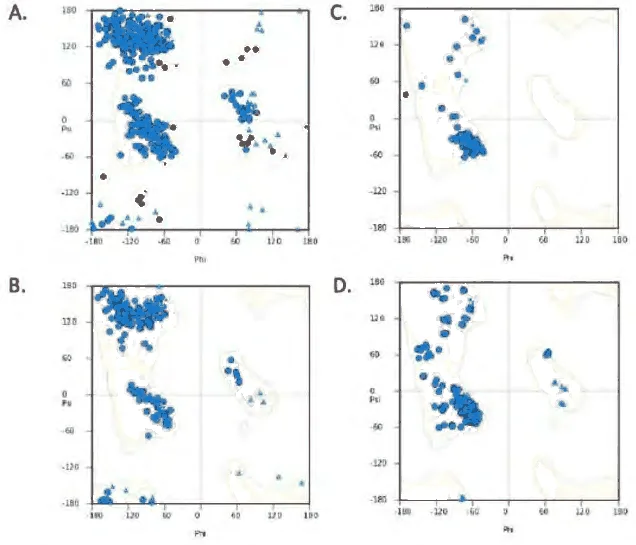
Choose the correct pair of proteins, both of which are predominantly alpha helical in nature.
- 1A and B
- 2A and C
- 3B and D
- 4C and D
Show answer and solution
An α-helical protein has most of its residues in the region around φ ≈ −60°, ψ ≈ −45°. Plots C and D are concentrated there. A and B have most points in the upper-left β-sheet region (ψ about +120° to +150°).
In Caenorhabditis elegans, blastomere identity occurs both through conditional and autonomous modes of cell specification. Which one of the following options is a correct statement in this regard?
- 1If the AB and P1 blastomeres are experimentally separated, the AB cell will generate all cells it would normally make.
- 2When AB divides to form daughter cells, ABp becomes different from ABa through its interaction with the P2 cell.
- 3The specification of AB cell is determined by the presence of cytoplasmic determinants.
- 4The P2 cell produces a morphogen for the determination of the ABp cell.
Show answer and solution
ABa and ABp start out equal. ABp becomes different because it touches the P2 cell, which signals to it through the Notch ligand APX-1 (and Wnt), so ABp is conditionally specified. P-lineage cells are autonomously specified by inherited determinants. Isolated AB cannot make all its normal fates, because it needs those signals.
Which one of the following options has the correct set of components for assaying reverse transcriptase activity?
- 1RNA primer, dNTPs, buffer, primase, DNA template
- 2DNA primer, NTPs, buffer, DNA template
- 3DNA primer, dNTPs, buffer, RNA template
- 4RNA primer, NTPs, buffer, RNA template
Show answer and solution
Reverse transcriptase is an RNA-dependent DNA polymerase. It copies an RNA template by extending a DNA primer (often oligo-dT) with dNTPs, in a suitable buffer containing Mg2+. Primase and NTPs are not part of the reaction.
In eukaryotic cells, DNA replication is restricted to the S phase of the cell cycle because
- 1DNA polymerase is present only in the S phase of the cell cycle.
- 2Origin recognition complex (ORC) recognizes origin only in the S phase.
- 3MCM helicases get activated in the S phase of the cell cycle.
- 4MCM helicases get activated in the G1 phase of the cell cycle.
Show answer and solution
In G1, origins are licensed: ORC, Cdc6 and Cdt1 load inactive MCM2–7. Only in S phase do CDK and DDK activate the MCM helicase (with Cdc45 and GINS forming CMG). High CDK activity then prevents re-licensing, so each origin fires only once.
Which one of the following does NOT occur during ribosome-associated quality control of damaged mRNA?
- 1mRNA degradation
- 2Nascent protein degradation
- 3Disengagement of ribosome from mRNA
- 4Ribosome-mRNA monosome degradation
Show answer and solution
In ribosome-associated quality control, stalled ribosomes are split from the mRNA, the faulty mRNA is cleaved and degraded, and the incomplete nascent chain is tagged (by Listerin and CAT tails) and destroyed. The ribosomal subunits are recycled, not degraded together with the mRNA.
In which one of the following stages pontogeniculo-occipital (PGO) spikes are found in human EEG recordings?
- 1Immediately before and during REM sleep
- 2Non-REM sleep stage 2
- 3Awake condition
- 4Non-REM sleep stage 4
Show answer and solution
PGO waves are bursts of activity that begin in the pons and spread through the lateral geniculate body to the occipital cortex. They appear just before and during REM sleep, together with rapid eye movements.
Which one of the following statements correctly explains the function of a GTPase activating protein (GAP) in the regulation of heterotrimeric G proteins in plants?
- 1It activates Gβ protein.
- 2It inactivates Gα protein.
- 3It directly inhibits ligand binding to GPCR.
- 4It leads to the dissociation of Gα from Gβ/Gγ subunits.
Show answer and solution
A GAP (in plants, RGS1-type proteins) speeds up GTP hydrolysis by Gα, returning it to the inactive GDP-bound form, so it inactivates Gα. That ends the signal and lets Gα rejoin Gβγ.
The following are sketches of wild-type and mutant (I – III) embryos of Drosophila melanogaster.

Which one of the following options represents a correct match between the gene and its loss of function phenotype?
- 1dorsal : I
- 2torpedo : III
- 3gurken : II
- 4cactus : III
Show answer and solution
The dorsal appendages of the eggshell are made by dorsal follicle cells that receive the oocyte’s Gurken (EGFR) signal. Without gurken, all follicle cells become ventral and the eggshell has no dorsal appendages, as in egg II.
Select the correct combination of terms from plant breeding systems that represents selfing or promote selfing.
- 1Autogamy and allogamy
- 2Cleistogamy and geitonogamy
- 3Geitonogamy and allogamy
- 4Autogamy and herkogamy
Show answer and solution
Cleistogamy (flowers that never open) forces self-pollination. Geitonogamy (pollen moving between flowers of the same plant) is genetically selfing. Allogamy is outcrossing, and herkogamy, the spatial separation of anthers and stigma, discourages selfing.
Which one of the following statements regarding principles of linkage mapping in plants is correct?
- 1Genetic markers would always show higher recombination frequencies when they are closer to each other than if they are far apart.
- 2The genetic distance between two markers is a true representation of the physical distance between them.
- 3An ideal mapping population for a self-pollinating species is generated using polymorphic parents that are inbred lines.
- 4An F2 mapping population would segregate in a 1:2:1 ratio for a dominant marker.
Show answer and solution
Mapping populations are best made by crossing two inbred, homozygous parents that differ at many loci, so every marker segregates clearly. Close markers recombine less, genetic distance does not map linearly to physical distance, and a dominant marker gives 3:1 in an F2.
In rate-zonal centrifugation, a mixture is spun just long enough to separate molecules that differ in mass but may be similar in shape and density. Which one of the following options represents the component that is typically used to create a gradient in this technique?
- 1phospholipids
- 2sucrose
- 3KCl
- 4starch
Show answer and solution
Rate-zonal (velocity) separation is run on a shallow pre-formed sucrose gradient (for example 5–20%), which stabilises the bands. The run is stopped before particles reach equilibrium.
Which one of the following options includes all plants that are major non-native invaders of aquatic ecosystems in India?
- 1Parthenium hysterophorus, Pontederia crassipes, Lantana camara
- 2Salvinia molesta, Prosopis juliflora, Mikania micrantha
- 3Nelumbo nucifera, Pogostemon erectus, Hygrophila serpyllum
- 4Pontederia crassipes, Salvinia molesta, Alternanthera philoxeroides
Show answer and solution
Water hyacinth (Pontederia, formerly Eichhornia, crassipes), giant salvinia (Salvinia molesta) and alligator weed (Alternanthera philoxeroides) are all South American aquatic invaders now widespread in Indian waters. Parthenium, Lantana, Prosopis and Mikania invade land.
How many times are sound waves amplified in the middle ear of a human?
- 116 – 18
- 26 – 8
- 39 – 12
- 42 – 4
Show answer and solution
The middle ear raises sound pressure mainly because the eardrum is much larger than the oval window (about 17:1). The ossicle lever adds a little more, so the total gain is about 17 to 22 times depending on the textbook. NTA’s key gives 16–18 times.
Select the geological time where some of the major events, like an increase in marine diversity, dominance of gymnosperms, diversification of synapsids (including the emergence of first dinosaurs), and first mammal-like forms, occurred.
- 1Cretaceous
- 2Jurassic
- 3Triassic
- 4Carboniferous
Show answer and solution
The Triassic (about 252–201 million years ago) saw marine life recover after the end-Permian extinction, gymnosperms dominate the land, the first dinosaurs appear (late in the period), and the first mammal-like forms (mammaliaforms) arise from synapsid ancestors.
Which one of the following activities is associated with Mitochondria-associated ER membranes (MAM)?
- 1Protein glycosylation
- 2ATP synthesis
- 3Phospholipid metabolism
- 4Iron-sulphur cluster assembly
Show answer and solution
Mitochondria-associated ER membranes are contact sites where phospholipids pass between the two organelles. For example, phosphatidylserine made in the ER is moved to mitochondria and turned into phosphatidylethanolamine. MAMs also carry Ca2+ and regulate mitochondrial division.
In animal cells, typically which organelle is only provided by the sperm to the oocyte following fertilization?
- 1Nucleolus
- 2Peroxisomes
- 3Mitochondria
- 4Centrioles
Show answer and solution
Most animal eggs discard their centrioles during oogenesis. The sperm provides the centriole, which organises the zygote’s sperm aster and first spindle. Mitochondria come from both gametes, but the paternal ones are destroyed.
Brassica juncea has bisexual flowers.
A mutation in the mitochondria leads to cytoplasmic male sterility (CMS). CMS can be restored by a restorer of fertility gene (Rf) which is a nuclear gene.
Fertility restoration is a dominant phenotype.
A CMS line is crossed to a homozygous Rf line. The obtained F1 progeny is self-pollinated. What percentage of F2 progeny will be male sterile?
- 10
- 225
- 375
- 4100
Show answer and solution
The CMS cytoplasm comes from the mother, so every F2 plant has sterile mitochondria. Selfing the F1 (Rf/rf) gives 1/4 rf/rf F2 plants with no restorer. Those plants are male sterile: 25%.
Which one of the following represents the predominant ‘source organ’ during phloem translocation in healthy plants?
- 1Roots
- 2Developing fruits
- 3Immature leaves
- 4Mature leaves
Show answer and solution
Mature leaves make more sugar by photosynthesis than they use, so they export it through the phloem and are the main sources. Roots, developing fruits and young leaves import sugar (sinks).
In 2007, scientists reported the fossil of a deer-like animal in Kashmir, India which is considered the most recent terrestrial ancestor of whales. The name of this fossil is
- 1Jainosaurus.
- 2Indohyus.
- 3Rajasaurus.
- 4Indosuchus.
Show answer and solution
Indohyus, a small Eocene raoellid artiodactyl from Kashmir, described in 2007, had the thickened ear bone (involucrum) and dense limb bones typical of whales. It is regarded as the closest known land relative of whales.
Which one of the following pairs correctly matches the enzyme with its allosteric activator?
- 1Phosphofructokinase : Citrate
- 2Pyruvate dehydrogenase : NADH
- 3Pyruvate carboxylase : ADP
- 4Pyruvate kinase : Fructose-1,6-bisphosphate
Show answer and solution
Fructose 1,6-bisphosphate, made by PFK, activates pyruvate kinase further down glycolysis (feed-forward activation). The other pairings are wrong: citrate inhibits PFK, NADH inhibits PDH, and pyruvate carboxylase is activated by acetyl-CoA, not ADP.
Part C: Life Sciences, analytical (Q71–145)
75 questions; answer any 25. Each carries 4 marks, and a wrong answer costs 1.
The interpretation of any clinical laboratory test is done by comparing the patient’s results to the test’s reference intervals. For example, the reference interval for white blood cells (WBC) in human adults is 4,500 – 11,000 cells/microlitre. Estimation of this reference interval is done by testing
- 1a large number of healthy adults and estimating the range between 2.5 to 97.5 percentiles of the reference population.
- 2a large number of healthy adults and estimating the range between 5 to 95 percentiles of the reference population.
- 3a large number of random adults and estimating the range between 5 to 95 percentiles of the reference population.
- 4a large number of random adults and estimating the range between -1.64 and +1.64 standard deviations either side of the mean of the reference population.
Show answer and solution
Reference intervals come from a large group of healthy reference individuals, and the central 95% of their values is taken: the 2.5th to 97.5th percentiles (equivalent to the mean ± 1.96 SD for normal data).
Cystic fibrosis is caused by a recessive allele. Roughly one out of every 500 individuals (0.20%) have this disease. Using the Hardy-Weinberg equation, the percentage of individuals who are carriers of the recessive allele for the disease is
- 110.2
- 21.0
- 315.2
- 47.6
Show answer and solution
By Hardy–Weinberg, q2 = 1/500 = 0.002, so q = 0.0447 and p = 0.955. Carriers are 2pq = 0.085, or about 8.5%. NTA’s final key gives 7.6%, which is the closest option.
The Ran GTPase imposes directionality on transport through nuclear pore complexes (NPCs). Like other GTPases, Ran is a molecular switch that can exist in two conformational states, depending on whether bound to GDP or GTP. Possible reasons for compartmentalization of Ran-GTP accumulation are:
- A. Ran-GAP is enriched in the nucleus
- B. Ran-GAP is localized in the cytosol
- C. Ran-GEF is enriched in the nucleus
- D. The nuclear import receptors help in the compartmentalization of Ran-GTP
Which of the options below has all the correct statements about Ran-GTP compartmentalization?
- 1A only
- 2A and B
- 3B and C
- 4C and D
Show answer and solution
Ran-GTP is high in the nucleus because the GEF (RCC1) is bound to chromatin in the nucleus, loading GTP there, while RanGAP sits in the cytosol (at the cytoplasmic face of the pores) and converts any Ran-GTP that leaves into Ran-GDP. B and C.
During physical exercise, a large amount of oxygen is delivered to the active muscles by many physiological adjustments including a change in the P50 value (which is determined by PO2 at which hemoglobin is half-saturated with oxygen). The following proposed statements explain the mechanism of change in P50 during exercise:
- A. P50 is increased during exercise as the temperature rises in active muscles.
- B. During exercise, metabolites accumulate in the active muscles resulting in higher pH that increases P50.
- C. P50 is increased during exercise as CO2 is decreased in active muscles.
- D. An increase in 2,3-DPG has been reported in non-trained person within 60 min of exercise resulting in higher P50.
Which one of the following options represents the correct combination of the above statements?
- 1A and B
- 2B and C
- 3C and D
- 4A and D
Show answer and solution
In working muscle the oxygen dissociation curve shifts right, so P50 rises. The causes are higher temperature (A), plus lower pH and higher CO2 (so B and C are stated backwards), and, within an hour of exercise in untrained people, more 2,3-DPG (D). A and D.
Given below are a few statements regarding the rate of glycolysis, gluconeogenesis and glycogen metabolism.
- A. Increased blood glucose would decrease gluconeogenesis and increase glycogen synthesis.
- B. Increased levels of fructose-1, 6-bisphosphate inhibits glycolysis.
- C. Increased blood glucagon inhibits glycogen synthesis and stimulates glycogen break down.
- D. Increase in AMP levels inhibits glycolysis and stimulates gluconeogenesis.
Which one of the following options represents INCORRECT statements?
- 1A and D
- 2B and D
- 3A and C
- 4B and C
Show answer and solution
B is incorrect: fructose 1,6-bisphosphate activates pyruvate kinase and so promotes glycolysis. D is incorrect: AMP stimulates glycolysis (PFK) and inhibits gluconeogenesis (FBPase). A and C are correct statements about fed and fasted regulation.
In a line transect of length L and half-width w, designed for estimating the density of gaur (~ D=N/2Lw), N animals were counted.
The following statements represent possible assumptions about population sampling.
- A. The probability of detection is independent of distance from the transect line.
- B. The animals in question are uniformly distributed through the study area.
- C. The animals are deemed to be stationary and thus detected only once during the sampling.
- D. Animals on the line will be detected with a probability equal to 1.
Select the options that are considered as assumptions in line transect sampling.
- 1A and B
- 2C and D
- 3A and C
- 4B and D
Show answer and solution
Distance-sampling methods assume that animals on the line are always seen (g(0) = 1) and that animals are counted once, at their original position, without moving because of the observer. Detection usually falls with distance, and animals need not be uniformly spread, as long as transects are placed randomly. C and D.
Biosynthesis of glutamine and asparagine is sensitive to light and to the availability of reduced carbon. Following are a few statements regarding the same.
- A. Expression of the plastid-localized Glutamine Synthetase (GS) gene is upregulated by light.
- B. Darkness promotes the expression of Asparagine Synthetase (AS) gene.
- C. Expression of GS is inhibited by sucrose while that of AS is upregulated by sucrose.
- D. Asparagine is a more efficient carbon source than glutamine.
Which one of the following options represents the combination of all correct statements?
- 1A, B and D
- 2B, C and D
- 3A, B and C
- 4A, C and D
Show answer and solution
Light and sugar induce the plastid GS2 gene, so GS is light-upregulated (A). Darkness and low carbon induce ASN1, so asparagine is made when carbon is short (B). NTA also counts D as correct: asparagine, with a high N:C ratio, is the economical compound for storing and moving nitrogen when carbon is scarce. C has the sucrose effects reversed. A, B and D.
Given below are a few statements on transgenic plants.
- A. Transgenic plants generated using a transformation vector with the CaMV35S promoter-GUS-35SpA cassette can show variations in expression levels of GUS protein in independent transgenic events due to differences in strength of promoter used to express the GUS gene.
- B. A transgenic plant containing two insertions of the transgene cassette as inverted repeats in tandem would segregate in a 3:1 ratio for the transgenic phenotype on backcrossing the transgenic plant with the untransformed parent.
- C. A transgene containing a potential polyadenylation signal in its coding sequence would generate full-length transgene mRNA but a truncated transgenic protein.
- D. A gene-pyramiding experiment to bring together two transgenic traits by crossing independent homozygous single-copy transgenic lines for each trait would produce a plant homozygous for both the transgenes in the F2 generation.
Which one of the following options represents a combination of only correct statements?
- 1A and B
- 2C and D
- 3D only
- 4A and C
Show answer and solution
D is correct: crossing two homozygous single-copy lines gives an F1 heterozygous for both, and 1/16 of the F2 is homozygous for both transgenes. A is wrong: independent events differ because of position effects and copy number, not because the promoter differs. B is wrong: two copies at one locus segregate 1:1 in a backcross. C is wrong: an internal poly(A) signal truncates the mRNA.
Given below are a few statements related to enzymes and their functions in molecular reactions.
- A. Alkaline phosphatases remove 3’ phosphates from DNA and RNA.
- B. S1 nuclease removes single-stranded regions from partially double-stranded DNA.
- C. 5’ end-labelling of DNA molecules can be done by using polynucleotide kinase which transfers a 32P-labelled phosphate group to the 5’ end of dephosphorylated DNA.
- D. 3’-5’ exonuclease activity of Taq polymerase releases the reporter from the 3’ end of Taqman probes in qPCR.
Which one of the following options represents a combination of all correct statements?
- 1A and D
- 2B and C
- 3B and D
- 4A and C
Show answer and solution
S1 nuclease cuts single-stranded DNA and RNA, trimming single-stranded tails and loops (B). Polynucleotide kinase transfers γ-32P from ATP to dephosphorylated 5′ ends (C). A is wrong: alkaline phosphatase removes 5′ phosphates. D is wrong: TaqMan probes are cleaved by Taq’s 5′→3′ exonuclease. B and C.
Phylogenetic trees are used to examine
- A. relatedness among different populations, species or genera.
- B. similarity in characters among different populations, species or genera.
- C. common ancestry among different populations, species or genera.
- D. functional significance of traits in populations, species or genera.
From the above statements, select the correct combination of statements that best represent the utility of phylogenetic trees.
- 1B, C and D
- 2A, B and D
- 3A, B and C
- 4A, C and D
Show answer and solution
Phylogenetic trees show relatedness (A) and common ancestry (C), and they are built from similarities in characters (B). They do not, by themselves, show what traits do: function needs separate tests, often comparative methods applied to the tree.
Following are certain statements regarding Crassulacean Acid Metabolism (CAM) plants:
- A. The HCO3− concentration is enriched in the cytosol during night by the CO2 coming from the external atmosphere through the open stomata and the mitochondrial respiration.
- B. Oxaloacetate produced by the action of PEPCase is stored in the vacuole during dark.
- C. During light, oxaloacetate produces malate that provides CO2 for Calvin-Benson cycle in the chloroplast.
- D. During dark, phosphoenolpyruvate is produced by the breakdown of starch present in the chloroplast.
- E. CAM is a mechanism of concentrating CO2 around Rubisco by keeping stomata closed during day.
Which one of the following options represents the combination of all correct statements?
- 1A, B and E
- 2B, C and E
- 3A, C and D
- 4A, D and E
Show answer and solution
A is true: at night CO2 from open stomata and from respiration raises cytosolic HCO3−. D is true: PEP comes from starch broken down at night. E is true: CAM concentrates CO2 around RuBisCO while the stomata stay shut by day. B is false: the vacuole stores malate, not oxaloacetate. C is false: it is stored malate that is decarboxylated by day. A, D and E.
In order to investigate the involvement of the following proteins in the mismatch repair mechanism (MMR), an in vitro reconstitution experiment was performed. A 5’-nicked circular DNA substrate having a C:C mismatch at the PstI site was incubated with different combination of proteins (as shown below), where upon the repair of C:C mismatch, the PstI site will be regenerated. Following the incubation, the resulting DNA were digested with PstI and ScaI restriction endonucleases, and the products were electrophoresed in 0.8% agarose gel.
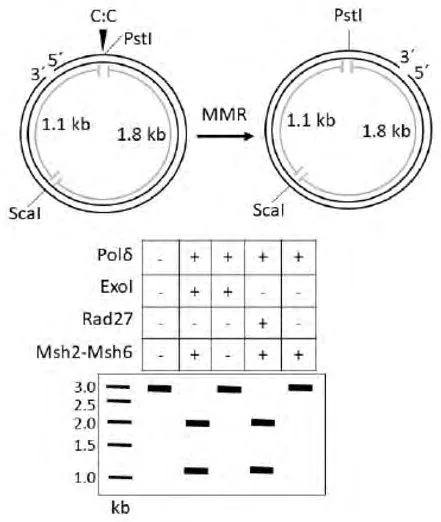
Based on the results obtained identify the INCORRECT statement.
- 1Msh2-Msh6 complex is required for the repair of the C:C mismatched DNA.
- 2Polδ and Msh2-Msh6 complex are necessary for the repair of the C:C mismatched DNA.
- 3Polδ and Msh2-Msh6 complex are sufficient for the repair of the C:C mismatched DNA.
- 4ExoI and Rad27 are redundant to each other for the repair of the C:C mismatched DNA.
Show answer and solution
The mismatch blocks the PstI site, and repair restores it, so PstI plus ScaI then gives 1.8 + 1.1 kb fragments. Repair happens with Polδ + Msh2–Msh6 + ExoI, or with Rad27 instead of ExoI, so the two exonucleases can substitute for each other. It fails without Msh2–Msh6, and also with Polδ + Msh2–Msh6 alone. Those two are necessary but not sufficient, so statement 3 is the incorrect one.
Which one of the following options represents a classical Hoogsteen base pairing?
- 1anti A base-paired with anti T
- 2anti G base-paired with anti C
- 3syn A base-paired with anti T
- 4anti G base-paired with anti U
Show answer and solution
In Watson–Crick pairs both bases are anti. In a Hoogsteen pair the purine flips to syn, so its N7 edge faces the partner. The classic case is syn-A paired with anti-T.
SLN1 receptor, a part of a two-component system, is required for osmoregulation in yeast. The yeast mutant (sln1) lacking the SLN1 receptor protein dies. A researcher tries to rescue the mutant by expressing an Arabidopsis gene for the cytokinin receptor, CRE1, which like SLN1 is also a histidine kinase that acts through a two-component system.
The following statements are made regarding the outcome of the experiment.
- A. SLN1 and CRE1 proteins respond to the same external signals and therefore, CRE1 rescues the yeast mutant.
- B. As CRE1 cannot interact with the downstream signaling pathway in the yeast, it will not rescue the yeast mutant.
- C. CRE1 will rescue the yeast mutant, only if cytokinin is present.
- D. The effector domains of CRE1 and SLN1 proteins are sufficiently similar and therefore, CRE1 can induce the downstream signaling pathway and rescue the yeast mutant.
Which one of the following options represents the combination of all correct statements?
- 1A and C
- 2C and D
- 3A only
- 4B only
Show answer and solution
CRE1/AHK4 is a histidine-kinase receptor whose phosphorelay can feed into the yeast SLN1 pathway (through Ypd1), so it can complement sln1 (D). But it signals only when its own ligand, cytokinin, is bound, so the rescue depends on adding cytokinin (C). This is the classic experiment (Inoue and colleagues, 2001) that identified CRE1 as a cytokinin receptor.
A student used the mark-recapture method to assess the population size of grasshopper in a field. The student was asked to repeat the recapture procedure once on three consecutive days. The procedure followed by the student and the observations made are as follows:
• On day one, 40 grasshoppers were captured, marked and released back in the field.
• On day two, 60 grasshoppers were re-captured of which, 4 were marked. He marked the unmarked ones and released all 60 in the field.
• On day three, 50 grasshoppers were re-captured of which 7 were marked. He marked the unmarked ones and released all 50 in the field.
• On day four, 25 grasshoppers were re-captured of which 6 were marked.
The student was asked to calculate the population size based on the mean of the three observations. The estimated population size is:
- 1600
- 2~622
- 3~351
- 4~454
Show answer and solution
Use Lincoln–Petersen each day with the running total of marked animals. Day 2: 40 × 60/4 = 600. Day 3: (40 + 56) × 50/7 = 96 × 50/7 ≈ 686. Day 4: (96 + 43) × 25/6 = 139 × 25/6 ≈ 579. Mean ≈ (600 + 686 + 579)/3 ≈ 622.
The following statements have been made regarding cell specification in an early embryo:
- A. The entire embryo rarely interacts with its environment, and its developmental trajectory cannot be guided by its immediate “ecosystem”.
- B. When cells are removed, changes in cellular biochemistry and function are never preceded by a process involving the commitment of the cell to a certain fate.
- C. The fate of a cell or a tissue in the intact embryo is said to be specified when it is not capable of differentiating autonomously on being placed in a neutral environment, such as a petri dish or test tube.
- D. If cells are removed, the interactions of the remaining cells compensate the fate of the removed cells, because the fate of a cell depends upon the conditions in which the cell finds itself.
With regard to the experiment shown below, where removal of cells from an early blastula leads to normal development of the larval form, which one of the above combination of statements apply to the development of the organism?

- 1A and D
- 2Only D
- 3B and C
- 4Only C
Show answer and solution
Removing cells from the early blastula still gives a normal larva, because the remaining cells adjust their fates to their new positions. That is regulative (conditional) development, where fate depends on position and interactions (D). A, B and C wrongly describe embryos as isolated, never committed, or unable to differentiate autonomously.
Sucrose-phosphate synthase (SPS) is a key enzyme in the biosynthesis of sucrose in plants. Following are certain statements regarding SPS:
- A. Uridine-diphosphate glucose and fructose-6-phosphate are the substrates for SPS.
- B. SPS directly converts its substrate into sucrose.
- C. Phosphorylation activates while dephosphorylation inactivates SPS.
- D. SPS converts its substrate into sucrose-6-phosphate which is then converted to sucrose by the action of sucrose-phosphate phosphatase.
- E. Glucose 6-phosphate activates while Pi inactivates SPS.
Which one of the following options represents the combination of all correct statements?
- 1A, C and D
- 2A, B and E
- 3B, C and D
- 4A, D and E
Show answer and solution
A is true: SPS uses UDP-glucose and fructose 6-phosphate. D is true: it makes sucrose 6-phosphate, which sucrose-phosphate phosphatase converts to sucrose. E is true: glucose 6-phosphate activates SPS allosterically and Pi inhibits it. B is false. C is false: phosphorylation inactivates SPS. A, D and E.
Given below are the blood clotting factors in column X and their names in column Y.
| Column X | Column Y | ||
|---|---|---|---|
| a. | XII | i. | Fitzgerald factor |
| b. | HMWK | ii. | Laki-Lorand factor |
| c. | Pre-Ka | iii. | Stuart-Prower factor |
| d. | X | iv. | Fletcher factor |
Which of the following combination is a correct match of the factor with its name.
- 1a-iv, b-iii, c-i, d-ii
- 2a-ii, b-iii, c-i, d-iv
- 3a-ii, b-i, c-iv, d-iii
- 4a-i, b-ii, c-iv, d-iii
Show answer and solution
High-molecular-weight kininogen is Fitzgerald factor (b–i), prekallikrein is Fletcher factor (c–iv), and factor X is Stuart–Prower factor (d–iii). Only option 3 gets those three right. (Factor XII is properly Hageman factor; Laki–Lorand is factor XIII.)
In vivo interaction between FLAG-tagged protein P and chaperone H was examined by co-immunoprecipitation (co-IP). Co-chaperone A was included and the co-IP was performed in the presence or absence of cycloheximide (CHX). The results of the co-IP experiments are shown below.
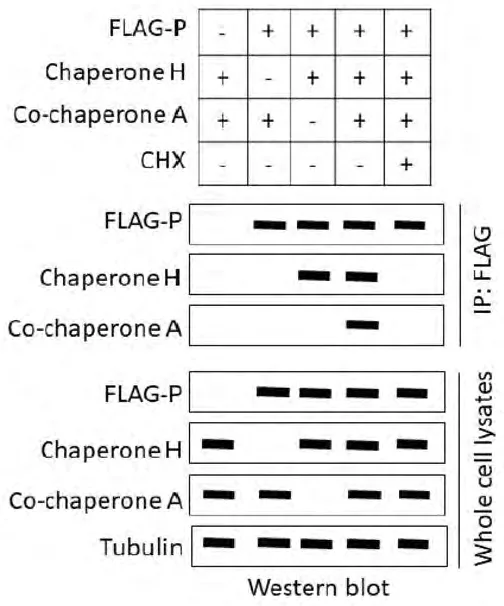
Which of the following interpretations from these experiments is INCORRECT?
- 1Protein P interacts with chaperone H and co-chaperone A.
- 2Chaperone H interacts only with the newly synthesized protein P.
- 3Interaction between co-chaperone A and protein P is independent of chaperone H.
- 4Interaction between chaperone H and protein P is independent of co-chaperone A.
Show answer and solution
With all components present, FLAG-P pulls down both H and A, so statement 1 holds. Blocking new synthesis with cycloheximide abolishes binding to H, so H binds newly made P (statement 2 holds). Without A, H still binds P (statement 4 holds). Without H, A no longer co-precipitates, so A’s association with P depends on H. Statement 3 is the incorrect one.
Overexpression of protein ‘A’ in the brain of Drosophila melanogaster causes the degradation of ovaries in the animal. Overexpression of a secretion-incompetent allele of ‘A’ does not cause this phenotype. However, downregulation of protein ‘B’ in ovaries concomitant with overexpression of protein ‘A’ in the brain prevents ovary degradation. ‘A’ and ‘B’ are found to physically interact in ovary lysates. In the light of the above experiments, which of the following inferences would be correct?
- 1The protein ‘A’ cell autonomously influences ovary development while B is secreted to influence brain function.
- 2‘A’ is a ligand secreted from the brain and ‘B’ is a receptor in ovaries.
- 3‘A’ is a neurotransmitter secreted from the brain and ‘B’ is a signal transducer in the ovaries.
- 4‘A’ is a receptor secreted from the ovaries and ‘B’ is a ligand in the ovary cell membrane.
Show answer and solution
The effect needs secretion of A from the brain, it acts on a distant organ, it is blocked by knocking down B in the ovary, and A and B bind each other. So A is a secreted ligand (a hormone) from the brain and B is its receptor in the ovary.
In the classic ABCDE model of flower development, different combinations of ABCDE class genes result in different whorls of organs. Which one of the following models would likely give rise to unisexual flower structures?
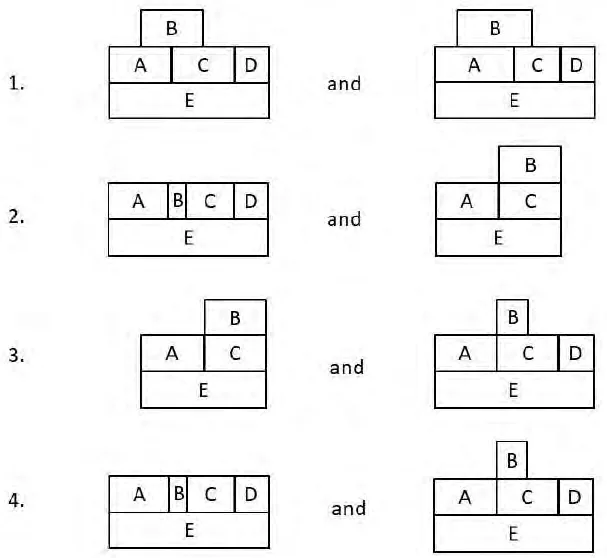
- 1Model 1
- 2Model 2
- 3Model 3
- 4Model 4
Show answer and solution
Stamens need B + C together and carpels need C alone (both with E). In model 2, the first flower has no whorl where B and C overlap, so no stamens form, giving a female flower. In the second, B covers the whole C domain, so no C-only whorl remains and no carpels form, giving a male flower. Two unisexual flowers.
An ecological community is more than just the sum of the attributes of the constituent species. Which one of the following options is NOT an attribute of ecological communities?
- 1Local extinction of a species caused by demographic stochasticity.
- 2Logseries species abundance distributions.
- 3Stability of a food web in the face of disturbance.
- 4The limits to similarity of competing species.
Show answer and solution
Species-abundance distributions, food-web stability and the limits to similarity of competitors are community-level properties. Local extinction of a single species by demographic stochasticity is a property of that one population.
Some features mentioned below are important for the segregation of homologous chromosomes in meiosis I.
- A. Synaptonemal complex formation between homologous chromosomes.
- B. Degradation of cohesins at the chromosome arms.
- C. Retention of cohesins at the centromeres.
- D. Bi-orientation of kinetochores of sister chromatids.
Which one of the following options has all correct features?
- 1A and B only
- 2A and C only
- 3A, B and C only
- 4A, B, C and D
Show answer and solution
Homologues pair and are held by the synaptonemal complex and crossovers (A). In anaphase I, arm cohesin is cleaved so the homologues separate (B), while centromeric cohesin is protected by shugoshin so sister chromatids stay together until meiosis II (C). In meiosis I the sister kinetochores are mono-oriented, so D is false.
The following statements are made for the effect of hormones on the glomerular filtration rate (GFR).
- A. Norepinephrine, epinephrine, and endothelin constrict renal blood vessels and decrease GFR.
- B. Endothelin dilates renal blood vessels to increase GFR.
- C. Norepinephrine and endothelin constrict renal blood vessels and decrease GFR, while epinephrine dilates renal blood vessels to increase GFR.
- D. Prostaglandin (PGE2) and bradykinin decrease renal vascular resistance and increase GFR.
Which one of the following options represents the combination of correct statements?
- 1A and B
- 2B and C
- 3C and D
- 4A and D
Show answer and solution
Noradrenaline, adrenaline and endothelin all constrict renal vessels and lower GFR (A). PGE2 and bradykinin dilate them and raise GFR (D). Endothelin is a potent vasoconstrictor, so B is wrong, and so is C’s claim that adrenaline dilates renal vessels.
In a hypothetical organism, at a four-celled embryonic stage, blastomere ‘X’ instructs one of the daughter cells of an adjoining blastomere ‘Y’ to take the fate ‘Ya’. The other daughter cell takes the fate ‘Yp’. This is illustrated in the figure below as lineages for Ya and Yp. If the X blastomere is removed, both daughter cells take up the Yp fate.
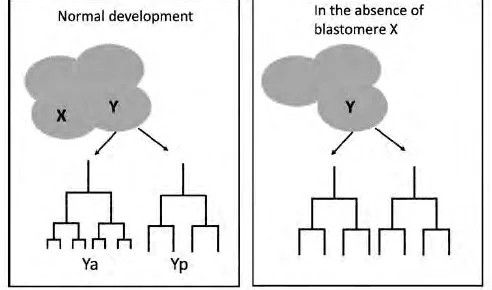
This instruction is mediated by a paracrine factor, Pap2 secreted by X blastomere interacting with Pap5 present on the membrane of Y blastomere.
The following experimental manipulations were carried out, which involved creating partial genetically mosaic embryos in vitro and following the fate of the Y blastomere.
Which one of the mosaics will show a developmental pattern similar to that when blastomere X is removed?
- 1X blastomere null for Pap2 and wild type Y blastomere
- 2Wild type X blastomere and constitutively activated Pap5 Y blastomere
- 3X blastomere null for Pap2 and constitutively activated Pap5 Y blastomere
- 4X blastomere null for Pap5 and wild type Y blastomere
Show answer and solution
The Ya fate needs Pap2 from X binding Pap5 on Y. An X that cannot make Pap2 is, as far as Y is concerned, the same as having no X, so both daughters become Yp. A constitutively active Pap5 would push both toward Ya, and Pap5 on X is irrelevant.
The CDS of the shortest isoform of human gene ‘A’ is cloned into a 3.3 kb vector under a CMV promoter at the BamHI and XhoI sites (pCMV-A vector).
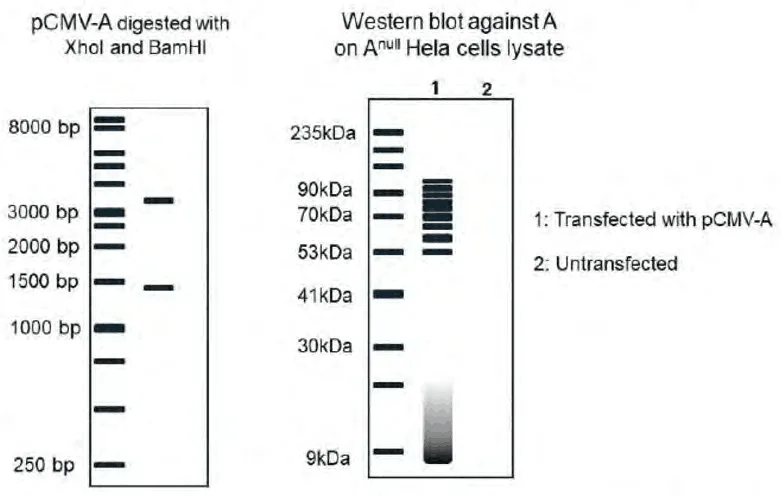
From the agarose gel and SDS-PAGE images shown above, which one of the following is most likely true for protein A in HeLa cells:
- 1Protein A forms homo-multimers.
- 2Protein A is degraded by the lysosome.
- 3Protein A is polyubiquitinated.
- 4Protein A localizes to autophagosomes.
Show answer and solution
The digest shows the insert at about 1.4 kb, enough for a protein of about 50 kDa. On the blot, the transfected cells show a ladder of bands stepping up by about 8 kDa above the expected size, plus a high-molecular-weight smear. That is the pattern of polyubiquitination, each ubiquitin adding about 8.5 kDa.
A researcher used CRISPR-Cas9 system and observed a different type of mutation in two alleles of a target gene in a T0 transgenic plant. These mutations are designated as follows:
Allele 1: addition of a nucleotide
Allele 2: deletion of a nucleotide
The observed mutations can be classified as
- 1monoallelic mutations.
- 2biallelic heterozygous mutations.
- 3biallelic homozygous mutations.
- 4chimeric mutations.
Show answer and solution
Both alleles were edited, and the two changes differ (a +1 insertion and a −1 deletion). That is a biallelic heterozygous mutation. Biallelic homozygous would mean the same change on both alleles, monoallelic only one allele edited, and chimeric different edits in different cells.
Which one of the following options represents all correct matches between Column X and Column Y?
| Column X: Microorganism | Column Y: Host receptor | ||
|---|---|---|---|
| A. | Influenza virus | i. | N-acetylglucosamine |
| B. | Entamoeba histolytica | ii. | CD44 |
| C. | Streptococcus pyogenes | iii. | Sialic acid residues of glycoproteins and glycolipids |
| D. | Human immunodeficiency virus | iv. | CD4 |
- 1A-i, B-ii, C-iii, D-iv
- 2A-ii, B-iv, C-i, D-iii
- 3A-iv, B-ii, C-iii, D-i
- 4A-iii, B-i, C-ii, D-iv
Show answer and solution
Influenza haemagglutinin binds sialic acid (A–iii). Entamoeba adheres through its Gal/GalNAc lectin, matched here to N-acetylglucosamine (B–i). The hyaluronic-acid capsule of Streptococcus pyogenes binds CD44 (C–ii). HIV gp120 binds CD4 (D–iv).
Given below are a few statements on concepts of molecular breeding.
- A. Correlations between quantitative traits can be because of pleiotropic effects of the same gene and/or genetic linkage of genes associated with the traits.
- B. In a Recombinant Inbred Line (RIL) population, genetic segregation of both dominant and codominant markers occurs in a 1:1 ratio.
- C. Near isogenic lines (NILs) can be produced by repeated backcrossing of the F1 to a recurrent parent.
- D. SNPs are dominant markers.
Which one of the following options represents all correct statements?
- 1A and B only
- 2A, B and D
- 3A, B and C
- 4C and D only
Show answer and solution
A is true: trait correlations come from pleiotropy or linkage. B is true: RILs are nearly homozygous, so markers segregate 1:1 between the parental types. C is true: repeated backcrossing to a recurrent parent produces NILs. D is false: SNPs are codominant markers. A, B and C.
ABA plays an important role in plant response to water stress. In the table below, column X represents some of the important enzymes in ABA biosynthesis/degradation pathways, while column Y summarizes the major function of these enzymes.
| Column X (Enzymes) | Column Y (Functions) | ||
|---|---|---|---|
| A. | 9-cis-epoxycarotenoid dioxygenase | i. | Involved in the oxidative pathway of ABA catabolism |
| B. | Cytochrome P450 monooxygenase (CYP707A3) | ii. | Production of a sugar-conjugated form of ABA |
| C. | ABA glucosyltransferase | iii. | Xanthoxin production |
| D. | β-glucosidase | iv. | Releases ABA from its sugar-conjugated form |
Choose the option showing the correct match between column X and column Y?
- 1A-iv, B-ii, C-i, D-iii
- 2A-iii, B-i, C-ii, D-iv
- 3A-ii, B-iii, C-iv, D-i
- 4A-i, B-iv, C-iii, D-ii
Show answer and solution
NCED cleaves 9-cis-epoxycarotenoids to give xanthoxin (A–iii). CYP707A (ABA 8′-hydroxylase) begins oxidative breakdown (B–i). ABA glucosyltransferase makes inactive ABA–glucose ester (C–ii), and β-glucosidase releases free ABA from it under stress (D–iv).
The following statements represent possible outcomes of competition between two species.
- A. Niche differentiation between species
- B. Expansion of fundamental niche of both species
- C. Expansion of realized niche of both species
- D. Character displacement between species
Which one of the following options represents the correct set of possible outcomes?
- 1A and C
- 2B and D
- 3A and D
- 4A and B
Show answer and solution
Competition can push species to use different resources (niche differentiation, A) and to diverge in the traits that mediate competition (character displacement, D). It never expands realised niches, and fundamental niches are fixed by physiology.
Given below are four topology diagrams corresponding to different proteins. N and C denote the N- and C-terminal ends of the protein chains.
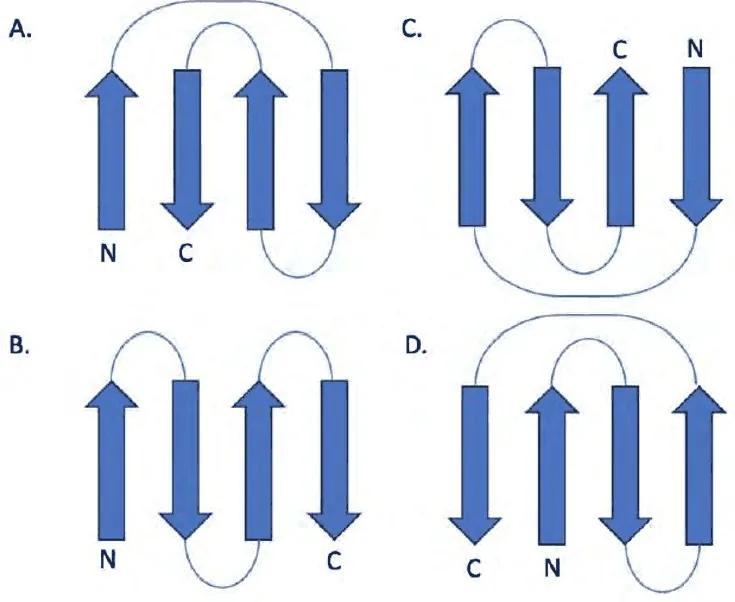
Which one of the following statements is CORRECT?
- 1All four are of different folds.
- 2All four are of the same fold.
- 3(A), (C) and (D) are of the same fold.
- 4(A) and (C) are of the same fold.
Show answer and solution
Fold is defined by how the strands are connected and ordered, not by which way the diagram is drawn. A and C have the same connectivity, a hairpin plus long cross-over connections, with C being A seen from the other side or rotated. B is a simple up-and-down meander, and D connects its strands differently.
The following statements describe different patterns of sequence evolution.
- A. Most non-synonymous mutations are selected against.
- B. Synonymous mutations can accumulate.
- C. The ratio of non-synonymous to synonymous substitutions is high.
- D. Non-synonymous sites accumulate mutations at higher rates.
Which one of the options is NOT true about sequence evolution under purifying selection?
- 1A and B
- 2C and D
- 3A and C
- 4B and D
Show answer and solution
Under purifying selection most amino-acid changes are harmful and removed (A true), while silent changes accumulate neutrally (B true). So non-synonymous changes are rarer than synonymous ones, with dN/dS < 1. C (a high ratio) and D (faster change at non-synonymous sites) describe positive selection, so they are NOT true here.
Molecular phylogeny indicates that whales are closely related to the artiodactyls. Given this information, select the phylogenetic tree that shows the correct set of terrestrial animals with which modern whales share their most recent ancestry.
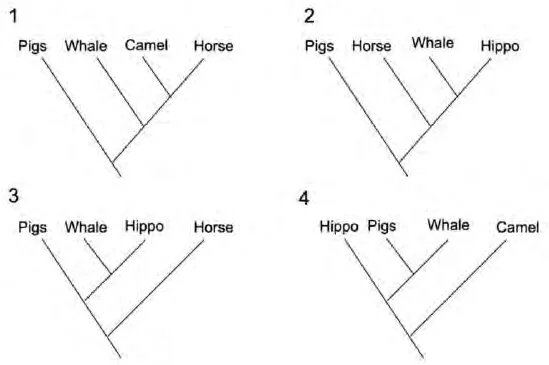
- 1Tree 1
- 2Tree 2
- 3Tree 3
- 4Tree 4
Show answer and solution
Molecular and fossil evidence places whales inside the even-toed ungulates as the sister group of hippopotamuses (the Whippomorpha clade), with pigs more distant and horses (odd-toed ungulates) outside. Tree 3 shows (whale + hippo), then pig, with horse as the outgroup.
In a frog species, foot webbing is controlled by a single gene where the allele for nonwebbed feet (W) is dominant and webbed feet (w) is recessive. Assume there is a population of 500 individuals, where 320 have the genotype WW, 160 have the heterozygous genotype of Ww, and 20 have the genotype ww.
What are the frequencies of the three genotypes and alleles in this population?
- 1Genotype frequencies: 0.04 WW, 0.32 Ww and 0.64 ww; Allele frequencies W – 0.5 and w – 0.5
- 2Genotype frequencies: 0.32 WW, 0.64 Ww and 0.04 ww; Allele frequencies W – 0.8 and w – 0.2
- 3Genotype frequencies: 0.64 WW, 0.32 Ww and 0.04 ww; Allele frequencies W – 0.8 and w – 0.2
- 4Genotype frequencies: 0.34 WW, 0.34 Ww and 0.32 ww; Allele frequencies W – 0.5 and w – 0.5
Show answer and solution
Genotype frequencies: WW = 320/500 = 0.64, Ww = 160/500 = 0.32, ww = 20/500 = 0.04. Allele frequencies: W = 0.64 + 0.32/2 = 0.8 and w = 0.2. The population is in Hardy–Weinberg proportions.
A cancer clinic is treating four unrelated patients suffering from chronic myelogenous leukemia. A researcher sequences the Philadelphia chromosome from the leukemic cells of these patients and makes the following statements:
- A. The DNA sequence was identical in the translocation breakage and rejoining (TBR) sections in all leukemic cells in all 4 patients.
- B. The DNA sequence was identical in all leukemic cells from patient 1, but every patient had a different TBR sequence.
- C. All patients have translocations between long arms of chromosomes 9 and 22.
- D. All patients have translocations between long arm of chromosome 9 and short arm of chromosome 22.
Which one of the following options represents a combination of all correct statements?
- 1A and D
- 2B and C
- 3B and D
- 4A and C
Show answer and solution
The Philadelphia chromosome comes from t(9;22)(q34;q11), between the long arms of 9 and 22, joining ABL1 to BCR (C). Within one patient the leukaemia is a clone, so all cells share the same junction. But the exact breakpoints inside the large introns differ between patients, so each patient’s junction sequence is different (B).
URA3 gene expression allows yeast cells to grow on synthetic media lacking Uracil (SC-URA). Shown below are cell types having URA3 gene inserted at distinct positions of the chromosome (cell types 1, 2 and 3 from top to bottom). The ability of each cell type to grow on SC-URA in either log or stationary phase is listed in the table.
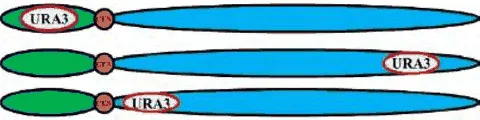
| Cell type | Growth on SC-URA: log phase | Growth on SC-URA: stationary phase |
|---|---|---|
| Cell type 1 | + | + |
| Cell type 2 | + | − |
| Cell type 3 | − | + |
The following interpretations were made:
- A. URA3 gene in cell type 1 is probably located in a heterochromatic region.
- B. URA3 gene in cell type 2 is located in facultative heterochromatin.
- C. URA3 gene in cell type 2 is probably located in a chromosome region silenced in log phase.
- D. URA3 gene in cell type 3 is heterochromatinized in log phase.
Which one of the following options are correct interpretations?
- 1A and C
- 2B and D
- 3A and D
- 4B and C
Show answer and solution
URA3 near the telomere (cell type 2) works in log phase but is silenced in stationary phase. Silencing that depends on conditions is facultative heterochromatin (B). URA3 near the centromere (cell type 3) is silent in log phase but expressed in stationary phase, so it is heterochromatinised during log phase (D). Cell type 1 grows in both phases, so it lies in euchromatin.
A complete retroposon was cloned under the entire galactose inducible promoter. The construct, as shown below, was inserted in the yeast genome to study the transposition event.
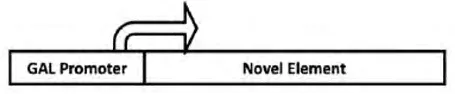
Some of the predicted outcomes are listed below:
- A. Cells grown in presence of glucose or galactose lead to increase in copy number of the transposon.
- B. The transposed copies will be same as the construct inserted in the genome.
- C. The transposed copies cannot transpose further.
- D. The transposed copies will not respond to either glucose or galactose in the media.
Assuming that the hypothesis is correct, choose the option that has all likely outcomes.
- 1A and B only
- 2A and C only
- 3A, B and C
- 4D only
Show answer and solution
A retroposon copies itself through an RNA intermediate. The RNA is transcribed from the GAL promoter, so it starts downstream of that promoter and does not contain it. The new copies therefore lack the GAL promoter and do not respond to glucose or galactose (D). Transposition happens only in galactose, so A is false, and the copies differ from the inserted construct (B false).
Which one of the options below includes habitats that are ALL found in the Indian subcontinent?
- 1Boreal forest, tropical rainforest, tropical deciduous forest, alluvial grassland
- 2Temperate forest, alluvial grassland, dry thorn forest, subtropical montane forest
- 3Scrub forest, Chapparal vegetation, dry grasslands, riparian forest
- 4Shola grasslands, alpine grasslands, tundra, warm broadleaved forest
Show answer and solution
India has temperate forests (Himalaya), alluvial grasslands (the Terai), dry thorn forests (Rajasthan and the Deccan) and subtropical montane forests. Boreal forest, chaparral and true tundra do not occur in the Indian subcontinent.
A researcher was interested in detecting parasite-derived antigens in Plasmodium falciparum-infected erythrocytes. The following labelling experiments were performed, followed by immunoprecipitation with antibodies against P. falciparum proteins and autoradiography.
- A. Labeling with 32P-ATP in the media
- B. Labeling with 125Iodine in the media
- C. Labeling with 35S-Methionine in the media
- D. Labeling with 3H-Hypoxanthine in the media
Which one of the following options represents labeling experiments to predominantly detect the parasite-derived antigens?
- 1A and C
- 2C only
- 3B only
- 4B and D
Show answer and solution
Mature red cells cannot make protein, so 35S-methionine is incorporated only by the parasite, labelling parasite-made proteins (C). 125I surface labelling and 32P label host proteins too, and hypoxanthine labels nucleic acids, not antigens.
The statements below are about possible genetic relatedness between individuals of a monogamous, haplodiploid insect.
- A. A female is related to its son by 0.5
- B. A female is related to its brother by 0.5
- C. A male is related to its mother by 1
- D. A male is related to its daughter by 1
Which one of the following options represents the combination of all correct statements?
- 1A, B and C
- 2B, C and D
- 3A, B and D
- 4A, C and D
Show answer and solution
In haplodiploids, males come from unfertilised eggs. A mother passes half her genes to a son (A: 0.5). A son’s whole genome comes from his mother (C: 1). A male passes his whole genome to each daughter (D: 1). A sister shares only 0.25 with her brother, not 0.5.
Given below are some components that could potentially influence membrane fluidity.
i. Monomeric G-proteins
ii. Peripheral membrane proteins
iii. Sphingolipids
iv. Phospholipid sidechain saturation
v. Cholesterol
Choose the option that has all the components that can influence membrane fluidity.
- 1i, ii, v
- 2i, ii, iv
- 3iii, iv, v
- 4ii, iv, v
Show answer and solution
Sphingolipids (long saturated chains that pack tightly, forming rafts), fatty-acid saturation (saturated chains pack tighter and reduce fluidity) and cholesterol (which buffers fluidity) all directly set membrane fluidity. Small G proteins and peripheral proteins sit on the surface and do not.
The plaque morphology of wild type and rII mutants of T4 bacteriophage following infection of different E. coli strains is summarized below.
| T4 phage strain | E. coli strain B | E. coli strain K |
|---|---|---|
| wild type | Small and ragged | Small and ragged |
| rII mutants | Large and round | No plaques |
The following two experiments were carried out:
Experiment I: Co-infection of two independent rII mutants on E. coli K strain resulted in several plaques, all being small and ragged.
Experiment II: E. coli B strain was co-infected with the above rII mutants. T4 phages from the resulting plaques were used to infect E. coli K strain. Few plaques were obtained, which were all small and ragged.
Based on the observations, the following statements were made:
- A. Experiment I indicates that the two mutants are allelic.
- B. Experiment II indicates that the wild type T4 phages that infected E. coli K strain resulted from a recombination event.
- C. In experiment II, if the T4 phage isolated from the E. coli B strain was used to infect E. coli B strain, all plaques would be large and round.
Which one of the following options is a combination of all correct statements?
- 1A only
- 2B only
- 3A and B
- 4B and C
Show answer and solution
Experiment I gives wild-type plaques on K, so the two rII mutations complement and are in different cistrons, not alleles (A false). In experiment II, the few wild-type phages from mixed infection of B must come from recombination between the two mutations (B true). Progeny from B are mostly rII (large plaques) with a few recombinants (small plaques), so not all plaques would be large (C false).
One hundred IgM+ B cells were plated at 1 cell/well and activated in vitro. This led to detectable proliferation in all wells by day four. At the end of seven days, it was found that some wells contained IgG1 antibodies, some contained both IgG1 and IgA antibodies, and some contained only IgA antibodies. The following interpretations were made:
- A. Cells that have switched to IgG1 may undergo further switching to IgA.
- B. Cells that have switched to IgA may undergo further switching to IgG1.
- C. A single cell can simultaneously secrete IgG1 and IgA.
- D. The progeny of proliferating cells may undergo independent switching events.
Which one of the following options represents the combination of all correct statements?
- 1A and D
- 2B and C
- 3A and B
- 4C and D
Show answer and solution
A cell can switch only to constant regions downstream of the one it is using, because the DNA in between is deleted. Cα lies downstream of Cγ1, so IgG1 cells can switch on to IgA (A), but IgA cells cannot go back to IgG1 (B false). Wells containing both isotypes reflect daughter cells switching independently (D), not a single cell making two isotypes.
Which of the following options represents the correct order of increasing biological organisation?
- 1ecosystems < communities < biomes < populations
- 2populations < communities < ecosystems < biomes
- 3biomes < ecosystems < communities < populations
- 4populations < ecosystems < communities < biomes
Show answer and solution
Increasing organisation: population (one species) < community (interacting species) < ecosystem (community plus physical environment) < biome (regional ecosystems of a climate type).
The ratio of total protein content to total RNA content was measured in yeast cells in log phase during growth in minimal media and in minimal media supplemented with amino acid cocktail. In the latter case, the ratio of protein to RNA increased dramatically. Which one of the following is a correct inference from the above information?
- 1In minimal medium, proteins are degraded at a higher rate.
- 2In amino acid-supplemented culture conditions, fewer ribosomes are simultaneously active on a single transcript.
- 3In minimal medium, amino acid availability limits protein translation to a greater extent than transcription.
- 4Amino acid supplementation reduces RNA synthesis by modification of RNA Pol II.
Show answer and solution
Adding amino acids greatly raises the protein:RNA ratio, so far more protein is made per RNA (mostly rRNA, that is, per ribosome). In minimal medium, amino acid supply limits translation more than it limits transcription, leaving ribosomes under-used. Nothing in the data points to faster degradation, fewer ribosomes per transcript, or modification of Pol II.
Given below are figures representing four different situations/examples of genetic and environmental (temperature) effects on plant height in two varieties of a plant species. In figures A, C and D, solid and dashed lines represent the mean values of plant height for the two varieties G1 and G2, respectively. In figure B, the solid and dashed lines overlap.
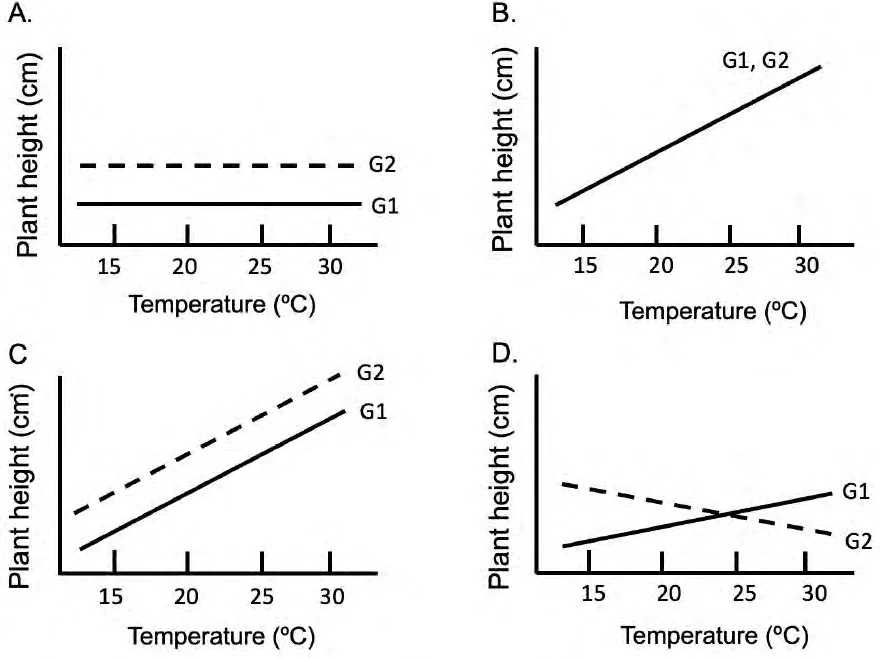
Given below are four statements explaining the four figures.
(i) Plant height is influenced primarily by the genotype of the two varieties.
(ii) Variation in plant height is influenced only by the temperature and genotype has no effect.
(iii) Genotype and temperature collectively have an additive effect on plant height.
(iv) Both genotype and environment have an effect on plant height with the two varieties responding differently to the environment.
Which one of the following options correctly matches the figures and their corresponding explanations?
- 1A – i, B – ii, C – iii, D – iv
- 2A – i, B – iii, C – ii, D – iv
- 3A – iii, B – ii, C – iv, D – i
- 4A – iv, B – i, C – iii, D – ii
Show answer and solution
A: the two varieties differ but neither responds to temperature, so height is set mainly by genotype (i). B: both varieties fall on the same rising line, so only temperature matters (ii). C: parallel rising lines show genotype and temperature acting additively (iii). D: crossing lines show a genotype × environment interaction (iv).
A propionate kinase enzyme utilizes two substrates, propionate and acetate, with Km for propionate being half that of acetate. Which one of the following options about the rate of the reaction at very low substrate concentrations is correct?
- 1The rate of propionate utilization is half that of acetate.
- 2The rate of propionate utilization is double that of acetate.
- 3The rate of propionate utilization is equal to that of acetate.
- 4The rate of propionate utilization is four times that of acetate.
Show answer and solution
At very low [S], v ≈ (kcat/Km)[E][S]. With the same enzyme and turnover, halving Km doubles kcat/Km, so propionate is used at twice the rate of acetate.
The table below lists nomenclatural categories in column X along with their description in column Y.
| Column X | Column Y | ||
|---|---|---|---|
| a | Homonym | i. | binomial name contains the same epithet for both the genus and species |
| b | Tautonym | ii. | same binominal name given to a plant and an animal |
| c | Basionym | iii. | original name of a taxon on which a new combination is based |
| d | Hemihomonym | iv. | two or more specific or subspecific scientific names with the same spelling, but for different nominal taxa |
Which of the following represents the correct sequence of matches:
- 1a-iv, b-iii, c-ii, d-i
- 2a-i, b-iv, c-iii, d-ii
- 3a-iii, b-ii, c-i, d-iv
- 4a-iv, b-i, c-iii, d-ii
Show answer and solution
A homonym is the same name spelled identically for different taxa (a–iv). A tautonym repeats the genus name as the species epithet, as in Rattus rattus (b–i). A basionym is the original name on which a new combination is based (c–iii). A hemihomonym is the same name used for a plant and an animal (d–ii).
For a population that grows exponentially in the time interval (t, t+1), we have Nt+1 = R Nt, where N denotes population size and R denotes the growth rate. Under intraspecific competition where births and deaths are density dependent, we expect the population to stabilize at carrying capacity, K. In the figure below, Nt/Nt+1 is plotted as a linear function of Nt.

We may write down the linear equation for the line joining A with B and derive a model for density-dependent population growth under intraspecific competition. Denoting (R−1)/K as a, which of the following is the correct relationship that describes population growth?
- 1Nt+1 = NtR / (1 + aNt)
- 2Nt+1 = aNt / (1 + RNt)
- 3Nt+1 = NtR / (a + Nt)
- 4Nt+1 = aNtR / (1 + aNt)
Show answer and solution
The line runs from (0, 1/R) to (K, 1), so its slope is (1 − 1/R)/K = a/R. Then Nt/Nt+1 = (1 + aNt)/R, which rearranges to Nt+1 = RNt/(1 + aNt), the Beverton–Holt model.
The nitrogen fixing bacterium, Rhizobium leguminosarum, isolated from the root nodules of garden pea (Pisum sativum) is cultured in a petri plate containing appropriate nutrient agar medium. A bacterial colony was picked and inoculated into a liquid growth medium to scale up the culture for the production of biofertilizer. Which one of the following statements is correct?
- 1The liquid culture will be red/pink in color due to the accumulation of the pigment leghaemoglobin.
- 2The rhizobial cells when reinoculated into the rhizosphere of soybean plants will effectively nodulate its roots to fix atmospheric nitrogen.
- 3The rhizobial cells cannot fix nitrogen when exposed to atmospheric air.
- 4The rhizobial cells get transformed into bacterioids when grown in liquid media.
Show answer and solution
Nitrogenase is destroyed by oxygen. Rhizobia fix nitrogen only as bacteroids inside nodules, where leghaemoglobin keeps free O2 very low, so free-living cells cannot fix N2 in air. Leghaemoglobin is made with the plant inside nodules, cultures do not turn into bacteroids, and R. leguminosarum (pea) does not nodulate soybean.
Following statements were made with respect to plant steroid hormones.
- A. The receptors for plant steroid hormones are found in the nucleus, similar to animal steroid hormones.
- B. There are multiple pathways for the plant steroid hormone biosynthesis involving cytochrome P450 class of enzymes.
- C. The first plant steroid hormone was isolated from male gametophytes.
- D. Plants deficient for the steroid hormone brassinosteroid show underproliferation of phloem and overproliferation of xylem cells.
- E. Castasterone is a plant steroid hormone abundant in the vegetative tissues of the plant.
Which one of the following options represents the combination of all correct statements?
- 1A, B and D
- 2B, C and E
- 3A, C and D
- 4B, D and E
Show answer and solution
B is true: several branched biosynthetic routes use P450 enzymes such as DWF4 and CPD. C is true: brassinolide was first isolated from rapeseed pollen. E is true: castasterone is the main brassinosteroid in vegetative tissues. A is false: the receptor BRI1 is at the plasma membrane. D is false: brassinosteroid-deficient plants produce less xylem. B, C and E.
The stimulation of sympathetic cardiac nerves increases the rate of action potential generation from the sinoatrial (SA) node of heart. The following statements suggest the mechanism of this action:
- A. The depolarizing effect of ‘h’ current (Ih) is decreased by sympathetic stimulation.
- B. Norepinephrine secreted by the sympathetic endings binds to β1 adrenoceptors resulting in the increase of intracellular cAMP.
- C. The increased intracellular cAMP facilitates the opening of long-lasting (L) Ca++ channels.
- D. The Ca++ current (ICa) due to the opening of voltage-gated L Ca++ channels is decreased.
Which one of the following options represents the correct combination of the statements?
- 1A and B
- 2B and C
- 3C and D
- 4A and C
Show answer and solution
Noradrenaline acts on β1 receptors and raises cAMP (B). cAMP increases the pacemaker current If (HCN channels) and promotes the opening of L-type Ca2+ channels (C), so the pacemaker potential rises faster. A and D state the opposite.
Four groups of students (A – D) were asked to determine whether memory B cells generated in mice immunized with ovalbumin (OVA), in Complete Freund’s adjuvant (CFA), could mount a secondary antibody response (recall response) to OVA in vitro. The groups did the following experiments:
Group A students harvested serum from the mice, loaded it on OVA-coated ELISA plates and showed that IgG and IgA anti-OVA antibodies were present.
Group B students harvested long-lived plasma cells from bone marrow of the mice, plated them in culture for 5 days and showed anti-OVA antibodies in supernatant by ELISA.
Group C students infected an epithelial cell line with the virus and showed that spleen cells from the mice could kill the infected targets.
Group D students stimulated spleen cells from the mouse with OVA for 5 days and showed anti-OVA antibodies in supernatant by ELISA.
Which one of the following options represents group(s) that did the correct experiment?
- 1Group A
- 2Group C
- 3Groups B and C
- 4Group D
Show answer and solution
A recall response by memory B cells is shown by re-stimulating spleen cells with OVA in vitro and finding new anti-OVA antibody (group D). Serum antibody (A) and long-lived plasma cells (B) show existing antibody production, not recall by memory cells, and C tests killing of virus-infected cells, which is irrelevant.
The following statements are made about the variety of thermoregulatory mechanisms in the body.
- A. Human voluntary activity is decreased in cold.
- B. There is a cutaneous vasodilation by heat.
- C. There is an increased secretion of epinephrine and nor-epinephrine in cold.
- D. There is a decreased heat production in cold.
Choose the combination of all correct statements about thermoregulatory mechanisms.
- 1A and B
- 2B and C
- 3C and D
- 4A and D
Show answer and solution
Heat causes cutaneous vasodilation, which increases heat loss (B). Cold increases adrenaline and noradrenaline, driving non-shivering thermogenesis (C). Cold increases voluntary activity and heat production (shivering), so A and D are false.
A KDEL sequence is added at the C-terminus of a secreted glycoprotein X (500 amino acid residues) having no site for N-linked glycosylation and expressed from an inducible promoter. Following 10, 20 and 60 minutes of induction, ER are purified and probed for newly synthesized glycoprotein X-KDEL. The immunoblot obtained is shown below.
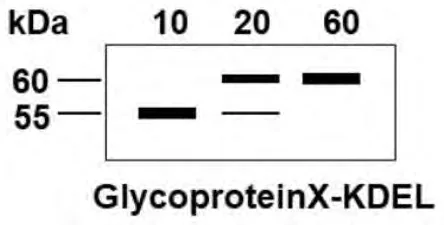
Which one of the following statements is the most likely explanation for presence of the higher molecular weight bands in lanes 20 and 60 minutes?
- 1The signal sequence is not removed from some of the glycoprotein X-KDEL molecules.
- 2Glycoprotein X-KDEL becomes modified in the endoplasmic reticulum after protein synthesis is completed.
- 3The glycoprotein X-KDEL molecules are modified in the Golgi prior to ER retrieval.
- 4The quality control mechanism in the ER recognizes a pool of glycoprotein X-KDEL as being aberrant and targets it for degradation.
Show answer and solution
The protein has no N-glycosylation sites, it is retained in the ER by KDEL, and its signal peptide is removed. Over time the 55 kDa band shifts to about 60 kDa in the ER fraction, so the protein is being modified in the ER after synthesis, for example by O-linked glycosylation or other post-translational additions. That is NTA’s answer.
The inhibitory IκBα protein binds to the NFκB dimer and holds them in an inactive state. On TNF treatment, the IκBα protein is degraded and NFκB enters the nucleus to transactivate gene expression. Importantly, one of the transcriptional targets of NFκB is the IκBα gene itself. Together, they form a negative feedback loop. Which one of the following graphs represents the NFκB protein expression kinetics when TNF exposure is given as a pulse (a) or continuously (b)?

- 1Graph set 1
- 2Graph set 2
- 3Graph set 3
- 4Graph set 4
Show answer and solution
A TNF pulse activates NFκB once, and newly made IκBα then switches it off: a single peak. With continuous TNF, the IκBα made in response keeps being degraded and resynthesised, so the negative feedback produces damped oscillations. That is graph set 2.
The mouse homozygous null mutant for a gene bfg always dies mid-gestation. Chimeric mice made of bfg null cells and wild-type cells have healthy pups. When the developing brain of these pups is examined, they have more than two hippocampi. Closer examination reveals bfg null cells at the centre of these supernumerary hippocampi.
Which of the following inferences can correctly be drawn from this experiment?
- 1Wild type bfg function in the developing brain induces hippocampus specification in neighbouring cells.
- 2Wild type bfg function in the developing brain suppresses hippocampus specification in neighbouring cells.
- 3bfg function is completely cell autonomous.
- 4bfg function is hippocampus specific.
Show answer and solution
Extra hippocampi form around bfg-null cells, so cells lacking bfg induce hippocampal fate in their neighbours. The wild-type bfg function must therefore suppress hippocampus specification in neighbouring cells, a non-cell-autonomous effect.
The given table shows the annual Net Primary Productivity (NPP), season length, and Leaf Area Index (LAI) for various ecosystems.
| Ecosystem | Season length (days) | Annual NPP (g m−2) | Total LAI (m2 m−2) |
|---|---|---|---|
| Tropical Forest | 365 | 2482 | 6.0 |
| Temperate Forest | 250 | 1550 | 6.0 |
| Tundra | 100 | 180 | 1.0 |
| Desert | 100 | 250 | 1.0 |
Which one of the following options represents the correct order of decreasing NPP per day per unit leaf area?
- 1Desert > Tundra > Tropical Forest > Temperate Forest
- 2Tropical Forest > Temperate Forest > Tundra > Desert
- 3Tundra > Desert > Temperate Forest > Tropical Forest
- 4Temperate Forest > Tropical Forest > Desert > Tundra
Show answer and solution
NPP per day per unit leaf area: desert 250/100/1 = 2.5, tundra 180/100/1 = 1.8, tropical forest 2,482/365/6 = 1.13, temperate forest 1,550/250/6 = 1.03. So desert > tundra > tropical > temperate (option 1). NTA also accepted option 2, the order of total annual NPP.
Here is some data for a cohort of 400 individuals of a species whose abundance was tracked for 6 years (its maximum lifespan). For one-year age intervals from birth to 6 years, you have the following numbers of survivors, 400, 200, 100, 40, 20, 10, and 0. The corresponding per capita birth rates are 0.1, 2.0, 3.0, 4.0, 4.0, 3.0, and 0.0. What is the basic reproductive rate R0?
- 12.52
- 22.92
- 32.36
- 43.20
Show answer and solution
Survivorship lx = 1, 0.5, 0.25, 0.1, 0.05, 0.025, 0. R0 = Σlxmx = 0.1 + 1.0 + 0.75 + 0.4 + 0.2 + 0.075 = 2.525.
The types of mammalian nerve fibers (Column X) and the conduction velocity in m/s of nerve impulses (column Y) are listed below:
| Column X | Column Y | ||
|---|---|---|---|
| a | Aα | i | 12-30 |
| b | B | ii | 30-70 |
| c | Aδ | iii | 70-120 |
| d | Aβ | iv | 3-15 |
Which one of the following options represents correct match between Column X and Column Y?
- 1a-i, b-ii, c-iii, d-iv
- 2a-ii, b-iii, c-iv, d-i
- 3a-iii, b-iv, c-i, d-ii
- 4a-iv, b-i, c-ii, d-iii
Show answer and solution
Conduction velocities: Aα 70–120 m/s (a–iii), B (preganglionic autonomic) 3–15 m/s (b–iv), Aδ 12–30 m/s (c–i), and Aβ 30–70 m/s (d–ii).
Given below are statements on concepts of genetics.
- A. The degree to which a particular gene is expressed in a phenotype is called ________.
- B. A heritable change in gene expression that does not result from a change in the nucleotide sequence of the genome is called ________ change.
- C. The frequency with which a dominant or homozygous recessive gene is phenotypically expressed within a population is called ________.
- D. An allele that results in the death of organisms that is homozygous for the allele is ________.
Which one of the following options represents the most appropriate sequence of terms to fill all the blank spaces in the above statements?
- 1A – expressivity, B – epigenetic, C – penetrance, D – recessive lethal
- 2A – penetrance, B – mutation, C – expressivity, D – dominant lethal
- 3A – penetrance, B – epigenetic, C – distribution, D – conditional lethal
- 4A – epistasis, B – mutation, C – penetrance, D – dominant lethal
Show answer and solution
The degree of expression in an individual is expressivity. Heritable change in gene expression without a change in DNA sequence is epigenetic. The proportion of carriers who show the phenotype is penetrance. An allele that kills only homozygotes is recessive lethal.
The table below represents a list of animals and larval stages.
| Animal | Larval stage | ||
|---|---|---|---|
| a. | sponges | i. | cercariae |
| b. | cnidarian | ii. | amphiblastula |
| c. | flatworms | iii. | planula |
Which one of the following options represents the combination of all correct matches:
- 1a-ii, b-i, c-iii
- 2a-i, b-iii, c-ii
- 3a-ii, b-iii, c-i
- 4a-iii, b-ii, c-i
Show answer and solution
Sponges have the amphiblastula larva (a–ii), cnidarians the planula (b–iii), and parasitic flatworms (flukes) the cercaria (c–i).
The theoretical resolution limit of the fluorescence microscope is about 200 nm. Super-resolution microscopy has been developed to address this limitation. Given below are super-resolution microscopy methods in column X and their principle in column Y.
| Super-resolution microscopy (Column X) | Principle (Column Y) | ||
|---|---|---|---|
| A. | Structured illumination microscopy (SIM) | (i) | focused excitation laser point is surrounded by donut-shaped depletion beam |
| B. | Stimulated emission depletion (STED) microscopy | (ii) | the specimen is illuminated with a pattern of light and dark stripes to generate Moire fringes |
| C. | Photoactivated localization microscopy (PALM) | (iii) | utilizes variant of GFP that is activated by a wavelength different from its excitation wavelength |
Which one of the following options represents the correct match between column X and column Y?
- 1A-(i), B-(ii), C-(iii)
- 2A-(ii), B-(i), C-(iii)
- 3A-(iii), B-(ii), C-(i)
- 4A-(ii), B-(iii), C-(i)
Show answer and solution
SIM illuminates with striped patterns and reconstructs detail from the moiré fringes (A–ii). STED surrounds the excitation spot with a doughnut-shaped depletion beam (B–i). PALM uses photoactivatable fluorescent proteins switched on by a different wavelength and localises single molecules (C–iii).
RPMI and DMEM, supplemented with serum, antibiotics, glutamine and phenol red are routinely used for tissue culture of human cells in CO2 incubators. In addition, sodium bicarbonate (NaHCO3) and HEPES are used as buffering agents. The following statements were made about the media.
- A. While 5% CO2 is optimal for cells cultured in RPMI, the optimal CO2 concentration for DMEM is 7.5-10%.
- B. HEPES is necessary if cells are to be kept outside the incubator in room air for long periods.
- C. NaHCO3 is necessary if cells are to be kept outside the incubator in room air for long periods.
- D. When cells grow rapidly in the culture medium for a few days, phenol red will turn the medium pink/red.
Which one of following options represents the correct combination of all the statements?
- 1A and B
- 2B and C
- 3A and D
- 4C and D
Show answer and solution
DMEM contains more bicarbonate (3.7 g/L) than RPMI (2 g/L), so it needs about 10% CO2 against 5% for RPMI to hold pH about 7.4 (A). HEPES buffers without CO2, so it protects cells kept in room air (B). Bicarbonate needs CO2 to buffer, so C is false. Fast-growing cells acidify the medium, turning phenol red yellow, not pink, so D is false.
In a protein stability study, three solutions, MolA (10 kDa) at 0.5 mM, MolB (20 kDa) at 0.5 mM, and MolC (20 kDa) at 1 mM, were subjected to denaturation by urea, SDS and guanidium hydrochloride (GnHCl), respectively. The profiles of the fraction of unfolded protein with increasing concentration of the denaturants is given below.
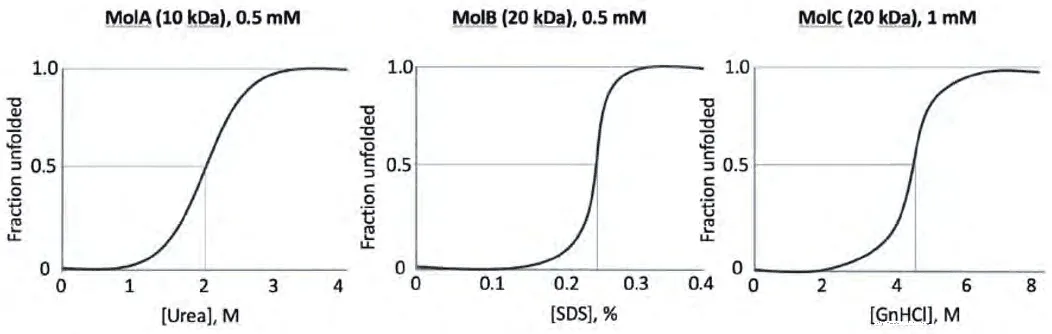
Which one of the following corresponds to reaction conditions at which the number of molecules of folded protein are equal, assuming the reaction volumes to be the same for all experiments?
- 10.2 M urea; 0.05 % SDS; 4.5 M GnHCl
- 22 M urea; 0.05 % SDS; 1 M GnHCl
- 30.2 M urea; 0.25% SDS; 4.5 M GnHCl
- 42 M urea; 0.25 % SDS; 1 M GnHCl
Show answer and solution
Folded molecules = concentration × fraction folded (equal volumes). In 0.2 M urea, MolA is fully folded: 0.5 mM. In 0.05% SDS, MolB is fully folded: 0.5 mM. In 4.5 M GdnHCl, MolC is half folded: 1 × 0.5 = 0.5 mM. All three are equal, which is option 1.
DNA polymerase PolA has high fidelity but low processivity and DNA polymerase PolB has low fidelity and high processivity. In vitro reactions for DNA synthesis using limiting amount of PolA or PolB were set to further characterise the enzymes according to the following scheme:
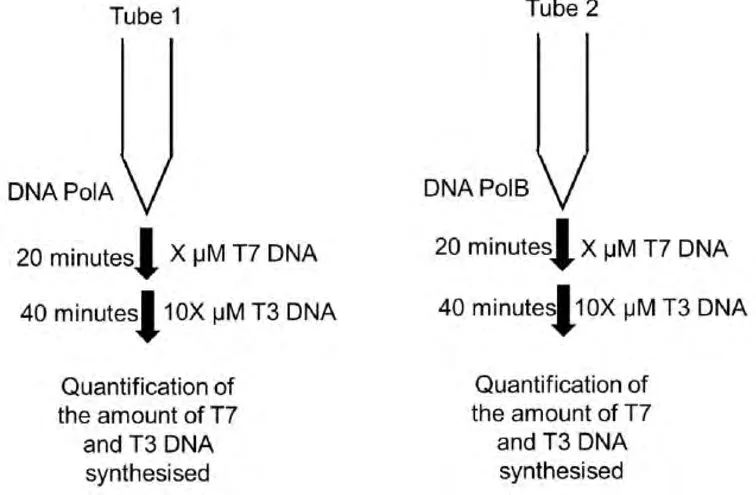
Which of the following outcome do you expect?
- 1Tube 1 will have more T3 DNA and tube 2 will have more T7 DNA.
- 2Tube 1 will have more T7 DNA and tube 2 will have more T3 DNA.
- 3Both tubes will have more T3 DNA than T7 DNA.
- 4Both tubes will have more T7 DNA than T3 DNA.
Show answer and solution
With limiting enzyme, the low-processivity PolA keeps falling off and rebinding, so once ten times more T3 DNA is added it redistributes to the more abundant template and makes more T3 product. The highly processive PolB stays on the T7 templates it bound first and makes more T7 product.
Given below are protein domains and their binding specificities.
| Column X: Interaction domain | Column Y: Binding site | ||
|---|---|---|---|
| A. | SH2 domain | i. | Phosphorylated tyrosine residue on receptors |
| B. | SH3 domain | ii. | Charged head groups of specific phosphoinositides on plasma membrane |
| C. | PH domain | iii. | Short proline-rich amino acid sequence on proteins |
| D. | PTB domain |
Which one of the following options represents all correct matches between Column X and Column Y?
- 1A-iii, B-i, C-ii, D-ii
- 2A-i, B-ii, C-iii, D-i
- 3A-iii, B-iii, C-i, D-ii
- 4A-i, B-iii, C-ii, D-i
Show answer and solution
SH2 and PTB domains bind phosphotyrosine motifs (A–i, D–i). SH3 domains bind proline-rich PxxP sequences (B–iii). PH domains bind phosphoinositide head groups at the membrane (C–ii).
A plant breeder plans to introgress a gene for pathogen resistance (R) from a wild species (B) into a cultivated variety (A). Panel I in the figure shows a profile of DNA markers for A and B. Panel II shows a genetic map for the linkage group which has the gene for pathogen resistance.
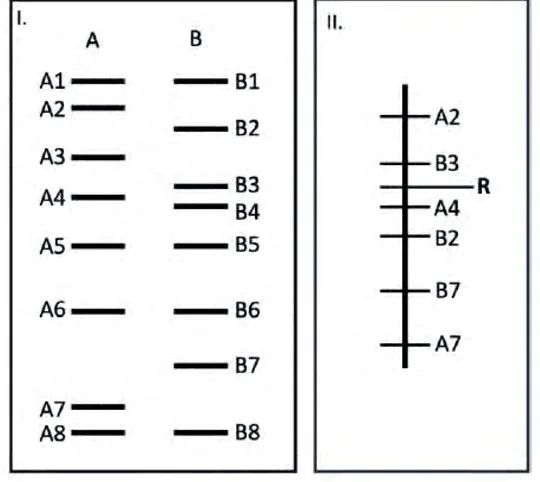
Which one of the following options has the correct choice of markers for foreground (FG) and background (BG) selection, respectively?
- 1FG: B3, A4 and BG: A2, A3, A7
- 2FG: B3, B2 and BG: A1, A5, A6, A8
- 3FG: B3, B2 and BG: A2, A3, A4, A7
- 4FG: B3, A4 and BG: A2, B2, B7 and A7
Show answer and solution
Foreground selection uses donor (B) markers tightly flanking R, here B3 and B2, to make sure the resistance gene has been introgressed. Background selection uses recurrent-parent (A) markers elsewhere in the genome, here A1, A5, A6 and A8, to recover the cultivated genome quickly.
The following gel patterns are that of DNA markers observed in parents (P1 and P2), F1 from a cross between them and doubled haploid progeny (panel A) or F2 progeny, derived from selfing of F1 (panels B and C).
A doubled haploid (DH) is a genotype formed when plants are developed from haploid cells which have undergone chromosome doubling.
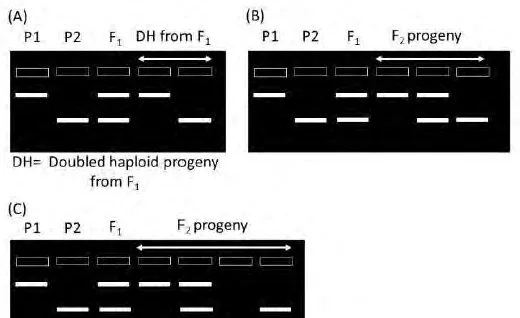
Based on the pattern observed in the DH or F2 progeny identify which of the patterns (A to C) are based on DNA markers that are allelic?
- 1A only
- 2B only
- 3A and C
- 4A and B
Show answer and solution
Allelic markers behave as alternatives at one locus. In panel A, every doubled haploid shows either the P1 band or the P2 band, never both or neither. In panel B, the F2 shows P1, both, or P2, as at one codominant locus. In panel C some F2 plants show neither band, which cannot happen with alleles of one locus, so those markers are at different loci.
Recessive mutations in the human dysferlin gene lead to Limb Girdle type II muscular dystrophy. The gene is located on the second chromosome. The patient’s parents do not have Limb Girdle type II dystrophy B. What is the probability that at least one of the four grandparents of this patient suffered from this disease?
- 11/4
- 23/10
- 31/2
- 47/10
Show answer and solution
The patient is dd, so both unaffected parents are carriers, and each received the d allele from one of their own parents. The probability that a grandparent was affected depends on assumptions about grandparent genotypes that the question does not state. NTA’s key gives 7/10.
For the coupled reaction given below, the equilibrium constants (K′eq) for equation [1] and equation [2] are 270 and 890, respectively.
Glucose 6-phosphate + H2O → glucose + Pi [1]
ATP + glucose → ADP + glucose 6-phosphate [2]
The standard free energy of hydrolysis of ATP at 25°C is
- 1−(24 to 26) kJ/mol
- 2−(18 to 20) kJ/mol
- 3−(30 to 32) kJ/mol
- 4−(60 to 62) kJ/mol
Show answer and solution
ΔG°′ = −RT ln K′eq. Reaction 1: −2.479 × ln 270 ≈ −13.9 kJ/mol. Reaction 2: −2.479 × ln 890 ≈ −16.8 kJ/mol. Adding the two gives ATP + H2O → ADP + Pi, so ΔG°′ ≈ −30.7 kJ/mol.
Following statements are made regarding the nature of the chromosomes in bacteria.
- A. Most bacterial chromosomes are circular. However, in few bacteria, linear chromosomes exist.
- B. All the bacterial systems are known to have a single chromosome.
- C. Some bacterial chromosomes contain enhancer-like elements.
- D. Chromosomes in bacteria are stabilized by histone-like proteins
Which one of the following options represents the combination of all correct statements?
- 1A, B and D
- 2B, C and D
- 3A, B and C
- 4A, C and D
Show answer and solution
Most bacterial chromosomes are circular, but Borrelia and Streptomyces have linear ones (A). Some bacteria have enhancer-like elements, for example in σ54 promoters (C). Nucleoid proteins such as HU, H-NS and IHF are histone-like (D). B is false: Vibrio cholerae, for example, has two chromosomes.
Select the option that correctly identifies the three labelled floral parts in the floral diagram of a grass flower:
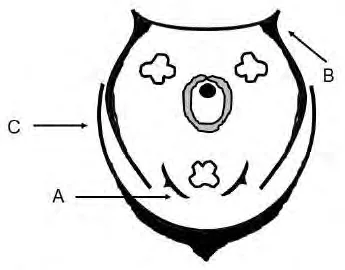
- 1A- palea, B- lemma, C- lodicule
- 2A- lemma, B- lodicule, C- stamen
- 3A- palea, B- stamen, C- lemma
- 4A- lodicule, B- palea, C- lemma
Show answer and solution
In the grass floral diagram, the outer, larger bract enclosing the floret is the lemma (C). The inner, two-keeled bract opposite it is the palea (B). The two small scales at the base of the ovary, which swell to open the floret, are the lodicules (A).
The names of the plant pathogens and their taxonomic groups are given in the table.
| Plant pathogen | Taxonomic group | ||
|---|---|---|---|
| A | Phytophthora infestans | i | Bacteria |
| B | Cladosporium fulvum | ii | Oomycetes |
| C | Ralstonia solanacearum | iii | Nematodes |
| D | Heterodera schachtii | iv | Fungi |
Choose the option with all the correct matches:
- 1A-ii, B-iv, C-i, D-iii
- 2A-iv, B-ii, C-iii, D-i
- 3A-i, B-iv, C-ii, D-iii
- 4A-iii, B-ii, C-iv, D-i
Show answer and solution
Phytophthora infestans (late blight) is an oomycete (A–ii). Cladosporium fulvum (tomato leaf mould) is a fungus (B–iv). Ralstonia solanacearum (bacterial wilt) is a bacterium (C–i). Heterodera schachtii (beet cyst nematode) is a nematode (D–iii).
Changes in NTA’s final answer key
Two options accepted: Q129. Every other question has the single answer shown.
How to revise from this paper
- Attempt it in one 3-hour sittingAnswer 15 in Part A, 35 in Part B and 25 in Part C, as in the real exam, before you check any answers.
- Score it with negative markingAdd 2 or 4 marks for each correct answer and subtract 0.5 or 1 for each wrong one. That is the number to track.
- Sort your mistakes by unitUse the unit tag on each question. Two or three wrong answers in the same unit tell you where to revise first.
- Repeat with a fresh paperTake a full-length mock a week later and compare your unit-wise mistakes.
Keep going