

All 145 questions from the CSIR-NET Life Sciences December 2023 paper (Shift 2), typed out in full, with NTA’s final answer key, a worked solution for every question and every diagram.
The Joint CSIR-UGC NET December 2023 Life Sciences exam was held on 26 December 2023 in two shifts. This page covers the afternoon shift (Shift 2, 3 pm to 6 pm). Below you will find every question from Part A (General Aptitude), Part B and Part C, in the order they appeared, each tagged with its syllabus unit. Tap Show answer and solution under any question to check the official answer and see how to reach it.
Marking scheme
| Part | Questions | Answer | Marks each | Wrong answer | Max marks |
|---|---|---|---|---|---|
| A: General Aptitude | Q1–20 | 15 | 2 | −0.5 | 30 |
| B: Life Sciences | Q21–70 | 35 | 2 | −0.5 | 70 |
| C: Life Sciences | Q71–145 | 25 | 4 | −1 | 100 |
| Total | 145 | 75 | 200 |
Which units this paper tested
We tagged each of the 125 Part B and Part C questions with its CSIR-NET syllabus unit. In this paper, Ecological Principles, Fundamental Processes and Inheritance Biology carried the most questions.
Practise any unit across all 11 papers, with every question linked to a worked solution:
Jump to a question
Part A: General Aptitude (Q1–20)
20 questions; answer any 15. Each carries 2 marks, and a wrong answer costs 0.5.
Which one of the following represents the most precise measurement of a length?
- 12.15 meter
- 2215 centimeter
- 321.5 decimeter
- 42.150 meter
Show answer and solution
Precision is shown by the number of significant figures. 2.150 m is quoted to the millimetre, while 2.15 m, 215 cm and 21.5 dm are all quoted only to the centimetre.
Angela travels from town A to town T, 10 km away. When she’s halfway, Betty starts from town B for T, 15 km away. When Betty is half way, Charlie starts from town C for T, 30 km away. When he’s half way, Dave starts from town D for T, 40 km away. If their speeds are uniform and in the ratio 1:3:12:16, respectively, the last one to reach T will be
- 1Angela
- 2Betty
- 3Charlie
- 4Dave
Show answer and solution
Angela takes 10/1 = 10 units. Betty starts at t = 5 and takes 15/3 = 5, finishing at 10. Charlie starts at 7.5 and takes 30/12 = 2.5, finishing at 10. Dave starts at 8.75 and takes 40/16 = 2.5, finishing at 11.25. Dave is last.
Starting at the same time policewomen A and B chase thief T. They all run in the same direction at constant speeds. A runs twice as fast and B thrice as fast as T. If A and B catch up with T at the same time, B must have started
- 1half as far behind T as A did
- 21½ times as far behind T as A did
- 3twice as far behind T as A did
- 43 times as far behind T as A did
Show answer and solution
Let the thief’s speed be v and the catch time t. A closes the gap at 2v − v = v, so she started vt behind. B closes it at 3v − v = 2v, so she started 2vt behind: twice as far.
Consider a string of letters and a mirror placed below it as shown.

Which of the above is the correct reflection of the string?
- 1A
- 2B
- 3C
- 4D
Show answer and solution
A horizontal mirror below the text flips each letter top-to-bottom but does not swap left and right, so the letters stay in the same order (L P S A R B), each upside-down. That is option A.
Which of the following equations represents the graph shown?
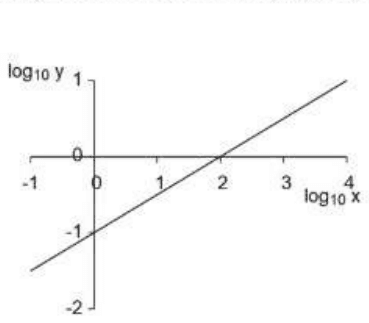
- 1log y = (log x) − 1
- 2log y = (log x)/2 − 1
- 3log y = (log x) − log(1)
- 4log y = (log x)/2 + 1
Show answer and solution
The line passes through (0, −1) and (2, 0), so its slope is 1/2 and its intercept −1: log y = (log x)/2 − 1.
Incomes (in lakhs) of two persons A and B, over the years 2006—2010 are shown in the graph.
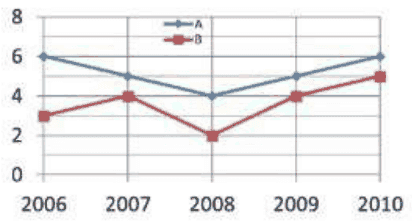
Which of the following statements is true?
- 1Over the years, trends of income of A and B are the same.
- 2The largest difference in incomes of A and B is in the year 2008.
- 3During the given period, the average income of A is higher by 1.8 lakh compared to B.
- 4During the given period, the annual income of A was below its average more than twice.
Show answer and solution
A’s incomes are 6, 5, 4, 5 and 6, with mean 5.2. A was below that mean in 2007, 2008 and 2009, three times, so statement 4 is true. B’s mean is 3.6, so the difference is 1.6, not 1.8. The largest gap (3) is in 2006, not 2008, and the two trends differ.
A test consists of 20 questions. A correct answer fetches 4 marks and a wrong answer is penalised by deducting 1 mark. Un-attempted questions fetch nothing. The number of triplets of (#correct, #incorrect, #unattempted) which give a score of 40, is
- 11
- 22
- 33
- 44
Show answer and solution
4c − w = 40 with c + w ≤ 20. w must be a multiple of 4: (10, 0, 10), (11, 4, 5) and (12, 8, 0) all work, while (13, 12) would need 25 questions. So there are 3 triplets.
Among A, B, C and D, one is a doctor, one is a teacher, one is an engineer, and the other is a lawyer. The teacher is older to B but younger than D. B is older to the doctor and younger than C. Which among the following is a conclusive inference?
- 1A is the engineer
- 2B is the lawyer
- 3C is the teacher
- 4D is not the doctor
Show answer and solution
The clues give D older than the teacher, who is older than B, and C older than B, who is older than the doctor. So D cannot be the doctor, since the doctor is younger than B, while C may be the teacher. NTA accepted options 3 and 4.
Four villages form the vertices of a rectangle of dimensions 8.0 km × 6.0 km. Roads are to be laid connecting the villages such that the distance by road between each pair of villages is the same. The shortest such road distance (in km) between any pair of villages will be
- 110
- 210√3
- 310√2
- 414
Show answer and solution
For every pair to be the same road distance apart, the roads should meet at the centre. Each village is half a diagonal from the centre: ½√(82 + 62) = 5 km. So every pair is 10 km apart.
Two circles of radii 9.0 units and 4.0 units touch each other externally as in the figure. Then the length (in units) of their common tangent AB is
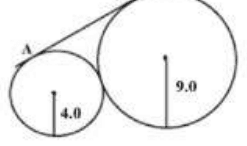
- 16√3
- 213
- 312
- 412√2
Show answer and solution
For externally touching circles, the direct common tangent length = 2√(r1r2) = 2√(9 × 4) = 12.
The production of goods in a factory over 9 months is shown in the graph.
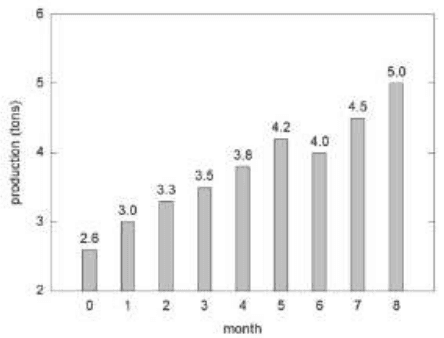
The average growth (in tons per month) over the period under consideration
- 1is 0.3
- 2is 0.4
- 3varies between −0.2 and +0.5
- 4varies between +0.2 and +0.5
Show answer and solution
Production rises from 2.6 tons (month 0) to 5.0 tons (month 8). Average growth = (5.0 − 2.6)/8 = 0.3 tons per month, even though individual months vary.
A large rectangular paper having sides in the ratio of 3:8 is cut in half across the longer side. The process is repeated several times. At which stages of the repeated cuttings will the ratio of the sides be 3:8?
- 1Never
- 2Every second cut
- 3Every third cut
- 4Every fifth cut
Show answer and solution
Halving a 3 × 8 sheet across the longer side gives 3 × 4 (3:4). Further cuts alternate between 2:3 and 3:4 (3×4 → 3×2 → 1.5×2 → …). The 3:8 ratio never returns.
Let 2a3b5c = 1200 where a, b, c are integers. Then a + 2b + 3c is
- 17
- 28
- 311
- 412
Show answer and solution
1200 = 24 × 31 × 52, so a = 4, b = 1 and c = 2. Then a + 2b + 3c = 4 + 2 + 6 = 12.
Four students Alpana, Behram, Ramesh and Doug joined a college in 1991, 1992, 1993 and 1994 but not necessarily in that order. Each student joined one of the four departments, viz. Physics, Chemistry, Mathematics and Biology. No two students joined the same department. One of those who joined the college before 1993 joined Chemistry. No one joined the college after Ramesh. Doug joined Physics. Alpana joined one year after Doug but didn’t join Chemistry. Then Behram joined the college in the year
- 11991
- 21992
- 31993
- 41994
Show answer and solution
Ramesh joined in 1994. Doug took physics, and Alpana, a year after him, did not take chemistry, so Behram took chemistry before 1993. Doug and Alpana must be in consecutive years, which works only if Behram joined in 1991 (then Doug 1992, Alpana 1993).
In the following finite sequence of integers, how many terms are divisible by their immediate next terms?
8,3,4,9,3,5,9,5,9,9,9,4,5,6,3,3,5,7,2,3,9,9
- 17
- 24
- 35
- 46
Show answer and solution
Check each term against the next one. 9÷3, 9÷9 (twice), 6÷3, 3÷3 and the final 9÷9 all divide evenly: 6 terms.
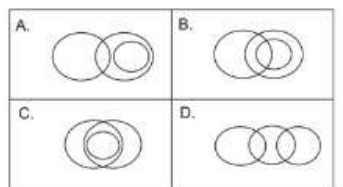
Suppose some Basketball players play Cricket, all Tennis players play Cricket, and no Tennis player plays Basketball. Which one of the following Venn diagrams correctly represents the relationship among Basketball, Cricket and Tennis players’ groups?
- 1A
- 2B
- 3C
- 4D
Show answer and solution
All tennis players play cricket, so the tennis circle sits inside the cricket circle. Some basketball players play cricket, so the basketball circle overlaps cricket. No tennis player plays basketball, so basketball does not touch tennis. Diagram A shows exactly this.
100 mL of alcohol from container A containing 1 L of alcohol is transferred to another container B containing 1 L of water and mixed well. From this, 100 mL is transferred back to container A. The amount of alcohol in container B would be
- 1the same as the amount of water in container A
- 2more than the amount of water in container A
- 3less than the amount of water in container A
- 4indeterminable
Show answer and solution
Each container ends with exactly 1 L, so whatever alcohol is missing from A has been replaced by the same volume of water. The alcohol now in B therefore equals the water in A.
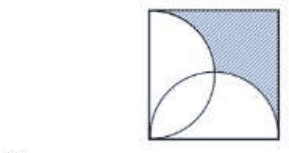
Two semicircles are drawn in a square with sides as diameters as shown. If the side of the square is 2 units, how much is the shaded area (in sq. units)?
- 12 − π/4
- 22 − π/3
- 33 − π/2
- 43 − π/4
Show answer and solution
Each semicircle has radius 1 and area π/2. They overlap in a lens of area 2(π/4 − 1/2) = π/2 − 1, so together they cover π/2 + π/2 − (π/2 − 1) = π/2 + 1. Shaded area = 4 − (π/2 + 1) = 3 − π/2.
The following 15 observations are heights (in inches) of 15 persons
65, 61, 63, 65, 61, 61, 60, 60, 65, 85, 65, 86, 61, 65, 62
Which of the following is true?
- 1Mean < Median < Mode
- 2Median < Mode < Mean
- 3Mode < Median < Mean
- 4Median < Mean < Mode
Show answer and solution
Sorted, the median (8th value) is 63, the mode (five times) is 65, and the mean is 985/15 ≈ 65.7, pulled up by 85 and 86. So median < mode < mean.
One letter is picked at random from each of the words LUNAR and LANDER. The chance that the letters picked from both words belong to the word PRAGYAN
- 13/10
- 23/7
- 31/2
- 47/10
Show answer and solution
PRAGYAN contains P, R, A, G, Y and N. From LUNAR, N, A and R qualify: 3/5. From LANDER, A, N and R: 3/6. Probability = (3/5) × (1/2) = 3/10.
Part B: Life Sciences (Q21–70)
50 questions; answer any 35. Each carries 2 marks, and a wrong answer costs 0.5.
The base composition of the genome of a newly identified virus is given below:
Adenine: 25%; Cytosine: 35%; Guanine: 30%; Thymidine: 10%
Based on this information, the genome of this virus is:
- 1double-stranded DNA.
- 2single-stranded DNA.
- 3double-stranded RNA.
- 4single-stranded RNA.
Show answer and solution
A (25%) ≠ T (10%) and G (30%) ≠ C (35%), so the strands are not paired, and the thymine shows it is DNA. The genome is single-stranded DNA.
The amount of energy required to break a single covalent bond is:
- 1200-500 kJ/mol
- 280-150 kJ/mol
- 3600-900 kJ/mol
- 420-70 kJ/mol
Show answer and solution
Typical covalent bond energies are about 200–500 kJ/mol (C–C about 348, C–H about 413, O–H about 463), far above non-covalent interactions. NTA accepted options 1 and 2.
Which one of the following options represents parts of a tRNA that are involved in amino acid charging and interaction with the mRNA, respectively?
- 15′ end and D-loop
- 23′ end and T-loop
- 35′ end and anti-codon loop
- 43′ end and anti-codon loop
Show answer and solution
The amino acid is attached to the 3′ CCA end (the acceptor stem) during charging, and the anticodon loop pairs with the mRNA codon.
An enzyme “X” converts a L-amino acid to a racemic mixture of D- and L- forms. Which one of the following coenzymes is utilized by enzyme X for this conversion?
- 1Pyridoxal phosphate
- 2Thiamine pyrophosphate
- 3Flavin adenine dinucleotide
- 4Tetrahydrofolate
Show answer and solution
Amino acid racemases use pyridoxal phosphate, which forms a Schiff base with the amino acid and stabilises the carbanion left when the α-hydrogen is removed. The proton can then return from either face.
Which one of the following statements about human transposons is INCORRECT?
- 1LINEs are autonomous active transposable elements in humans.
- 2SINEs and LINEs are retrotransposons.
- 3Human genome contains many more copies of retrotransposons than DNA transposons.
- 4LINEs and SINEs contain LTR elements that initiate transcription.
Show answer and solution
LINEs and SINEs are non-LTR retrotransposons. Their transcription comes from internal promoters (Pol II for LINE-1, Pol III for Alu), so statement 4 is the incorrect one.
Mammalian cells that have just crossed the Restriction Point of the cell cycle are likely to have:
- 1high levels of unphosphorylated retinoblastoma protein.
- 2an active anaphase promoting complex.
- 3low levels of mitotic cyclin B.
- 4condensed chromosomes.
Show answer and solution
Past the restriction point (late G1), Rb is hyperphosphorylated, APC/C–Cdh1 is being switched off, chromosomes are decondensed, and mitotic cyclin B is still low, rising only in S and G2.
Which one of the following statements about ATP generating mitochondria is TRUE?
- 1The outer membrane is permeable to protons.
- 2The inner membrane is not permeable to protons.
- 3The intermembrane space has high concentration of protons.
- 4The matrix has the highest concentration of protons.
Show answer and solution
The respiratory chain pumps protons from the matrix into the intermembrane space, so that is where the H+ concentration is highest. The matrix has the lowest. NTA’s key gives option 3.
Which one of the following statements about biological membranes is INCORRECT?
- 1Lipid molecules can diffuse freely in the plane of the bilayer.
- 2The ratio of the size of head group to fatty acyl chain of phospholipids contributes to the curvature properties of lipid membranes.
- 3Individual lipid molecules rapidly rotate along their long axis.
- 4Phospholipids freely diffuse from one leaflet of bilayer to another.
Show answer and solution
Lipids move rapidly sideways and rotate, and head-group size affects curvature. But flip-flop between leaflets is very slow without flippases or scramblases, so statement 4 is the incorrect one.
Which one of the following exhibits ATPase and helicase activities for promoter opening and clearance?
- 1TFIID
- 2TFIIH
- 3TFIIF
- 4TFIIE
Show answer and solution
TFIIH carries the XPB ATPase/helicase that opens the promoter, and the CDK7 kinase that phosphorylates the Pol II CTD, which helps the polymerase escape the promoter.
The tri-snRNP particle is composed of:
- 1U1, U4 and U3 snRNPs
- 2U2, U4 and U3 snRNPs
- 3U3, U6 and U5 snRNPs
- 4U4, U6 and U5 snRNPs
Show answer and solution
The spliceosomal tri-snRNP is U4/U6·U5. It joins after U1 and U2, and U4 then leaves so that U6 can form the catalytic core.
Which one of the following statements about clamp loader is NOT correct?
- 1The clamp loader is a five-subunit heteropentamer that helps in DNA replication.
- 2Clamp loading is an ATP-dependent process.
- 3In the absence of ATP, clamp loader attains a spiral shape to bind and open the clamp.
- 4The clamp loader and DNA polymerase compete for the same C-terminal face of the clamp.
Show answer and solution
The clamp loader is a five-subunit AAA+ complex that needs ATP binding to adopt its spiral shape, grab the clamp and open it. ATP hydrolysis then releases the clamp onto DNA. Statement 3 says this happens without ATP, so it is the incorrect one.
Which of the following is a co-translational amino acid modification, rather than a post-translational modification?
- 1Phosphate added to a serine.
- 2Selenium added to a cysteine.
- 3Acetyl added to a lysine.
- 4Methyl added to an arginine.
Show answer and solution
Selenocysteine is made on its tRNA, from Ser-tRNASec, and inserted at UGA codons during translation, so it is co-translational. Phosphorylation, acetylation and methylation happen after synthesis.
Which one of the following statements about Anthrax is correct?
- 1This is an acute infectious disease caused by a gram-negative bacterium.
- 2The B subunit of anthrax toxin is known as the lethal factor.
- 3The A subunit of the lethal toxin is a protease that cleaves the members of MAP kinase kinase family.
- 4The lethal toxin and edema toxin consist of identical A subunits.
Show answer and solution
Lethal factor, the A component of lethal toxin, is a zinc protease that cleaves MAP kinase kinases (MEKs). B. anthracis is Gram-positive. The B (binding) subunit is protective antigen. Lethal and oedema toxins share protective antigen but have different A subunits (LF versus EF).
Many signal transduction pathways work as molecular switches. On receiving a signal, they switch from an inactive form to an active form. They return to the inactive form when another signal switches them off. Which of the following processes does NOT directly involve a molecular switch?
- 1Proteasome degradation of HIF1a during normoxia.
- 2Regulation of Ras during cell proliferation.
- 3Regulation of AKT in response to growth signals.
- 4Growth cone collapse regulation by RhoA.
Show answer and solution
Ras, Akt and RhoA flip between active and inactive states, by GTP/GDP exchange or phosphorylation. HIF-1α degradation in normal oxygen (hydroxylation, then VHL, then the proteasome) destroys the protein rather than switching it reversibly.
Which one of the following statements about different cellular junctions is INCORRECT?
- 1Gap junctions are channel-forming junctions linking the cytoplasm of adjacent cells.
- 2Tight junction, desmosome, and gap junction together form the junctional complex.
- 3Hemidesmosome helps in anchoring intermediate filaments with extracellular matrix.
- 4Adherens junctions help in connecting actin filaments of adjacent cells.
Show answer and solution
The epithelial junctional complex is the tight junction, the adherens junction (zonula adherens) and the desmosome. Gap junctions are not part of it, so statement 2 is the incorrect one.
Which one of the following statements is a characteristic property of B cell epitopes on a protein?
- 1Amino acid sequences in the interior region are composed predominantly of hydrophobic amino acids.
- 2Amino acid sequences in the interior region are composed predominantly of hydrophilic amino acids.
- 3Protruding regions on the surface composed are predominantly of hydrophobic amino acids.
- 4Protruding regions on the surface are composed predominantly of hydrophilic amino acids.
Show answer and solution
B-cell epitopes are recognised in the native protein, so they are usually on exposed, protruding surface regions rich in hydrophilic residues, such as loops and termini.
Mutants and transgenic models have played a pivotal role in understanding development. Which one of the following statements is true?
- 1A transgenic DNA chimaera experiment involves the transplantation of cells from a genetically modified organism to another embryo.
- 2Interspecies chimaera are the easiest and most common model systems to study developmental processes.
- 3A transgenic female mouse (XX) expressing Sry (sex-determining region of the Y-chromosome) induces the production of Y-chromosome-carrying ovum in the mouse.
- 4A transgenic animal model is exclusively utilized to study gene function by deletion of a gene.
Show answer and solution
A chimaera experiment combines cells from a genetically modified organism with another embryo (statement 1). Interspecies chimaeras are hard to make. Sry in an XX mouse makes it develop as a male, but it cannot create Y-bearing eggs. Transgenics are used for many purposes besides deletions.
The meeting of sperm and eggs in a dilute concentration is one of the challenges of external fertilization. Which one of the following proteins helps in overcoming the challenge?
- 1Bindin
- 2Resact
- 3Izumo
- 4Ovastacin
Show answer and solution
Resact, a peptide released by sea-urchin egg jelly, is a species-specific chemoattractant and sperm activator. It brings sperm to dilute eggs in the sea. Bindin, Izumo and ovastacin act later, at contact and fusion.
Which one of the following statements is correct for early embryonic development in terms of differentiation?
- 1The first stage of commitment is termed as specification, while the second stage is determination.
- 2If a specified cell is transplanted to a region of differently specified cells, the fate of the specified cell remains unchanged.
- 3A cell or tissue is said to be determined when it shows reversible fate under the influence of the surrounding cells or tissue.
- 4The first stage of specification is termed as commitment when a cell develops autonomously.
Show answer and solution
Commitment has two stages: specification, which is reversible, so the cell takes on a neighbour’s fate if moved, followed by determination, which is irreversible.
The mobile signal, florigen, that controls the flowering status of the plants is encoded by which one of the following?
- 1Flowering locus C (FLC)
- 2Flowering locus D (FD)
- 3Flowering locus T (FT)
- 4CONSTANS (CO)
Show answer and solution
FLOWERING LOCUS T encodes florigen, made in leaves and carried in the phloem to the shoot apex, where it partners FD.
In which one of the following organelles does glycine decarboxylase complex and serine hydroxymethyltransferase convert two molecules of glycine into one molecule of serine during photorespiration?
- 1Endoplasmic reticulum
- 2Chloroplast
- 3Mitochondria
- 4Peroxisome
Show answer and solution
In photorespiration, two glycines become one serine plus CO2 and NH3 in the mitochondria, catalysed by glycine decarboxylase and serine hydroxymethyltransferase.
Which one of the following statements about the guardee protein, that plays an important role during plant-pathogen interactions is correct?
- 1It is a bacterial protein that guards the host cell components.
- 2It is secreted by the type III secretion system of the pathogenic bacteria.
- 3It imparts disease resistance in plants that lack, cognate R protein.
- 4Degradation of guardee protein can activate the defense response.
Show answer and solution
In the guard model, a host “guardee” protein (such as RIN4 or PBS1) is targeted by a pathogen effector. The R protein guarding it senses the modification or degradation and sets off defence.
Which one of the following statements regarding the production of various reactive oxygen species during oxidative burst is INCORRECT?
- 1NADPH oxidase involved in this process is a plasma membrane-spanning protein.
- 2In Arabidopsis, NADPH oxidases are encoded by respiratory burst oxidase homolog (Atrboh) genes.
- 3Superoxide dismutase is an apoplastic enzyme involved in the formation of superoxide.
- 4FAD is involved in the formation of superoxide.
Show answer and solution
Superoxide is made by plasma-membrane NADPH oxidases (RBOHs, with FAD). Superoxide dismutase converts superoxide into H2O2; it does not form superoxide, so statement 3 is the incorrect one.
A researcher, while studying vernalization in plants, has made the following statements. Choose the INCORRECT one.
- 1Vernalization causes stable change in the competency of the meristem to form an inflorescence in some plant species.
- 2Vernalization causes changes in gene expression that do not involve alteration in the DNA sequence.
- 3Flowering is not altered under normal growth conditions in plants defective in vernalization.
- 4Vernalization alters the expression of FLC gene.
Show answer and solution
Vernalisation stably changes the meristem’s competence to flower, epigenetically, by silencing FLC (statements 1, 2 and 4 are true). In vernalisation-requiring plants, a defect in vernalisation does alter flowering, which becomes late, so statement 3 is the incorrect one.
The hematocrit of human blood is highest when collected from:
- 1jugular vein
- 2pulmonary vein
- 3right coronary artery
- 4brachial artery
Show answer and solution
Venous red cells take up Cl− and water (the chloride shift) and swell slightly, so systemic venous blood such as jugular blood has a higher haematocrit than arterial or pulmonary venous blood.
The volume of the pleural fluid in a healthy human is:
- 155-60 ml
- 235-40 ml
- 315-20 ml
- 41-5 ml
Show answer and solution
The pleural space holds only a thin film of fluid, about 15–20 mL in total, which lubricates breathing movements. That is NTA’s answer.
Which one of the following hormones elicits its cellular response by producing cAMP as a second messenger?
- 1Calcitonin
- 2Oxytocin
- 3Prolactin
- 4Leptin
Show answer and solution
Calcitonin receptors are Gs-coupled and raise cAMP. Oxytocin acts through Gq and Ca2+, and prolactin and leptin through JAK–STAT.
Which one of the following amino acids is present in vasopressin at position 3?
- 1Tyrosine
- 2Phenylalanine
- 3Glutamine
- 4Asparagine
Show answer and solution
Arginine vasopressin is Cys-Tyr-Phe-Gln-Asn-Cys-Pro-Arg-Gly-NH2, so position 3 is phenylalanine. In oxytocin it is isoleucine.
While developing genetic maps, Alfred Sturtevant proposed that genetic distances are additive. From test crosses involving two genes, if the genetic distance between genes A and B was observed to be 15 cM and between B and C was 10 cM, then the percentage of recombinants observed between A and C would be 25, given that the arrangement is A—B—C. This will be observed only when there is:
- 1No interference
- 2Complete interference
- 3Negative interference
- 4Variable interference
Show answer and solution
The A–C recombination frequency equals the sum of the intervals (15 + 10 = 25%) only if no double crossovers occur, that is, with complete interference.
Which one of the following statements about determination of ABO blood types is INCORRECT?
- 1ABO blood types are determined by three alleles of one gene.
- 2Four blood group phenotypes are produced by six genotypes.
- 3Parents with a type A and a type B could produce a type O child.
- 4Universal donors with O blood type do not carry antibodies against A and B.
Show answer and solution
Group O people lack A and B antigens on their red cells, but their plasma does contain anti-A and anti-B antibodies. Statement 4 is the incorrect one. O cells are universal donor cells because of the missing antigens, not missing antibodies.
DNA from a strain of bacteria with genotype a+ b+ c+ d+ e+ was isolated and used to transform a strain of bacteria that was a− b− c− d− e−. The transformants were tested for the presence of donated genes. The following genes were co-transformed:
a+ and c+ b+ and d+ e+ and d+ c+ and b+
Which one of the following options gives the correct order of genes on the bacterial chromosome?
- 1a c d b e
- 2a c b d e
- 3b d c a e
- 4e d c a b
Show answer and solution
Genes taken up together on one DNA fragment must lie close together. The co-transformed pairs a–c, c–b, b–d and d–e chain into the order a c b d e.
Monozygotic and dizygotic twins are used to study the onset of mental illness. The influence of genetic factors on these diseases can be done by calculating the:
- 1Mutation rate
- 2Concordance rate
- 3Phenotype variation
- 4Environmental effect
Show answer and solution
Twin studies compare the concordance rate, the chance that both twins are affected, in monozygotic and dizygotic pairs. Much higher concordance in monozygotic twins points to a genetic contribution.
As per Aichi Target 11 of the Convention on Biological Diversity, what percentage of geographical area was proposed to be protected for biodiversity conservation by the year 2020?
- 1Terrestrial and inland water 23%, coastal and marine areas 17%
- 2Terrestrial and inland water 23%, coastal and marine areas 10%
- 3Terrestrial and inland water 17%, coastal and marine areas 10%
- 4Terrestrial and inland water 17%, coastal and marine areas 7%
Show answer and solution
Aichi Target 11 (2011–2020) called for 17% of terrestrial and inland water areas and 10% of coastal and marine areas to be protected by 2020.
Phelloderm is derived from:
- 1Cork cambium
- 2Fascicular cambium
- 3Interfascicular cambium
- 4Provascular tissue
Show answer and solution
The cork cambium (phellogen) produces phellem (cork) to the outside and phelloderm to the inside. Together they make the periderm.
As per the ENVIS database, approximately how much of India’s landmass is designated under various categories of protected areas for biodiversity conservation, as of January 2023?
- 123.08%
- 217.51%
- 311.62%
- 45.28%
Show answer and solution
According to ENVIS (2023), India’s roughly 1,000 protected areas (national parks, sanctuaries, conservation and community reserves) cover about 5.28% of the country’s land area.
An herbivore eats food that provides 1,000 kJ of energy of which, 500 kJ is lost in faeces, 350 kJ is used in cellular respiration, and 150 kJ is used for growth. The percent production efficiency of the herbivore is:
- 150
- 235
- 330
- 415
Show answer and solution
Production efficiency = production ÷ assimilation. Assimilation = 1,000 − 500 (faeces) = 500 kJ, and production = 150 kJ. So efficiency = 150/500 = 30%.
Which one of the following pollutants does NOT concentrate in organisms at higher trophic levels due to biomagnification?
- 1Mercury
- 2Phosphate
- 3Persistent Organic Pollutants (POPs)
- 4Selenium
Show answer and solution
Persistent, fat-soluble or tightly bound substances, such as methylmercury, selenium and POPs, biomagnify up food chains. Phosphate is a nutrient that is used and excreted, so it does not.
What is the typical maximum sustainable yield for a fish population, given that its carrying capacity (K) is 20,000 and intrinsic growth rate (r) is 0.15?
- 11,333
- 21,500
- 33,000
- 46,666
Show answer and solution
For logistic growth, maximum sustainable yield is usually rK/4 = 0.15 × 20,000/4 = 750, which is not among the options. NTA’s key gives 1,500 (= rK/2). Note that NTA itself used rK/4 in the June 2025 paper (Q86).
According to the latest IUCN Red List (2022), which one of the following groups has the highest percentage of assessed species that are threatened with extinction?
- 1Amphibians
- 2Birds
- 3Mammals
- 4Reptiles
Show answer and solution
On the IUCN Red List, amphibians have the highest share of assessed species threatened, about 41%. That compares with about 27% of mammals, 21% of reptiles and 13% of birds.
Which one of the following is NOT an example of learning?
- 1Imprinting
- 2Fixed action pattern
- 3Operant conditioning
- 4Habituation
Show answer and solution
A fixed action pattern is innate and stereotyped, needing no experience. Imprinting, operant conditioning and habituation are all forms of learning.
Which one of the following statements about the molecular clock hypothesis as proposed by Zuckerkandl and Pauling 1962 is CORRECT?
- 1DNA and protein sequences evolve at a relatively constant rate.
- 2DNA sequences evolve at a relatively slow rate when compared to proteins.
- 3Amino acid sequences evolve stochastically.
- 4Protein sequences do not evolve even when DNA evolves at a constant rate.
Show answer and solution
Zuckerkandl and Pauling saw that the number of differences between haemoglobin sequences grows roughly in proportion to the time since species diverged. They proposed that molecules evolve at an approximately constant rate: the molecular clock.
Juvenile hormone is secreted by which one of the following glands?
- 1Corpus allatum
- 2Pituitary
- 3Pineal
- 4Labial
Show answer and solution
Insect juvenile hormone is secreted by the corpora allata, small glands behind the brain. It keeps larvae in the larval state between moults.
Absence of dormant buds and absence of annual growth rings in a fossilized trunk specimen of a coal swamp plant indicates:
- 1long dry seasons.
- 2slow growth rate.
- 3highly fluctuating seasons.
- 4unvarying, seasonless climate.
Show answer and solution
Annual growth rings and dormant buds record seasons. A trunk with neither grew continuously, in a uniform, seasonless (tropical) climate, as in Carboniferous coal swamps.
To evaluate insulin-dependent diabetes, clinicians prefer evaluating mono-glycated hemoglobin referred to as HbA1c, which occurs due to a nonenzymatic reaction between glucose and a few amino acids in hemoglobin. Which of the following amino acids are likely to be involved in the modification of hemoglobin?
- 1Asparagine and Glutamic acid
- 2Proline and Tryptophan
- 3Glutamine and Aspartic acid
- 4Valine and Lysine
Show answer and solution
In HbA1c, glucose is attached non-enzymatically to the N-terminal valine of the β chains, and glycation also occurs on lysine ε-amino groups.
Which one of the following strategies will generate the most precise mutation at the predetermined location of a plant genome?
- 1CRISPR/Cas9 editing
- 2T-DNA insertion mutagenesis
- 3Transposon mutagenesis
- 4Targeting Induced Local Lesions in Genomes (TILLING)
Show answer and solution
CRISPR/Cas9 cuts at a site chosen by the guide RNA, so the edit is made exactly where intended. T-DNA, transposon and TILLING approaches produce random lesions that then have to be screened.
Which one of the following is the major antibody in the early stages of a primary immune response?
- 1IgA
- 2IgM
- 3IgD
- 4IgE
Show answer and solution
IgM is the first antibody made in a primary response. Its pentameric form binds strongly through avidity even before affinity maturation.
Using patch-clamp technique, one can find the ligands that could influence specific ion channel. How many molecules of acetylcholine are required to open an acetylcholine receptor ion channel in such an experiment?
- 1One
- 2Two
- 3Three
- 4Four
Show answer and solution
The nicotinic acetylcholine receptor has two ACh-binding sites, at the α–γ/ε and α–δ interfaces, and opens efficiently only when both are occupied, so two molecules are needed.
Which microscope is typically used to detect a single fluorescent molecule?
- 1DIC microscope
- 2Epifluorescence microscope
- 3TIRF microscope
- 4Phase contrast microscope
Show answer and solution
TIRF microscopy excites only a roughly 100 nm layer next to the coverslip. That removes out-of-focus background and makes single fluorophores visible.
Using an analytical ultracentrifugation sedimentation velocity run, a researcher has calculated the S value (Svedberg units) of a part of the freshly purified 12 kDa enzyme to be ~ 1.83, corresponding to its monomeric state. However, during an identical run of the remaining protein after 2 days, the researcher finds that the S value increased to ~ 2.57. What would be the correct conclusion about the enzyme in question?
- 1The enzyme is aggregated and forms a homo octamer.
- 2The enzyme is monomeric but is now associated with the buffer components.
- 3The enzyme has undergone monomer to a homodimer transition.
- 4The enzyme has degraded due to autocatalytic activity.
Show answer and solution
The sedimentation coefficient scales with mass to the 2/3 power, so doubling the mass raises S by about 1.6 times. A rise from 1.83 to 2.57 (about 1.4 times) fits a monomer-to-dimer change, allowing for shape, far more closely than an octamer would.
A researcher measures the height of 50 teak trees in wet and dry habitats. Which one of the following options is an appropriate statistical test to determine if heights significantly differ in wet and dry habitats?
- 1Student’s t-test
- 2Chi-square test
- 3Regression analysis
- 4Discriminant analysis
Show answer and solution
Comparing mean height between two independent groups (wet and dry habitats) calls for a Student’s t-test. Chi-square is for counts, and regression for relationships.
Part C: Life Sciences, analytical (Q71–145)
75 questions; answer any 25. Each carries 4 marks, and a wrong answer costs 1.
If the length of a single continuous α-helical polypeptide is 108 Å, which one of the following statements is true?
- 1The α-helix contains 72 amino acids without Proline(s) and Glycine(s)
- 2The α-helix contains 76 amino acids without Alanine(s) and Valine(s)
- 3The α-helix contains 80 amino acids without Lysine(s) and Aspartic Acid(s)
- 4The α-helix contains 74 amino acids without Arginine(s) and Histidine(s)
Show answer and solution
At 1.5 Å per residue, a 108 Å helix holds 72 residues. It would avoid proline and glycine, the classic helix breakers.
Which one of the sequences given below is a portion of a potential microRNA precursor?
- 15′ GTAGCGTAGCAGTAGTTAAGCGCTTAAGCU 3′
- 25′ AUUCUUGACGAUUAACGCGCAUAACCAUC 3′
- 35′ GUUUUCCCUAAAAUUUUGAGACCCCAUAG 3′
- 45′ UAGGGGUUUUUGCCUCCAACUGACUCCUA 3′
Show answer and solution
A pre-miRNA is a short hairpin whose ends pair with each other. In option 4, 5′-UAGG… can pair with …CCUA-3′, giving the self-complementary stem typical of a precursor. NTA’s key gives option 4.
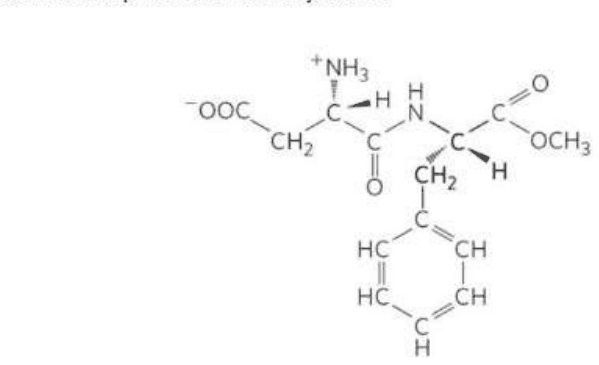
Which one of the following options correctly depicts the stereo-conformation of the dipeptide derivative of Aspartic acid and Phenylalanine?
- 1L-Aspartyl-L-phenylalanine methyl ester
- 2D-Aspartyl-L-phenylalanine methyl ester
- 3D-Aspartyl-D-phenylalanine methyl ester
- 4L-Aspartyl-D-phenylalanine methyl ester
Show answer and solution
The structure is aspartame, L-aspartyl-L-phenylalanine methyl ester. Only the L,L form tastes sweet.
Given below are inhibitors of electron transport (Column X) and their target enzymes (Column Y)
| Column X: Inhibitors of electron transport | Column Y: Respiratory chain complex enzymes | ||
|---|---|---|---|
| A | Dicyclohexylcarbodiimide and Oligomycin | i | NADH coenzyme Q reductase |
| B | Rotenone and Demerol | ii | ATP Synthase |
| C | Thenoyltrifluroacetone and Carboxin | iii | Succinate coenzyme Q reductase |
| D | Cyanide and Azide | iv | Cytochrome c oxidase |
Which one of the following options represents all correct matches between Column X and Column Y?
- 1A (iii); B (iv); C (i); D (ii)
- 2A (ii); B (i); C (iii); D (iv)
- 3A (iv); B (ii); C (i); D (iii)
- 4A (i); B (iii); C (iv); D (ii)
Show answer and solution
DCCD and oligomycin block ATP synthase (A–ii). Rotenone (and pethidine) block NADH–CoQ reductase, complex I (B–i). TTFA and carboxin block succinate–CoQ reductase, complex II (C–iii). Cyanide and azide block cytochrome c oxidase (D–iv).
Newly identified proteins X, Y, and Z are associated with endoplasmic reticulum (ER) membrane fraction. The above ER membrane fraction is subjected to high salt treatment (buffer pH 7.4, 0.5 M KCl) followed by fractionation by centrifugation into soluble and insoluble pellet components. The following observations were made from the above experiment:
(i) The proteins X and Y are fractionated into soluble components.
(ii) Protein Z is fractionated into insoluble pellet components.
Based on these observations, the following inferences are made:
- A. Proteins X and Y are peripheral membrane proteins
- B. Protein Z is an integral membrane protein
- C. Protein Z is a peripheral membrane protein
- D. Proteins X and Y are integral membrane proteins.
Which one of the following options represents the combination of all correct statements?
- 1A and B
- 2B and C
- 3A and C
- 4B and D
Show answer and solution
Proteins stripped off by high salt are held only electrostatically: peripheral proteins (X and Y). Z stays with the membrane, so it is an integral protein.
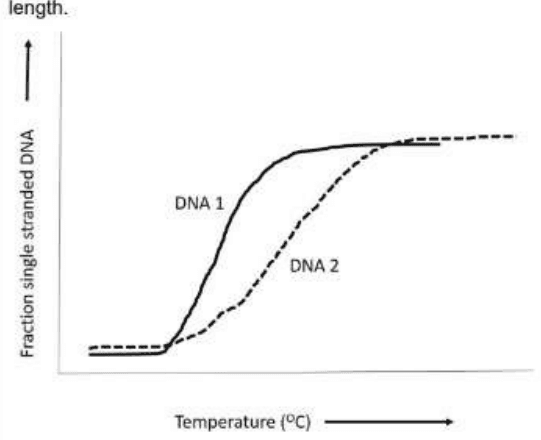
The melting curves shown below are of two double-stranded DNA molecules of the same length.
Which one of the following statements about these DNA molecules is correct?
- 1DNA1 has a lower AT content than DNA2
- 2DNA1 has a lower GC content than DNA2
- 3The DNA1 solution has a sequence-independent dsDNA binding protein
- 4DNA2 has a high number of mismatched nucleotides
Show answer and solution
DNA 2 melts at a higher temperature than DNA 1. G–C pairs have three hydrogen bonds and stack more strongly, so DNA 1 has the lower GC content.
Following statements were made about supercoiling of DNA:
- A. DNA supercoiling acts as a regulator of gene expression, but not for genome organization.
- B. Circular DNAs found in mitochondria, viruses and bacteria are invariably negatively supercoiled.
- C. A moving RNA polymerase generates positive superhelical tension in the DNA in front of it and negative helical tension behind it.
- D. Human topoisomerase I cuts both the strands of supercoiled DNA to undergo a controlled rotation to relax the supercoiled DNA.
- E. Human topoisomerase II makes a transient break in single strands of a DNA duplex which rotates around a phosphodiester bond in the intact strand to relax the supercoiled DNA.
Which one of the following options is a combination of all correct statements?
- 1A, B, D
- 2B, C, E
- 3A and E only
- 4B and C only
Show answer and solution
B is true: natural circular DNAs are negatively supercoiled. C is true: a moving RNA polymerase over-winds the DNA ahead of it and under-winds it behind (the twin-domain model). A is false: supercoiling also organises genomes. D and E are swapped: topo I cuts one strand and topo II cuts both.
Microtubule cytoskeleton utilizes some accessory proteins to regulate microtubule dynamics. Accessory proteins are given in column X and their typical functions in column Y.
| Accessory protein (Column X) | Function (Column Y) | ||
|---|---|---|---|
| A. | γ-TuRC | (i) | stabilizes plus end, promotes rapid microtubule growth |
| B. | XMAP215 | (ii) | helps in microtubule branching |
| C. | Katanin | (iii) | nucleates assembly and remains associated with the minus end |
| D. | Augmin | (iv) | severs microtubules |
Which one of the following options represents all correct matches between Column X and Column Y?
- 1A-(i), B-(ii), C-(iv), D-(iii)
- 2A-(iii), B-(i), C-(iv), D-(ii)
- 3A-(iii), B-(ii), C-(iv), D-(i)
- 4A-(ii), B-(i), C-(iv), D-(iii)
Show answer and solution
γ-TuRC nucleates microtubules and caps the minus end (A–iii). XMAP215 speeds plus-end growth (B–i). Katanin severs microtubules (C–iv). Augmin drives branching nucleation (D–ii).
During metaphase to anaphase transition, complete removal of cohesin allows sister chromatids to separate and move to opposite poles of the spindle. Given below are a few proteins/protein complexes involved in mitotic progression.
- A. Cdc20
- B. APC/C
- C. Separase
- D. CyclinA
Which one of the following options represents the protein(s)/protein complexes involved in cohesin removal at the onset of anaphase during mitosis?
- 1C only
- 2A only
- 3A, B, and C
- 4B, C, and D
Show answer and solution
At anaphase, Cdc20 activates APC/C, which ubiquitinates securin (and cyclin B). That frees separase to cleave the cohesin subunit Scc1 and release the sisters. Cyclin A is destroyed earlier and is not part of cohesin removal.
The critical micellar concentration (CMC) of a detergent is 5 mM. Choose the option that uses the minimum amount of detergent that can be used for cell lysis and is least likely to denature soluble proteins?
- 10.5 mM
- 210 mM
- 36 mM
- 42.5 mM
Show answer and solution
A detergent solubilises membranes only above its CMC (5 mM). Just above it, at 6 mM, cells lyse while the risk of denaturing soluble proteins is kept to a minimum.
Protein transport into the ER is co-translational and proteins are inserted via an aqueous channel into the ER. This can be studied using microsomes in an in vitro translation set up. Statements given below are possible outcomes when salt conductance is measured in this system.
- A. Microsomes do not show any conductance of salt ions when isolated from the cells.
- B. Addition of puromycin will lead to increased salt conductance.
- C. Addition of puromycin will have no effect on salt conductance.
Which one of the following options has the combination of all correct statements?
- 1A only
- 2A and B
- 3B only
- 4A and C
Show answer and solution
In isolated rough microsomes, ribosomes and nascent chains plug the Sec61 channels, so there is no salt conductance (A). Puromycin releases the nascent chains and opens the aqueous pores, so conductance increases (B).
Following statements were made for fragile X syndrome:
- A. It is caused due to increased numbers of CGG trinucleotide (>200 repeats) in the 5′ UTR of FMR1 genes.
- B. Unaffected people do not show any CGG repeats in the 5′ UTR of the FMR1 gene.
- C. Expanded numbers of CGG repeats in 5′ UTR of FMR1 transcripts causes its premature degradation.
- D. Expansion over 200 repeats leads to methylation of the FMR1 promoter.
- E. Fragile appearance of X chromosome develops due to dissociation of non-histone protein from the FMR1 locus.
Which one of the following options provides combination of all correct statements?
- 1A, B and E
- 2B, C and E
- 3A and E only
- 4A and D only
Show answer and solution
In fragile X, more than 200 CGG repeats in the FMR1 5′ UTR (A) cause methylation and silencing of the promoter (D). Normal alleles do carry about 5–50 repeats, the problem is transcriptional silencing rather than mRNA decay, and the fragile site is not caused by protein dissociation.
The following DNA molecules are provided as substrates for replication by DNA polymerase III.
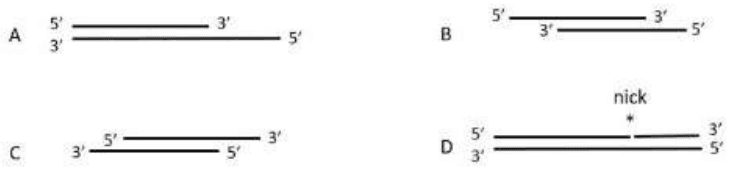
Which one of the following options lists the molecules that CANNOT function as substrates for DNA polymerase III?
- 1A and C
- 2B and D
- 3C and D
- 4C only
Show answer and solution
Pol III needs a template with a primer whose 3′-OH is recessed. Molecules A and B have that. C has no recessed 3′ end facing a template. D is a nick, which Pol III cannot extend, because it lacks the strand displacement or 5′→3′ exonuclease needed. C and D cannot serve.
Various types of processed eukaryotic endogenous mRNA are mentioned below:
- A. Unspliced and polyadenylated mRNA.
- B. Polyadenylated and capped, unspliced mRNA.
- C. Polyadenylated, spliced, capped mRNA.
- D. Spliced, uncapped, polyadenylated mRNA.
Choose the option that identifies all the mRNA species that can be exported to the cytosol.
- 1A, B, C and D
- 2B, C, D only
- 3C only
- 4B only
Show answer and solution
Normally only fully processed mRNAs, capped, spliced and polyadenylated, are exported. Unspliced transcripts are held back by retention factors, and uncapped ones are degraded.
The eukaryotic mRNA shown schematically in the diagram below has five ribosomes carrying out translation.

Which one of the following statements about this polyribosome complex is true?
- 1The mRNA was being transcribed when the first ribosome started translation.
- 2Ribosome 5 is nearest to the initiation codon.
- 3The polypeptide attached to ribosome 4 is longer than that attached to ribosome 3.
- 4All the ribosomes have incorporated the carboxyl-terminal amino acid.
Show answer and solution
Ribosomes enter at the 5′ end and move toward the 3′ end. Ribosome 5, nearest the 3′ end, has travelled furthest and carries the longest chain, so ribosome 4 carries a longer polypeptide than ribosome 3.
Following statements are made about DNA base excision repair (BER):
- A. BER process begins with a DNA glycosylase, which extrudes a base in a damaged base pair, then clips out the damaged base.
- B. In bacteria, DNA polymerase III fills in the missing nucleotide in BER.
- C. Eukaryotic apurinic/apyrimidinic (AP) endonuclease (APE1) performs proofreading activities.
- D. APE1 possesses 5′→3′ exonuclease activity.
Which one of the following options shows combination of all correct statements?
- 1A, B and D
- 2A and C only
- 3A and D only
- 4B and C only
Show answer and solution
BER starts when a glycosylase flips out the damaged base and removes it (A). Eukaryotic APE1 also has 3′→5′ exonuclease (proofreading) activity (C). In bacteria the gap is filled by Pol I, and APE1 has no 5′→3′ exonuclease.
Two teams of researchers (I and II) extracted chromatin from nuclei and examined them with an electron microscope. The Team I found that isolated chromatin resembles beads on a string. In contrast, Team II found that isolated chromatin appears as a condensed fiber of 30 nm in diameter.
Given below are a few reasons for these different outcomes.
- A. Team I isolated the chromatin with low-ionic-strength buffer, and Team II isolated chromatin with an ionic strength of ~0.15M KCl (physiological ionic strength).
- B. Team I isolated the chromatin with ~0.15M KCl and Team II did it with a low-ionic-strength buffer.
- C. For Team II, the nuclear isolation method was not appropriate, and they had contamination from the cytoplasmic pool, leading to the appearance of the chromatin as a condensed fiber.
- D. Team I chromatin got sheared during isolation, thus giving the appearance of beads on a string.
Among the statements given above, which statement/s most appropriately defines the divergent outcomes of Team I and Team II?
- 1A only
- 2B only
- 3C and D
- 4B and D
Show answer and solution
Chromatin opens into “beads on a string” at low ionic strength and folds into the 30 nm fibre at physiological salt (about 0.15 M). The two teams used different buffers.
As depicted in the figure below, the sequence of trypanosomal mitochondrial cytochrome oxidase subunit II (COX II) mRNA does not match the sequence of the COX II gene. The mRNA contains four additional U’s (highlighted) which are not represented by ‘T’s in the gene, and these four U’s are presumably added to the RNA by editing.

The following statements were made about RNA editing:
- A. RNA editing can add or remove U’s from the target mRNA.
- B. Editing occurs in the 5′ → 3′ direction by successive action of one or more guide RNAs.
- C. A terminal uridylyl transferase (TUTase) facilitates addition of extra UMPs (uridylates) to the mRNA during editing.
- D. The proteins required for editing are encoded by the mitochondrial DNA, while the required guide RNAs are encoded in the nucleus and imported into the mitochondria.
Which one of the following options shows the combination of all correct statements?
- 1A and B
- 2A and C
- 3B and C
- 4B and D
Show answer and solution
Trypanosome kinetoplast editing inserts and deletes uridines (A), guided by guide RNAs. A TUTase adds the U’s (C). Editing proceeds 3′→5′ along the mRNA, and the guide RNAs are encoded in the mitochondrial maxi- and minicircles.
Column X enlists some of the common animal viruses and column Y enlists cell surface proteins that serve as their receptors.
| Column X | Column Y | ||
|---|---|---|---|
| A. | Hepatitis A virus | i. | Immunoglobulin superfamily |
| B. | Rotavirus | ii. | Acetylcholine receptor on neurons |
| C. | Polio virus | iii. | Alpha 2-macroglobulin |
| D. | Rabies virus | iv. | Acetylated sialic acid on glycoprotein |
Which one of the following options represents the correct match between columns X and Y?
- 1A-iii, B-iv, C-i, and D-ii
- 2A-i, B-ii, C-iii, and D-iv
- 3A-ii, B-iii, C-iv and D-i
- 4A-iv, B-i, C-ii and D-iii
Show answer and solution
NTA’s matches: hepatitis A virus with α2-macroglobulin (A–iii), rotavirus with sialic acid (B–iv), poliovirus with CD155, an Ig superfamily receptor (C–i), and rabies virus with the nicotinic acetylcholine receptor (D–ii).
The table below summarizes various Hormones (in Column X) and induced cell responses mediated by them via Cyclic AMP (in Column Y).
| Hormone (Column X) | Major Response (Column Y) | ||
|---|---|---|---|
| (A) | Epinephrine | (i) | Increasing heart contraction |
| (B) | Vasopressin | (ii) | Progesterone secretion |
| (C) | Glucagon | (iii) | Water resorption |
| (D) | Luteinizing hormone | (iv) | Glycogen breakdown |
| (E) | Parathyroid hormone | (v) | Bone resorption |
Match all correct combinations from the options given below:
- 1A-i; B-v; C-iv; D-ii; E-iii
- 2A-iv; B-iii; C-iv; D-ii; E-v
- 3A-iv; B-v; C-i; D-ii; E-iii
- 4A-iv; B-v; C-iv; D-i; E-iii
Show answer and solution
Through cAMP: adrenaline and glucagon drive glycogen breakdown (A–iv, C–iv), vasopressin (V2) drives water reabsorption (B–iii), LH drives progesterone secretion (D–ii), and PTH drives bone resorption (E–v).
Changes in cancer-critical genes/proteins in different human tumours were analyzed. Gene amplification or deregulation leads to increased expression (X) while mutations, deletions, or recombination leads to inactivation (Y).
| Column X | Column Y | ||
|---|---|---|---|
| A | E-cadherin, Smad4, Ras, Myc | i | PTEN, APC, AKT, Her2 |
| B | AKT, Ras, Myc, Her2 | ii | PTEN, E-cadherin, APC, Smad4 |
| C | AKT, Ras, Myc, Smad4 | iii | PTEN, E-cadherin, APC, Her2 |
| D | E-cadherin, AKT, Ras, Myc | iv | Her2, PTEN, APC, Smad4 |
Which combination of X and Y is most likely to be found in the tumours?
- 1A-i
- 2B-ii
- 3C-iii
- 4D-iv
Show answer and solution
Oncogenes activated by amplification or deregulation include AKT, Ras, Myc and Her2. Tumour suppressors inactivated by mutation or deletion include PTEN, E-cadherin, APC and Smad4.
Apart from the interaction of antigenic peptide with the TCR-CD3 complex (signal 1), T-cell activation requires another signal termed as “Co-stimulatory signal” (signal 2). Given below are a few statements regarding the co-stimulatory signal.
- A. All three professional antigen-presenting cells (dendritic cells, macrophages, and B cells) possess the same capacity in respect to delivering the co-stimulatory signal.
- B. Co-stimulatory signals are not antigen-specific.
- C. The principal co-stimulatory molecules expressed on antigen presenting cells are B7-1 and B7-2.
- D. Unlike B7, CD28, the ligand for B7 which is expressed on T cells, is not a member of immunoglobulin superfamily.
Which of the above statement(s) is/are NOT true?
- 1C only
- 2B and C
- 3A and D
- 4B only
Show answer and solution
A is not true: dendritic cells are far stronger co-stimulators than macrophages or resting B cells. D is not true: CD28 is an Ig-superfamily protein. B and C are true: co-stimulation is not antigen-specific, and B7-1 and B7-2 are the main ligands.
The following steps/events represent the pathway of presenting extracellular pathogen to cytotoxic T cells:
- A. Fusion of endosome membrane with the virus and escape of RNA and protein in the cytosol.
- B. Assembly of class I MHC protein with bound viral peptide in Golgi apparatus.
- C. Proteolysis of viral proteins by the proteasome.
- D. Binding of the peptide to α chain and stabilization of the assembly of α chain and β2-microglobulin.
- E. Recognition of viral peptide by cytotoxic T cell.
Which one of the following options is the correct sequence of events?
- 1C – B – E – D – A
- 2E – A – B – C – D
- 3A – C – D – B – E
- 4A – D – C – B – E
Show answer and solution
In cross-presentation, the endocytosed virus releases its contents into the cytosol (A). Its proteins are cut by the proteasome (C), peptides load onto the MHC I α chain and stabilise its pairing with β2m in the ER (D), the complex passes through the Golgi to the surface (B), and CTLs recognise it (E).
G-protein-coupled receptors (GPCRs) form the largest family of cell surface receptors. The GPCRs activate G proteins. G proteins are usually composed of three subunits: α, β and γ. The typical features of these subunits and the receptor activation are:
- A. Gα is membrane-bound, and in an unstimulated state it binds to GDP.
- B. Gα is non-membrane bound, and in an unstimulated state it binds to GDP.
- C. After binding to the ligand, GPCR acts like a guanine nucleotide exchange factor (GEF) and helps in Gα activation.
- D. RGS proteins act as α-subunit-specific GTPase-activating proteins (GAPs)
Which one of the following combinations marks all correct statements?
- 1A, C, and D
- 2B, C, and, D
- 3A, and C
- 4A, and D
Show answer and solution
Gα is lipid-anchored to the membrane and holds GDP when inactive (A). A ligand-bound GPCR acts as a GEF (C). RGS proteins are GTPase-activating proteins for Gα (D).
Bicoid was identified as a head morphogen in Drosophila and embryos lacking Bicoid could not form a head. In an experiment, bicoid mRNA was introduced in different regions of bicoid-deficient (bcd−) or wild type embryos and development of the head and tail (as indicated by arrows) was followed.

Which one of the following options represents the correct developmental pattern?
- 1A and C
- 2B and C
- 3B and D
- 4A and D
Show answer and solution
bicoid mRNA injected at the anterior of a bcd− embryo restores a normal head-to-tail axis (A). Injected at the posterior of a wild-type embryo, it makes a second head there, giving head–tail–head (D).
The insulin receptor is activated on binding insulin molecules. This leads to the activation of the downstream PI3K pathway that triggers AKT to phosphorylate and inactivate a FOXO transcription factor. The lipid phosphatase PTEN antagonizes the PI3K pathway.
A reduction of function mutation in the insulin receptor dramatically increases life span of an organism.
The following statements were made regarding the mutations and their outcomes.
- A. A gain of function mutation in AKT makes the organism long-lived.
- B. A FOXO deletion mutation suppresses the long life span of the organism with a reduction of function mutation in the insulin receptor.
- C. A PTEN deletion mutation suppresses the long life span of the organism with a reduction of function mutation in the insulin receptor.
- D. A loss of function mutation in the FOXO ortholog makes the worms long-lived.
Which one of the following options represents the correct combination of the statements?
- 1A and B
- 2B and C
- 3A and C
- 4B and D
Show answer and solution
Long life comes from reduced insulin signalling, which leaves FOXO (DAF-16) active. Deleting FOXO removes that benefit (B), and deleting PTEN boosts PI3K/Akt signalling, which switches FOXO off again (C). Gain-of-function Akt or loss of FOXO would shorten life.
Columns X and Y list the terms associated with gametogenesis and fertilisation.
| Column X | Column Y | ||
|---|---|---|---|
| A | Primordial germ cells | i | Luteinizing hormone |
| B | Dictyate resting stage | ii | Posterior epiblast |
| C | Sodium channels | iii | Male pronuclei |
| D | Protamines | iv | Block polyspermy |
Which one of the following options represents all correct matches?
- 1A-i; B-iv; C-iii; D-ii
- 2A-ii; B-i; C-iii; D-iv
- 3A-ii; B-i; C-iv; D-iii
- 4A-i; B-iii; C-ii; D-iv
Show answer and solution
Mouse primordial germ cells arise in the posterior epiblast (A–ii). The LH surge releases oocytes from the dictyate arrest (B–i). Sodium channels depolarise the egg as the fast block to polyspermy (C–iv). Protamines pack DNA in the sperm head and are replaced as the male pronucleus forms (D–iii).
This is a hypothetical example. Sequencing of the genome of an organism led to the identification of several ORFs. One of them was found to code for a protein that showed sequence similarity to proteins known to have a role in early development. The protein was named as Brainy. The results of RNA in situ hybridization in egg and 4-celled embryo is schematically depicted below:

Further, based on fate map, it was proposed that the B4 blastomere gave rise to the notochord. Different experiments were carried out which led to the hypothesis that notochord developed autonomously by acquiring and retaining Brainy.
The following statements represent experiments that could support the above hypothesis and is also correctly matched with the outcome:
- A. Microinjection of brainy mRNA in other blastomeres would lead to ectopic development of notochord.
- B. If the 4 blastomeres were dissociated and allowed to develop individually, the B4 blastomere would cease to develop.
- C. Treating the 4-celled embryo with lithium chloride would lead to the ventralization of the embryo.
- D. Microinjection of morpholinos against brainy mRNA in B3 would convert the fate of B3 to that of B4.
Which one of the following options represents statements that support the hypothesis?
- 1A only
- 2A and B only
- 3A and C only
- 4A, B and D
Show answer and solution
If notochord forms autonomously from inherited brainy, then putting brainy mRNA into other blastomeres should make ectopic notochord (A). An isolated B4 would still develop notochord, so B is wrong. Lithium and morpholino effects as stated do not test autonomy. A only.
The following statements were made with reference to the strategies used to identify the organizer molecules like Noggin:
- A. A cDNA library was prepared from a lithium chloride treated amphibian gastrula. The organizer molecule was identified from a clone whose mRNA could rescue the phenotype of a UV-irradiated 1-cell embryo and allow normal development.
- B. Clones of cDNA whose mRNA was present in dorsalized but not in ventralized embryo were tested by injecting them into ventral blastomeres and seeing whether they induced secondary axes.
- C. The molecule, an inhibitor of both Activin and BMPs, caused ectoderm to become a neural tissue.
Which one of the options is/are correct?
- 1A only
- 2A and B only
- 3B and C only
- 4A, B and C
Show answer and solution
In expression cloning, cDNAs present in dorsalised but not ventralised embryos were tested by injection into ventral blastomeres for secondary-axis induction (B). The organiser molecule found this way neuralises ectoderm by blocking BMP and activin-like signals (C). NTA’s key gives B and C.
Given below are statements regarding the specialized embryonic structure of the grass family:
- A. The scutellum forms the interface between the embryo and the starchy endosperm tissue.
- B. Coleorhiza protects and covers the first leaf while buried in the soil.
- C. Coleoptile forms a protective sheath around the radicle.
- D. In some species such as maize, the upper hypocotyl has been modified to form a mesocotyl.
Which one of the following options represents a combination of all correct statements?
- 1A, B and C
- 2A, B and D
- 3B and C
- 4A and D
Show answer and solution
In grasses the scutellum (the cotyledon) absorbs food from the endosperm (A). In maize the upper hypocotyl region elongates as the mesocotyl (D). B and C are swapped: the coleorhiza sheathes the radicle, and the coleoptile sheathes the first leaf.
Following are certain statements regarding the plant cell water potential (ψ):
- A. The major factors influencing the water potential in plants are potentials of solutes (ψs), pressure (ψp) and gravity (ψg).
- B. The solute potential (ψs) increases the free energy of water by diluting the water.
- C. Positive pressures raise the water potential while negative pressures reduce it.
- D. The gravitational potential depends on the height of the water above the reference-state of water, the density of water and the acceleration due to gravity.
Which one of the following options represents all correct statements?
- 1A, B and C
- 2A, B and D
- 3B, C and D
- 4A, C and D
Show answer and solution
Water potential is ψ = ψs + ψp + ψg (A). Positive pressure (turgor) raises ψ and tension lowers it (C). ψg = ρwgh depends on height, water density and gravity (D). B is false: solutes lower the free energy of water, so ψs is negative.
The table below represents plant disease resistance genes, the protein type and race-specific nature:
| Disease resistance gene | Protein type | Race-specific nature | |||
|---|---|---|---|---|---|
| A. | edr1 | a. | subunit of the general transcription factor TFIIA | i. | yes |
| B. | mlo | b. | Raf-like MAPKKK | ii. | no |
| C. | xa5 | c. | a member of the NODULIN3 gene family of SWEET proteins | ||
| D. | xa13 | d. | plant-specific seven transmembrane helices protein |
Choose the correct combination of disease resistance gene, its protein type, and race-specific nature from the options given below.
- 1A-c-i, B-d-ii, C-b-i, and D-a-ii
- 2A-b-ii, B-d-ii, C-a-i, and D-c-i
- 3A-d-i, B-c-i, C-a-ii, and D-b-ii
- 4A-b-i, B-d-i, C-c-ii, and D-a-ii
Show answer and solution
edr1 encodes a Raf-like MAPKKK and gives broad, non-race-specific resistance (A-b-ii). mlo encodes a seven-transmembrane protein and also gives non-race-specific resistance (B-d-ii). xa5 encodes a TFIIA subunit (C-a-i) and xa13 a SWEET sugar transporter (D-c-i). Both give race-specific resistance to Xanthomonas.
The following statements are made regarding diverse strategies adopted by fungal pathogens:
- A. HC toxin inhibits histone deacetylase of the host plant.
- B. Oxalic acid produced by fungal pathogens suppresses early plant defense responses.
- C. Oxalic acid produced by fungal pathogens induces callose deposition in the infected tissues.
- D. HC toxin targets plasma membrane-localized H+-ATPase in the host plant.
Which one of the following options represents all correct statements?
- 1A and C
- 2B and D
- 3A and B
- 4C and D
Show answer and solution
HC toxin from Cochliobolus carbonum inhibits host histone deacetylases (A). Oxalic acid from Sclerotinia suppresses early defences such as the oxidative burst (B). Oxalic acid inhibits callose deposition rather than inducing it, and fusicoccin, not HC toxin, targets the H+-ATPase.
The following statements are made regarding the defense signaling pathways locally activated following pathogen infection or pest attack.
- A. When JAILE levels rise, the JAZ proteins interact with COI1 protein and get degraded by 26S proteasomal pathways.
- B. Elevated reactive oxygen species levels enhance SA-mediated defense signaling.
- C. Under normal (uninfected) conditions, NPR1 is preferentially localized into the nucleus.
- D. Gibberellic acid and abscisic acid cannot participate in plant defense signaling.
Choose the option with all correct statements:
- 1A and D
- 2B and C
- 3C and D
- 4A and B
Show answer and solution
When JA-Ile rises, JAZ repressors bind COI1 and are degraded by the 26S proteasome (A). Higher ROS amplifies SA signalling (B). C is false: in uninfected cells NPR1 sits mainly in the cytoplasm as oligomers. D is false: GA and ABA both feed into defence signalling.
Following statements are made regarding the plant hormones, Gibberellins.
- A. Gibberellins are ubiquitous in plants and are also present in several fungi.
- B. GA1 is the most abundant gibberellin produced in the fungus Fusarium fujikuroi.
- C. The exogenous application of gibberellin, GA3 stimulates dramatic stem elongation in the dwarf maize mutant but has little effect on the tall, wild-type plant.
- D. The application of exogenous gibberellins causes upregulation of the GA20 oxidase and GA3 oxidase genes.
Which one of the following options represents the combination of all correct statements?
- 1A and B
- 2B and D
- 3C and D
- 4A and C
Show answer and solution
Gibberellins occur throughout plants and in some fungi (A). GA3 makes GA-deficient dwarf maize grow tall but has little effect on wild type (C). B is false: Fusarium fujikuroi mainly makes GA3. D is false: added GA feeds back to down-regulate GA20ox and GA3ox.
Following statements are given regarding cell toxicity due to heavy metals in plants:
- A. The uptake of heavy metals does not lead to accumulation of ROS.
- B. They usually mimic essential metals (e.g. Ca2+, Mg2+ etc.) and take their place in essential reactions.
- C. Ion channels that transport essential metals do not participate in transport of heavy metals.
- D. Heavy metals can directly interact with oxygen to form ROS.
Which one of the following options represents all correct statements?
- 1A and B
- 2A and C
- 3C and D
- 4B and D
Show answer and solution
Heavy metals often mimic essential cations and displace them from active sites (B). Redox-active metals such as Fe and Cu generate ROS directly through Fenton and Haber–Weiss reactions (D). Heavy metals do cause ROS accumulation (A false), and they enter through channels and transporters for essential metals (C false).
Endothelial cells which form the innermost layer of blood vessels secrete many vasoactive substances. The formation and functions of some of these vasoactive substances are proposed in the following statements.
- A. Prostacyclin produced by the endothelial cells promotes vasoconstriction.
- B. Inhibitors of the cyclooxygenase increase the production of prostacyclin.
- C. When endothelial cells are stimulated by acetylcholine or serotonin, nitric oxide (NO) is released that causes relaxation of vascular smooth muscle.
- D. NO is short-lived and inactivated by haemoglobin.
Which one of the following options represents the combination of correct statements?
- 1A and B
- 2A and C
- 3C and D
- 4B and D
Show answer and solution
Acetylcholine and serotonin cause endothelium to release NO, which relaxes vascular smooth muscle (C). NO is short-lived and quickly mopped up by haemoglobin (D). Prostacyclin is a vasodilator (A false), and COX inhibitors reduce prostacyclin production (B false).
Lung surfactant is composed of phospholipids and proteins and plays an important role in lowering the surface tension of alveoli when they are small in size. The following statements suggest the structure and functions of proteins in lung surfactant:
- A. Surfactant protein B (SP-B) and surfactant protein C (SP-C) are the key protein members of monomolecular film of surfactant.
- B. Surfactant protein A (SP-A) is a large glycoprotein and has a collagen like domain within its structure.
- C. SP-A does not play any role in the feedback uptake of surfactant by the type II alveolar epithelial cells.
- D. The formation of phospholipid film lining the alveoli is inhibited by the proteins in surfactant.
Which one of the following options represents the combination of correct statements?
- 1A and B
- 2B and C
- 3C and D
- 4A and D
Show answer and solution
The hydrophobic SP-B and SP-C are central to the surface film (A). SP-A is a large collectin glycoprotein with a collagen-like domain (B). SP-A does help type II cells take surfactant back up (C false), and the proteins promote film formation rather than inhibiting it (D false).
The functional connection between the cell body of neuron and its axonal terminal is achieved by axonal transport. Some features of axonal transport are suggested in the following statements.
- A. Orthograde transport occurs from the axonal terminal to the cell body.
- B. Orthograde transport has two components – fast axonal transport and slow axonal transport.
- C. The rate of orthograde fast axonal transport is higher than that of retrograde transport.
- D. The molecular motor dynein is required for orthograde transport while kinesin is molecular motor for retrograde transport.
Which one of the following options represents the combination of correct statements?
- 1A and B
- 2B and C
- 3C and D
- 4A and D
Show answer and solution
Orthograde (anterograde) transport has fast and slow components (B), and fast orthograde transport, up to about 400 mm/day, is quicker than retrograde transport, about 200–300 mm/day (C). A is false: orthograde means from the cell body to the terminal. D is false: kinesin drives orthograde and dynein retrograde transport.
Synthesis of thyroid hormones (T3 and T4) takes place in a highly intricate manner in the thyroid gland. Following statements are made regarding synthesis of these hormones.
- A. Iodine enters the thyroid follicular cells through a transporter.
- B. Thyroid hormone synthesis takes place outside the follicular cells in the follicular colloid.
- C. Thyroglobulin glycoprotein is composed of four large subunits.
- D. Thyroglobulin glycoprotein is composed of two large subunits.
Which one of the following options has the combination of correct statements?
- 1A and C
- 2B and D
- 3B and C
- 4A and D
Show answer and solution
Thyroid hormone is made in the follicular colloid, at the apical surface, where thyroglobulin tyrosines are iodinated and coupled (B). Thyroglobulin is a dimer of two large, about 330 kDa, subunits (D). NTA’s key gives B and D.
Nephrons are structural and functional units of the kidneys. Certain statements are made below about structure and function of a nephron.
- A. P cells of the collecting duct are involved in Na+ reabsorption and vasopressin-stimulated water reabsorption.
- B. P cells of the collecting duct are concerned with acid secretion and HCO3− transport.
- C. I cells of the collecting duct are concerned with acid secretion and HCO3− transport.
- D. The total length of the nephrons including collecting ducts ranges from 45 to 65 mm.
Which one of the following options has all correct statements?
- 1A and B only
- 2B and D only
- 3A, C and D
- 4B, C and D
Show answer and solution
Principal (P) cells reabsorb Na+ and water under vasopressin (A). Intercalated (I) cells handle acid and HCO3− secretion (C). A nephron with its share of collecting duct is about 45–65 mm long (D). B gives P cells the job of I cells, so it is false.
Some of the sequence of events involved in phototransduction in rod cells upon illumination are given below:
- A. Hyperpolarization
- B. Activation of phosphodiesterase
- C. Decreased release of synaptic transmitter
- D. Activation of transducin
- E. Decreased intracellular cGMP
- F. Conformational change in rhodopsin
Choose the correct sequence of events in visual transduction during light perception.
- 1F-B-D-A-E-C
- 2D-F-E-C-A-B
- 3F-D-B-E-A-C
- 4E-D-C-B-F-A
Show answer and solution
Light changes rhodopsin’s conformation (F), which activates transducin (D), which activates PDE (B). PDE lowers cGMP (E), cGMP-gated channels close and the rod hyperpolarises (A), and glutamate release falls (C). Order: F–D–B–E–A–C.
A cross was carried out between two strains of Neurospora carrying alleles ‘A’ and ‘a’, respectively. The cross led to the following octad patterns. The numbers in the last row indicate the number of octads observed with the given pattern.
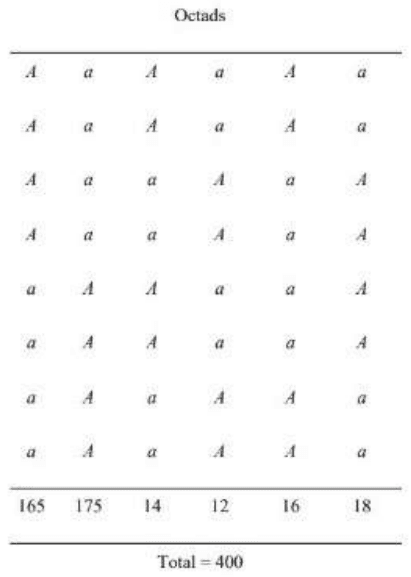
In what percentage of meiocytes did segregation occur at Anaphase II?
- 11.5
- 215.0
- 38.5
- 485.0
Show answer and solution
Second-division (MII) segregation shows as a 2:2:2:2 or 2:4:2 arrangement. Those octads number 14 + 12 + 16 + 18 = 60 of 400, so 15% of meiocytes had segregation at anaphase II (gene–centromere distance 7.5 cM).
Given below are two figures (X and Y) representing molecular markers and their profiles in parental lines (P1 and P2) and F1 progeny.
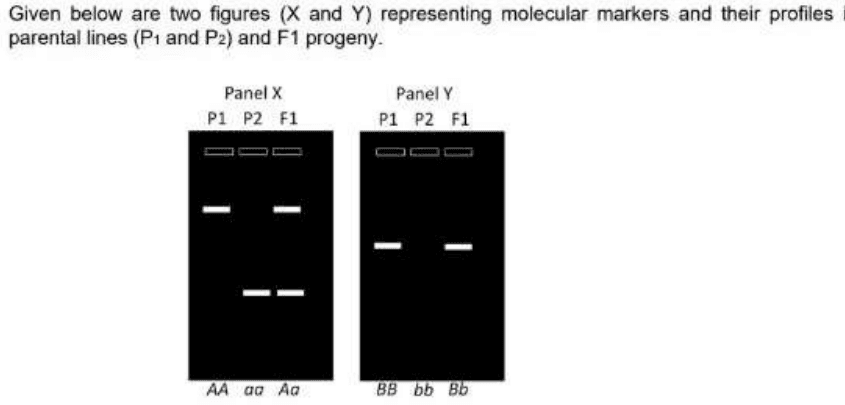
The following statements describe the nature or probable identity of markers in the above figure.
- A. Panel X represents a codominant marker.
- B. Panel X represents a dominant marker while Panel Y represents a codominant marker.
- C. Panel X could be SSR marker while Panel Y could be a RAPD marker.
- D. Panel Y represents a dominant marker.
Which one of the following options represents a combination of all correct statements?
- 1A and C only
- 2B and D only
- 3A, C and D
- 4A and D only
Show answer and solution
In panel X the F1 shows both parental bands: a codominant marker (A), typical of SSRs. In panel Y one parent’s band is simply present or absent: a dominant marker (D), typical of RAPD (C).
The loci for three mutations on X-chromosome, yellow body colour (y), cross-vein less (cv), and forked bristles (f) are shown below in the map:
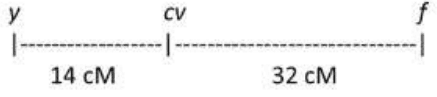
The interference between these genes is zero.
A male fly with yellow body, cross-vein less and forked bristles was crossed with virgin female flies homozygous for the wild type phenotype. The F1 flies were sib-mated and a total of 1000 F2 progeny flies were obtained.
Which one of the following options represents a correct conclusion from the analysis of F2 progeny?
- 1Parental type – 585, Single cross over between y and cv – 95, Single cross over between cv and f – 275, Double cross over – 45
- 2Parental type – 540, Single cross over between y and cv – 140, Single cross over between cv and f – 320, Double cross over – 0
- 3Parental type – 1000, no other class of flies because interference is 0
- 4Parental type – 540, Single cross over between y and cv –275, Single cross over between cv and f – 140, Double cross over – 45
Show answer and solution
With zero interference, double crossovers = 0.14 × 0.32 ≈ 4.5%, about 45 of 1,000. Single crossovers between y and cv = 140 − 45 = 95. Between cv and f = 320 − 45 = 275. Parentals = 1000 − 95 − 275 − 45 = 585.
Christiane Nüsslein-Volhard and Eric Wieschaus carried out an extensive mutation screen to identify all genes involved in segmentation of Drosophila. The graph shows results of analyzing mutations on chromosome 2.
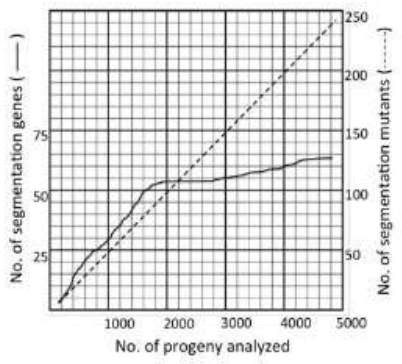
Based on the above figure, which one of the following options is a correct statement?
- 1Analyzing 10,000 progeny would have led to identification of substantially more number of segmentation genes.
- 2Analysis of progeny beyond 2000 led to identification of new alleles of already identified genes rather than more new genes.
- 3More dominant mutations would have been observed in the first 1000 progeny.
- 4The curves would remain the same irrespective of the mutagen used.
Show answer and solution
Most segregation genes were found within the first roughly 2,000 lines, and further screening mostly turned up new alleles of genes already found. The screen was close to saturation.
This is a hypothetical example. The pedigree for a monogenic trait is given below. The shaded individuals show spotted skin color while the rest have uniform skin color. The individuals (1 to 9) in the pedigree were analyzed for a DNA marker (both fragments) that shows complete linkage with the skin color trait.
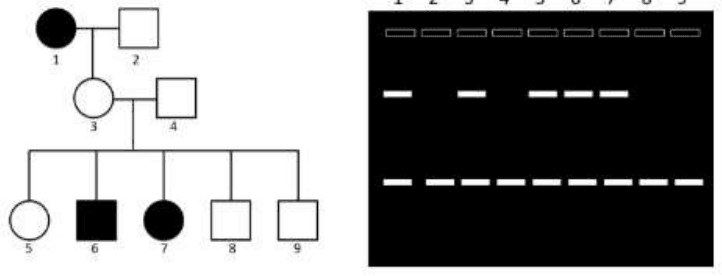
The following statements were made regarding the above observations:
- A. Spotted skin color is a dominant phenotype.
- B. Spotted skin color shows variable expressivity.
- C. The DNA marker associated with the skin color trait is co-dominant.
- D. The probability that the individual 5 will pass on the allele responsible for the spotted skin color to the next generation is 0.25.
Which one the following options represents the combination of all correct statements?
- 1A and B
- 2A and C
- 3B and C
- 4C and D
Show answer and solution
Every spotted individual carries the upper band, and each also has the lower band, so spotting appears in heterozygotes: it is dominant (A). Individuals 3 and 5 carry the upper band but are unaffected, showing incomplete penetrance. Heterozygotes show both bands, so the marker is codominant (C). Individual 5 is heterozygous and would pass the allele on with probability 0.5, not 0.25.
The figure given below is of two homologous chromosomes paired during meiosis where one event of recombination occurred between two homologues:

The following interpretations were made:
- A. The individual is heterozygous for an inversion
- B. The figure depicts a paracentric inversion
- C. After recombination at Anaphase I a dicentric and an acentric chromosomes will be formed
- D. At Anaphase II the recombinant chromatids will have large deletion or duplication
- E. Inversions are often considered as crossover suppressors because crossover product does not survive
Which one of the options given below has all correct answers:
- 1A and B only
- 2B, C and D only
- 3C, D and E only
- 4A, B, C, D and E
Show answer and solution
The loop pairing shows a heterozygous inversion (A) that excludes the centromere, so it is paracentric (B). A crossover inside the loop gives a dicentric bridge and an acentric fragment at anaphase I (C), and the recombinant products carry large deletions and duplications (D). They are inviable, so inversions act as crossover suppressors (E). All five are correct.
The gametophytes of liverworts have the following types of apical cells, which contribute to different thallus forms:
- A. Tetrahedral
- B. Cuneate
- C. Lenticular
- D. Hemidiscoid
Which one of the following options correctly states the number of cutting faces (planes) each apical cell type has?
- 1A – Four, B – Three, C – Three, D – Two
- 2A – Three, B – Four, C – Two, D – Three
- 3A – Four, B – Two, C – Three, D – Three
- 4A – Three, B – Three, C – Two, D – Two
Show answer and solution
NTA’s key: a tetrahedral apical cell cuts on three faces, a cuneate (wedge) cell on four, a lenticular cell on two, and a hemidiscoid cell on three. These give the different forms of the liverwort thallus.
Following table shows cultivated crops (Column X) and the continents where their centers of origin (Column Y) are situated:
| Column X | Column Y |
|---|---|
| A. Coffee | i. South America |
| B. Pineapple | ii. Africa |
| C. Banana | iii. Asia |
| D. Rubber |
Which one of the following options represents the correct match between column X and column Y?
- 1A-ii, B-i, C-iii, D-i
- 2A-ii, B-iii, C-ii, D-i
- 3A-i, B-ii, C-iii, D-iii
- 4A-i, B-iii, C-i, D-ii
Show answer and solution
Coffee comes from Africa (Ethiopia), pineapple from South America, banana from South-east Asia, and the rubber tree (Hevea) from the Amazon in South America.
Angiosperms have witnessed evolutionary changes which includes a few apomorphies. Which one of the following options depicts the correct apomorphy/apomorphies that has/have evolved in Eudicots?
- 1Endospory and retention of megaspore
- 2Tricolpate derived pollen
- 3Heterospory and atactostelic vasculature
- 4Ovules with two integuments
Show answer and solution
Tricolpate pollen, with three furrows or pores, is the defining shared derived trait of the eudicots. Heterospory, endospory and two integuments arose earlier in seed-plant evolution.
The table given below contains some of the classes of phylum Arthropoda in Column X and their characteristic head structures in Column Y.
| Column X | Column Y | ||
|---|---|---|---|
| A. | Arachnida | i. | Head is distinct with a pair of compound eyes, a paired antennae, a paired mandibles and a paired maxillae |
| B. | Crustacea | ii. | Head is distinct having a pair of simple eyes, paired antennae and paired mandibles |
| C. | Myriapoda | iii. | Five segmented head with two pairs of antennae, two pairs of maxillae and one pair of mandibles |
| D. | Insecta | iv. | Cephalothorax with two chelicerae, two pedipalps |
Which one of the following options represents the correct match between Column X and Column Y?
- 1A-i; B-ii; C-iii; D-iv
- 2A-iii; B-iv; C-i; D-ii
- 3A-iv; B-iii; C-ii; D-i
- 4A-ii; B-i; C-iv; D-iii
Show answer and solution
Arachnids have a cephalothorax with chelicerae and pedipalps (A–iv). Crustaceans have a five-segmented head with two pairs of antennae, two pairs of maxillae and mandibles (B–iii). Myriapods have a distinct head with simple eyes, one pair of antennae and mandibles (C–ii). Insects have compound eyes, one pair of antennae, mandibles and maxillae (D–i).
Given below is a table listing selected extant molluscs (Column X) and a range of eye complexities (Column Y) found in them.
| Column X | Column Y |
|---|---|
| A. Limpet | i. Complex camera lens-type eye |
| B. Marine snail | ii. Eyecup |
| C. Nautilus | iii. Eye with primitive lens |
| D. Squid | iv. Patch of pigmented cells |
| v. Simple pinhole eye |
Which one of the following options represents the correct match between Column X and Column Y?
- 1A-iv, B-v, C-ii, D-i
- 2A-iv, B-iii, C-v, D-i
- 3A-ii, B-i, C-v, D-iii
- 4A-v, B-ii, C-i, D-iii
Show answer and solution
Mollusc eyes span the whole range of complexity: a limpet has a patch of pigmented cells (A–iv), a marine snail an eye with a primitive lens (B–iii), Nautilus a lensless pinhole eye (C–v), and a squid a complex camera eye (D–i).
The following table shows common millets (Column X) and their scientific names (Column Y):
| Column X | Column Y |
|---|---|
| A. Ragi (Finger millet) | i. Eleusine coracana |
| B. Jowar (Great millet) | ii. Paspalum scrobiculatum |
| C. Kodo millet | iii. Pennisetum typhoides/ glaucum |
| D. Bajra (Pearl millet) | iv. Sorghum bicolor |
Which one of the following options represents the correct match between Column X and Column Y?
- 1A-i, B-iii, C-iv, D-i
- 2A-i, B-iv, C-ii, D-iii
- 3A-ii, B-i, C-iv, D-iii
- 4A-iii, B-iv, C-i, D-ii
Show answer and solution
Ragi is Eleusine coracana, jowar is Sorghum bicolor, kodo millet is Paspalum scrobiculatum, and bajra is Pennisetum glaucum.
Nutrients are gained or lost by ecosystems in a variety of ways. These nutrients may accumulate in different organic or inorganic pools over time. The different pools of phosphorus are
(i) Mineral inorganic phosphorus
(ii) Labile (available) phosphorus
(iii) Occluded inorganic phosphorus
(iv) Soil organic phosphorus
(v) Plant organic phosphorus
The following graph shows the generalized change in phosphorus dynamics during primary succession:
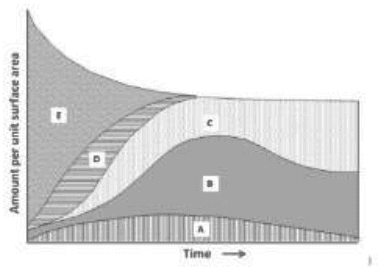
Which one of the following options correctly matches the region (A to E) shown in the graph to the phosphorous pool?
- 1A-ii; B-v; C-iv; D-iii; E-i
- 2A-i; B-ii; C-iii; D-iv; E-v
- 3A-iii; B-ii; C-v; D-i; E-v
- 4A-v; B-iv; C-iii; D-ii; E-i
Show answer and solution
In Walker and Syers’ model of phosphorus during primary succession, primary mineral P (apatite) falls steadily as it weathers, while organic and occluded P accumulate. Labile P peaks early. NTA’s key matches the regions as A–v, B–iv, C–iii, D–ii and E–i.
Which one of the following graphs typically represents the change in C:N ratio over time in decomposing leaf litter in temperate forests?
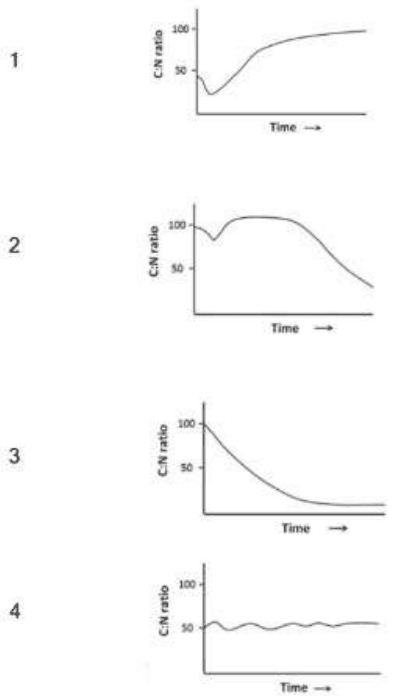
- 1Graph 1
- 2Graph 2
- 3Graph 3
- 4Graph 4
Show answer and solution
As leaf litter decomposes, carbon is respired away while microbes retain and take up nitrogen, so the C:N ratio falls over time towards the microbial C:N. NTA accepted graphs 2 and 3, which both show that decline.
The table below lists terminologies (column X) and concepts (column Y) related to ecological niche.
| Column X | Column Y | ||
|---|---|---|---|
| A | Niche complementarity | i | Species distribution explained by trophic levels and biotic interactions. |
| B | Niche packing | ii | Tendency for coexisting species which occupy a similar position along at least one niche dimension. |
| C | Community niche | iii | Tendency for coexisting species to fill the available space along important niche dimensions. |
| D | Eltonian niche | iv | Composition of niches of all individual species niches that co-occur at the same site. |
Which one of the following options represents the correct match between column X and column Y?
- 1A-i, B-ii, C-iii, D-iv
- 2A-iii, B-i, C-ii, D-iv
- 3A-ii, B-iii, C-iv, D-i
- 4A-ii, B-iv, C-i, D-iii
Show answer and solution
Niche complementarity is coexisting species differing in some dimensions while similar in others (A–ii). Niche packing is species filling the available niche space (B–iii). The community niche is the combined niches of co-occurring species (C–iv). The Eltonian niche is a species’ trophic and biotic role (D–i).
Some of the statements given below are related to species that show r– or k-selection strategies:
- A. Maximum rate of increase of a population
- B. Density of individuals supported by the environment at equilibrium
- C. Life history evolution
- D. Liebig’s law of the minimum
- E. Precociality and altriciality
Choose the option that contains all the correct statements related to r– and k-selection strategies.
- 1A and B only
- 2A, B and C only
- 3C, D, and E only
- 4A, B, C and E only
Show answer and solution
r–K theory uses r, the maximum rate of increase (A), and K, the equilibrium density (B), to explain life-history evolution (C), including traits such as precocial versus altricial young (E). Liebig’s law of the minimum is about limiting nutrients, not r/K selection.
A researcher captured 45 fish from a lake on day 1, tagged and released them back. On day 2 the researcher caught 50 fish out from the same lake, of which 15 were already tagged. Estimate the population size of fish in the lake with this information and pick the correct option.
- 1150
- 2135
- 3166
- 475
Show answer and solution
Lincoln–Petersen: N = (45 × 50)/15 = 150 fish.
Western Ghats of India is considered as one of the global biodiversity hotspots because of some of the following characteristics:
- A. High species richness
- B. High endemism
- C. Habitat loss
- D. Large altitudinal range
Which one of the following options represents the correct combination of characteristics that qualifies the Western Ghats as a biodiversity hotspot?
- 1A, B and C
- 2A, C and D
- 3A and B only
- 4B and D only
Show answer and solution
A hotspot needs high species richness with at least 1,500 endemic plants and at least 70% loss of original habitat. The Western Ghats meet A, B and C. Altitudinal range is not a criterion.
Consider a disease caused by a recessive allele. In a study population, one out of every 500 individuals (0.20%) has the disease.
Based on the Hardy-Weinberg equation, what is the percentage of individuals who are carriers of the recessive allele for the disease?
- 17.6%
- 220.2%
- 31.5%
- 430.5%
Show answer and solution
By Hardy–Weinberg, q2 = 0.002, so q ≈ 0.0447 and 2pq ≈ 8.5%. NTA’s key gives 7.6%, the nearest option.
An ancestral sequence (TTAG) has diverged into two sequences and has since accumulated nucleotide substitutions along two lineages (1 and 2).
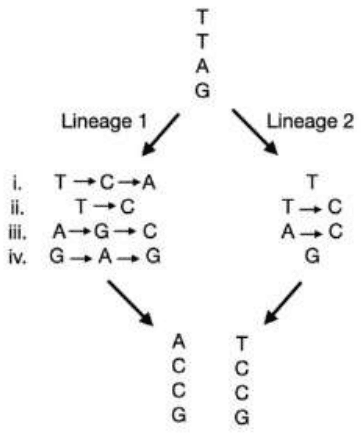
Match the type of substitutions observed in the two sequences with their correct names:
- 1i) convergent substitution, ii) parallel substitution, iii) multiple substitutions, iv) back substitution
- 2i) multiple substitutions, ii) parallel substitution, iii) convergent substitution, iv) back substitution
- 3i) back substitution, ii) convergent substitution iii) parallel substitution, iv) multiple substitutions
- 4i) parallel substitution, ii) back substitution, iii) convergent substitution, iv) multiple substitutions
Show answer and solution
Following each site in the two lineages: one site changes more than once in a single lineage (multiple substitutions, i). One changes to the same state independently in both lineages from the same starting base (parallel, ii). One reaches the same state from different starting bases (convergent, iii). One changes and then reverts to the ancestral base (back substitution, iv).
Competition between two species (A and B) can be represented as vector field graphs. Competition in its classic form can have four qualitative outcomes based on the placement of linear isoclines in four qualitatively distinct patterns as shown in the graphs below. Here, when two isoclines cross each other at the equilibrium point, it is called an attractor. Select the correct graph where both species are expected to coexist for an extended period of time.
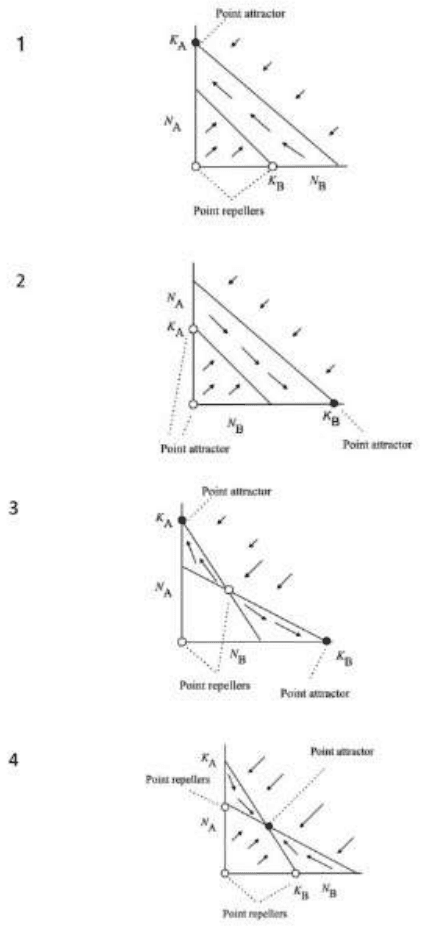
- 1Graph 1
- 2Graph 2
- 3Graph 3
- 4Graph 4
Show answer and solution
Stable coexistence needs the two isoclines to cross so that each species limits itself more than its competitor: the vectors then converge on the crossing point (an attractor). NTA’s key identifies graph 4 as that configuration.
Certain animal species use infrasound for acoustic signaling. In this context, consider the statements below:
- A. Infrasound signals propagate over several kilometers in deserts.
- B. Infrasound signals propagate over several kilometers in open oceans.
- C. Infrasound is employed only by mammals for acoustic signaling.
- D. Infrasound signal transmission is prone to scattering and attenuation.
Which one of the following options represents all correct combination about infrasound signaling?
- 1A and B only
- 2B and D only
- 3A, C and D
- 4A, B and C
Show answer and solution
Low-frequency infrasound loses little energy and is little scattered, so it travels kilometres across open deserts (elephants, for example) and oceans (whales). Birds such as cassowaries also use it, so C is false, and it resists scattering, so D is false.
The following table lists selected concepts (Column X) in behavioral biology and their descriptions (Column Y):
| Column X | Column Y | ||
|---|---|---|---|
| A. | Allee effect | i. | Male–male interactions increase plasma testosterone and thus sustain subsequent aggressive behavior. |
| B. | Bateman’s hypothesis | ii. | Parasites and pathogens play an important role in sexual selection when secondary sexual traits are costly and condition-dependent. |
| C. | Challenge hypothesis | iii. | A situation in which the fitness of individuals increases with increased population density. |
| D. | Hamilton-Zuk hypothesis | iv. | Female reproductive success is most strongly limited by the number and success of eggs that she can produce, while male reproductive success is limited by the number of matings he has. |
Which one of the following options represents the correct match between Column X and Column Y?
- 1A-i, B-iii, C-iv, D-i
- 2A-i, B-iv, C-ii, D-iii
- 3A-ii, B-i, C-iv, D-iii
- 4A-iii, B-iv, C-i, D-ii
Show answer and solution
The Allee effect is fitness rising with density (A–iii). Bateman’s principle is that females are limited by egg production and males by matings (B–iv). The challenge hypothesis is that male–male contests raise testosterone (C–i). Hamilton–Zuk is that parasites keep costly sexual signals honest (D–ii).
The reproductive cycles of two populations (X and Y) of the silk cotton tree (Ceiba pentandra) were monitored for one year. A census was carried out and all plants were tagged and counted throughout this period and is reflected in the data sheet given below:
| Parameter | Population X | Population Y |
|---|---|---|
| Initial number of plants (N0) | 500 | 300 |
| Number of new seedlings established (B) | 100 | 210 |
| Number of initial plants that died (D) | 20 | 27 |
Given that there is no seedling mortality, which one of the options correctly depicts the per capita rate of increase (r) for the two populations?
- 1X: 0.16, Y: 0.61
- 2X: 580, Y: 483
- 3X: 1.16, Y: 1.61
- 4X: 0.208, Y: 0.77
Show answer and solution
Per capita rate of increase = (births − deaths)/N0. X: (100 − 20)/500 = 0.16. Y: (210 − 27)/300 = 0.61.
Given below is a schematic representation of the T-DNA region of a binary vector used for genetic transformation of plants. The figure shows the presence of restriction sites for EcoRV and probes (labelled 1 – 4) for Southern hybridization to analyse copy number of T-DNA in the transgenic plants.
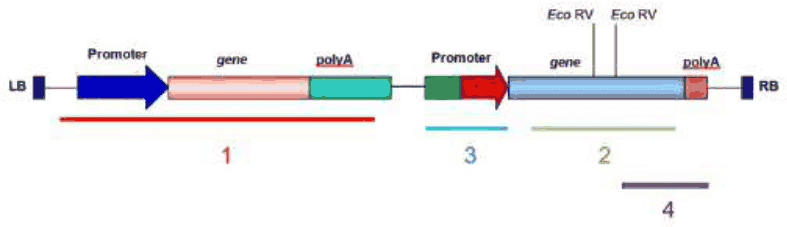
Given below are probes or combination of probes that were used by researchers for Southern blotting following digestion of genomic DNA with EcoRV.
- A. Probe 3 and Probe 4
- B. Probe 1 and Probe 3
- C. Probe 1 only
- D. Probe 2 only
- E. Probe 1 and Probe 4
Which one of the following options represents the correct combinations of probes that would identify single copy integration events from BOTH flanks of T-DNA?
- 1A and C only
- 2B and D only
- 3A, D and E only
- 4B and E only
Show answer and solution
With EcoRV cutting only inside gene 2, each T-DNA flank gives its own border fragment, and the number of bands per flank shows copy number. Using probe 1 (left) together with probe 4 (right) reads both flanks (E). NTA’s key gives B and E.
Following statements are made regarding heterosis breeding in plants.
- A. Heterosis is always lowest in a cross between two genetically diverse parents.
- B. Cytoplasmic Male Sterility (CMS) may be used in heterosis breeding to eliminate emasculation.
- C. The A-line (CMS) and B-line (used for maintenance of CMS) are isogenic lines, differing at only a specific locus.
- D. Heterosis can be retained in the F2 generation.
Which one of the following options represents the combination of all correct statements?
- 1A, B, and C
- 2B, C, and D
- 3B and C only
- 4C and D only
Show answer and solution
CMS lines remove the need for emasculation in hybrid seed production (B). The A (CMS) line and its maintainer B line are isogenic apart from cytoplasmic male sterility (C). Heterosis is greatest between diverse parents (A false) and declines in the F2 (D false).
A knock-in cassette was constructed in order to introduce the β-casein gene in an animal cell. The viable clones were selected using a double-marker system, with G418 (neomycin analog) and ganciclovir. Identify the correctly designed cassette from the options given below. (SoH – sequence of homology; GoI – gene of interest; neor – neomycin resistant; tk – thymidine kinase)
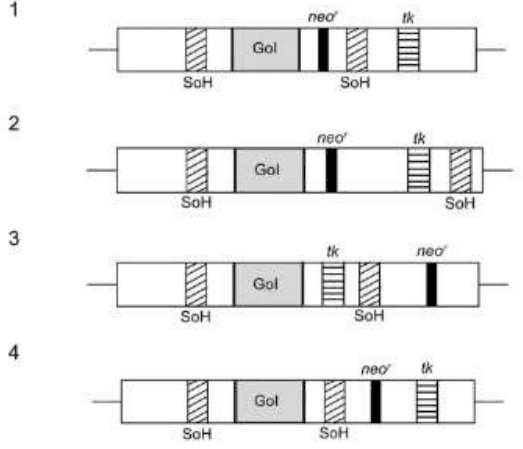
- 1Cassette 1
- 2Cassette 2
- 3Cassette 3
- 4Cassette 4
Show answer and solution
For positive–negative selection, neor goes inside the homology arms, so homologous integration keeps it and G418 resistance results, and tk goes outside, so it is lost on homologous recombination but kept on random insertion. Ganciclovir then kills random integrants. Cassette 1 is laid out this way.
Plotless sampling techniques have been applied by plant ecologists when rapid estimates of the density of plants in a large region are needed. The image below depicts one of the techniques. P is the sampling point, xi and zi are distances measured from points P and I, and points I and Q, respectively. The canopy with the crossbar indicates the location of a tree.
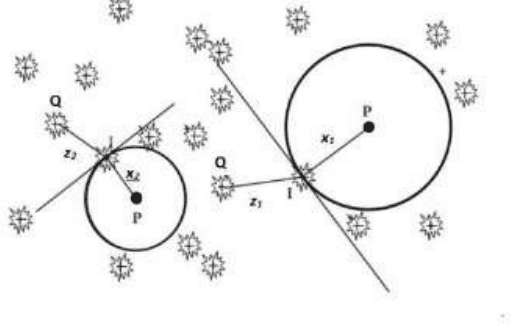
Which one of the following options correctly identifies the technique?
- 1Point-centered quarter method
- 2Wandering-quarter method
- 3T-square method
- 4Basic distance sampling method
Show answer and solution
From a random point P, the observer finds the nearest tree I, then measures from I to its nearest neighbour Q that lies beyond a T-shaped line through I. That is the T-square plotless sampling method.
Certain statements are made below regarding radio-receptor assay technique.
- A. It is a competitive protein binding method.
- B. It is a non-competitive protein binding method.
- C. Radioligand is present in excess of unlabelled ligand.
- D. Unlabelled ligand is present in excess of radioligand.
- E. Activated charcoal incubation and further centrifugation lead to separation of free ligand in the charcoal pellet.
- F. Activated charcoal incubation and further centrifugation lead to separation of bound ligand in the charcoal pellet.
Which one of the following options is the combination of all correct statements?
- 1A, C and E
- 2B, C and D
- 3A, D and E
- 4B, C and F
Show answer and solution
A radioreceptor assay is a competitive binding method (A). Unlabelled ligand, the sample or standard, competes with a fixed tracer amount of radioligand, so the unlabelled ligand is in excess (D). Charcoal adsorbs free small ligand, leaving receptor-bound ligand in the supernatant (E).
Yeast two-hybrid system allows detection of interacting proteins. In the following schematic, various components of yeast two-hybrid system have been indicated by letters A-F.
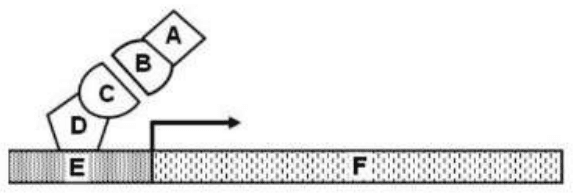
Which one of the following options provides a correct match of A to F and components of yeast two-hybrid system?
- 1A- Prey; B- Gal4 activation domain; C- Gal4 binding domain; D- Bait; E- Reporter gene; F- UAS element
- 2A- Gal4 binding domain; B- Bait; C-Prey; D-Gal4 activation domain; E- Reporter gene; F- UAS element
- 3A- Bait; B- Gal4 binding domain; C-Gal4 activation domain; D-Prey; E- UAS element; F- Reporter gene
- 4A- Gal4 activation domain; B- Prey; C- Bait; D- Gal4 binding domain; E- UAS element; F- Reporter gene
Show answer and solution
In the yeast two-hybrid system, the bait is fused to the Gal4 DNA-binding domain, which binds the UAS, and the prey is fused to the Gal4 activation domain. If bait and prey interact, the reporter gene downstream of the UAS is switched on. NTA’s key gives option 4 for the letters in the diagram.
Given below are two figures (X and Y) representing the segregation of molecular markers in 12 individuals of a mapping population (1 to 12). P1 and P2 represent the parents, and F1 the hybrid.
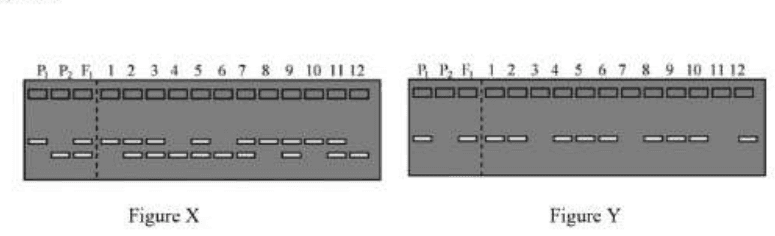
The following statements are made based on the above figures:
- A. Figure X represents profile of a codominant marker in an F2 population.
- B. Figure Y represents profile of a codominant marker in a doubled haploid population.
- C. Figure Y represents profile of a dominant marker in an F2 population
- D. Figure X represents profile of a dominant marker in a doubled haploid population.
Which one of the following options represents a combination of all correct statements?
- 1B and D only
- 2A and B only
- 3C and D only
- 4A and C only
Show answer and solution
Panel X shows parental and heterozygous patterns (three classes) segregating among the progeny: a codominant marker in an F2 (A). Panel Y shows a single band present or absent in about a 3:1 ratio: a dominant marker in an F2 (C).
Given below is a DNA sequence:
5′ – ATGCGATGACGATTGACGATGACGATAGAC – 3′
In the absence of any other affecting parameters such as length, Tm, GC-content, which one of the following combinations of PCR primer sequences would be able to amplify the above fragment?
- 15′– TACGCTAC – 3′ and 5′ – CGATAGAC – 3′
- 25′ – GTCTATCG – 3′ and 5′ – ATGCGATG – 3′
- 35′ – ATGCGATG – 3′ and 5′ – CAGATAGC – 3′
- 45′ – CATCGCAT – 3′ and 5′ – CGATAGAC – 3′
Show answer and solution
The forward primer matches the 5′ end of the top strand, ATGCGATG. The reverse primer is the reverse complement of the 3′ end (CGATAGAC), which is GTCTATCG.
Which one of the following intermediate enzymatic reactions would be most effective in facilitating ligation of a blunt-ended insert fragment with a vector digested with EcoRI restriction enzyme (G | AATTC)?
- 1Treatment of vector with Mung Bean Nuclease followed by treatment with Shrimp Alkaline Phosphatase
- 2Treatment of insert with Klenow DNA Polymerase and vector with Polynucleotide Kinase
- 3Treatment of vector with Polynucleotide Kinase and insert with Mung Bean Nuclease
- 4Treatment of insert with Klenow DNA polymerase followed by treatment with Shrimp Alkaline Phosphatase
Show answer and solution
To clone a blunt insert into an EcoRI-cut vector, first make the vector blunt with mung bean nuclease, which removes the single-stranded AATT overhangs. Then dephosphorylate it with shrimp alkaline phosphatase so it cannot re-ligate to itself.
Changes in NTA’s final answer key
Two options accepted: Q8, Q22, Q126. Every other question has the single answer shown.
How to revise from this paper
- Attempt it in one 3-hour sittingAnswer 15 in Part A, 35 in Part B and 25 in Part C, as in the real exam, before you check any answers.
- Score it with negative markingAdd 2 or 4 marks for each correct answer and subtract 0.5 or 1 for each wrong one. That is the number to track.
- Sort your mistakes by unitUse the unit tag on each question. Two or three wrong answers in the same unit tell you where to revise first.
- Repeat with a fresh paperTake a full-length mock a week later and compare your unit-wise mistakes.
Keep going