

All 145 questions from the CSIR-NET Life Sciences June 2023 paper (Shift 2), typed out in full, with NTA’s final answer key, a worked solution for every question and every diagram.
The Joint CSIR-UGC NET December 2022–June 2023 cycle held its Life Sciences exam on 6 June 2023 in two shifts. This page covers the afternoon shift (Shift 2, 3 pm to 6 pm). Below you will find every question from Part A (General Aptitude), Part B and Part C, in the order they appeared, each tagged with its syllabus unit. Tap Show answer and solution under any question to check the official answer and see how to reach it.
Marking scheme
| Part | Questions | Answer | Marks each | Wrong answer | Max marks |
|---|---|---|---|---|---|
| A: General Aptitude | Q1–20 | 15 | 2 | −0.5 | 30 |
| B: Life Sciences | Q21–70 | 35 | 2 | −0.5 | 70 |
| C: Life Sciences | Q71–145 | 25 | 4 | −1 | 100 |
| Total | 145 | 75 | 200 |
Which units this paper tested
We tagged each of the 125 Part B and Part C questions with its CSIR-NET syllabus unit. In this paper, System Physiology – Plant, Fundamental Processes and Evolution and Behavior carried the most questions.
Practise any unit across all 11 papers, with every question linked to a worked solution:
Jump to a question
Part A: General Aptitude (Q1–20)
20 questions; answer any 15. Each carries 2 marks, and a wrong answer costs 0.5.
A certain number of apples, when attempted to be distributed to three groups in the ratio 3:4:5, fall short by one. If distributed in the ratio 4:5:6 two apples would be left undistributed. Which one of the following is a possible number of apples?
- 135
- 247
- 359
- 462
Show answer and solution
In ratio 3:4:5 the total must be a multiple of 12, and the apples fall one short: n + 1 = 12k. In ratio 4:5:6 the total must be a multiple of 15, with two left over: n − 2 = 15m. 47 works, since 48 = 12 × 4 and 45 = 15 × 3: 47.
In a queue, A stands 14th from the front and B 17th from the last. C is exactly at the middle of the queue with 16 persons between him and A. How many persons are between B and C?
- 111
- 212
- 313
- 414
Show answer and solution
C is 16 + 1 = 17 places behind A, so C is 31st, and as the middle person the queue has 61 people. B is 17th from the end, so 45th from the front. Between B and C: 45 − 31 − 1 = 13.
Capital investments of two partners, A and B, are different. A gets 20% of the profit as bonus, and the rest of the profit is distributed in the proportion of their investment. If the entire profit were divided in proportion to their capital investment, B would have got Rs. 25,000 more than he gets now. What amount does B get now?
- 12.00 lakh
- 21.50 lakh
- 31.25 lakh
- 41.00 lakh
Show answer and solution
Let B’s share of the capital be f and the profit P. Now B gets 0.8Pf; otherwise he would get Pf. The difference is 0.2Pf = 25,000, so Pf = 1,25,000 and B now gets 0.8 × 1,25,000 = Rs 1.00 lakh.
Given that a ≠ b and a, b > 0, and (an+2 + bn+2)/(an + bn) = ab then n =
- 11
- 21/2
- 3−1/2
- 4−1
Show answer and solution
Cross-multiplying gives an+2 + bn+2 − ab(an + bn) = (a − b)(an+1 − bn+1) = 0. Since a ≠ b, an+1 = bn+1, so n + 1 = 0 and n = −1.
To complete a task, A takes 15 days whereas B takes 21 days. If they work alone on alternate days by turn, B starting on the first day, the number of days required to complete the task is
- 18 3/35
- 216 3/35
- 318 2/5
- 417 4/7
Show answer and solution
Each two-day pair does 1/21 + 1/15 = 4/35. After 16 days (8 pairs) 32/35 is done, leaving 3/35 = 9/105. On day 17 B does 5/105, leaving 4/105. A needs (4/105)/(1/15) = 4/7 of day 18. Total 17 4/7 days.
Two fair cubical dice are thrown. What is the probability that at least one of them shows 4?
- 11/36
- 211/36
- 31/6
- 41/18
Show answer and solution
P(no 4) = (5/6)2 = 25/36, so P(at least one 4) = 11/36.
Straight lines drawn inside a rectangle can create multiple rectangles of different sizes. The lines can intersect each other. The minimum number of straight lines needed so as to result in a total of 9 rectangles is
- 15
- 22
- 33
- 44
Show answer and solution
One horizontal and one vertical line give 4 small rectangles, 4 made of two small ones, and the whole: 9 rectangles from 2 lines.
In the given diagram, lines AB and CD are parallel. What is the angle θ?
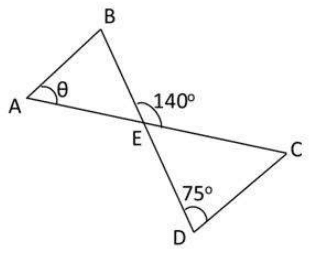
- 145°
- 260°
- 365°
- 470°
Show answer and solution
Angle AEB = 180° − 140° = 40°. AB ∥ CD, so ∠ABE = ∠EDC = 75° (alternate angles). In triangle ABE: θ = 180° − 75° − 40° = 65°.
A metro train runs at a speed of 45 km/h. It covers a total distance of 72 km on its route from origin to destination station in 2 hours that includes stops at intermediate stations. If it stops for 2 minutes at each station, how many intermediate stations are there in the route?
- 124
- 218
- 312
- 49
Show answer and solution
Running time = 72/45 h = 96 min, so 120 − 96 = 24 min was spent at stops. 24/2 = 12 stations.
ABCD is a square with sides of 1 unit. AC and BD are arcs of circles with their centers at B and A, respectively. The area of the shaded sector AED is
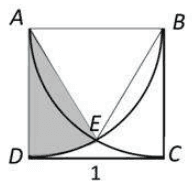
- 1π/12
- 2π/6
- 3π/4
- 4√3/4
Show answer and solution
E lies on both arcs, so AE = BE = AB = 1 and triangle ABE is equilateral. That makes ∠DAE = 90° − 60° = 30°. Sector AED (radius 1, 30°) = π/12.
Four identical incompressible spheres of radius 1 unit are stacked in a pyramidal form as shown in the figure. All the spheres touch each other. The height of the structure is

- 12 + 2√(2/3)
- 22 + √2
- 32 + √3
- 43
Show answer and solution
The four centres form a regular tetrahedron of edge 2, with height 2√(2/3). Add one radius at the top and one at the bottom: 2 + 2√(2/3).
At a polling booth polling starts at 6 AM. Which of the given graphs CANNOT depict cumulative voting percentage (of the total voters enrolled) against time?
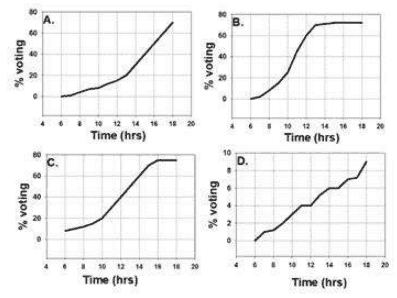
- 1A
- 2B
- 3C
- 4D
Show answer and solution
Cumulative turnout must start at 0% when polling opens at 6 AM and can never fall. Graph C already shows about 8% at 6 AM, so it cannot be right. D is only a low turnout.
Choose the option that will make the following statement correct:
IF WE COUNT THE NUMBER OF APPEARANCES OF THE LETTER “N” IN THIS SENTENCE, THE RESULT WILL BE ________.
- 1SIX
- 2SEVEN
- 3NINE
- 4TEN
Show answer and solution
Without the blank, the sentence has 7 Ns: COUNT, NUMBER, APPEARANCES, “N”, IN and SENTENCE (2). NINE adds 2 Ns, making 9, which is true. SIX would give 7, and SEVEN or TEN would give 8.
If the sum of the two-digit numbers formed from the digits a and b is a perfect square, the sum of the digits is
- 17
- 29
- 310
- 411
Show answer and solution
(10a + b) + (10b + a) = 11(a + b). For this to be a perfect square, a + b = 11 (since a + b ≤ 18), giving 121.
A total of 20 toys of a child are to be put in a box. Every 30 seconds 2 toys are put inside but 1 is thrown out by the child. How much time (in minutes) will it take to put all toys in the box for the first time?
- 110
- 29.5
- 35
- 410.5
Show answer and solution
The box gains a net 1 toy per 30 s cycle. After 18 cycles (9 min) it holds 18; in the next cycle 2 more go in, reaching 20 before the child throws one out. So 9.5 minutes.
120 students wrote an exam with 4 questions. 100 solved the first question, 95 the second, 90 the third, and 80 the fourth. What is the smallest possible number of students that solved all four questions?
- 180
- 25
- 320
- 415
Show answer and solution
The failures are 20, 25, 30 and 40, a total of 115. At most 115 students can have missed a question, so at least 120 − 115 = 5 solved all four.
Rivers A and B with constant water speeds a and b merge at point P to form river C with a constant water speed c.
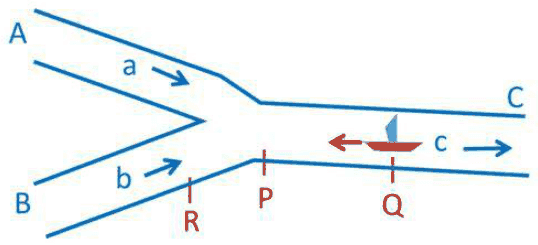
A boat having speed s in still water would reach point R from Q only if s is more than.
- 1minimum of a, b and c
- 2maximum of b and c
- 3mean of a and b
- 4mean of b and c.
Show answer and solution
From Q the boat goes upstream in C to P, then up river B to R. It must beat both currents, so s > max(b, c).
For any three distinct prime numbers, all greater than 13, which of the following is NOT true?
- 1Mean of the three numbers may be 19
- 2Median of the three numbers may be 19
- 3Standard deviation of the three numbers may be greater than 1
- 4Standard deviation of the three numbers is always greater than 0.5
Show answer and solution
The smallest three distinct primes above 13 are 17, 19 and 23, summing to 59. A mean of 19 needs a sum of 57, which is impossible, so statement 1 is not true.
A palindrome is a word that reads the same backwards and forwards. For example, the word LEVEL is a palindrome. If we are allowed to construct words that need not have a meaning, then in how many different ways can we construct a five-letter palindrome using English alphabets?
- 126 × 25 × 24
- 226 × 26
- 326 × 26 × 26
- 426 × 26 × 26 × 26 × 26
Show answer and solution
A five-letter palindrome is fixed by its first three letters (the 4th and 5th mirror the 2nd and 1st): 26 × 26 × 26.
Consider a dataset A with 55 observations, all distinct. Dataset D is created from A by adding 2023 to the largest observation in A and subtracting 2023 from the smallest observation in A. Which of the following is NOT true?
- 1Mean of D = Mean of A.
- 2Sum of D = Sum of A.
- 3Median of D = Median of A.
- 4Standard deviation of D = Standard deviation of A.
Show answer and solution
+2023 and −2023 cancel, so the sum and mean are unchanged. The median (28th value) is untouched. But the extremes move further from the mean, so the SD increases.
Part B: Life Sciences (Q21–70)
50 questions; answer any 35. Each carries 2 marks, and a wrong answer costs 0.5.
Which one of the following statements is TRUE?
- 1A, B, and Z DNA helices are left-handed.
- 2A, and B DNA helices are right-handed, Z DNA helix is left-handed.
- 3A, and Z DNA helices are left-handed, B DNA helix is right-handed.
- 4A, and B DNA helices are left-handed, Z DNA helix is right-handed.
Show answer and solution
A-DNA and B-DNA are right-handed. Z-DNA (alternating purine–pyrimidine, zig-zag backbone) is left-handed.
In a hydrogen bond of the type D-H…A, where D-H is a weakly acidic donor group and A is a lone-pair-bearing acceptor atom, the D…A distance is
- 1one-and-a-half times the sum of the van Der Waals radii.
- 2equal to the sum of the van Der Waals radii.
- 3less than the sum of the van Der Waals radii.
- 4twice the sum of the van Der Waals radii.
Show answer and solution
The hydrogen bond pulls D and A closer than the sum of their van der Waals radii; N…O, for example, is about 2.9 Å against about 3.07 Å.
Several proteins are modified by phosphorylation at specific amino acid residues to alter their activities. Which one of the following amino acids is NOT typically a site of phosphorylation in proteins?
- 1Lysine
- 2Serine
- 3Threonine
- 4Tyrosine
Show answer and solution
Kinases in eukaryotic signalling phosphorylate the hydroxyl groups of Ser, Thr and Tyr. Lysine is acetylated, methylated or ubiquitylated instead.
One gram of a polysaccharide composed of 1000 glucose units has the same effect on osmolarity as that of
- 11 mg glucose
- 2100 mg glucose
- 3500 mg glucose
- 41000 mg glucose
Show answer and solution
Osmolarity depends on the number of particles. One polysaccharide molecule weighs about as much as 1000 glucose molecules, so 1 g of it gives about as many particles as 1 mg of glucose.
In a lac operon, a nonsense mutation in the gene encoding beta-galactosidase was found to interfere with the expression of downstream permease and transacetylase genes. Which one of the following may explain this observation most appropriately?
- 1polar effect of the mutation
- 2trans-effect of the mutation
- 3Binding of the release factor to the nonsense codon prevents translation of the downstream cistrons
- 4Formation of a stem-loop structure in the upstream cistron prevents translation of downstream cistrons.
Show answer and solution
A nonsense codon in lacZ leaves the downstream mRNA bare of ribosomes. Rho can then bind and end transcription early, so lacY and lacA fall. This is a polar effect.
In cell membranes, the lipid molecules are arranged as a continuous double layer, with an approximate thickness of
- 120 nm
- 250 nm
- 35 nm
- 41 nm
Show answer and solution
The hydrophobic core plus head groups of a lipid bilayer is about 5 nm thick.
A bacterial culture initiated from a single bacterial cell with a DNA repair- deficient system is inoculated into several individual test tubes and allowed to grow in parallel. Wild type cells are also inoculated in a similar manner and grown simultaneously. After several generations, individual cultures are tested for resistance to antibiotics. Which one of the following statements describes the most likely outcome?
- 1More antibiotic resistant cells will emerge from the DNA repair-deficient cultures and all wild type cells will be sensitive.
- 2Wild type cells will produce more antibiotic resistant populations than the DNA repair-deficient cells.
- 3The DNA repair-deficient cells may produce more antibiotic resistant cells but wild type cells will also produce some antibiotic resistant population.
- 4The DNA repair-deficient cells would be dead and therefore will not produce any resistant population of cells.
Show answer and solution
Resistance arises by spontaneous mutation in every culture (as in the Luria–Delbrück experiment). Repair-deficient (mutator) cells mutate more often and give more resistant cells, but wild-type cultures also give some.
Which one of the following conditions associated with chromosome 15 may cause Prader-Willi syndrome?
- 1Paternal uniparental disomy
- 2Maternal uniparental disomy
- 3Imprinting of 15q11-q13 locus in maternal copy
- 4Imprinting of 15q23-q25 locus in paternal copy
Show answer and solution
Prader–Willi syndrome comes from losing the paternal 15q11–q13 genes, through paternal deletion or maternal uniparental disomy, since the maternal copies are imprinted (silent).
In eukaryotic genes, DNA sequences that define gene promoters occur:
- 1only in the regions upstream of the transcription start sites.
- 2only in the regions that represent the transcribed parts of the genes.
- 3only in the regions downstream of the transcription termination sites.
- 4either in the regions upstream of the transcription start site or within the transcribed regions of the gene.
Show answer and solution
Pol II core promoters lie upstream (TATA) or around the start site and downstream (DPE). Pol III genes such as tRNA and 5S rRNA have internal promoters within the transcribed region. So promoters can lie upstream or within the transcribed region.
Introns in the eukaryotic genes are found in:
- 1rRNA and mRNA encoding genes but not in the tRNA encoding genes.
- 2mRNA and tRNA encoding genes but not in the rRNA encoding genes.
- 3mRNA encoding genes but not in the tRNA and rRNA encoding genes.
- 4rRNA, tRNA and mRNA encoding genes.
Show answer and solution
Introns are found in protein-coding genes, in some tRNA genes (spliced at the anticodon loop) and in some rRNA genes (such as the Tetrahymena group I intron). So all three.
The ColE1 plasmid has a low to medium copy number. However, pUC18, which is also a ColE1-based plasmid, has a high copy number because:
- 1It has a mutation in RNAI (antisense RNA) and does not carry the rop gene.
- 2It has a mutation in RNAII (primer for replication initiation) and does not carry the rop gene.
- 3It has a mutation in RNAI and the rop gene is overexpressed.
- 4It has a mutation in RNAII and the rop gene is overexpressed.
Show answer and solution
pUC carries a point mutation in RNAII that weakens its pairing with RNAI at 37–42°C, and it has lost rop. Both remove copy-number control, giving hundreds of copies.
Which one of the following statements about TATA Binding Protein (TBP) is NOT true?
- 1It is a component of transcription factor TFIID.
- 2TBP recognizes the TATA element by inserting one of its α-helices into the major groove of DNA.
- 3The TBP-DNA interaction causes the DNA to bend.
- 4The TBP-DNA interaction is governed in part by the intercalation of the side chains of phenylalanine residues of TBP between the base pairs at the two ends of the TATA element sequence.
Show answer and solution
TBP grips the TATA box through the minor groove using its β-sheet “saddle”, with Phe side chains wedged in to kink the DNA by about 80°. It does not insert an α-helix into the major groove, so statement 2 is not true.
In response to a Wnt signal, β-catenin enters the nucleus and binds to the LEF1/TCF proteins by displacing which one of the following proteins?
- 1CBP
- 2GSK3
- 3Groucho
- 4NEMO
Show answer and solution
Without Wnt, TCF/LEF is bound by the co-repressor Groucho. Nuclear β-catenin displaces it and brings in co-activators such as CBP.
Which one of the following statements regarding ligand identity and effector dynamics is typically correct?
- 1Specificity of receptors do not determine effector dynamics.
- 2Ligands and receptors do not cluster at the cell interface to select the effector.
- 3Ligand concentration can be represented by the amplitude and duration of adaptive pulses of effector activity.
- 4Effector dynamics does not depend on how many different types of ligands influence a single pathway.
Show answer and solution
In signalling dynamics, the level of ligand is encoded in the amplitude and duration of adaptive pulses of effector activity. The other three statements contradict what is known about receptor specificity, clustering and multi-ligand pathways.
Which one of the following mechanisms permits immunoglobulin to be synthesized in either a membrane-bound or secreted form?
- 1Allelic exclusion
- 2Class switch recombination
- 3Differential RNA processing
- 4Codominant expression
Show answer and solution
The membrane and secreted forms of IgM and IgD come from one transcript, through a different choice of polyadenylation site and splicing that includes or excludes the transmembrane exons.
Which one of the following leads to the induction of defensin PDF1.2 in Arabidopsis?
- 1Wounding
- 2Salicylic Acid (SA)
- 3Dichloroisonicotinic acid (INA)
- 4Ethylene
Show answer and solution
PDF1.2 is the marker gene of the JA/ethylene defence pathway. SA and its analogue INA induce PR-1 instead. NTA’s key gives ethylene.
In the avian embryo, the blastocoel-like fluid-filled cavity is formed between:
- 1epiblast and hypoblast
- 2hypoblast and yolk
- 3primary hypoblast and secondary hypoblast
- 4Koller’s sickle and Posterior Marginal Zone
Show answer and solution
In the chick, the subgerminal (blastocoel-like) cavity lies between the upper epiblast and the lower hypoblast.
Which one of the following statements regarding regeneration in Hydra is correct?
- 1It follows only stem cell-mediated regeneration.
- 2It follows only stem cell-mediated regeneration and morphallaxis.
- 3It follows stem cell-mediated regeneration, morphallaxis and epimorphosis.
- 4It follows only morphallaxis.
Show answer and solution
Hydra regenerates by morphallaxis (remodelling existing tissue), by stem cells (interstitial cells) and, in some cases, by epimorphosis-like proliferation. NTA counts all three.
Which one of the following does NOT characterize aging?
- 1An insulin/IGF-1 signalling system plays an important role in controlling lifespan.
- 2Lifespan increases due to resistance to oxidative stress.
- 3Shortening of telomeres.
- 4Female mice with a mutation in the IGF-1 and IGF-2 show reduced lifespan.
Show answer and solution
Lower IGF signalling usually lengthens life: female mice heterozygous for the IGF-1 receptor live longer (Holzenberger, 2003). So statement 4 does not characterise ageing.
The flowering repressor gene that is responsible for the vernalization requirement in Arabidopsis is:
- 1CONSTANS (CO)
- 2FLOWERING LOCUS D (FD)
- 3FLOWERING LOCUS T (FT)
- 4FLOWERING LOCUS C (FLC)
Show answer and solution
FLC is a MADS-box repressor of FT and SOC1. Cold (vernalisation) silences it epigenetically, which is why winter annuals need cold to flower.
Which one of the following statements about phytohormone ABA is correct?
- 1High level of ABA predominantly promotes vivipary.
- 2ABA-β-D-glucosyl ester is an active form of ABA.
- 3Inactivation of ABA involves its oxidation to phaseic acid.
- 4ABA biosynthesis occurs entirely in the plastids.
Show answer and solution
ABA is inactivated by 8′-hydroxylation to phaseic acid or by conjugation to ABA-glucosyl ester, a storage form that is inactive. High ABA prevents vivipary, and its synthesis starts in plastids but finishes in the cytosol.
Which one of the following statements is NOT a characteristic feature of aquaporins?
- 1They are integral membrane proteins in the major intrinsic protein (MIP) family.
- 2They are absent in bacteria.
- 3A highly conserved Asn-Pro-Ala (NPA) triad of residues is present in the N-terminal half of the protein.
- 4A highly conserved Asn-Pro-Ala (NPA) triad of residues is present in the C-terminal half of the protein.
Show answer and solution
Aquaporins are found in all kingdoms, including bacteria (such as E. coli AqpZ and GlpF). So statement 2 is not a feature. Each half of the protein carries an NPA motif.
Which one of the following class of plant secondary metabolites is present specifically in the order Brassicales?
- 1Glucosinolates
- 2Alkaloids
- 3Phenolics
- 4Terpenoids
Show answer and solution
Glucosinolates, the mustard-oil glycosides, are almost unique to the Brassicales (crucifers, capers and papaya).
Which one of the following statements related to photosynthesis is NOT correct?
- 1Light reaction takes place in the thylakoid membranes.
- 2ATP and NADPH are produced in thylakoid membranes.
- 3Lumen is the enclosed interconnected region of the thylakoid membranes.
- 4NAPDH is produced during carbon reactions by the enzymes present in stroma.
Show answer and solution
NADPH is made by light reactions on the stromal face of the thylakoid (ferredoxin–NADP+ reductase), not by the carbon reactions, so statement 4 is wrong. Statement 2 is loosely worded, since ATP and NADPH are released into the stroma, and NTA accepted both 2 and 4.
Which one of the following is NOT a characteristic feature of platelets present in human blood:
- 1They are 2-4 µm in diameter.
- 2They lack nuclei.
- 3Their half-life is 20-24 days.
- 4They are derived from bone marrow megakaryocytes.
Show answer and solution
Platelets are 2–4 µm, anucleate fragments of megakaryocytes. They survive only about 8–10 days, not 20–24.
Which one of the following is NOT a vasoconstrictor?
- 1Prostacyclin
- 2Thromboxane A2
- 3Angiotensin-II
- 4Endothelin-1
Show answer and solution
Prostacyclin (PGI2), from the endothelium, dilates vessels and blocks platelet aggregation. Thromboxane A2, angiotensin II and endothelin-1 constrict vessels.
Which one of the following synaptic vesicles (as observed under transmission electron microscope) contains catecholamines?
- 1Small, round shaped and clear
- 2Small, round shaped and dense core
- 3Large dense core
- 4Small, flattened and clear
Show answer and solution
Catecholamines are stored in small dense-core vesicles. Small clear vesicles hold ACh, glutamate or GABA, and large dense-core vesicles hold neuropeptides.
Which one of the following descriptions does NOT apply to circadian rhythmicity?
- 1A process that can be found in bacteria, plants, fungi, and animals
- 2A process that is rhythmic only in the presence of 24 hour light and dark cycle
- 3A process that can be synchronized by environmental cycles
- 4A process that can be disrupted by prolonged exposure to constant darkness
Show answer and solution
A circadian rhythm free-runs with a period of about 24 h in constant conditions, so it is not rhythmic “only” under light–dark cycles. Statement 2 does not apply.
A plant heterozygous for a dominant trait was selfed. The progeny had 140 plants showing the dominant trait and 20 plants showing the recessive trait. A researcher hypothesised that there are two genes with identical functions that control the dominant trait. The researcher also proposed that the two genes are not linked. The researcher carried out a chi-square test to test the hypothesis. Which one of the following options is the correct chi-square value (rounded to second decimal) obtained by the researcher?
- 122.86
- 213.33
- 310.67
- 45.71
Show answer and solution
Duplicate genes predict 15:1, so of 160 plants 150 should be dominant and 10 recessive. χ2 = (140 − 150)2/150 + (20 − 10)2/10 = 0.67 + 10 = 10.67.
Reduction in the frequency of heterozygous genotype with a concomitant increase in the frequency of homozygous genotype, in context of random mating is due to
- 1Genetic drift
- 2Intense inbreeding
- 3Reverse mutation
- 4Founder effect
Show answer and solution
NTA dropped this question. Loss of heterozygotes with a gain in homozygotes is the signature of inbreeding, which is non-random mating, so the phrase “random mating” made the question flawed.
A cruciform structure of chromosomes during meiosis is a characteristic feature of:
- 1Translocation
- 2Inversion
- 3Deletion
- 4Duplication
Show answer and solution
In a reciprocal translocation heterozygote, the four chromosomes pair as a cross-shaped quadrivalent at pachytene. Inversions form loops instead.
A colour blind father has a daughter who is also colour blind and has Turner’s syndrome. The genotype of the daughter is due to:
- 1Translocation event in the father.
- 2Translocation event in the mother.
- 3Non-disjunction event in the mother.
- 4Non-disjunction event in the father.
Show answer and solution
The Turner daughter (45,Xc) is colour-blind, so her only X is the father’s Xc. She received no X from her mother, through maternal nondisjunction.
Select the correct former name for The International Code of Nomenclature (ICN) which was changed as part of the Melbourne code.
- 1International Code of Zoological Nomenclature (ICZN)
- 2International Code of Nomenclature for Algae, Fungi, and Plants (ICNafp)
- 3International Code of Botanical Nomenclature (ICBN)
- 4International Code of Nomenclature for Cultivated Plants (INCP)
Show answer and solution
At Melbourne (2011), the International Code of Botanical Nomenclature (ICBN) was renamed the International Code of Nomenclature for algae, fungi and plants (ICN).
Select the group of plants that are known to have an increase in the amount of vascular tissues by means of secondary growth from a vascular cambium.
- 1gymnosperms only
- 2dicotyledons only
- 3dicotyledons and monocotyledons
- 4dicotyledons and gymnosperms
Show answer and solution
A vascular cambium producing secondary xylem and phloem is found in gymnosperms and dicots. Monocots lack it; the “secondary growth” of palms and Dracaena is anomalous.
Which one of the following honeybee species is native to the Indian subcontinent?
- 1Apis mellifera
- 2Apis dorsata
- 3Apis koschevnikovi
- 4Apis nigrocincta
Show answer and solution
Apis dorsata, the giant rock bee, is native to South and South-East Asia. A. mellifera was introduced, and the other two are Sundaland or Sulawesi species.
Which one of the options given below is NOT desirable when setting up nature reserves in the tropics?
- 1Reserves that are linked to each other by corridors
- 2Reserves that are surrounded by a buffer zone of same ecosystem
- 3High edge-to-area ratio of the reserve
- 4Circular shaped reserve
Show answer and solution
A high edge-to-area ratio increases edge effects (light, wind, invasives and hunters). Reserves should be compact, as close to circular as possible, connected and buffered.
Which one of the following curves correctly depicts the relationship of the NPP/GPP ratio with latitude?
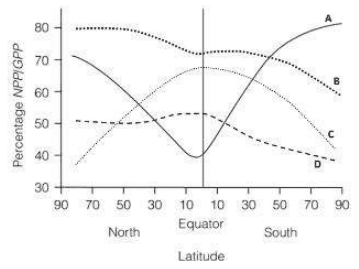
- 1A
- 2B
- 3C
- 4D
Show answer and solution
Plant respiration rises with temperature, so the NPP/GPP ratio is lowest in the tropics and rises toward the poles. That is the U-shaped curve A.
Which one of the following options lists mechanisms that drive ecological succession?
- 1Only facilitation and tolerance
- 2Disturbance and tolerance
- 3Only tolerance and inhibition
- 4Facilitation, tolerance and inhibition
Show answer and solution
Connell and Slatyer (1977) proposed three succession models: facilitation, tolerance and inhibition.
A tree species has leaves that contain an allelochemical compound that leaches into the soil and prevents the growth of its own seedlings. What kind of dispersion pattern is likely as a result of this process in the adult population of this species?
- 1Random
- 2Clumped
- 3Uniform
- 4Bimodal
Show answer and solution
Self-inhibiting allelochemicals stop seedlings growing near adults, so adults end up evenly spaced: a uniform pattern.
Based on the reported estimates of biodiversity in India, select the correct option that represents the decreasing order of total number of species reported in these taxa.
- 1Angiosperms > Insects > Algae > Birds > Fishes > Mammals
- 2Insects > Angiosperms > Algae > Fishes > Birds > Mammals
- 3Algae > Insects > Angiosperms > Birds > Fishes > Mammals
- 4Insects > Algae > Angiosperms > Birds > Mammals > Fishes
Show answer and solution
Indian species counts: insects about 63,000+, angiosperms about 18,000+, algae about 7,000+, fishes about 3,000+, birds about 1,300 and mammals about 430. So insects > angiosperms > algae > fishes > birds > mammals.
In a cooperatively breeding species, under which condition is a helper more likely to exhibit philopatry?
- 1If adult survivorship is higher for group members than for solitary individuals
- 2When resources are abundant and widely distributed
- 3When the chance of acquiring territory is higher
- 4If the possibility of acquiring mates is higher outside the group
Show answer and solution
Helpers stay home (philopatry) when leaving is costly. If members of the group survive better than solitary birds, staying and helping pays. Abundant resources, available territories or mates outside the group would all favour leaving.
Which one of the following options best represents the sequence of events leading to the phenomenon of introgression?
- 1only back crossing and hybridization
- 2hybridization, back crossing and stabilization
- 3stabilization, repeated hybridization
- 4hybridization, stabilization, back crossing, mutation
Show answer and solution
Introgression is the movement of genes from one species into another through hybridisation, then repeated backcrossing to one parent, then stabilisation of the introgressed genes by selection.
Which one of the following methods is NOT useful for sampling pteridophytes to study their distribution patterns?
- 1Ad libitum sampling
- 2Quadrat sampling
- 3Belt transect sampling
- 4Random sampling
Show answer and solution
Ad libitum sampling records whatever happens to be noticed, so it is unsystematic and biased. It is used in behaviour studies, not for estimating plant distribution. Quadrats, belt transects and random plots are all standard.
Which one of the following fossils is no longer considered to be a true vascular plant based on the structure of the secondary thickening of the conducting elements?
- 1Asteroxylon mackiei
- 2Lepidodendron licopodites
- 3Rhynia major
- 4Sphenophyllum plurifoliatum
Show answer and solution
The conducting cells of Rhynia major lack the lignified secondary thickenings of true tracheids. It is now called Aglaophyton major and is treated as a non-vascular, protracheophyte plant.
Which one of the following statements is correct?
- 1None of the virulence genes of Agrobacterium tumefaciens are expressed constitutively.
- 2Integration of T-DNA with the nuclear genome of plant cells occurs only by homologous recombination.
- 3Host plant genes do not play any role in Agrobacterium-mediated transfer of T-DNA into plant cells.
- 4Opines are a source of nitrogen for Agrobacterium cells.
Show answer and solution
Agrobacterium catabolises the opines made by the tumour as carbon and nitrogen sources. virA and virG are expressed constitutively, T-DNA integrates by illegitimate (non-homologous) recombination, and host proteins such as VIP1 help transfer. So statements 1–3 are false.
Different experimental approaches were used to quantify serum levels of IL-17 in human patient samples. Which one of the following approaches provides the most accurate quantification in a standard clinical setting?
- 1Sandwich ELISA, with monoclonal capture and detection antibodies against the same epitope of human IL-17
- 2Fractionation of the serum sample on SDS-PAGE followed by Western blotting with polyclonal anti-human IL-17 antibody
- 3Direct ELISA by coating the plate with patient serum and detection with polyclonal anti-human IL-17 antibody
- 4Sandwich ELISA with monoclonal capture and detection antibodies against different epitopes of human IL-17
Show answer and solution
A sandwich ELISA with two monoclonals against different epitopes captures and detects the same molecule without competition, giving the most specific and quantitative result. With the same epitope, the detection antibody cannot bind.
Which one of the following statements is NOT true for a continuous culture-based fermentation?
- 1The exponential phase of growth is extended.
- 2Nutrients are utilized efficiently and faster.
- 3Risk of contamination is lower than batch fermentation.
- 4A chemostat allows maintenance of growth rate during fermentation.
Show answer and solution
Continuous culture runs for long periods with constant inflow and outflow, so the risk of contamination is higher than in batch culture, not lower.
Which one of the following is NOT typically a product of fermentation?
- 1Cheese
- 2Black tea
- 3Kombucha
- 4Green tea
Show answer and solution
Green tea is steamed or pan-fired to inactivate polyphenol oxidase, so it is not “fermented”. Black tea is oxidised (“fermented”), and cheese and kombucha are microbial fermentations.
Which one of the following parameters of a healthy leaf plays the major role in its reflectance in the near infrared region?
- 1Water content in the leaf
- 2Concentration of chlorophyll in the leaf
- 3Concentration of carotenes and xanthophylls in the leaf
- 4Arrangement of spongy and palisade mesophyll tissue of the leaf
Show answer and solution
Strong NIR reflectance comes from light scattering at the many air–cell-wall interfaces of the spongy and palisade mesophyll. Pigments control visible reflectance and water controls the SWIR.
To examine the in vivo co-localization pattern of two different proteins using fluorescently labeled antibodies, which one of the following combinations of fluorochromes will be appropriate?
- 1Alexa 488 and Cy5
- 2Alexa 488 and FITC
- 3Alexa 647 and Cy5
- 4Fluorescein and FITC
Show answer and solution
Two-colour co-localisation needs fluorophores whose spectra barely overlap. Alexa 488 (green, ~520 nm) and Cy5 (far red, ~670 nm) fit. The other pairs are almost spectrally identical.
Part C: Life Sciences, analytical (Q71–145)
75 questions; answer any 25. Each carries 4 marks, and a wrong answer costs 1.
The following statements are made with regard to the optical activity of amino acids derived from natural proteins:
- A. All alpha-amino acids have the D stereochemical configuration.
- B. All L-amino acids have the (S) absolute configuration except cysteine, which has the (R) absolute configuration.
- C. All D-amino acids have the (S) absolute configuration except cysteine, which has the (R) stereochemical configuration.
- D. In the absolute configuration system, L-threonine and L-isoleucine are (2S, 3R)-threonine and (2S, 3S)-isoleucine diastereomers, respectively.
Which one of the following options represents the combination of all correct statements?
- 1A and C
- 2B and D
- 3A and D
- 4C and D
Show answer and solution
Protein amino acids are L. By CIP rules L means (S), except cysteine, which is (R) because sulfur outranks the carboxyl (B). L-Thr is (2S,3R) and L-Ile is (2S,3S) (D). A and C are false. Answer: B and D.
How long should it take the polypeptide backbone of a 6-residue, 10-residue, 15-residue and 20-residue folding nucleus to explore all its possible conformations? Assume that the polypeptide backbone randomly reorients every 10−13 seconds (s).
- 110−7 s, 10−3 s, 102 s, 107 s, respectively
- 210−10 s, 10−6 s, 103 s, 1010 s, respectively
- 310−5 s, 10−2 s, 10 s, 103 s, respectively
- 41 s, 10 s, 100 s, 107 s, respectively
Show answer and solution
Allowing about 10 conformations per residue, an n-residue nucleus has 10n states. At 10−13 s each: 106 → 10−7 s, 1010 → 10−3 s, 1015 → 102 s and 1020 → 107 s, as in Levinthal’s paradox.
The enzyme-catalysed reaction shown below follows Michaelis-Menten kinetics.
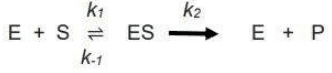
k1 = 1 × 10⁸ M−1 s−1, k−1 = 4 × 10⁴ s−1, k2 = 8 × 10² s−1
From the information given above, calculate Km and Ks.
- 1Ks: 400 M−1 s−1, Km: 408 M
- 2Ks: 400 µM, Km: 400 µM
- 3Ks: 400 µM s−1, Km: 408 µM
- 4Ks: 400 µM, Km: 408 µM
Show answer and solution
Ks = k−1/k1 = 4 × 10⁴/108 = 4 × 10⁻⁴ M = 400 µM. Km = (k−1 + k2)/k1 = 4.08 × 10⁴/108 = 408 µM. Both are concentrations.
The plot below has two curves (A, B) that show the fractional occupancy of hemoglobin and myoglobin by oxygen as a function of the amount of oxygen.
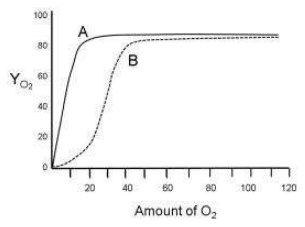
The two reactions are
i. E + S ⇌ ES and
ii. E + nS ⇌ ESn
where S is O2 and E is myoglobin or hemoglobin
The equations that could be used to fit the two curves are:
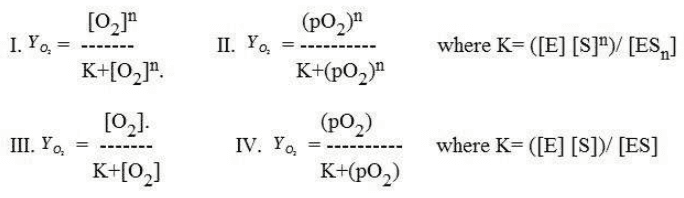
YO2 is the fraction of oxygen-binding sites occupied by oxygen. pO2 is partial pressure of oxygen.
From the options given below, select the option with the right curve (A, B), reaction (i, ii) and equation/s (I, II, III, IV) that describe oxygen binding to hemoglobin and myoglobin.
- 1Myoglobin: curve A, reaction i, equations III and IV. Hemoglobin: curve B, reaction ii, equations I and II.
- 2Myoglobin: curve B, reaction i, equations II and IV. Hemoglobin: curve A, reaction ii, equations I and III.
- 3Myoglobin: curve A, reaction ii, equations III and IV. Hemoglobin: curve B, reaction i, equations I and II.
- 4Myoglobin: curve A, reaction ii, equations I and II. Hemoglobin: curve B, reaction i, equations III and IV.
Show answer and solution
Myoglobin binds one O2 (reaction i), giving a hyperbola (curve A, equations III and IV). Hemoglobin binds cooperatively (reaction ii, Hill form), giving a sigmoid (curve B, equations I and II).
Pyruvate generated by glycolysis, is converted to acetyl-coenzyme A, which is metabolized by the citric acid cycle generating energy-rich molecules. From the choices given below, select the right combination of these molecules produced from one molecule of acetyl-CoA.
- 12 NADH + 2 FADH2 + 1 GTP
- 23 NADH + 1 FADH2 + 1 GTP
- 33 NADH + 1 GTP
- 44 NADH + 1 FADH2 + 1 GTP
Show answer and solution
One turn of the cycle per acetyl-CoA gives 3 NADH (isocitrate, α-KG and malate dehydrogenases), 1 FADH2 (succinate dehydrogenase) and 1 GTP (succinyl-CoA synthetase).
In yeast, under anaerobic conditions, pyruvate is fermented to ethanol through two steps: decarboxylation of pyruvate to acetaldehyde and NADH-mediated reduction of acetaldehyde to ethanol. The mammalian liver also expresses alcohol dehydrogenase (Liver ADH: L-ADH). From the options given below, choose the one that best explains the physiological significance of L-ADH in the absence of fermentation in the liver.
- 1The direction of L-ADH reaction varies with the relative concentrations of acetaldehyde and ethanol. In addition, the enzyme metabolizes the alcohols produced by intestinal microflora anaerobically.
- 2NAD+ produced by L-ADH drives glycolysis in the liver.
- 3Mammalian L-ADH converts pyruvate to lactate and the NAD+ thus generated drives glycolysis.
- 4Mammalian L-ADH has non-metabolic moonlighting functions.
Show answer and solution
ADH is reversible: its direction follows the acetaldehyde/ethanol ratio. In the liver it mainly oxidises ethanol, including alcohol made by gut bacteria and absorbed through the portal blood.
Columns X and Y of the following table list some treatment methods, reagents, and events that are related to human lymphocyte culture, and banding/ karyotyping of human chromosomes.
| Column X | Column Y | ||
|---|---|---|---|
| A. | 5 % barium hydroxide treatment at 50°C | i. | R-banding |
| B. | Trypsin treatment | ii. | C-banding |
| C. | Phytohaemagglutinin | iii. | Mitotic stimulation |
| D. | Phosphate buffer treatment at 80°C | iv. | Nucleolar Organizer Regions (NOR) |
| E. | Silver Staining | v. | G-banding |
Which one of the following options represents all correct matches between Column X and Column Y?
- 1A-ii; B-v; C-iii; D-i; E-iv
- 2A-v; B-iii; C-ii; D-iv; E-i
- 3A-iv; B-v; C-i; D-iii; E-ii
- 4A-ii; B-v; C-iv; D-i; E-iii
Show answer and solution
Barium hydroxide at 50°C gives C-banding. Trypsin gives G-banding. PHA is the mitogen for lymphocytes. Hot phosphate buffer (80°C) gives R-banding. Silver stains NORs.
The following statements were made about X-chromosome inactivation in humans:
- A. Maternally-derived X-chromosome has a greater chance of becoming inactivated in any given cell.
- B. Both X-chromosomes are activated during the process of oogenesis.
- C. The XIST gene encodes for a single, long non-coding transcript, which binds with the X chromosome and helps in its inactivation.
- D. The XIST gene expression is required to initiate inactivation of X- chromosome, and also to maintain inactivation from one cell generation to the next.
- E. Tsix transcription affects the abundance of Xist RNA in cis.
Which one of the following options represents the combination of all correct statements?
- 1A, C and D
- 2B, C and E
- 3A and C only
- 4B and E only
Show answer and solution
Both X chromosomes are reactivated in the oocyte line (B). XIST makes one long non-coding RNA that coats its X in cis (C). Antisense Tsix lowers Xist in cis (E). Inactivation is random, not biased to the maternal X, and once set up it is maintained without XIST. Answer: B, C and E.
Cytoskeleton-dependent motor proteins are critical for the movement of cellular organelles in animal cells. In the fertilized egg of C. elegans, once the polarity has been established, the maternal nucleus migrates towards the paternal nucleus, which eventually leads to fusion of the two pronuclei (see below).
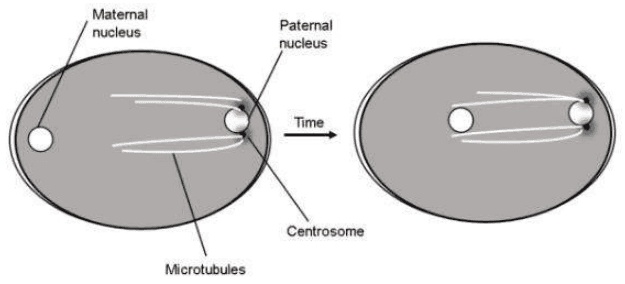
What molecular motor is likely to be directly involved in nuclear migration?
- 1Myosin II
- 2Kinesin
- 3Dynein
- 4Tropomyosin
Show answer and solution
The maternal pronucleus moves along microtubules toward the sperm centrosome, which is the microtubules’ minus end. Dynein is the minus-end-directed motor.
An investigator identified a nuclear localization signal (NLS; Pro-Lys-Lys-Lys-Arg-Lys) at the C-terminus of the protein X (50 kDa). To analyse the localization of protein X, the investigator fused protein X with GFP at the C-terminus. The fusion protein was detected in the cytosol. When the nuclear localization signal was fused with GFP at the N-terminus, the NLS-tagged GFP extensively localized in the nucleus. Based on this observation, the investigator made a few hypotheses:
- A. The basic amino-acid stretch in the protein X-GFP chimeric construct is masked by the GFP sequence and thus not capable of directing entry of protein X-GFP into the nucleus.
- B. The X-protein in the full-length X-GFP chimeric protein is post-translationally modified that impacts its import into the nucleus.
- C. Fusion with GFP makes the protein X too bulky to enter the nucleus through the nuclear pore complex.
- D. The GFP is post-translationally modified that impacts the import of protein X-GFP into the nucleus.
Which one of the following options gives the combination of all possible hypotheses that best explain Protein-X’s trafficking mechanisms?
- 1A and D
- 2B only
- 3A and B
- 4C and D
Show answer and solution
NLS-GFP is imported, so the NLS itself works. In X-GFP, the C-terminal NLS may be masked by GFP (A), or protein X may be modified in a way that blocks import (B). At 77 kDa the fusion is not too big for active import (C), and GFP does not stop NLS-GFP from entering (D).
When budding yeast (a facultative anaerobe) is grown for a few days in medium containing high glucose it shows a growth pattern with two lag phases (see figure below).
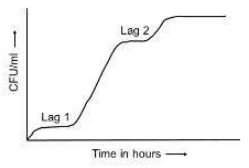
Which one of the following statements best explains this growth pattern?
- 1In first lag phase, cells become acclimatized to the new glucose environment, in the second lag phase they undergo selective cell death and robust cells start dividing again.
- 2In the second lag phase, yeast cells switch from fermentation to utilizing non-fermentable carbon sources and the lag is to acclimatize to this source of energy.
- 3Yeast cells use glucose in the first exponential phase and use sucrose in the second phase.
- 4Yeast cells switch from mitotic to meiotic division in low glucose and hence require the lag phase to prepare for meiosis.
Show answer and solution
This is the diauxic shift. Yeast ferments glucose to ethanol first. When glucose runs out, a second lag follows while it switches on respiration to use ethanol and other non-fermentable carbon sources.
A researcher isolated a mutant of an ER resident protein-folding enzyme (PFE) that has lost its KDEL sequence (ER retention sequence). Potential consequences of such a mutation are given below.
- A. PFE is found in the extracellular space
- B. PFE is degraded in the ER
- C. Unfolded proteins increase in the ER
- D. PFE is transported to the cytosol
Which one of the following options represents the combination of all correct statements?
- 1B and C
- 2A and D
- 3A and C
- 4C and D
Show answer and solution
Without KDEL, the enzyme is not returned from the Golgi and is secreted (A). The ER loses its folding enzyme, so unfolded proteins pile up (C). Answer: A and C.
A mutant DNA polymerase was found to have higher error rate and synthesized only short DNA fragments. In the statements below, potential explanations are given.
- A. The 5’ to 3’ exonuclease activity is compromised.
- B. The 3’ to 5’ exonuclease activity is compromised.
- C. The polymerase tends to frequently dissociate from the template.
- D. The polymerase is unable to unwind the DNA template during replication.
Which one of the following options represents the combination of all correct statements?
- 1A and B
- 2C and D
- 3A and D
- 4B and C
Show answer and solution
Higher error rate means lost 3′→5′ proofreading (B). Short products mean low processivity: the enzyme falls off the template often (C). The 5′→3′ exonuclease removes primers and does not affect fidelity, and unwinding is the helicase’s job.
Column X lists proteins that play a role in mediating DNA recombination processes and Column Y lists the possible functions of these proteins.
| Proteins (Column X) | Functions (Column Y) | ||
|---|---|---|---|
| A. | Rad51 | i. | Assembly of strand exchange proteins |
| B. | Spo11 | ii. | Resection of ends of DNA strands at double strand break sites to create single strand overhangs |
| C. | Rad52 and Rad59 | iii. | Causes double strand breaks in meiosis |
| D. | MRX/N complex | iv. | Strand invasion |
Which one of the following options represents all correct matches between Column X and Column Y?
- 1A (i), B (ii), C (iv), D (iii)
- 2A (iv), B (i), C (ii), D (iii)
- 3A (iv), B (iii), C (i), D (ii)
- 4A (iii), B (iv), C (ii), D (i)
Show answer and solution
Rad51: strand invasion. Spo11: meiotic DSBs. Rad52 and Rad59: mediators that load Rad51, assembling the strand-exchange proteins. MRX/MRN: end resection.
The following statements are made about post-transcriptional processing:
- A. RNA editing can occur via the deamination of cytosine residues, leading to formation of uracil and thus a change in coding sequence.
- B. The major spliceosomal complex mediates the removal of Group II introns.
- C. Trans-splicing events seen in trypanosomes allow the formation of multiple gene products by bringing together different combinations of exons of three or more genes.
- D. Capping of eukaryotic mRNAs occurs exclusively in the nucleus of the cell.
Which one of the following options represents the combination of all correct statements?
- 1A and D
- 2B and D
- 3B and C
- 4A only
Show answer and solution
C→U deamination editing is real, as in apoB (A). Group II introns are self-splicing, not removed by the spliceosome. Trypanosome trans-splicing adds the same spliced-leader exon to every mRNA rather than mixing exons from several genes. Re-capping can also occur in the cytoplasm. Answer: A only.
Bacteriophage λ proteins, CI and Cro are crucial regulators of the lysogeny and lytic cycles of the bacteriophage. These proteins bind to the rightward operator region consisting of OR1, OR2, and OR3 (shown below).

Which one of the following statements about the regulation by CI and Cro proteins is CORRECT?
- 1Cro binding to OR3 activates expression of cI.
- 2CI binding to OR3 activates expression of cI and represses the expression of cro.
- 3CI binding to OR1 and OR2 leads to repression of cI and cro.
- 4CI binding to OR1 and OR2 leads to higher expression of cI and repression of cro.
Show answer and solution
CI binds OR1 and OR2 cooperatively, repressing PR (cro). CI bound at OR2 also activates PRM, raising cI expression. Cro at OR3, or CI at OR3 at high levels, represses cI.
The aminoacyl-tRNA synthetases (AARSs) in an organism have evolved to catalyze aminoacylation of their cognate tRNAs
- 1either at the 3’-OH or 2’-OH positions of the adenosine at the CCA end.
- 2only at the 3’-OH position of the adenosine at the CCA end.
- 3only at the 2’-OH position of the adenosine at the CCA end.
- 4only at the C1’ position of the adenosine at the CCA end.
Show answer and solution
Class I synthetases attach the amino acid to the 2′-OH and class II to the 3′-OH of A76. The 2′ ester then moves to 3′ by transesterification. So aminoacylation occurs at either position.
Following statements are made about the bacterial ribosomes and their functions:
- A. Association of 23S rRNA with 16S rRNA is essential to catalyze in vitro peptide bond formation using model substrates.
- B. The 23S rRNA is necessary and sufficient to catalyze in vitro peptide bond formation using model substrates.
- C. Ribosome carries a polymerization activity.
- D. The 16S rRNA is necessary and sufficient to catalyze in vitro peptide bond formation using model substrates.
Which one of the following options represents the combination of both correct statements?
- 1A and B
- 2B and C
- 3C and D
- 4A and D
Show answer and solution
The peptidyl transferase centre is made of 23S rRNA: it is a ribozyme, and protein-depleted 23S-based particles can form peptide bonds with model substrates (B). The ribosome is thus a polymerase for amino acids (C). 16S rRNA does not catalyse this.
Given below is the list of viruses in Column X and their receptors in human host cells in Column Y.
| Viruses (Column X) | Receptors (Column Y) | ||
|---|---|---|---|
| A. | Influenza A | i. | CD21 |
| B. | SARS coronavirus | ii. | Sialic acid |
| C. | Poliovirus | iii. | ACE 2 |
| D. | HIV | iv. | CD4 |
| E. | Epstein-Barr Virus | v. | CD155 |
Which one of the following options gives all correct matches between Column X and Column Y?
- 1A-i; B-ii; C-iii, D-iv; E-v
- 2A-v; B-iii; C-i; D-iv; E-ii
- 3A-ii; B-iii; C-v; D-iv; E-i
- 4A-v; B-iv; C-iii; D-ii; E-i
Show answer and solution
Influenza: sialic acid. SARS-CoV: ACE2. Poliovirus: CD155 (PVR). HIV: CD4. Epstein–Barr virus: CD21 (CR2).
Two protein kinases, K1 and K2, regulate an intracellular pathway in response to the extracellular signal. The following observations were made regarding the pathway.
i. Response is observed even in the absence of an extracellular signal when a mutation permanently activates K1.
ii. Response is observed even in the absence of an extracellular signal when K1 contains an activating mutation and K2 has an inactivating mutation.
iii. No response is observed even in the presence of an extracellular signal when K2 is inactivated by mutations.
iv. Response is observed even in the absence of an extracellular signal when both kinases are activated by mutations.
Which one of the following statements is correct?
- 1K1 inhibits K2
- 2K2 inhibits K1
- 3K1 activates K2
- 4K2 activates K1
Show answer and solution
Active K1 gives a response even when K2 is dead (i, ii), so K1 acts downstream. Losing K2 blocks the signal (iii), so K2 is needed upstream. Hence K2 activates K1.
In a tissue, cells are bound together by physical attachment between cell to cell or between cell to the extracellular matrix. The following are some of the characteristics of cell junctions:
- A. Tight junctions are cell-cell junctions connecting the intermediate filament in one cell with that in the adjacent cell.
- B. Desmosomes are cell-matrix anchoring junctions connecting actin filament in one cell to the extracellular matrix.
- C. Gap junctions are channel-forming junctions allowing the passage of small water-soluble molecules from cell to cell.
- D. Tight junctions are occluding junctions that seal the gap between two cells.
- E. Hemidesmosomes are cell-matrix anchoring junctions connecting intermediate filaments in one cell to the extracellular matrix.
Which one of the following options represents the combination of ALL INCORRECT statements?
- 1A and B
- 2B and D
- 3C and E
- 4D and E
Show answer and solution
Statement A is wrong: tight junctions seal and do not link intermediate filaments; desmosomes do. Statement B is wrong: desmosomes are cell–cell junctions anchoring intermediate filaments; focal adhesions link actin to the matrix. C, D and E are correct.
The following experiment was designed to establish the synergy of Bcl2 with genes like Myc in leading to B-cell lymphomas.
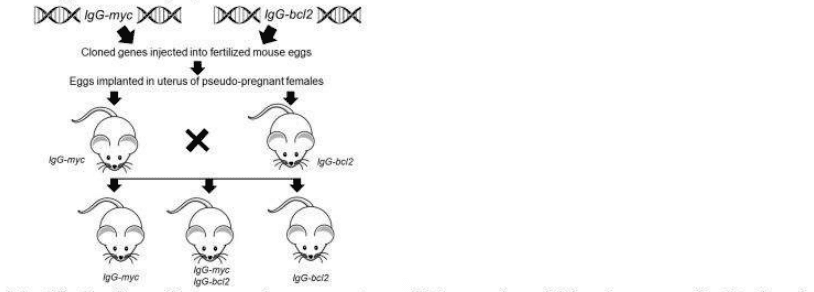
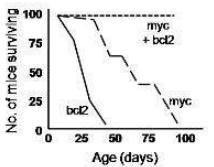
Identify the figure that correctly represents conditions under which mice succumbed to lymphomas.
- 1

- 2

- 3

- 4

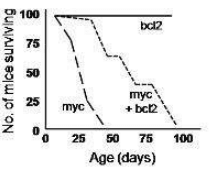
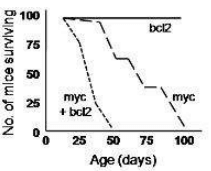

Show answer and solution
Bcl2 alone blocks apoptosis but does not drive growth, so those mice survive. Myc alone causes lymphomas slowly. Myc + Bcl2 together cause lymphomas fastest, showing synergy between proliferation and survival. That is figure 3.
The figure below represents the data from immunoblots (IB) of co-immunoprecipitation (IP) experiments with antibodies as indicated, after HeLa cells were treated with arsenic (β-cat refers to β-catenin; and E-cad refers to E-cadherin).
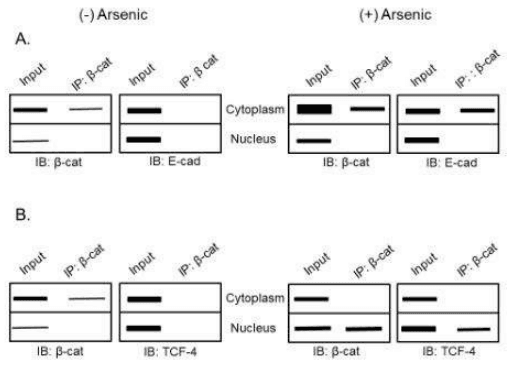
The following assumptions were made:
- A. Arsenic activates the non-canonical β-catenin pathway.
- B. Arsenic leads to cellular proliferation.
- C. Arsenic leads to proteasomal degradation of β-catenin.
- D. Arsenic induces apoptosis in the HeLa cells.
Which one of the following options represents the combination of all correct assumptions?
- 1A and B
- 2B and C
- 3C and D
- 4A and D
Show answer and solution
With arsenic, β-catenin moves into the nucleus and binds TCF-4, which drives proliferation genes (B). NTA’s key also accepts A (“non-canonical” activation), giving A and B. Nothing shows β-catenin degradation or apoptosis. Strictly, the TCF-4 binding looks canonical, so this solution follows NTA’s key.
Below are some of the proposed roles of reactive oxygen species (ROS) in plant defense.
- A. H2O2 may be directly toxic to pathogens
- B. In presence of iron, H2O2 gives rise to an extremely reactive hydroxyl radical.
- C. H2O2 leads to induced biosynthesis of salicylic acid (SA).
- D. H2O2 production is always delayed during incompatible interactions.
Which one of the following options represents the combination of all correct statements?
- 1A, B and C
- 2B, C and D
- 3A, C and D
- 4A, B and D
Show answer and solution
H2O2 can be directly antimicrobial (A), forms •OH by Fenton chemistry with Fe (B), and induces SA synthesis (C). In incompatible (resistant) interactions the oxidative burst is rapid and strong, not delayed (D false).
Following statements are made regarding amphibian development:
- A. Fibronectin plays an important role in enabling the mesodermal cells to migrate into the embryo.
- B. Organizer secrete proteins that block the BMP signal, which allows the ectodermal cells to become epidermis.
- C. Wnt signalling causes a gradient of β-catenin along the anterior-posterior axis of the neural plate, which appears to specify the regionalization of the neural tube.
- D. The more ventral blastomeres in the endoderm have high expression of nodal-related proteins.
Which one of the following options represents the combination of all correct statements?
- 1A and B
- 2A and C
- 3B and C
- 4C and D
Show answer and solution
Fibronectin tracks guide involuting mesoderm (A). A Wnt/β-catenin gradient patterns the neural plate along the A–P axis (C). Blocking BMP makes ectoderm neural, not epidermis (B false). Nodal-related genes are highest in dorsal vegetal cells (D false).
In wild type C. elegans hermaphrodites, two adjacent cells, Z1.ppp and Z4.aaa, have the potential to become the anchor cell. They interact in a manner that causes one of them to become the anchor cell, while the other one becomes the precursor of the uterine tissue. The following statements are given to describe the interaction of the two cells:
- A. The cell secreting LAG-2 becomes the anchor cell.
- B. The cell secreting LIN-12 remains as the precursor of the uterine tissue.
- C. The LIN-12 secreting cell takes the fate of anchor cell while the LAG-2 secreting cell takes the fate of uterine precursor cell.
- D. The Hippo kinase signaling pathway brings lateral inhibition so that one cell is inhibited and the other cell is promoted to become the anchor cell.
Which one of the following options represents the combination of all correct statements?
- 1A and D
- 2A and B
- 3D only
- 4C only
Show answer and solution
Both cells start out equal. The one that ends up making more LAG-2 (the Delta-like ligand) becomes the anchor cell (A). The one receiving the signal through its LIN-12 (Notch) receptor becomes the ventral uterine precursor (B). This is Notch lateral inhibition, not Hippo (D false).
Following statements are made about fertilization occurring in sea urchins:
- A. Chemoattraction of the sperm to the egg is mediated by sperm activating peptides like bindin.
- B. Exocytosis of the sperm acrosomal vesicles and release of enzymes occur.
- C. The capacitated sperm undergoes acrosome reaction.
- D. The acrosome protein mediating the critical species-specific binding event is resact.
- E. The slow block to polyspermy is accomplished by the cortical granule reaction.
Which one of the following options represents the combination of all correct statements?
- 1A and B only
- 2A, B and D
- 3B and E only
- 4A, B and E
Show answer and solution
The acrosome reaction is exocytosis of the acrosomal vesicle (B). The cortical granule reaction makes the fertilisation envelope, the slow block to polyspermy (E). The chemoattractant is resact, not bindin. Capacitation is mammalian. The species-specific binding protein is bindin, not resact.
Following figure shows the early interactions between the Apical Ectodermal Ridge (AER) and the limb bud mesenchyme. The red lines with block head indicate repression while the black lines indicate activation.
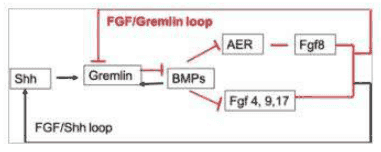
The following statements were made regarding the development of a tetrapod limb:
- A. When the limb bud grows Shh creates a new signalling centre that induces the posterior-anterior polarity.
- B. When the concentration of FGFs rises, it can inhibit Gremlin thus allowing BMPs to begin repressing the AER-FGFs.
- C. FGFs 4, 9 and 17 from the AER inhibit Shh to stabilize the ZPA.
- D. Repression of Gremlin synthesis helps maintain the AER.
Which one of the following options represents the combination of all correct statements?
- 1A and B
- 2A and C
- 3B and D
- 4C and D
Show answer and solution
Shh from the ZPA sets up anterior–posterior polarity (A). High FGF eventually represses Gremlin, letting BMPs shut down the AER FGFs and end outgrowth (B). AER FGFs maintain Shh (C false), and Gremlin maintains the AER (D false).
Following statements with respect to development in sea urchin were put forth:
- A. The cell fates are determined both by autonomous and conditional modes of specification.
- B. Large micromeres are conditionally specified.
- C. Large micromeres produce paracrine and juxtacrine factors that specify the fates of their neighbours.
- D. β-catenin is not required for the specification of the micromeres.
Which one of the following options represents the combination of all correct statements?
- 1A and B
- 2A and C
- 3C and D
- 4B and D
Show answer and solution
Sea-urchin embryos use both autonomous (micromeres) and conditional (others) specification (A). Large micromeres send Wnt8 and Delta to their neighbours (C). They are autonomously specified and need nuclear β-catenin, so B and D are false.
Given below are the five experiments (A-E) showing effects of duration of the light and dark periods on flowering of the short-day plants (SDP) and long-day plants (LDP).
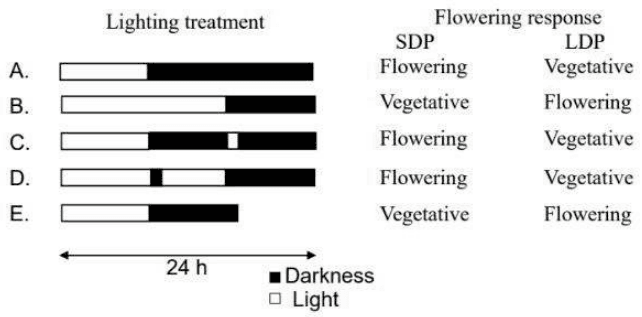
Which one of the following options represents the combination of all correct flowering responses?
- 1A, B and C
- 2A, B, and E
- 3B, C and D
- 4B, C and E
Show answer and solution
Flowering depends on the dark period. A (long night): SDP flowers, LDP vegetative. B and E (short night): SDP vegetative, LDP flowers. C (night broken by light) should make SDP vegetative and LDP flower. D (short dark gap in the day, short night) also favours LDP. Only A, B and E are correct.
Given below are the list of plant derived alkaloids and their uses in modern medicine.
| Alkaloids | Uses | ||
|---|---|---|---|
| A. | Caffeine | i. | Antineoplastic used to treat leukemia and other cancers |
| B. | Morphine | ii. | Traditional anti-malarial agent |
| C. | Quinine | iii. | Powerful narcotic analgesic |
| D. | Vincristine | iv. | Widely used central nervous system stimulant |
Which one of the following options represents all correct matches?
- 1A (iii), B (iv), C (ii), D (i)
- 2A (iii), B (iv), C (i), D (ii)
- 3A (iv), B (i), C (iii), D (ii)
- 4A (iv), B (iii), C (ii), D (i)
Show answer and solution
Caffeine: CNS stimulant. Morphine: narcotic analgesic. Quinine: classic antimalarial. Vincristine: antineoplastic used for leukaemias.
During water stress, ABA increases dramatically in leaves causing stomatal closure. Given below are the various events involved in this process.
- A. Opening of plasma membrane Ca2+ permeable ion channels and elevation of cytosolic Ca2+
- B. Activation of plasma membrane anion channels, efflux of anions and potassium ions.
- C. Binding of ABA to cytosolic ABA receptor and inhibition of activity of Type 2C protein phosphatases (PP2Cs).
- D. Phosphorylation and activation of NADPH oxidases (RBOH) and formation of apoplastic ROS.
Which one of the following options represents the correct sequence of events involved?
- 1A, B, C, D
- 2A, C, D, B
- 3C, D, B, A
- 4C, D, A, B
Show answer and solution
ABA binds PYR/PYL receptors, inhibiting PP2Cs and freeing SnRK2/OST1 (C). This activates RBOH and produces ROS (D). ROS open Ca2+ channels, raising cytosolic Ca2+ (A). Then anion and K+ efflux shrink the guard cells (B). Order: C, D, A, B.
The figure below depicts the absorption spectra of chlorophylls and carotenoid over a range of wavelengths.
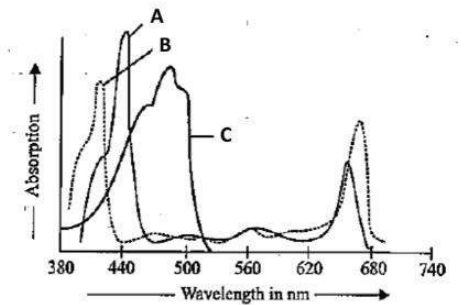
Which one of the following combinations best describes A, B and C from the absorption spectra shown above?
- 1A- chlorophyll a, B- chlorophyll b, C- carotenoid
- 2A- chlorophyll b, B- carotenoid, C- chlorophyll a
- 3A- chlorophyll b, B- chlorophyll a, C- carotenoid
- 4A- carotenoid, B- chlorophyll b, C- chlorophyll a
Show answer and solution
Chlorophyll a (B) peaks at about 430 and 662 nm. Chlorophyll b (A) peaks at about 453 and 642 nm. Carotenoids (C) absorb broadly at 450–500 nm with no red peak.
The following statements refer to the observations made by a student, upon using 2,6-dichloroisonicotinic acid (INA) to induce systemic acquired resistance (SAR) in tobacco. INA treatment,
- A. enhances salicylic acid concentration in plants.
- B. does not enhance salicylic acid concentration in plants.
- C. fails to activate SAR in nahG-expressing plants.
- D. activates SAR in nahG-expressing plants.
Which one of the following options represents the combination of all correct statements?
- 1A and C
- 2A and D
- 3B and C
- 4B and D
Show answer and solution
INA acts downstream of SA: it does not raise SA levels (B), and it still induces SAR in nahG plants, which cannot accumulate SA (D).
The following statements are made regarding cytokinin (CK) biosynthesis in plants:
- A. Trans-zeatin (tZ) and iso-pentenyladenile (iP) are common active forms of isoprenoid CKs.
- B. CKs are present as nucleoside and glycosidic conjugates but not as nucleotide conjugates.
- C. Dephosphorylation and deribosylation steps are involved in two-step pathway for active CK formation.
- D. Lonely Guy (LOG) enzyme is involved in CK metabolism
Which one of the following options represents the combination of all correct statements?
- 1A, B and C
- 2A, B and D
- 3A, C and D
- 4B, C and D
Show answer and solution
tZ and iP are the main active cytokinins (A). Active forms are made either in two steps (dephosphorylation, then deribosylation) (C) or directly by LONELY GUY phosphoribohydrolases (D). Cytokinins do occur as nucleotides such as iPRMP, so B is false.
The following statements are made regarding materials transported through the phloem of a plant.
- A. Only reducing sugars are translocated.
- B. Non-reducing sugars are generally translocated.
- C. Sucrose and raffinose are generally translocated.
- D. Only D-glucose and D-fructose are translocated.
Which one of the following options represents the combination of all correct statements?
- 1A, C and D
- 2B and C only
- 3B and D only
- 4A and C only
Show answer and solution
Phloem carries non-reducing sugars, mainly sucrose, and in some species raffinose-family oligosaccharides. Reducing sugars such as glucose and fructose are too reactive to travel. Answer: B and C.
Blood hemostasis is the interplay of several intrinsic and extrinsic factors. Deficiency of some of the blood clotting factors and their clinical manifestations are listed below.
| Factors | Manifestations | ||
|---|---|---|---|
| A. | V | i. | Hageman trait |
| B. | VII | ii. | Hypoconvertemia |
| C. | IX | iii. | Hemophilia B |
| D. | XII | iv. | Parahemophilia |
Which one of the following options represents all correct matches?
- 1A-(i), B-(ii), C-(iii), D-(iv)
- 2A-(iv), B-(ii), C-(iii), D-(i)
- 3A-(ii), B-(iii), C-(iv), D-(i)
- 4A-(iii), B-(i), C-(ii), D-(iv)
Show answer and solution
Factor V deficiency: parahaemophilia (Owren). VII: hypoproconvertinaemia. IX: haemophilia B (Christmas disease). XII: Hageman trait.
Parathyroid hormone (PTH) regulates calcium homeostasis in humans. The following statements are made regarding PTH:
- A. It is a 108 amino acid (aa) residue long hormone whose 1-42 aa exhibits full biological activity.
- B. It is an 84 aa hormone whose 1-34 aa exhibits full biological activity.
- C. An acute decrease of Ca++ results in a marked increase of PTH mRNA, followed by increased rate of PTH synthesis.
- D. Rate of degradation of pro-PTH increases when Ca++ concentrations are low.
- E. Cathepsin B cleaves PTH into two fragments.
Which one of the following options represents the combination of all correct statements?
- 1A, C and D
- 2B, C and E
- 3A, D and E
- 4B, D and E
Show answer and solution
PTH is 84 aa, and its 1–34 fragment is fully active (B). A fall in Ca2+ raises PTH mRNA and synthesis (C). Cathepsin B cleaves PTH into fragments (E). Low Ca2+ reduces intracellular degradation (D false), and 108 aa is the size of the precursor (A false).
The following statements are made regarding male reproductive system, particularly with reference to spermatogenesis and sperm production:
- A. The membranes of spermatozoa contain germinal angiotensin-converting enzyme (gACE).
- B. Mature spermatozoa are released from Leydig cells.
- C. Sertoli cells secrete Mullerian inhibiting substance (MIS).
- D. Sertoli cells synthesize androgens.
- E. Rete testis has high content of estrogen and alpha estrogen receptors (ERα).
Which one of the following options represents the combination of all correct statements?
- 1A, B and C
- 2B, C and D
- 3C, D and E
- 4A, C and E
Show answer and solution
Sperm carry germinal ACE (A). Sertoli cells secrete MIS/AMH (C). The rete testis is rich in oestrogen and ERα, which control fluid resorption (E). Sperm are released from Sertoli cells, and androgens come from Leydig cells, so B and D are false.
Following statements are made about the chemical properties and distributions of the respiratory pigments found in animals:
- A. Hemoglobins are the most common and widespread respiratory pigments in vertebrates and invertebrates and are always present in blood cells.
- B. The heme structure in hemoglobins is an iron (ferrous) porphyrin which varies widely among species, and also varies among the different molecular forms of hemoglobin within any single species. The globin, however is exactly identical.
- C. Hemocyanin contains copper and turns bright blue when oxygenated and it is always dissolved in the plasma.
- D. Chlorocruorins are similar to hemocyanin, but have a lower affinity for oxygen binding than hemocyanin present in blood cells of some marine annelid worms.
- E. Hemerythrins are non-heme, iron-containing respiratory pigment that have a limited and scattered distribution.
Which one of the following options represents the combination of all INCORRECT statements?
- 1A, B and C
- 2A, B and D
- 3B, D and E
- 4C, D and E
Show answer and solution
Incorrect statements: A, since haemoglobin is often dissolved in plasma in invertebrates, not always in cells. B, since the heme is constant while the globin varies. D, since chlorocruorin is a heme pigment like haemoglobin, dissolved in the plasma of some polychaetes. Hemocyanin is copper-based, blue when oxygenated and always extracellular (C). Hemerythrin is non-heme iron (E).
The effects of stimulation of cholinergic vagal fibers on the pacemaker potential of the cells of sinoatrial (SA) node of heart and on the nodal impulse generation are suggested below:
- A. The nodal cell membrane becomes depolarized.
- B. The slope of the pacemaker potential is increased.
- C. The K+ conductance of nodal cell membrane is decreased.
- D. The depolarizing effect of ‘h’ current (Ih) on the membrane potential is slowed down due to the opening of G protein gated K+ channels.
- E. The opening of Ca++ channels are slowed down due to the decreased cAMP level in the nodal cells.
Which one of the following options represents the combination of all correct statements?
- 1A and B
- 2B and C
- 3C and D
- 4D and E
Show answer and solution
ACh acts on M2 receptors. Gβγ opens GIRK K+ channels, which hyperpolarise the cell and oppose Ih (D). Lower cAMP slows If and L-type Ca2+ channel opening (E). Membrane potential becomes more negative, the pacemaker slope falls, and K+ conductance rises.
The following statements are made regarding the characteristic features of body temperature in humans:
- A. The core body temperature varies least with the changes of environmental temperature.
- B. During severe muscular exercise the rectal temperature may rise up to 40°C.
- C. The oral temperature is relatively higher than the rectal temperature.
- D. The core body temperature is highest at 6:00 AM and lowest in the evening in humans who sleep at night and remain awake during day time.
- E. The temperature of scrotum is regulated at 37°C.
- F. In women, a rise of basal body temperature occurs immediately after ovulation.
Which one of the following options represents the INCORRECT combination of the statements?
- 1A, B, C
- 2B, C, D
- 3C, D, E
- 4D, E, F
Show answer and solution
Wrong statements: C, since oral temperature is about 0.5°C below rectal. D, since core temperature is lowest in the early morning and highest in the evening. E, since the scrotum is held at about 32–35°C for spermatogenesis. A, B and F are correct; F holds because progesterone raises basal temperature after ovulation.
The following represents selected AFLP bands (I to V) observed in parents (P1 and P2), F1 progeny and 20 doubled haploid (DH) progeny developed from the F1. DH are created through chromosome doubling of pollen grains in anther culture.
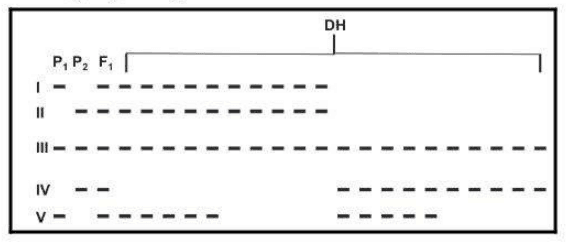
The following statements were made about the above AFLP bands:
- A. Bands I and IV are allelic.
- B. Bands II and V assort independently.
- C. Band III is uninformative.
Which one of the following options represents a combination of all correct statements?
- 1A only
- 2C only
- 3A and B only
- 4A, B and C
Show answer and solution
Bands I and IV are present in complementary DH lines and never together, so they are alleles of one locus (A). Band II segregates independently of band V across the DH lines (B). Band III is in every parent and DH line, so it is uninformative (C). Answer: A, B and C.
Two mutations were isolated in bacteriophage, one causing clear plaque (c) and the other causing minute plaque (m). The genes responsible for these two mutations are 9 cM apart. The plaques with genotype c+ m− and c− m+ were mixed to infect bacterial cells. The progeny plaques were collected, cultured and plated on bacteria.
The expected number of the different types of plaques are shown below:
- A. c+ m+ 455, c+ m− 45, c− m+ 45, c− m− 455
- B. c+ m+ 455, c+ m− 455, c− m+ 45, c− m− 45
- C. c+ m+ 45, c+ m− 455, c− m+ 455, c− m− 45
- D. c+ m+ 65, c+ m− 680, c− m+ 685, c− m− 70
Which one of the following options represents the combination of all correct statements?
- 1A only
- 2B only
- 3C only
- 4C and D
Show answer and solution
The parents are c+m− and c−m+, so those are the common parental classes. Recombinants (c+m+ and c−m−) should make up 9%. C gives 90/1000 and D gives 135/1500, both 9%. Answer: C and D.
In Drosophila, a cross was set between a male homozygous for alleles s+/s+ (phenotype A) and a female homozygous of s/s (phenotype B) (‘s+’ being a dominant allele and ‘s’ a recessive allele). All of the F1 individuals thus obtained had the phenotype B. When F1 individuals were crossed among themselves, all progeny obtained were of phenotype A in F2.
The following explanations were proposed for the results obtained:
- A. This is an example of cytoplasmic inheritance.
- B. This is exhibiting genetic maternal effect.
- C. This is a quantitative trait influenced by the environment.
- D. This is exhibiting gene interaction with epistasis.
- E. The trait is showing position effect variegation.
Which one of the following option is correct?
- 1A only
- 2B only
- 3C only
- 4D and E
Show answer and solution
The F1 look like their s/s mother. F2 all look like A because their F1 mothers are s+/s. Each phenotype follows the mother’s genotype: a maternal effect, as in Limnaea coiling.
A founder population has an Aa heterozygous genotype with a frequency of 1, and no individual with either AA or aa genotypes. With repeated self-fertilization, the frequency of AA, Aa and aa after three generations will be:
- 1A/A 15/32, A/a 1/16, a/a 15/32
- 2A/A 7/16, A/a 1/8, a/a 7/16
- 3A/A 3/8, A/a 1/4, a/a 3/8
- 4A/A 1/4, A/a 1/2, a/a 1/4
Show answer and solution
Each round of selfing halves heterozygosity: after three generations Aa = (1/2)3 = 1/8. The remaining 7/8 splits equally, so AA = aa = 7/16.
To obtain recombinant products during meiosis, a double-strand break in the DNA yields crossovers needed for chiasmata formation. The progression of the non-crossover and crossover pathways begins with the formation of D loop, however, it may not result in the production of recombinant gametes.
Following statements are made regarding recombination:
- A. Expansion of D-loop takes place in non-crossover pathway, but not in the crossover pathway.
- B. Expansion of D-loop takes place in crossover pathway, but not in the non-crossover pathway.
- C. Ejection of elongating strand takes place in the non-crossover pathway, but not in the crossover pathway.
- D. Ejection of elongating strand takes place in the crossover pathway, but not in the non-crossover pathway.
Which one of the following options represents the correct combination of statements that explain the formation of recombinant gametes?
- 1A and B
- 2B and C
- 3C and D
- 4D and A
Show answer and solution
A crossover needs the D-loop to expand and capture the second end, forming a double Holliday junction (B). In SDSA, the extended strand is ejected and re-anneals, giving a non-crossover (C).
The following are some statements made regarding mutations:
- A. Change of DNA sequence from AGC to ATC in non-coding strand can have a major impact on the protein production.
- B. Suppressor mutation restores the original phenotype, only when a second mutation occurs at the original site of the mutation.
- C. Mutation rates remain the same in all organisms.
- D. Strand slippage during replication is a consequence of loop formation in one strand of DNA.
- E. Hydroxylamine adds a hydroxyl group only on cytosine.
Which one of the following options represents the combination of all INCORRECT statements?
- 1A and B
- 2B and C
- 3C and D
- 4D and E
Show answer and solution
B is incorrect: suppressor mutations usually act at a second site, in the same or another gene. C is incorrect: mutation rates differ widely between organisms. A template change can alter a codon (A), slippage needs a looped-out strand (D), and hydroxylamine specifically hydroxylates cytosine (E).
Given below are the list of some of the most rare species on our planet (Column X) and the regions of the world where they occur (Column Y).
| Name of the organism (Column X) | Region of occurrence (Column Y) | ||
|---|---|---|---|
| A. | Saola | i. | Tianshan mountains |
| B. | Ili Pika | ii. | Vietnam |
| C. | Greater Bamboo Lemur | iii. | Sahara Desert |
| D. | Addax | iv. | Madagascar |
Which one of the following options represents all correct matches between Column X and Column Y?
- 1A-ii; B-i; C-iv; D-iii
- 2A-iii; B-iv; C-i; D-ii
- 3A-iv; B-iii; C-ii; D-i
- 4A-ii; B-iv; C-i; D-iii
Show answer and solution
Saola: Annamite range of Vietnam and Laos. Ili pika: Tianshan mountains of China. Greater bamboo lemur: Madagascar. Addax: Sahara.
The figure below depicts the evolutionary tree of organisms based on characteristics that are depicted as numbers (i-iv).
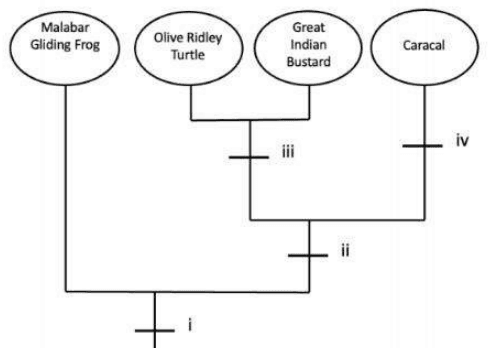
Choose the option that correctly matches the characteristics to the numbers:
- 1i) Amniotic egg ii) Oviparous iii) Fur present iv) Tetrapod
- 2i) Oviparous ii) Amniotic egg iii) Fur present iv) Tetrapod
- 3i) Fur present ii) Oviparous iii) Tetrapod iv) Amniotic egg
- 4i) Tetrapod ii) Amniotic egg iii) Oviparous iv) Fur present
Show answer and solution
All four are tetrapods (i). Turtle, bustard and caracal share the amniotic egg (ii). Turtle and bustard are oviparous (iii). The caracal alone has fur (iv).
Select the rare or endangered species which also have exceptionally low genetic variability, as documented by multi-locus molecular methods.
- 1Eucalyptus phylacis (Australian Meelup Mallee)
- 2Impatiens parviflora (Small balsam)
- 3Pavo cristatus (Indian peacock)
- 4Hydrobates castro (Hawaiian Band-rumped Storm Petrel)
Show answer and solution
The Meelup mallee (Eucalyptus phylacis) is a single ancient clone with almost no genetic variation across multilocus markers. It is a classic case of a rare species with extremely low diversity.
The diagram below depicts the relationship of land plants with some of the major apomorphies indicated.

Below is a list of apomorphies that have not been labeled on the tree above.
i. Intercalary growth of sporophyte
ii. Oil bodies
iii. Archegonium
iv. Leptoids
Which one of the following options correctly matches the apomorphies with their positions on the tree?
- 1A-iii; B-ii; C-iv; D-i
- 2A-i; B-iii; C-ii; D-iv
- 3A-i; B-ii; C-iii; D-iv
- 4A-ii; B-i; C-iv; D-iii
Show answer and solution
Archegonia unite all land plants (A). Oil bodies are unique to liverworts (B). Leptoids are food-conducting cells in mosses (C). An intercalary meristem in the sporophyte defines hornworts (D).
Column X lists various plant types and Column Y lists key features of these plants.
| Type of plant (Column X) | Characteristic feature (Column Y) | ||
|---|---|---|---|
| A. | Heteroblastic | i. | The plant that dies back to near ground level at the onset of the unfavourable season. |
| B. | Phanerogams | ii. | Morphological changes that take place with plant development. |
| C. | Hemicryptophyte | iii. | Reproduce through well-developed sexual structures. |
| D. | Hermaphrodite | iv. | Organism with both male and female sex organs in the same flower. |
Which one of the following options represents all correct matches between Column X and Column Y?
- 1A-i, B-iv, C-iii, D-ii
- 2A-iii, B-i, C-ii, D-iv
- 3A-iv, B-iii, C-i, D-ii
- 4A-ii, B-iii, C-i, D-iv
Show answer and solution
Heteroblastic: changes in form during development. Phanerogams: seed plants, with well-developed sexual structures. Hemicryptophyte: dies back to ground level, with buds at the soil surface. Hermaphrodite: both sexes in one flower.
The two columns given below lists various organisms and their dispersal and distribution status in India.
| Organism | Dispersal and distribution status | ||
|---|---|---|---|
| A. | Tabebuia rosea | i. | Introduced and invasive from Africa |
| B. | Achatina fulica | ii. | An extralimital species, migratory or otherwise, that has been reliably reported fewer than ten times from India. |
| C. | Datura innoxia | iii. | Introduced and invasive from Americas |
| D. | Merops viridis | iv. | Introduced from South America |
Which one of the following options represents all correct matches between the above two columns?
- 1A-i, B-iv, C-ii, D-iii
- 2A-iii, B-ii, C-iv, D-i
- 3A-iv, B-i, C-iii, D-ii
- 4A-ii, B-iii, C-i, D-iv
Show answer and solution
Tabebuia rosea: introduced from tropical America as an ornamental (iv). Achatina fulica: invasive snail from Africa (i). Datura innoxia: invasive from the Americas (iii). Merops viridis: a rare vagrant to India (ii).
The following is the life table of a natural population of a small annual succulent where ‘x’ is its life phase, ‘lx’ is its survivorship till that stage and ‘dx’ is its age specific mortality.
| x | lx | dx |
|---|---|---|
| Seed produced | 1.000 | 0.16 |
| Seeds Available | 0.840 | 0.63 |
| Germinated | 0.210 | 0.17 |
| Established | 0.033 | 0.009 |
| Rosettes | 0.024 | 0.010 |
| Mature individuals | 0.014 | 0.014 |
Which of the following options from the above life phases show the lowest age specific mortality rate?
- 1Seeds produced
- 2Germinated
- 3Established
- 4Rosettes
Show answer and solution
Stage-specific mortality qx = dx/lx: seeds produced 0.16, available 0.75, germinated 0.81, established 0.27, rosettes 0.42 and mature 1.0. The lowest is seeds produced.
Which of the following plots best depicts growth as per the logistic equation?
- 1

- 2

- 3

- 4

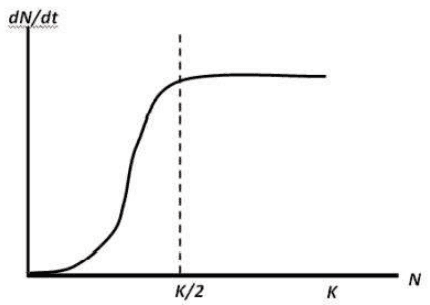

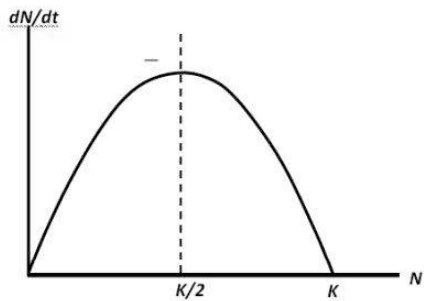

Show answer and solution
In the logistic model, dN/dt = rN(1 − N/K), an inverted parabola that is zero at N = 0 and K and greatest at K/2. That is plot 3.
The theory of island biogeography has synthesized into theory the following concepts, except:
- 1Competition
- 2Immigration
- 3Equilibrium
- 4Speciation
Show answer and solution
MacArthur and Wilson’s theory brings together immigration, extinction (including through competition) and a dynamic equilibrium. Speciation on the island is left out of the basic model.
The figure below represents the fundamental and realised niche of two species.
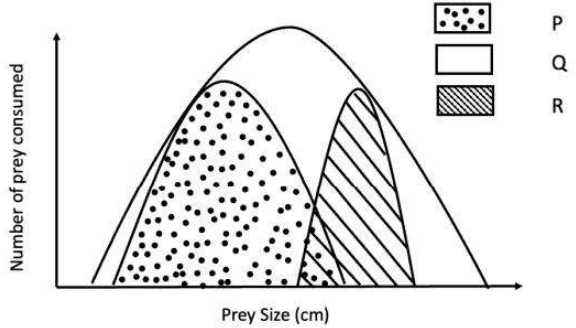
Which one of the following options correctly identifies the fundamental niche and realised niche of any one of the species?
- 1Fundamental niche – P; Realised niche – Q
- 2Fundamental niche – Q; Realised niche – P
- 3Fundamental niche – P; Realised niche – R
- 4Fundamental niche – R; Realised niche – P
Show answer and solution
The fundamental niche is the full range a species could use, here the widest curve Q. Competition narrows it to the realised niche, such as P.
The number of individuals of different species in two communities P and Q is given below.
| Species | P | Q |
|---|---|---|
| A | 59 | 21 |
| B | 12 | 20 |
| C | 44 | 23 |
| D | 20 | 12 |
| E | 11 | 19 |
| F | 10 | 14 |
| G | 2 | 1 |
| H | 5 | 13 |
| I | 3 | 13 |
| J | 30 | 12 |
Based on the given data, select the correct statement?
- 1Community P has higher species diversity than Q.
- 2Community Q has higher species diversity than P.
- 3Both communities P and Q are equally diverse.
- 4Data is not sufficient to compute species diversity.
Show answer and solution
Both communities have 10 species, but P is dominated by species A (59) and C (44), while Q’s counts are far more even. Q therefore has the higher Shannon or Simpson diversity.
You are sampling birds in a forest community to determine species diversity of birds in this region. How would you assess the sampling effort to ensure that you have obtained a reasonable estimate of the diversity in the region?
- 1Based on the species accumulation curve.
- 2You cannot determine this, as sampling effort and species richness are independent of one another.
- 3Based on the calculation of Morisita-Horn similarity index.
- 4Based on the calculation of Simpson’s diversity index.
Show answer and solution
Plot species found against sampling effort. When the species accumulation curve levels off, further sampling adds few new species, and effort is adequate.
The two phylogenetic trees given below represent evolutionary patterns in species or population. The differently colored or dashed lines represent a single species or gene genealogy.
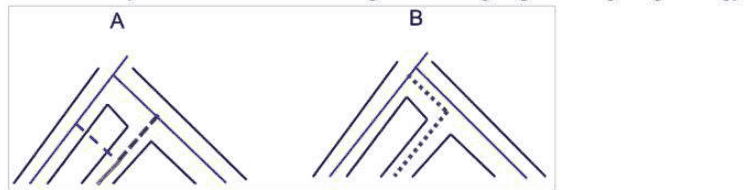
Select the option that correctly identifies the type of evolutionary process that these two figures represent.
- 1A- hybridization, B – incomplete lineage sorting
- 2A- convergence, B – incomplete lineage sorting
- 3A- adaptive introgression, B – hybridization
- 4A – hybridization, B – adaptive introgression
Show answer and solution
In A, a segment of one lineage’s genealogy appears inside another species, which means gene flow, or hybridisation. In B, the gene tree differs from the species tree with no gene flow, because ancestral polymorphism persisted: incomplete lineage sorting.
The following statements are potential explanations for the continued existence of genes that control eye development in eyeless cavefish.
- A. They have inherited these genes from their ancestors and this remains even though they no longer have eyes.
- B. In case of a possibility that they return to the surface environment retention of vision would be advantageous, so evolution retains this trait.
- C. Evolution can only lead to gain of a trait, not loss of a trait.
- D. These genes are retained because of combined role of these genes with other sensory mechanisms.
Which one of the following options represents the combination of correct statements?
- 1A and B
- 2B and C
- 3A and D
- 4C and D
Show answer and solution
Eye genes are inherited from sighted ancestors (A), and many, such as Pax6, have other roles in sensory and brain development, so selection keeps them (D). Evolution cannot plan for a return to the surface (B), and traits can certainly be lost (C).
Column X lists evolutionary ideas and scientists who proposed them, and Column Y lists the description of these ideas.
| Column X | Column Y | ||
|---|---|---|---|
| A. | Modern synthesis by Julian Huxley | I. | A stochastic process where lineages show random geneological relationships when traced back in time. |
| B. | Phyletic gradualism by Charles Darwin | II. | Evolutionary change appears instantaneous between geological sedimentary layers. |
| C. | Punctuated equilibrium by Stephen Jay Gould and Niles Eldredge | III. | Synthesis between Mendelian genetics, population genetics, and selection theory. |
| D. | Coalescent model (inspired by) Wright- Fisher model | IV. | New species arise by the gradual transformation of ancestral species. |
Which one of the following options represents all correct matches between Column X and Column Y?
- 1A-iii, B-iv, C-ii, D-i
- 2A- i, B-ii, C-iv, D-iii
- 3A-ii, B-iv, C-iii, D-i
- 4A-iv, B-i, C-ii, D-iii
Show answer and solution
Huxley’s Modern Synthesis joins genetics and selection (iii). Darwin’s phyletic gradualism is slow transformation of one species into another (iv). Punctuated equilibrium predicts abrupt change between strata (ii). The coalescent traces random genealogies back in time (i).
Males of a species of grasshopper produce loud calls to attract females. Most energy of these calls lie in the species-specific frequency, while other frequencies have much less energy. This is depicted in a power spectrum (plots with solid line in the figures below). Females find males by listening to and recognizing the species-specific call, and they are most sensitive to the species-specific frequency. This is depicted using hearing threshold curves (plots in dashed lines in the figures below). This allows females to find even the softest calling males of their own species and ignore even the loud callers of other species, resulting in reproductive isolation.
Which one of the following figures represents the correct option for the hearing threshold (dashed lines) of females, given the power spectrum (solid lines) of male calls of this grasshopper species?
- 1

- 2

- 3

- 4

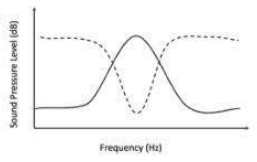

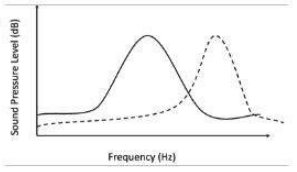
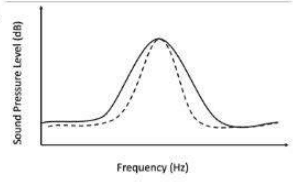
Show answer and solution
Females should be most sensitive, with the lowest hearing threshold, exactly at the frequency where the male call has most energy. The dashed threshold curve should dip where the solid power spectrum peaks, as in figure 1.
Behavioral and cognitive responses in organisms are finely tuned to environmental cues. Given below is a list of specific hormone/chemical signals (Column X) and biological functions (Column Y).
| Hormone/Chemical signal (Column X) | Function (Column Y) | ||
|---|---|---|---|
| A. | Cortisol | I. | movement and coordination |
| B. | Adrenaline | II. | sleep-wake cycle |
| C. | Melatonin | III. | stress response |
| D. | Dopamine | IV. | flight or fright response |
Select the option that represents all correct matches between Column X and Column Y.
- 1A-ii; B-iv; C-i; D-iii
- 2A- iii; B- iv; C-ii; D-i
- 3A-iv; B-iii; C- i; D-ii
- 4A-iv; B-i; C-ii; D-iii
Show answer and solution
Cortisol: stress response. Adrenaline: fight-or-flight. Melatonin: sleep–wake cycle. Dopamine (nigrostriatal pathway): movement and coordination.
Many species of birds call at dawn in temperate regions. The phenomenon is referred to as “Dawn Chorus”. Several explanations have been proposed for this. Which one of the options is NOT a correct explanation for the occurrence of “Dawn Chorus”?
- 1Transmission of sound is better at dawn due to colder temperature at that time.
- 2Singing at dawn is costly as the birds are low on energy. This makes singing at dawn a handicap and thereby indicates honest signalling.
- 3Dawn chorus allows birds to utilise a time window for singing which does not interfere with their feeding time.
- 4The syrinx muscles are unable to move freely after early morning, resulting in poorer control over song production at later times of the day.
Show answer and solution
Better sound transmission in cool, still dawn air (1), honest signalling while low on energy (2) and avoiding clashes with feeding time (3) are all proposed explanations. Nothing stops the syrinx muscles from working later in the day, so option 4 is not an explanation.
Two batches of antibodies (Q and R) were generated for an antigen and affinities of both the antibodies were assayed using pure antigen. Given below are Scatchard plots obtained for the antibody-antigen binding assays and the inferences drawn upon Scatchard analysis.
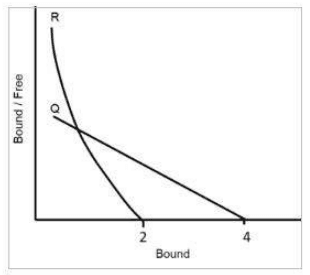
- A. Antibody Q is possibly a monoclonal while R is polyclonal
- B. The curved nature of Scatchard plot for R indicates that it cross-reacts with the blocking reagent
- C. The average affinity of R is more than affinity of Q to the antigen
- D. Antibody Q is possibly IgA and R is IgG
- E. The valency of the antibodies cannot be inferred from the Scatchard plots.
Select the option that groups all the correct inferences.
- 1A, B, C
- 2B, D, E
- 3A, C, D
- 4B, C, E
Show answer and solution
The straight Scatchard line for Q means one affinity, as from a monoclonal. The curved line for R means mixed affinities, as from a polyclonal (A). R’s steeper initial slope means a higher average affinity (C). The x-intercepts (4 versus 2 sites) fit a dimeric IgA for Q and an IgG for R (D).
Given below are a few statements on mapping populations and marker-assisted selection (MAS):
- A. MAS can be used to eliminate undesirable genotypes early in the breeding program by screening plants at the seedling stage.
- B. In backcross breeding programs, breeders use molecular markers to select against the donor genome to accelerate recovery of the recurrent parent genome.
- C. Among different types of mapping populations, F2 and F2:3 populations are immortal populations.
- D. Near Isogenic Lines (NILs) can be produced by repeated self-pollination of F1.
Which one of the following options represents the combination of all correct statements?
- 1A and D
- 2B and D
- 3C and A
- 4A and B
Show answer and solution
MAS lets breeders discard poor genotypes at the seedling stage (A). Background selection against the donor genome speeds recovery of the recurrent parent (B). F2 and F2:3 populations are not immortal, and NILs come from backcrossing, not selfing.
Given below are some statements that are associated with transgenic plants. Each statement has a blank space indicated by ‘_______’.
- A. A transgenic plant with two functional copies of a transgene can segregate in a ______ ratio for the transgenic phenotype on self-pollination if the two genes are linked.
- B. The ______ system can be used for removal of marker genes from transgenic plants.
- C. The endogenous plant gene, ______, can be used to engineer resistance to imidazolinone herbicides.
- D. Variations in transgene expression levels between five independent transgenic lines generated using the same T-DNA construct can be due to _________.
Which one of the following options has the correct sequence of terms that can be used to fill in the blanks in the above statements (from A to D) such that all statements become true?
- 1A-9:3:3:1; B-Cre/loxP; C-ALS; D-codon usage of the transgene
- 2A-3:1; B-FLP/FRT; C-bar; D-copy number of transgene
- 3A-3:1; B-Cre/loxP; C-ALS; D-position effect
- 4A-1:2:1; B-FLP/FRT; C-EPSPS; D-position effect
Show answer and solution
Two tightly linked copies segregate as one locus, giving 3:1. Cre/loxP removes marker genes. Mutant ALS (AHAS) gives imidazolinone resistance. Variation between independent lines comes from the position effect of where the transgene lands.
Given below are some statements with blank spaces indicated by ‘_______’.
- A. A plasmid cloning vector digested with an enzyme (with a single restriction site in the plasmid) that generates 3’ overhangs can be made blunt-ended using _______________.
- B. DNA with a nucleotide composition of 30% A, 35% G, 20% C and 15% T is most likely _____________.
- C. Production of only truncated molecules of transgene-derived mRNA in transgenic plants generated using a transgene from a prokaryotic source is most likely due to __________.
- D. _________ is a method for identifying the positions where individual DNA-binding proteins attach to a genome.
Which one of the following options has the correct sequence of terms that can be used to complete the above statements (from A to D) such that all statements become true?
- 1A – Taq polymerase; B – single-stranded; C – presence of mRNA instability sequences; D – FISH
- 2A – Pfu polymerase; B – double-stranded; C – codon usage variations; D – ChIP-seq
- 3A – Mung bean nuclease; B – single-stranded; C – presence of potential poly-adenylation signals in the transgene sequence; D – ChIP-seq
- 4A – Reverse transcriptase; B – single-stranded; C – absence of polyA signal; D – PFGE
Show answer and solution
Mung bean nuclease trims single-stranded overhangs to blunt ends. A ≠ T and G ≠ C, so the DNA is single-stranded. AT-rich prokaryotic genes contain cryptic polyadenylation signals (AAUAAA-like) that cut transcripts short in plants. ChIP-seq maps where proteins bind across the genome.
Shown below is the proton coupled carbon-13 NMR spectrum of sodium trimethylsilylpropanesulfonate (DSS), a common internal chemical shift standard used in NMR spectroscopic studies of proteins and peptides. Also shown on the spectrum is the structure of DSS in which the different carbon atoms have been labeled a-f. The peaks in the NMR have been labeled 1-4.
Which of the following represents the correct assignments for the carbons in DSS? (Hint – The nuclear spin quantum numbers of 1H and 13C are I = 1/2)
- 1peak 1 – carbon a, peak 2- carbon b, peak 3 – carbon c, peak 4 – carbons d, e and f
- 2peak 1 – carbon f, peak 2 – carbon e, peak 3 – carbon d, peak 4 – carbons a, b and c
- 3peak 1 – carbon d, peak 2 – carbon e, peak 3 – carbon f, peak 4 – carbons a, b and c
- 4peak 1 – carbon e, peak 2 – carbon f, peak 3 – carbon d, peak 4 – carbons a, b, and c
Show answer and solution
In a proton-coupled spectrum, CH3 gives a quartet and CH2 a triplet. Peak 4 (about 0 ppm, quartet) is the three Si–CH3 carbons (a, b, c). Peak 1 (about 57 ppm) is CH2 beside the sulfonate (f), peak 2 (about 22 ppm) the middle CH2 (e) and peak 3 (about 18 ppm) Si–CH2 (d).
Shown below are the CD spectra of a protein recorded under two different conditions.
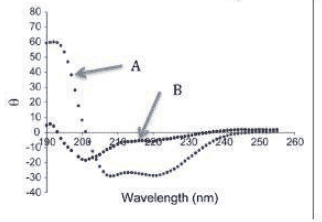
From the options given below, select the one that is the best interpretation of the spectra.
- 1The protein has α helical secondary structure under condition A that is denatured under condition B.
- 2The protein has α helical secondary structure under condition A that is converted to β sheets under condition B.
- 3The spectra represent the tertiary fold of the protein with condition A corresponding to mixed α helical + β sheet fold and condition B corresponding to largely β sheet fold.
- 4The difference between the spectra under conditions A and B is due to lower protein concentration under condition B
Show answer and solution
Spectrum A has a positive band at about 192 nm and negative bands at 208 and 222 nm, the α-helix signature. Spectrum B has a single minimum near 200 nm, typical of random coil. Condition B has unfolded the helix.
The following statements were made about Laser Scanning Confocal Microscopy (LSCM).
- A. LSCM is a wide field technique with Köhler illumination system.
- B. Spatial resolution higher than that achieved in wide field imaging could be obtained if only the central portion of an Airy Disk is used to form an image.
- C. Scanning mirrors sweep the excitation beam over the sample point-by-point to build the image.
- D. An altered pinhole size does not make any impact on the resolution of the image.
- E. A photomultiplier tube (PMT) in LSCM helps in generating real colour of fluorophores.
Which one of the following options represents the combination of all correct statements?
- 1A, B and D
- 2C, D and E
- 3B and C only
- 4B and E only
Show answer and solution
A confocal microscope uses point scanning: mirrors raster the laser over the sample (C). The pinhole passes only the central Airy disk, which improves resolution and sectioning (B). It is not a wide-field technique, pinhole size does affect resolution, and PMTs record intensity only (colours are assigned afterwards).
In an experiment, immunophenotyping of human blood cells was done to analyse the relative number of CD8+ T cells and CD4+ T cells. The following antibody-fluorochrome conjugates for staining different blood cells were available:
i. CD19-FITC for B lymphocytes
ii. CD8-CY7 PE for T lymphocytes
iii. CD4-Cy7 PE for T lymphocytes
iv. CD3-PE for T lymphocytes
v. DAPI for nucleus
Which one of the following options gives the correct sequence of antibody-fluorochrome conjugates, to be used to sort the relative abundance of CD8+ and CD4+ cells in the given blood sample by FACS?
- 1DAPI and CD3-PE
- 2DAPI; CD3-PE; CD8-CY7 PE or CD4-Cy7 PE
- 3CD19-FITC and CD3-PE; CD8-CY7 PE or CD4-Cy7 PE
- 4DAPI; CD19-FITC and CD3-PE; CD8-CY7 PE and CD4-Cy7 PE
Show answer and solution
DAPI marks nucleated or dead cells for gating. CD19-FITC excludes B cells and CD3-PE identifies T cells. CD8 and CD4 then split the T cells; because both carry Cy7-PE they must be stained in separate tubes. NTA’s key lists all of these (option 4), and this solution follows that key.
Given below are the approximate lengths of DNA fragments obtained on agarose gel electrophoresis following restriction digestion of a 3kb circular plasmid with different restriction enzymes:
| BamHI | 0.5kb, 2.5kb |
|---|---|
| HincII | 3 kb |
| EcoRI | 3 kb |
| EcoRI + BamHI | 0.5kb, 1kb, 1.5kb |
| EcoRI + HincII | 1.3kb, 1.7kb |
| BamHI + HincII | 0.2kb, 0.3kb, 2.5kb |
Based on the above information, which one of the following statements is INCORRECT?
- 1HincII and EcoRI have a single recognition site each in the plasmid.
- 2HincII site is located between two BamHI sites.
- 3The distance between EcoRI and BamHI sites is less than that between the HincII site and BamHI sites.
- 4HincII is located closer to one BamHI site than the other.
Show answer and solution
BamHI cuts twice (0.5 + 2.5 kb), and EcoRI and HincII once each. EcoRI splits the 2.5 kb Bam fragment into 1 + 1.5 kb. HincII splits the 0.5 kb Bam fragment into 0.2 + 0.3 kb. So EcoRI is 1–1.5 kb from a BamHI site, farther than HincII (0.2–0.3 kb), and statement 3 is incorrect.
Changes in NTA’s final answer key
Dropped: Q50 (marks given to everyone). Two options accepted: Q44. Every other question has the single answer shown.
How to revise from this paper
- Attempt it in one 3-hour sittingAnswer 15 in Part A, 35 in Part B and 25 in Part C, as in the real exam, before you check any answers.
- Score it with negative markingAdd 2 or 4 marks for each correct answer and subtract 0.5 or 1 for each wrong one. That is the number to track.
- Sort your mistakes by unitUse the unit tag on each question. Two or three wrong answers in the same unit tell you where to revise first.
- Repeat with a fresh paperTake a full-length mock a week later and compare your unit-wise mistakes.
Keep going