

All 145 questions from the CSIR-NET Life Sciences June 2023 paper (Shift 1), typed out in full, with NTA’s final answer key, a worked solution for every question and every diagram.
The Joint CSIR-UGC NET December 2022–June 2023 cycle held its Life Sciences exam on 6 June 2023 in two shifts. This page covers the morning shift (Shift 1, 9 am to 12 pm). Below you will find every question from Part A (General Aptitude), Part B and Part C, in the order they appeared, each tagged with its syllabus unit. Tap Show answer and solution under any question to check the official answer and see how to reach it.
Marking scheme
| Part | Questions | Answer | Marks each | Wrong answer | Max marks |
|---|---|---|---|---|---|
| A: General Aptitude | Q1–20 | 15 | 2 | −0.5 | 30 |
| B: Life Sciences | Q21–70 | 35 | 2 | −0.5 | 70 |
| C: Life Sciences | Q71–145 | 25 | 4 | −1 | 100 |
| Total | 145 | 75 | 200 |
Which units this paper tested
We tagged each of the 125 Part B and Part C questions with its CSIR-NET syllabus unit. In this paper, System Physiology – Plant, Evolution and Behavior and Ecological Principles carried the most questions.
Practise any unit across all 11 papers, with every question linked to a worked solution:
Jump to a question
Part A: General Aptitude (Q1–20)
20 questions; answer any 15. Each carries 2 marks, and a wrong answer costs 0.5.
If 6 students occupy a bench, one bench will be left completely unoccupied. If 5 students occupy each bench, instead, one student will not find a seat. The number of students is
- 130
- 231
- 336
- 442
Show answer and solution
With b benches: 6(b − 1) = 5b + 1, so b = 7 and the number of students is 6 × 6 = 36.
Four villages A, B, C and D are connected in that order by a circular road. A car traveling with a uniform speed covers the distance between A and B in 43 minutes, B and C in 23 minutes, C and D in 19 minutes and D and A in 47 minutes. Which of the following will be closest to the time (in minutes) taken to travel from A to C with the same speed along a straight road?
- 142
- 266
- 345
- 421
Show answer and solution
The full circuit takes 43 + 23 + 19 + 47 = 132 minutes. A to C is 66 minutes either way round, so A and C are ends of a diameter. Diameter = circumference/π = 132/π ≈ 42 minutes.
A test consists of 20 questions and the students are awarded 4 marks for a correct answer, −1 mark for a wrong answer and 0 mark for an unattempted question. Which of the following could be a possible number of questions attempted by a student who secured 27 marks?
- 115
- 216
- 317
- 418
Show answer and solution
4c − w = 27, so w = 4c − 27. That gives (c, w) = (7, 1), (8, 5) or (9, 9), with 8, 13 or 18 questions attempted. (10, 13) would need 23 questions, more than 20.
A, B, C, D and E are members of a family. A is a doctor and wife of a lawyer. B is the brother of C and husband of a teacher. C is an engineer and daughter of the lawyer. Which of the following inferences can be definitely made?
- 1D is the lawyer
- 2E is the teacher
- 3A is the wife of D
- 4B is the son of A
Show answer and solution
B is C’s brother, so both are children of the lawyer, whose wife is A. B is married to the teacher, so neither B nor A is the lawyer or teacher; D and E share those roles in some order. The only definite inference is that B is A’s son.
Which of the following correspond to x, y and z, respectively in the following square where sum of elements in each column, row, and diagonal is the same?
| 16 | 11 | x |
|---|---|---|
| 17 | y | 13 |
| z | 19 | 14 |
- 1(17, 15, 13)
- 2(18, 15, 12)
- 3(12, 15, 17)
- 4(17, 16, 14)
Show answer and solution
Try (18, 15, 12): rows 16 + 11 + 18, 17 + 15 + 13 and 12 + 19 + 14 all give 45, as do the columns and both diagonals (16 + 15 + 14, 18 + 15 + 12). So x = 18, y = 15, z = 12.
P starts a business with an investment of Rs. 30 lakh. Two months later Q joined with Rs. 90 lakh. Subsequently R joined with Rs. 180 lakh. The year-end profit of Rs. 1.2 crore was distributed in proportion of the investment and duration in the partnership. If the profit received by R was Rs. 60 lakh, how many months after Q, did R join?
- 13
- 24
- 35
- 47
Show answer and solution
Shares of capital × months: P = 30 × 12 = 360, Q = 90 × 10 = 900. R’s share is half the profit, so 180m = 360 + 900 and m = 7 months. R joined in month 5, which is 3 months after Q.
If the difference between the two-digit numbers made from digits a and b is 27, the difference between a and b is
- 12
- 21
- 34
- 43
Show answer and solution
(10a + b) − (10b + a) = 9(a − b) = 27, so a − b = 3.
Two cards are drawn together at random from a deck of 52 playing cards. What is the probability to get one red and one black card?
- 11/2
- 213/51
- 326/51
- 4(26 × 25)/(52 × 51)
Show answer and solution
P = (26 × 26) / C(52, 2) = 676/1326 = 26/51.
ABCD is a square. EFGH is a rectangle inscribed within the square with its sides parallel to the diagonal AC of the square. The perimeter of the rectangle EFGH is 16. The side of the square is

- 18/√2
- 28
- 34
- 48√2
Show answer and solution
Triangles AEF and CGH are isosceles right triangles. With F at distance a from A, EF = a√2 and FG = (s − a)√2, so the perimeter is always 2s√2. 2√2s = 16 gives s = 8/√2 (= 4√2).
A square paper is folded twice to a square shape one-fourth in area to the original square. Then equilateral triangles and circles are cut as shown in the figure.
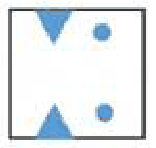
Which one of the following is a possible pattern on the fully unfolded paper?

- 1A
- 2B
- 3C
- 4D
Show answer and solution
Unfolding reflects the cuts across both fold lines. The edge triangles on the folds open into diamonds (and half-triangles on the outer edges), and the circles mirror into pairs. The mirror-symmetric arrangement this produces is B.
Two cylindrical candles A and B are of the same height. The radius of A is twice that of B. If A takes 120 minutes to completely burn, how long does B take to burn half its initial height?
- 160 min
- 230 min
- 315 min
- 410 min
Show answer and solution
A has 4 times B’s cross-section and so 4 times its wax. Burning wax at the same rate, B burns completely in 120/4 = 30 min, and half its height in 15 min.
A and B are circles of unit radius. Their centres are marked by ×. The area of the shaded region is (hint: area of an equilateral triangle of unit side length is √3/4)

- 12π/3 − √3/2
- 2(2√3/4 + π)
- 32π/3 + √3/2
- 42π/3 − √3/4
Show answer and solution
Each centre lies on the other circle, so each half of the lens is a 120° sector minus a triangle: π/3 − √3/4. The lens is twice this, 2π/3 − √3/2.
Three identical rings of radius 1 unit are stacked as shown in the figure. The length x is

- 12 + √3
- 22 + √2
- 32 + 2√(2/3)
- 43
Show answer and solution
The three centres form an equilateral triangle of side 2, height √3. Add one radius below the bottom centres and one above the top centre: x = 2 + √3.
Given graph depicts the data of people going to gym and deaths per year in different cities. Which of the following can be definitely concluded from the graph?

- 1Gym makes people fit and improves their health.
- 2None will die if all go to gym.
- 3Gym helps people to save their lives in cities.
- 4In the city where on the average 50% people go to gym, 50 people die per year.
Show answer and solution
The graph shows only a correlation, so it cannot prove that the gym saves lives or that nobody would die. All it supports is the reading at 50%: about 50 deaths per year.
Which of the following is INCORRECT?
- 131/2 + 31/2 + 31/2 = 31/2 × 31/2 × 31/2
- 241/3 + 41/3 + 41/3 + 41/3 = 41/3 × 41/3 × 41/3 × 41/3
- 351/4 + 51/4 + 51/4 + 51/4 + 51/4 = 51/4 × 51/4 × 51/4 × 51/4 × 51/4
- 461/6 + 61/6 + 61/6 + 61/6 + 61/6 + 61/6 = 61/6 × 61/6 × 61/6 × 61/6 × 61/6 × 61/6
Show answer and solution
Each left side is n · n1/k = n1+1/k, and the right side is nn/k. These match for 3 (k = 2), 4 (k = 3) and 5 (k = 4). For 6, the left is 67/6 but the right is 61, so option 4 is incorrect.
Choose the option that will make the following statement correct:
THE NUMBER OF TIMES THE LETTER “I” OCCURS IN THIS SENTENCE IS ___.
- 1FOUR
- 2FIVE
- 3SIX
- 4SEVEN
Show answer and solution
Without the blank, “I” occurs 5 times: TIMES, “I”, IN, THIS and IS. FIVE adds one I, making 6 (false). SIX adds one, making 6, which is true.
Mary and Mike are married to each other. John is Mary’s brother while Douglas is Mike’s brother. In a gathering of 2 children of Mary and Mike, 3 of John and 2 of Douglas, the number of first-cousin pairs (sibling’s children are first-cousins to each other) is
- 13
- 26
- 310
- 421
Show answer and solution
First cousins are children of siblings. Mary’s 2 with John’s 3 give 6 pairs, and Mike’s (the same 2) with Douglas’s 2 give 4. John’s and Douglas’s children are not related. Total 10.
In a round-robin tournament (each team plays with all other teams once) between 8 teams, a win fetched 3 points and a draw, 1. After each team had played 4 matches, the total of the points of the teams was 34. The number of drawn games among those played till then was
- 17
- 22
- 36
- 414
Show answer and solution
Matches played = 8 × 4/2 = 16. A win adds 3 points, a draw 2. If all were won the total would be 48, and each draw takes off 1: 48 − d = 34, so d = 14.
Suppose (729)22/3(81)x/2 = 3. The value of x is
- 1−21
- 2−21.5
- 3−22
- 4−20.5
Show answer and solution
72922/3 = 344 and 81x/2 = 32x. 44 + 2x = 1, so x = −21.5.
The possible number of integers between 1000 and 10000 containing two 2’s, one 0 and one 3 (for example, 2023 is such an integer) is
- 16
- 29
- 312
- 424
Show answer and solution
The digits 2, 2, 0, 3 can be arranged in 4!/2! = 12 ways; 3!/2! = 3 of them start with 0. That leaves 9.
Part B: Life Sciences (Q21–70)
50 questions; answer any 35. Each carries 2 marks, and a wrong answer costs 0.5.
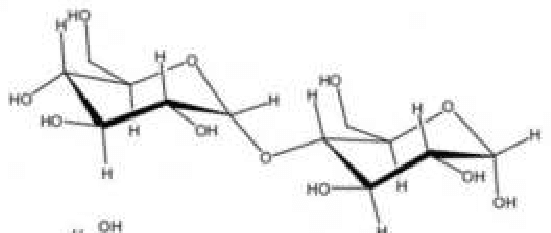
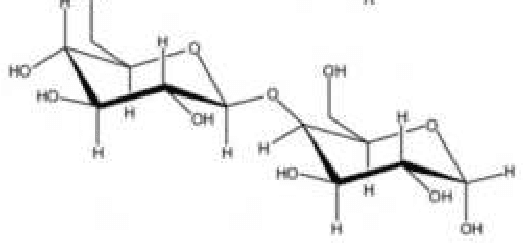
Which one of the following sugars will not reduce Tollen’s reagent?
- 1

- 2

- 3

- 4



Show answer and solution
A sugar reduces Tollens’ reagent if it has a free anomeric carbon (hemiacetal). In option 4 the two rings are joined through both anomeric carbons (a 1↔1 link, as in trehalose), so it is non-reducing.
The solubility of NaCl is greater in water than ethanol. What physical property of the solvent governs this difference?
- 1Surface tension
- 2Viscosity
- 3Dielectric constant
- 4Boiling point
Show answer and solution
NaCl dissolves when the solvent weakens the attraction between Na+ and Cl−. Water’s dielectric constant (~80) is much higher than ethanol’s (~24), so it separates the ions far better.
In mature erythrocytes, the end-product of glycolysis that contains the carbons of glucose is:
- 1ethanol
- 2pyruvate
- 3acetaldehyde
- 4lactate
Show answer and solution
Mature red cells have no mitochondria. Pyruvate is reduced to lactate by lactate dehydrogenase to regenerate NAD+.
The standard free energy (kJ mol−1) of hydrolysis of glucose-1-phosphate is:
- 1−40.3
- 2−35.8
- 3−7.7
- 4−20.9
Show answer and solution
Glucose-1-phosphate is a moderately high-energy phosphate ester: ΔG°′ of hydrolysis = −20.9 kJ/mol (glucose-6-phosphate is −13.8, PEP −61.9).
Which one of the following statements about LINEs present in the human genome is TRUE?
- 1LINEs preferentially localize to AT-rich DNA.
- 2LINEs cannot transpose independently.
- 3By parasitizing on the SINE element transposition machinery, LINEs can attain very high copy number.
- 4The Alu family is the most prominent LINE family in terms of copy number.
Show answer and solution
L1 elements concentrate in AT-rich, gene-poor DNA (G-dark bands), while Alu prefers GC-rich regions. LINEs are autonomous. It is SINEs that parasitise LINE machinery. Alu is a SINE, not a LINE.
Which one of the following changes is energetically favorable and occurs spontaneously in an aqueous solution?
- 1Formation of a bilayer from phospholipid molecules
- 2Dispersion of one oil droplet into many small ones
- 3Tearing of the lipid bilayer
- 4Conversion of a membrane vesicle to a flat bilayer
Show answer and solution
The hydrophobic effect makes phospholipids assemble into a bilayer spontaneously. Dispersing oil, tearing a bilayer or flattening a vesicle all expose more hydrophobic surface and cost free energy.
A temperature sensitive S. pombe mutant exhibits cell cycle arrest both, at the G1 to S, as well as at the G2 to M transition phases. This is possibly a mutant of:
- 1Clb1
- 2Cyclin B
- 3Cdc2 only
- 4Cdc2 and Clb3
Show answer and solution
Fission yeast has a single mitotic CDK, Cdc2, which drives both the G1/S and G2/M transitions, so one ts allele arrests at both. Clb proteins are budding-yeast cyclins.
In the context of protein import in the nucleus, which molecule is responsible for releasing the cargo from the importing receptor?
- 1Ras
- 2RhoA
- 3Ran
- 4Rock
Show answer and solution
In the nucleus, Ran-GTP binds importin β and forces the cargo off. The importin–Ran-GTP complex then returns to the cytoplasm.
Which one of the following mRNAs is most likely to be exported out of the nucleus?
- 1Spliced RNA associated with the poly A binding and cap binding complex.
- 2Mis-spliced RNA with multiple stop codons, for degradation in cytosol.
- 3Spliced RNA with the associated spliceosomal complex.
- 4Uncapped and unspliced RNA.
Show answer and solution
Only mature mRNA is licensed for export: spliced, capped (bound by the cap-binding complex), polyadenylated with PABP, and carrying export adaptors. Mis-spliced, spliceosome-bound or uncapped RNAs are kept back and degraded.
Which one of the following translation factors is used at the step of translation initiation and defined as anti-association factor for 30S and 50S subunit interactions?
- 1IF1
- 2IF2
- 3IF3
- 4RRF
Show answer and solution
IF3 binds the 30S subunit and stops it joining the 50S subunit, keeping a pool of free 30S for initiation. It also helps select the start codon.
Which one of the following codons is used to code for selenocysteine in Escherichia coli?
- 1UGA
- 2UAA
- 3UAG
- 4UCC
Show answer and solution
Selenocysteine is coded by UGA when a SECIS element in the mRNA recruits SelB with Sec-tRNASec.
Which of the following statements about site-specific recombinases is NOT true?
- 1The Cre recombinase is believed to mediate the circularization of the P1 phage genome during infection of the bacterial host.
- 2The λ integrase cannot mediate integration of the λ genome into the host genome without the help of accessory proteins.
- 3The Hin invertase-mediated recombination event is stimulated by protein-DNA interactions at a 60 bp enhancer sequence.
- 4In Xer recombinase-mediated monomerization of chromosomal dimers, the interaction of FtsK with XerCD activates XerC and initiates the recombination process.
Show answer and solution
In Xer recombination at dif, FtsK activates XerD, which makes the first strand exchange; XerC acts second. Statement 4 says XerC, so it is not true.
The mode of action of cholera toxin in causing diarrhoea is by:
- 1inactivating Gi protein.
- 2continuous activation of adenylyl cyclase.
- 3locking Gs protein in an inactive state.
- 4rapidly hydrolyzing GTP to GDP.
Show answer and solution
Cholera toxin ADP-ribosylates Gsα, blocking its GTPase. Gs stays on, adenylyl cyclase is continuously active, cAMP opens CFTR, and Cl− and water pour into the gut.
Which one of the following is the communicating junction linking adjacent cells in plants, which permits small molecules to pass from cell to cell while blocking the passage of most large molecules?
- 1Adherens junction
- 2Gap junction
- 3Plasmodesmata
- 4Hemidesmosome
Show answer and solution
Plasmodesmata are cytoplasmic channels through the plant cell wall that let small molecules pass between cells (about 1 kDa limit). Gap junctions are the animal equivalent.
The extracellular domain of a cell surface receptor (A) was switched with the extracellular domain of another receptor (B) to create a chimeric receptor (B-A). Assuming that there is no effect on the functionality of the domains in the chimeric receptor, what is the most likely outcome in the presence of the ligand for receptor B?
- 1The ligand will activate the pathway normally triggered by receptor A.
- 2The ligand will activate the pathway normally triggered by receptor B.
- 3The chimeric receptor will fail to transduce any signal in response to the ligand.
- 4The chimeric receptor will cause constitutive activation of the signalling pathway.
Show answer and solution
The ligand binds B’s extracellular domain, but the signal is passed on by A’s transmembrane and cytoplasmic domains. So ligand B triggers receptor A’s pathway.
Appressorium is expected to be formed during which one of the following diseases?
- 1Bacterial leaf blight in rice
- 2Bacterial wilt in tomato
- 3Powdery mildew in pea
- 4Leaf curl disease in tobacco
Show answer and solution
An appressorium is a fungal infection structure that presses on the host surface to penetrate it. Powdery mildew (Erysiphe) is fungal; blight and wilt are bacterial and leaf curl is viral.
Clonogenic neoblasts are involved in planarian (flatworm) regeneration. This is an example of:
- 1epimorphosis
- 2morphallaxis
- 3stem cell-mediated regeneration
- 4compensatory regeneration
Show answer and solution
Planarian neoblasts are adult pluripotent stem cells; they proliferate and differentiate to rebuild missing tissue.
Which one of the following describes an amphisome?
- 1It is an intermediate/hybrid organelle produced through the fusion of endosomes with autophagosomes within cells.
- 2It is a double-membrane sequestering vesicle that is the hallmark of the intracellular catabolic process called macroautophagy.
- 3It is a compartment formed when autophagosome fuses with a lysosome.
- 4It is a vacuole that arises when membranes of the ER sequester parts of the cytoplasm.
Show answer and solution
An amphisome forms when an autophagosome fuses with an endosome, before it fuses with a lysosome. Option 2 describes an autophagosome and option 3 an autolysosome.
Homeotic selector genes are responsible for the specification of Drosophila body parts. Which one of the following identities would you expect if the ultrabithorax gene is deleted?
- 1The third thoracic segment is transformed to another second thoracic segment and a fly with four wings.
- 2The third thoracic segment develops halteres.
- 3The second thoracic segment loses wings.
- 4The first and second thoracic segments fuse and wings are formed on the third thoracic segment.
Show answer and solution
Ubx gives the third thoracic segment its identity, including halteres. Without it T3 develops like T2, giving a four-winged fly.
Which one of the following root initials gives rise to the root vascular system, including the pericycle?
- 1Columella initials
- 2Epidermal-lateral root cap initials
- 3Cortical-endodermal initials
- 4Stele initials
Show answer and solution
In the Arabidopsis root, stele (vascular) initials give rise to the pericycle and the vascular tissues.
Which one of the following plant-derived molecules is widely used as an analgesic?
- 1Abscisic acid
- 2Salicylic acid
- 3Jasmonic acid
- 4Gibberellic acid
Show answer and solution
Salicylic acid, from willow bark, is the parent of aspirin (acetylsalicylic acid), the classic analgesic.
Which one of the following statements is INCORRECT?
- 1Avr proteins predominantly have SecA secretion signals.
- 2Avr proteins are secreted through the type III secretion system (T3SS).
- 3Hypersensitive response and pathogenicity (HRP) cluster proteins are involved in the secretion of Avr proteins.
- 4Some of the components of the T3SS pathway are conserved between animal- and plant-pathogenic bacteria.
Show answer and solution
Avr effectors are delivered by the type III secretion system, encoded in the hrp cluster, not by the Sec pathway. So statement 1 is incorrect.
During glycolysis in plants, alanine and related amino acids are directly produced from which one of the following precursors?
- 13-Phosphoglycerate
- 2Phosphoenolpyruvate
- 3Pyruvate
- 4Acetyl-CoA
Show answer and solution
Pyruvate is transaminated to alanine. Valine and leucine also come from pyruvate.
Which one of the following statements regarding PEPCase is INCORRECT?
- 1During the day, C4 PEPCase is inactive whereas CAM PEPCase is active.
- 2PEPCase is inactivated by dephosphorylation.
- 3PEPCase kinase phosphorylates PEPCase.
- 4The synthesis of PEPCase kinase is modulated by circadian rhythm in CAM leaves.
Show answer and solution
C4 PEPCase works during the day and CAM PEPCase at night, so statement 1 has them reversed. The kinase activates PEPCase by phosphorylation, and dephosphorylation inactivates it.
The hemolysis of red blood cells takes place when they are suspended in which one of the following solutions?
- 12.0% NaCl
- 21.5% NaCl
- 31.0% NaCl
- 40.5% NaCl
Show answer and solution
Plasma is isotonic with about 0.9% NaCl. 0.5% NaCl is hypotonic, so water enters the cells until they burst.
The non-ciliated cuboidal epithelial cells in bronchioles that secrete important defense markers are called
- 1Goblet cells
- 2Basal cells
- 3Langerhans cells
- 4Club cells
Show answer and solution
Club (Clara) cells are non-ciliated, dome-shaped cells in bronchioles. They secrete club cell secretory protein and surfactant components, and detoxify inhaled substances.
Which one of the following factors inhibits renin secretion?
- 1Increased level of plasma catecholamines.
- 2Increased blood pressure in the afferent arterioles leading to glomerulus.
- 3Increased activity of sympathetic nerves connected to kidney.
- 4Prostaglandins.
Show answer and solution
Juxtaglomerular cells act as baroreceptors: higher afferent arteriolar pressure stretches them and suppresses renin. Sympathetic (β1) input, catecholamines and prostaglandins all raise renin.
Which one of the following is correct regarding zeitgebers?
- 1Have no effect on biological rhythms
- 2Sense biological rhythms
- 3Synchronize biological rhythms
- 4Abolish biological rhythms
Show answer and solution
Zeitgebers (“time-givers”), such as light, temperature and feeding, entrain, or synchronise, the internal clock to the 24-h day.
Segregation of alleles can occur either at anaphase I or anaphase II of meiosis. Which one of the following is an ideal model system for identifying the stage at which allelic segregation occurred?
- 1Arabidopsis thaliana
- 2Drosophila melanogaster
- 3Neurospora crassa
- 4Saccharomyces cerevisiae
Show answer and solution
Neurospora produces ordered octads. A 2:2:2:2 spore pattern shows second-division (anaphase II) segregation, and 4:4 shows first-division segregation.
Based on the image given below, select the option that describes it correctly:
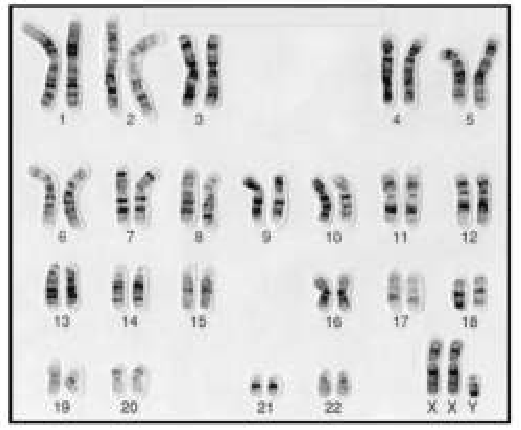
- 1Q-banded normal human karyotype.
- 2G-banded human karyotype depicting aneuploidy.
- 3C-banded karyotype depicting Klinefelter syndrome.
- 4G-banded normal human karyotype.
Show answer and solution
Giemsa bands after trypsin mean G-banding. The sex chromosomes are X, X, Y (47,XXY), so this is an aneuploid karyotype (Klinefelter syndrome).
Consider alleles ‘A’ and ‘a’ in a population. The frequency of heterozygotes will be highest when:
- 1Frequency of ‘A’ is more than frequency of ‘a’
- 2Frequency of ‘A’ is less than frequency of ‘a’
- 3Frequency of ‘A’ is equal to frequency of ‘a’
- 4Frequency of ‘A’ and ‘a’ affects the frequency of homozygotes, not heterozygotes
Show answer and solution
Heterozygote frequency 2pq = 2p(1 − p) is greatest at p = q = 0.5, when the alleles are equally frequent.
Recessive lethal alleles are never completely eliminated from the population because:
- 1lethal alleles are always conditional in nature.
- 2lethal alleles have selective advantage.
- 3lethal alleles protect organisms from other deleterious mutations.
- 4they are maintained in the population as heterozygotes.
Show answer and solution
As a recessive lethal becomes rare, almost all copies sit in heterozygotes, where selection cannot see them. Elimination slows sharply and mutation keeps replacing them.
Which one of the following mammalian species is distributed in evergreen forests?
- 1Nilgai
- 2Black buck
- 3Cheetah
- 4Lion-tailed macaque
Show answer and solution
The lion-tailed macaque is endemic to the Western Ghats evergreen rainforests. Nilgai and blackbuck live in open scrub and grassland, and the cheetah in grassland.
The grizzled giant squirrel, Ratufa macroura, naturally occurs in
- 1north-east India and Burma
- 2western Himalayas
- 3southern India and Sri Lanka
- 4Andaman and Nicobar islands
Show answer and solution
Ratufa macroura lives in riverine forests of southern India (Cauvery, Chinnar and Srivilliputhur) and Sri Lanka.
Which one of the following characteristics is NOT correct for bryophytes?
- 1All bryophytes are homosporous.
- 2Gametophyte is the dominant phase of the life cycle.
- 3The antherozoids are always biflagellate.
- 4Water is conducted by hydroids in all bryophytes.
Show answer and solution
Hydroids are water-conducting cells found only in some mosses, such as Polytrichum, not in all bryophytes. Liverworts and hornworts lack them, so statement 4 is not correct.
Which one of the following species of birds is known to migrate across the Himalayas?
- 1Sarus Crane
- 2Red-vented Bulbul
- 3Jacobin Cuckoo
- 4Bar-headed Goose
Show answer and solution
The bar-headed goose crosses the Himalayas, flying over 7,000 m between Central Asian breeding grounds and Indian wintering sites.
Which one of the following terms is used for species that exploit the same resources in a similar manner?
- 1Guild
- 2Taxonomic order
- 3Community
- 4Assemblage
Show answer and solution
A guild is a group of species that exploit the same resources in a similar way (Root, 1967).
Invasive species, in general grow very well in a new area that they invade, and often outcompete native species. An explanation for the better growth and propagation of invasive species in comparison to their native counterparts is provided by which one of the following hypotheses?
- 1Ecological niche hypothesis
- 2Intermediate disturbance hypothesis
- 3Enemy release hypothesis
- 4Biotic resistance hypothesis
Show answer and solution
The enemy release hypothesis says that invaders leave their natural enemies (herbivores and pathogens) behind and so outgrow natives that remain under attack.
A positive association between absolute average individual fitness and population size over some finite interval is known as
- 1Allee effect
- 2Founder effect
- 3Rensch’s rule
- 4Bergmann’s rule
Show answer and solution
The Allee effect: below some density, fitness rises with population size, through mate finding, group defence and similar benefits.
Given below are characteristic traits found in sun- or shade-acclimated leaves
- A. High dry mass per unit area
- B. Higher number of chloroplasts per area
- C. Lower Chl-a/Chl-b ratio
- D. Lower dark respiration per area
- E. Higher light harvesting complexes per area
Select the option that has all correct characteristics for shade-acclimated leaves?
- 1A, B and C
- 2C, D and E
- 3A, C and D
- 4B, C and D
Show answer and solution
Shade leaves are thinner, with lower mass per area (A is a sun trait) and fewer chloroplasts per area (B is a sun trait). They have a lower Chl a/b ratio, lower dark respiration and more light-harvesting complex: C, D and E.
Which one of the following statements is correct for a primary successional species?
- 1These species do not follow specific survivorship curves.
- 2These species show Type II survivorship curve.
- 3These species show Type III survivorship curve.
- 4These species show Type I survivorship curve.
Show answer and solution
Primary-succession pioneers are r-selected: they produce huge numbers of small propagules, most of which die early. That is a Type III survivorship curve.
Directional Selection for a particular trait will lead to the frequency of the trait:
- 1being normally distributed in the population.
- 2always showing a left-skewed distribution in the population.
- 3always showing a right-skewed distribution in the population.
- 4showing either a right- or a left-skewed distribution in the population.
Show answer and solution
Directional selection favours one extreme, so the trait distribution is pushed and skewed toward whichever end is favoured, left or right depending on the direction.
Given that Asian Koel is a brood parasite, which one of the following statements is TRUE for this species?
- 1The brood of the bird is usually infested with parasitic wasps.
- 2The young ones learn the calls of their foster parents.
- 3The bird feeds parasitic wasps to its brood.
- 4The call of the species is innate and not learned.
Show answer and solution
Koel chicks are raised by crows, so they never hear an adult koel. Yet they produce the koel call, so the call must be innate, not learned.
The following terms represent different methods in phylogenetic tree constructions.
- A. Unweighted Pair Group Method Using Arithmetic Average (UPGMA)
- B. Minimum Evolution (ME) method
- C. Maximum Parsimony (MP) method
- D. Maximum Likelihood (ML) method
Select the option that represents all distance-based methods?
- 1A and B
- 2B and C
- 3C and D
- 4A and D
Show answer and solution
UPGMA and minimum evolution (like neighbour-joining) work from a pairwise distance matrix. Parsimony and maximum likelihood are character-based.
Which one of the following types of promoters would NOT be used within the T-DNA for expression of a negative selection marker gene for generation of transgenic plants by Agrobacterium-mediated transformation?
- 1strong constitutive promoter
- 2tissue-specific promoter
- 3substrate-inducible promoter
- 4stress-inducible promoter
Show answer and solution
A negative selection marker (such as codA, which turns 5-fluorocytosine into toxic 5-fluorouracil) kills the cells that express it. NTA’s key treats it as needing controlled expression, from tissue-, substrate- or stress-inducible promoters, so that transformed tissue can still regenerate. On that reasoning a strong constitutive promoter is the one not used.
Which one of the following statements regarding molecular markers for genotyping is INCORRECT?
- 1Polymorphism in intronic regions of a gene cannot be used for trait mapping.
- 2Codominant molecular markers can be used to detect heterozygosity.
- 3Sequence Tagged Microsatellite Sites (STMS) and Simple Sequence Repeat Polymorphisms (SSRPs) are based on polymorphisms in repetitive DNA sequences.
- 4Restriction Fragment Length Polymorphisms (RFLPs) and Simple Sequence Repeats (SSRs) are multi-allelic markers.
Show answer and solution
Intronic SNPs and indels are inherited like any other variant and are widely used as markers in linkage and association mapping. Statement 1 is therefore incorrect. Co-dominant markers do reveal heterozygotes, and SSRs and RFLPs can have many alleles.
A patient was injected with Purified Protein Derivative (PPD) to diagnose TB disease or a previous exposure to Mycobacterium tuberculosis. The injected area, when inspected after 48-72 hours was found to develop induration (thick, hardened bulge). Which of the following cells will be predominant at this site?
- 1Neutrophils and mast cells
- 2Helper T cells and macrophages
- 3Eosinophils and mast cells
- 4Natural killer and dendritic cells
Show answer and solution
The tuberculin (Mantoux) reaction is type IV delayed-type hypersensitivity. Memory Th1 cells release IFN-γ, which recruits and activates macrophages and produces induration after 48–72 h.
The flowers of which one of the following plant species is used by indigenous communities of Central India to make an intoxicant for consumption?
- 1Mahua (Madhuca spp.)
- 2Monkey-puzzle tree (Araucaria spp.)
- 3Rhododendron (Rhododendron spp.)
- 4Elephant grass (Pennisetum spp.)
Show answer and solution
Tribal communities in central India ferment and distil mahua (Madhuca longifolia) flowers into a traditional liquor.
Which one of the following methods is best suited to estimate the population size of fish?
- 1Camera Trap
- 2Line Transect
- 3Point count
- 4Mark-Recapture
Show answer and solution
Fish move and are hidden underwater, so they cannot be counted visually. Mark–recapture (the Lincoln–Petersen estimate, N = MC/R) is the standard method.
Which one of the following factors will NOT have any impact on the resolving power of a bright field microscope?
- 1Color of light
- 2Intensity of light
- 3Angle of admittance of light in the objective lens
- 4Medium between the objective lens and specimen
Show answer and solution
Resolution d = 0.61λ/NA depends on wavelength (colour) and numerical aperture, which is set by the half-angle and the medium’s refractive index. Light intensity affects brightness only.
Part C: Life Sciences, analytical (Q71–145)
75 questions; answer any 25. Each carries 4 marks, and a wrong answer costs 1.
What is the pH of a 10−7 M solution of HCl?
- 16.00
- 26.79
- 37.00
- 47.50
Show answer and solution
At such low concentration, water’s own H+ counts. [H+]([H+] − 10−7) = 10−14 gives [H+] = 1.62 × 10⁻⁷ M, so pH = 6.79.
A polypeptide was subjected to the following treatments with the indicated results.
I. Acid hydrolysis: (1) (Ala, Arg, Cys, Glx, Gly, Lys, Leu, Met, Phe, Thr)
II. Aminopeptidase M: (2) No fragments.
III. Carboxypeptidase A + Carboxypeptidase B: (3) No fragments.
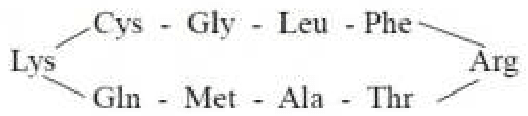
IV. Trypsin followed by Edman degradation of the separated products: (4) Cys-Gly-Leu-Phe-Arg; (5) Thr-Ala-Met-Gln-Lys
Which one of the following represents the primary structure of the peptide?
Option 4 refers to this cyclic peptide:
- 1Thr-Ala-Met-Gln-Lys-Cys-Gly-Leu-Phe-Arg
- 2Cys-Gly-Leu-Phe-Arg-Thr-Ala-Met-Gln-Lys
- 3Gln-Lys-Cys-Gly-Leu-Thr-Ala-Met-Phe-Arg
- 4Cyclic peptide shown above
Show answer and solution
Neither aminopeptidase nor carboxypeptidase releases anything, so the peptide has no free N- or C-terminus: it is cyclic. Trypsin cuts after Arg and Lys, opening the ring into Cys-Gly-Leu-Phe-Arg and Thr-Ala-Met-Gln-Lys. So Arg is joined to Thr and Lys to Cys, as in the cyclic structure.
Consumption of untreated corn as the staple food causes the disease, pellagra. Pre-treatment of corn with Ca(OH)2 prevents this disease. Given below are options listing possible effects of Ca(OH)2 treatment (Column X) and the enzymes affected (Column Y).
| Possible effects of Ca(OH)2 treatment (Column X) | Enzyme/s affected (Column Y) | ||
|---|---|---|---|
| A | Release of Vitamin B3 upon Ca(OH)2 treatment | i | Activity of trypsin |
| B | Alkaline pH aids in digestion. | ii | Enzymes of the TCA cycle |
| C | Ca improves bone strength | iii | Activity of NAD-dependent dehydrogenases |
| D | Prevents formation of ROS | iv | Activity of cathepsin K |
Select the correct match relevant for preventing pellagra from the options listed below.
- 1C – iv
- 2B – i
- 3A – iii
- 4D – ii
Show answer and solution
Corn niacin is bound (niacytin) and cannot be absorbed. Alkali treatment (nixtamalisation) releases vitamin B3, which is needed to make NAD+ for the NAD-dependent dehydrogenases. So A–iii.
Aspartate (Asp) is an amino acid with the structure NH2-CH(CH2-COOH)-COOH. Given below are biosynthetic processes occurring in cells:
- A. protein synthesis
- B. de novo synthesis of inosine monophosphate and orotic acid
- C. synthesis of adenosine monophosphate from inosine monophosphate
- D. glutathione synthesis
Which one of the following options correctly represents all the biosynthetic process(es) wherein Asp is involved as a precursor?
- 1A only
- 2A, C and D
- 3A and C only
- 4A, B and C
Show answer and solution
Asp is used in protein synthesis (A). It supplies N1 of the purine ring in de novo IMP synthesis and condenses with carbamoyl phosphate to make orotate (B). It also donates the amino group in IMP → adenylosuccinate → AMP (C). Glutathione is γ-Glu-Cys-Gly, with no Asp. Answer: A, B and C.
The following statements are made regarding conversion of pyruvate to acetyl-CoA going from glycolysis to citric acid cycle:
- A. Oxidation of pyruvate to acetyl-CoA is reversible.
- B. Pyruvate is transported into the mitochondrion by a transporter.
- C. Pyruvate is carboxylated by pyruvate dehydrogenase.
- D. Acetyl lipoamide reacts with coenzyme A to form acetyl-CoA.
- E. The flavoprotein, dihydrolipoyl dehydrogenase, containing flavin adenine dinucleotide (FAD), is involved in conversion of pyruvate to acetyl-CoA.
Which one of the following options represents the combination of all correct statements?
- 1A, B and C
- 2B, C and D
- 3C, D and E
- 4B, D and E
Show answer and solution
Pyruvate dehydrogenase is irreversible (A false) and decarboxylates pyruvate (C false). Pyruvate enters via the mitochondrial pyruvate carrier (B). Acetyl-lipoamide transfers the acetyl group to CoA (D). The E3 enzyme, dihydrolipoyl dehydrogenase, is an FAD flavoprotein (E). Answer: B, D and E.
Some properties of enzymes are listed in column X, and their kinetic expressions are listed in column Y.
| Enzyme properties (Column X) | Expressions (Column Y) | ||
|---|---|---|---|
| A. | Specific activity | i. | kcat/Km |
| B. | Turnover number | ii. | substrate concentration at which v = (Vmax)/2 |
| C. | Michaelis constant | iii. | Vmax/moles of enzyme |
| D. | Catalytic efficiency | iv. | Vmax/protein concentration |
Which one of the following options represents all correct matches between Column X and Column Y?
- 1A – ii, B – i, C – iii, D – iv
- 2A – iii, B – ii, C – iv, D – i
- 3A – iv, B – iii, C – ii, D – i
- 4A – i, B – iv, C – ii, D – iii
Show answer and solution
Specific activity = activity per mg protein (A–iv). Turnover number kcat = Vmax/[E] (B–iii). Km is the [S] at half Vmax (C–ii). Catalytic efficiency = kcat/Km (D–i).
A researcher isolated chromatin from mammalian cells and digested with micrococcal nuclease in different tubes for 1 h, 3 h, 6 h, and 12 h. Thereafter, DNA was purified from all the digested chromatin samples, and two independent Southern blot hybridization experiments were performed with probe-I and probe-II. The probe-I and probe-II correspond to different loci of the chromosome(s). The images below represent the Southern blot hybridization pattern generated by probe-I and probe-II.
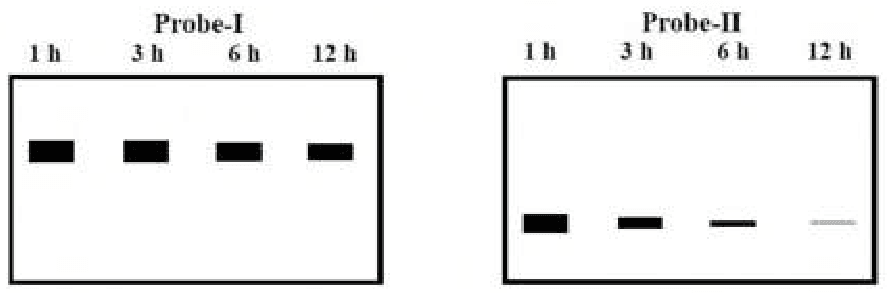
Following statements were made to explain the results of the Southern blot experiments.
- A. Size of probe-II is smaller than probe-I.
- B. Probe-I may correspond to the centromeric region of the chromosome.
- C. Probe-I may correspond to a hypomethylated locus of the genome.
- D. Probe-II may correspond to an euchromatic locus of the genome.
Which one of the following options represents the combination of all correct statements?
- 1A and C
- 2B and D
- 3A only
- 4B only
Show answer and solution
Probe-I’s band does not change with longer MNase digestion, so its locus is tightly packed and protected, like centromeric heterochromatin. Probe-II’s band fades steadily, so its DNA is accessible euchromatin. Band intensity says nothing about probe size, and heterochromatin is usually hypermethylated. Answer: B and D.
The following statements were made about the structure of the 30-nm chromatin fiber:
- A. In the solenoid model, the linker DNA connects the consecutive core particles.
- B. In the zig-zag model, alternating nucleosomes become interacting neighbors.
- C. In the solenoid model, 12 nucleosomes are organized into two separate stacks, whereas 8 nucleosomes per turn make a single stack in the zig-zag model.
- D. H1 histone is essentially required as per the zig-zag model, but not as per the solenoid model.
- E. Chromatin fibers prepared with H4 histones that lack their tails could fold into higher-order fibers.
Which one of the following options represents the combination of all correct statements?
- 1A, C and D
- 2A, B and E
- 3A and B only
- 4C and E only
Show answer and solution
In the solenoid, consecutive nucleosomes stack along a single helix joined by linker DNA (A). In the zig-zag two-start model, alternate nucleosomes (i and i + 2) contact each other (B). C swaps the two models’ features, H1 helps both models (D false), and the H4 tail is essential for folding (E false). Answer: A and B only.
The following statements were made about cell cycle regulation in fission yeast:
- A. A cdc25 mutant cannot enter mitosis due to its inability to remove the inhibitory phosphate.
- B. Wee1 consistently maintains the Cdk in an active state, to maintain cell size during cell cycle.
- C. CAK (Cdk-activating kinase)-mediated phosphorylation of Threonine 161 residue of Cdc2 is necessary, but not sufficient, for the Cdk to be active.
- D. Activation of Sic1 in G1 allows the cyclin–Cdk that is present in the cell to initiate DNA replication.
- E. sic1 mutant exhibits activation of premature DNA replication from fewer origins and extension of the duration of S phase.
Which one of the following options represents the combination of all correct statements?
- 1A, B and D
- 2A, C and E
- 3B, D and E
- 4A, C and D
Show answer and solution
Cdc25 removes Wee1’s inhibitory Tyr15 phosphate (A). CAK phosphorylation of Thr161 is needed but not enough (C). Without Sic1, S-phase CDK fires too early, from fewer origins, and S phase lengthens (E). Wee1 inhibits Cdk (B false), and Sic1 is a CDK inhibitor, so its destruction allows replication (D false). Answer: A, C and E.
In the context of signaling, the enzyme protein kinase C (PKC) depends on multiple molecules for its complete activation. This activation depends on the presence of:
- A. phosphatidylserine at the inner leaflet of the plasma membrane.
- B. Ca2+
- C. phosphatidylethanolamine at the inner leaflet of the plasma membrane.
- D. diacylglycerol present in the inner leaflet of the plasma membrane.
Which one of the following options represents the combination of all correct molecules?
- 1A, B and C
- 2A, C and D
- 3B, C and D
- 4A, B and D
Show answer and solution
Conventional PKC moves to the membrane when Ca2+ binds its C2 domain. There it needs phosphatidylserine and diacylglycerol (C1 domain) on the inner leaflet. PE is not required. Answer: A, B and D.
Match the eukaryotic cellular organelles listed in Column X with their typical function from among those listed in Column Y.
| Organelles (Column X) | Function (Column Y) | ||
|---|---|---|---|
| A. | Golgi | (i) | Ribosomes assembly |
| B. | Nucleolus | (ii) | O-linked Glycosylation |
| C. | Peroxisomes | (iii) | Site for lipid synthesis |
| D. | ER | (iv) | Oxygen utilization |
Which one of the following options represents all correct matches between Column X and Column Y?
- 1A-(iii), B-(iv), C-(ii), D-(i)
- 2A-(ii), B-(i), C-(iv), D-(iii)
- 3A-(ii), B-(iii), C-(i), D-(iv)
- 4A-(iii), B-(i), C-(iv), D-(ii)
Show answer and solution
Golgi: O-linked glycosylation. Nucleolus: ribosome assembly. Peroxisome: oxidases that use O2, making H2O2. ER: lipid synthesis. That is A–ii, B–i, C–iv and D–iii.
In eukaryotes, microtubules and actin-binding proteins influence the dynamics and organization of the cytoskeleton. Match the cytoskeleton-binding proteins listed in column B, to actin or microtubule mentioned in Column A, and their function from those listed in Column C.
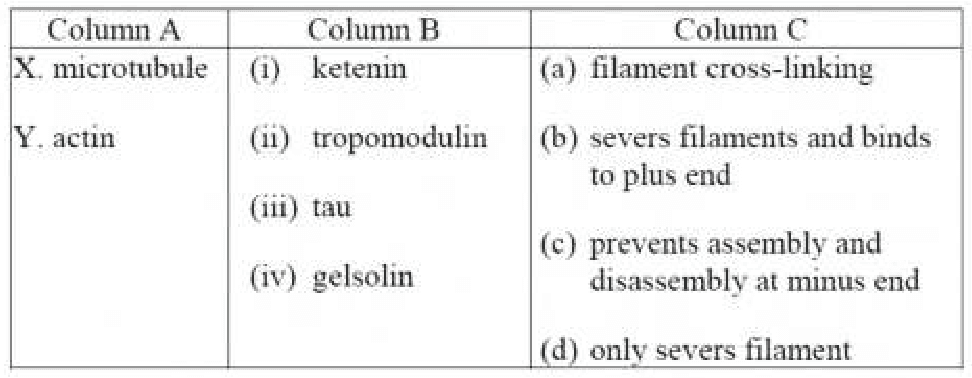
Which one of the following options represents all the correct matches between columns A, B and C?
- 1X-(iv)-(c), X-(iii)-(b), Y-(i)-(a), Y-(ii)-(d)
- 2X-(ii)-(a), X-(i)-(c), Y-(iv)-(c), Y-(iii)-(b)
- 3X-(iii)-(a), X-(i)-(d), Y-(ii)-(c), Y-(iv)-(b)
- 4X-(i)-(d), X-(iv)-(a), Y-(iii)-(d), Y-(ii)-(c)
Show answer and solution
Microtubules: tau cross-links and bundles them (iii–a), and katanin only severs (i–d). Actin: tropomodulin caps the minus (pointed) end, stopping assembly and disassembly there (ii–c), and gelsolin severs filaments and caps the plus end (iv–b).
The following statements are made about the E. coli SOS response to DNA damage:
- A. RecA-DNA filament complex stimulates the autoproteolytic activity of the LexA repressor.
- B. RecA is activated due to the blunt ends of double-strand breaks caused by DNA damage-inducing agents.
- C. The SOS response includes the activation of synthesis of translesion polymerases.
- D. The destruction of LexA promotes synthesis of photolyase, which acts along with RecA to reverse the pyrimidine dimer formation process.
Which one of the following options represents the combination of all correct statements?
- 1A and D
- 2B and D
- 3A and C
- 4C and D
Show answer and solution
RecA coats single-stranded DNA, not blunt ends (B false), and becomes a co-protease that triggers LexA self-cleavage (A). LexA removal derepresses translesion polymerases Pol IV and Pol V (C). Photolyase is not part of the SOS regulon and does not work with RecA (D false). Answer: A and C.
The following statements are made about telomeres:
- A. Telomere-binding proteins (TBPs) are believed to shield telomeres from the cell’s DNA repair machinery, preventing them from being recognized as double-strand breaks.
- B. Telomeres in human cells are repeats of TTAGGGG sequence that can extend upto 150 kb, which are replicated by the action of TERT in actively dividing cells.
- C. In differentiated cells, telomerase is inactive, leading to shortening of telomeres over hundreds of cell divisions, damage to ends of chromosomes, and eventually apoptosis.
- D. The persistence of telomerase activity in several cancers allows the cells to continue to proliferate.
Which one of the following options represents the combination of all correct statements?
- 1A and C only
- 2A, B and C
- 3B and D only
- 4A, C and D
Show answer and solution
Shelterin proteins hide chromosome ends from the DNA-damage response (A). Somatic cells lack telomerase, so telomeres shorten until senescence or apoptosis (C), and cancers reactivate it (D). Human telomeres are TTAGGG (six bases), about 10–15 kb long, not 150 kb (B false). Answer: A, C and D.
The LacI and TrpR repressors bind with their ligands allolactose and tryptophan respectively, resulting in alteration of their DNA binding properties. The following statements are made about the mechanism of LacI and TrpR binding with DNA (operator) and regulation of gene expression in E. coli.
- A. Allolactose binding to LacI leads to its poor binding to the lac operator whereas tryptophan binding to TrpR leads to its better binding to the trp operator.
- B. Allolactose binding to LacI leads to induction of lac operon, whereas tryptophan binding to TrpR leads to repression of trp operon.
- C. Binding of allolactose and tryptophan to LacI and TrpR respectively, leads to repression of their corresponding operons.
- D. Binding of allolactose and tryptophan to LacI and TrpR respectively, leads to activation of their corresponding operons. However, in trp operon regulation, availability of tryptophan also results in attenuation-mediated transcriptional termination leading to an overall effect of repression of trp operon.
Which one of the following options represents a combination of all correct statements?
- 1A and B only
- 2B and C
- 3C and D
- 4A, B and D
Show answer and solution
Allolactose lowers LacI’s affinity for the operator, which induces lac. Tryptophan is a corepressor that raises TrpR’s affinity and represses trp. So A and B are correct, and C and D wrongly treat both ligands alike.
Bacteriophage λ and P1 are both temperate phages. Which one of the following statements made about these phages and their lytic and lysogeny cycles in E. coli is INCORRECT?
- 1Both the λ and P1 phages are double stranded DNA viruses.
- 2In their lysogenic states in E. coli, while the λ phage integrates into the genome, the P1 phage remains as a low copy number plasmid.
- 3In their lysogenic states, both the λ and the P1 phages are integrated into the genome in E. coli.
- 4In their lytic cycles, both the phages occur in plasmid forms in E. coli.
Show answer and solution
P1 does not integrate. Its prophage stays as a low-copy plasmid, while λ integrates at attλ. Statement 3 is therefore incorrect.
The following statements refer to factors regulating the fidelity of DNA replication.
- A. The 5’ to 3’ exonuclease activity of the replicative DNA polymerase.
- B. Imbalanced intracellular concentrations of the four dNTPs.
- C. Increased intracellular concentrations of rNTPs resulting in increased incorporation of rNTPs during DNA synthesis, which are not easily removed by the polymerase’s proof-reading activity.
- D. Removal of incorrectly incorporated nucleotides by the mismatch repair system.
Which one of the following options gives the combination of all correct statements?
- 1A and D only
- 2B, C and D
- 3B and C only
- 4A, B and D
Show answer and solution
Proofreading uses the 3′→5′ exonuclease, not 5′→3′ (A false). Unbalanced dNTP pools (B), misincorporated rNTPs (C) and mismatch repair (D) all affect fidelity. Answer: B, C and D.
Which one of the following statements is correct in the context of erythromycin-mediated inhibition of protein synthesis in bacteria?
- 1Erythromycin inhibits protein synthesis at the step of elongation, but it nonetheless allows translation of the first few codons.
- 2Erythromycin inhibits protein synthesis at the step of elongation, and it prevents formation of even the first peptide bond.
- 3Erythromycin inhibits formation of the translation initiation complex.
- 4Erythromycin is toxic to bacteria because it results in initiation of protein synthesis with elongator tRNAs.
Show answer and solution
Erythromycin binds in the 50S exit tunnel. The ribosome can make a few peptide bonds before the short nascent chain hits the drug and peptidyl-tRNA drops off.
Following statements are made regarding the roles of complement components in immunity:
- A. Binding of complement components to antigen presenting cells decreases their phagocytic ability and modulates cytokine secretion.
- B. Complement components enhance the B cell-mediated immune response by increasing the avidity with which a B cell binds to a complement-bound antigen.
- C. Immature T cells are protected from the natural antibody and complement-mediated lysis by provision of additional sialic acid residues on their cell surface glycoproteins.
- D. Binding of C3a, C5a and C3b to their respective receptors on mature T cells inhibits their growth, differentiation, and survival.
- E. During the contraction phase of the immune response, excess lymphocytes that were made during antigen-induced expansion are eliminated by apoptosis, with the help of C1q complement component.
Which of the following options represents the combination of all correct statements:
- 1A, B and C
- 2A, C and D
- 3B, C and E
- 4B, D and E
Show answer and solution
Complement bound to an antigen (C3d binding CR2/CD21) increases B-cell activation (B). Extra sialic acid protects immature T cells from complement lysis (C). C1q helps remove excess lymphocytes during contraction (E). Complement increases phagocytosis (A false) and supports T-cell survival (D false). Answer: B, C and E.
Some ligands/stimuli that operate through G protein-coupled receptors (GPCRs) are listed in column X, and the most common effectors through which they act are listed in column Y.
| Ligands/stimuli (Column X) | Effectors (Column Y) | ||
|---|---|---|---|
| A. | Serotonin | i. | Phospholipase C |
| B. | Acetylcholine | ii. | cGMP phosphodiesterase |
| C. | IgE-antigen complexes | iii. | Adenylyl cyclase |
| D. | Light | iv. | Potassium channel/Adenylyl cyclase |
Which one of the following options represents all correct matches between Column X and Column Y?
- 1A – i; B – ii; C – iii; D – iv
- 2A – ii; B – iii; C – iv; D – i
- 3A – iii; B – iv; C – i; D – ii
- 4A – iv; B – i; C – ii; D – iii
Show answer and solution
Serotonin (5-HT receptors): adenylyl cyclase. Acetylcholine at M2 receptors: K+ channels and adenylyl cyclase inhibition. IgE–antigen complexes in mast cells: phospholipase C. Light (rhodopsin, transducin): cGMP phosphodiesterase. That is A–iii, B–iv, C–i and D–ii.
The cycling of monomeric G proteins, such as Ras, between active and inactive states is aided by accessory proteins that bind to the G protein and regulate its activity. These accessory proteins include GTPase-activating proteins (GAPs) and guanine nucleotide-exchange factors (GEFs). The following conditions refer to different states of GAP and GEF proteins:
- A. A non-functional GAP
- B. A permanently activated GAP
- C. A non-functional GEF
- D. A permanently activated GEF
Which one of the following options represents conditions/states that might cause a constantly activated signaling cascade?
- 1A and B
- 2B and C
- 3C and D
- 4A and D
Show answer and solution
Ras stays active when it cannot hydrolyse GTP (non-functional GAP) or when GTP loading never stops (constitutively active GEF). Answer: A and D.
The following patterns of gene expression were obtained after activating Notch1 receptor with two different ligands Dll1, and Dll4.
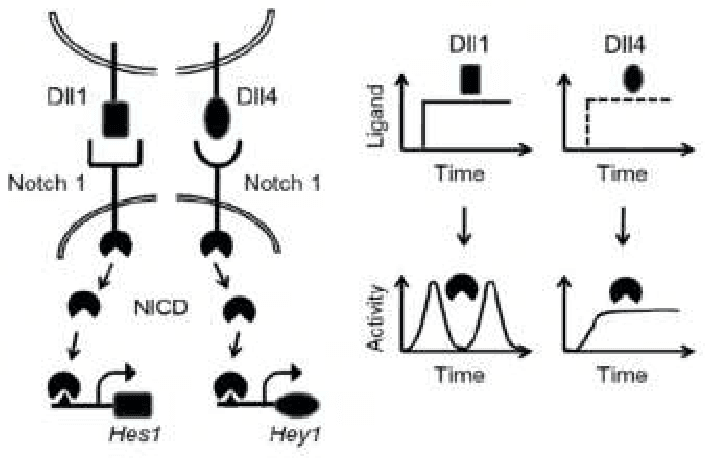
Which one of the following statements depicts the correct interpretation of observations?
- 1The Notch pathway ligands Dll1 and Dll4 both bind to the Notch1 receptor but activate different downstream effectors with similar dynamics.
- 2Dll1 induces sustained responses, which preferentially activate the transcriptional target Hes1.
- 3Dll4 induces pulsatile responses in response to NICD, which are required for activating Hey1.
- 4The Notch pathway ligands Dll1 and Dll4 both bind to the Notch1 receptor but activate the downstream effector NICD with different dynamics.
Show answer and solution
Both ligands act on Notch1 and release NICD. Dll1 gives pulsatile NICD activity, which switches on Hes1, while Dll4 gives sustained activity, which switches on Hey1. The same effector with different dynamics is option 4.
ERK5 is a MAP kinase that is activated upon phosphorylation by MEK5. MEK5 binds with MEKK2 when co-expressed. HEK293 cells were transfected with plasmid encoding ERK5, along with plasmids encoding either MEK5 alone, or MEKK2 alone, or both MEKK2 and MEK5, or both MEKK2 and MEK5AA (MEK5 mutant). Lysates of transfected cells were analysed by Western blotting using anti-ERK5 antibody as shown below:
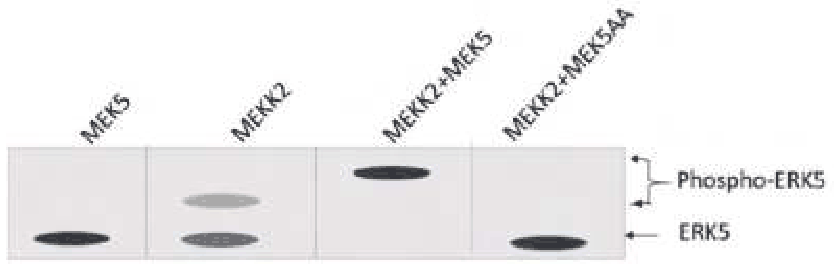
From the data in the figure above, the following conclusions were drawn:
- A. Full activation of ERK5 requires both MEKK2 and MEK5.
- B. Phosphorylation with MEKK2 alone suggests that it can activate ERK5 without MEK5.
- C. Difference in the levels of phosphorylation with MEKK2 alone and MEKK2 + MEK5 is due to more phosphorylation at the same site.
- D. Phosphorylation with only MEKK2 transfection suggests that it might be associating with endogenous MEK5 to get partially activated, leading to ERK5 phosphorylation to some extent.
- E. MEK5AA might be a dominant-negative mutant of MEK5 which prevents signalling through active, endogenous MEK5.
Which of the following options represents the combination of all correct statements?
- 1A, B and C
- 2B, C and E
- 3C, D and E
- 4A, D and E
Show answer and solution
MEKK2 + MEK5 gives the fully shifted phospho-ERK5 band (A). MEKK2 alone gives a partial shift, probably through endogenous MEK5 (D). MEK5AA abolishes even that, so it acts as a dominant negative (E). Answer: A, D and E.
The recognized family of PR proteins in plants and their activities are listed in columns X and Y, respectively.
| Proteins (Column X) | Activities (Column Y) | ||
|---|---|---|---|
| A. | PR2 | i. | β-1,3-glucanase |
| B. | PR3 | ii. | chitinase |
| C. | PR6 | iii. | proteinase inhibitor |
| D. | PR10 | iv. | ribonuclease-like |
Which one of the following options represents all correct matches between Column X and Column Y?
- 1A-i, B-iii, C-iv, D-ii
- 2A-i, B-ii, C-iii, D-iv
- 3A-iii, B-iv, C-i, D-ii
- 4A-iv, B-i, C-ii, D-iii
Show answer and solution
PR-2: β-1,3-glucanase. PR-3: chitinase. PR-6: proteinase inhibitor. PR-10: ribonuclease-like.
Following statements are made regarding animal development:
- A. The cell is first specified towards a given fate, suggesting that it would develop into this cell type, even in a neutral environment.
- B. Holoblastic rotational cleavage is observed in tunicates.
- C. Infolding of sheet of cells is called ingression.
- D. Conditional specification can be observed in sea urchin embryos.
Which one of the following options represents the combination of all correct statements?
- 1A and B
- 2B and C
- 3A and D
- 4C and D
Show answer and solution
A specified cell follows its fate when cultured in a neutral medium (A). Sea-urchin blastomeres other than micromeres show conditional specification (D). Rotational cleavage is found in mammals and nematodes, and tunicates show bilateral cleavage (B false). Infolding is invagination, not ingression (C false). Answer: A and D.
Transforming the neural plate into a neural tube is an important event towards the formation of central nervous system, in which the following sub-events might take place:
- A. In primary neurulation, the cells surrounding the neural plate direct the neural plate cells to proliferate, invaginate and separate from the surface ectoderm to form a hollow tube.
- B. In secondary neurulation, the neural tube does not arise from the aggregation of mesenchyme cells into a solid cord.
- C. The morphogen, Sonic hedgehog, that is expressed in notochord, is required for induction of floor plate cells in the neural plate to form the medial hinge point.
- D. In mammals, secondary neurulation begins at the level of sacral vertebrae.
- E. In mammals, the primary neurulation forms brain regions while the secondary neurulation takes care of forming rest of the central nervous system from neck to tail.
Which one of the following options represents the combination of all correct statements?
- 1A, C and D
- 2A, B and E
- 3B, C and D
- 4C, D and E
Show answer and solution
Primary neurulation is the folding and pinching off of the plate (A). Notochord Shh induces the floor plate and the medial hinge point (C). Secondary neurulation starts at about the sacral level (D). Secondary neurulation does come from a solid mesenchymal cord (B false), and primary neurulation forms the brain and most of the spinal cord (E false). Answer: A, C and D.
The following statements are made regarding the amphibian early-embryonic development:
- A. The Nieuwkoop center cells are mesodermal in origin.
- B. Chordin, Noggin and Goosecoid are secreted by the Organizer.
- C. The default fate of the ectoderm is to become neural tissue.
- D. BMP levels are high in the presumptive dorsal mesoderm.
Which one of the following options represents the combination of all correct statements?
- 1A, B and C
- 2C and D
- 3B and C only
- 4A and D
Show answer and solution
The Nieuwkoop centre is dorsal vegetal endoderm (A false), and BMP is high ventrally (D false). The ectoderm’s default fate is neural (C). The Organizer secretes chordin and noggin (B), although goosecoid is really a transcription factor expressed by the Organizer. Answer: B and C only.
The following figure represents the interaction between different blastomeres in a 4-cell stage of C. elegans embryo:

The following statements were made regarding the above:
- A. The fate of EMS blastomere is autonomously specified.
- B. The default fate of EMS blastomere is MS cell lineage.
- C. Conditional specification can be observed in the development of E cell lineage.
- D. Assuming that a receptor needs to be activated for E fate, a C. elegans embryo where the receptor is constitutively active, is likely to develop cells of E fate only, in all three of the above cases.
Which one of the following options represents the combination of all correct statements?
- 1A and C only
- 2B and C only
- 3A, B and C
- 4B, C and D
Show answer and solution
Remove P2 and EMS makes MS on both sides, so MS is the default (B). Move P2 and E forms next to it, so E is conditionally specified by P2’s Wnt signal (C). A constitutively active receptor would make E fate in all three cases (D). EMS fate depends on P2, so A is false. Answer: B, C and D.
Following statements were made regarding regeneration in different organisms:
- A. The regenerating blastema cells in amphibians retain their specification even when they dedifferentiate.
- B. A transgenic Hydra when made to misexpress β-catenin will show numerous ectopic tentacles.
- C. In Planaria, if the Wnt pathway is activated, then the posterior blastema would regenerate a head.
- D. A regenerating blastema is formed in the mammalian liver.
Which one of the following options represents all correct statement(s)?
- 1A only
- 2C only
- 3B and C
- 4C and D
Show answer and solution
Blastema cells keep a memory of their origin (A). Ectopic β-catenin in Hydra induces ectopic heads or axes, and in planaria Wnt activation makes tails, not heads. The mammalian liver regenerates by compensatory growth without a blastema. Answer: A only.
Genetic screens for mutants affecting development of leaf trichomes have led to the discovery of genes regulating trichome patterning – especially trichome density and spacing, as depicted in the figure below.
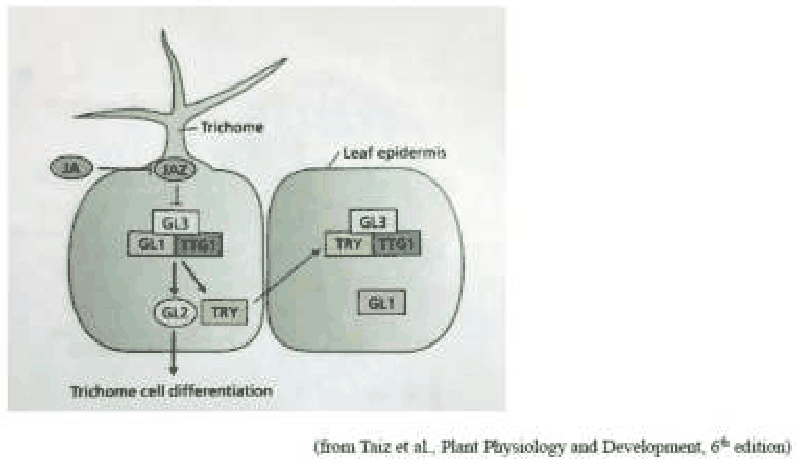
The following statements are made in this regard:
- A. GLABRA1 (GL1) mutant plant will show fewer or no trichomes.
- B. Cells that form trichomes strongly express the GLABRA2 (GL2) and TRYPTICON (TRY) genes.
- C. TRY protein acts as a positive regulator of trichome cell differentiation in the surrounding cells.
- D. Addition of exogenous JA will reduce the number of leaf trichomes.
Which one of the following options represents the combination of all correct statements?
- 1A and B
- 2B and C
- 3C and D
- 4A and D
Show answer and solution
GL1 is part of the activator complex, so gl1 plants have few or no trichomes (A). Trichome cells express GL2 and TRY (B). TRY moves to neighbouring cells and inhibits trichome fate there (C false). JA degrades JAZ, which releases GL3 and so increases trichomes (D false). Answer: A and B.
Given below are the list of abiotic environmental factors (Column X) and their primary effects (Column Y) in plants:
| Factors (Column X) | Effects (Column Y) | ||
|---|---|---|---|
| A. | Water deficit | (i) | Ion cytotoxicity |
| B. | Salinity | (ii) | Hypoxia to the roots |
| C. | Flooding | (iii) | Photoinhibition |
| D. | High light intensity | (iv) | Water potential reduction |
Which one of the following options represents all correct matches?
- 1A (i), B (ii), C (iii), D (iv)
- 2A (iv), B (i), C (ii), D (iii)
- 3A (ii), B (i), C (iv), D (iii)
- 4A (iv), B (iii), C (ii), D (i)
Show answer and solution
Water deficit lowers water potential (A–iv). Salinity adds ion toxicity (B–i). Flooding starves roots of O2, causing hypoxia (C–ii). Excess light causes photoinhibition of PSII (D–iii).
The following are certain statements regarding the PSII electron carrier during the light reaction of photosynthesis:
- A. The first electron released from reaction centre P680 is transferred to QA to produce a plastosemiquinone.
- B. QA is the mobile plastoquinone.
- C. The first electron transferred from QA to QB converts QB into plastosemiquinone.
- D. QB is tightly bound to the complex and is not mobile.
Which one of the following options represents the correct statement(s)?
- 1A and B
- 2B and D
- 3A only
- 4C only
Show answer and solution
Electrons go from P680 through pheophytin to the tightly bound QA, making a semiquinone (A). QA is fixed and QB is the mobile quinone, so B and D are false. NTA’s key gives A only. Strictly, statement C (the first electron to QB gives a semiquinone) is also textbook-correct, so this solution follows NTA’s key.
The following statements are made regarding the nitrogenase enzyme involved in the reduction of atmospheric nitrogen to ammonia:
- A. Nitrogenase enzyme is composed of two components: dinitrogenase and dinitrogenase reductase.
- B. MoFe protein component is a homodimer.
- C. Fe protein component is dinitrogenase.
- D. MoFe protein contains the active site metal cluster where N2 binds.
- E. Fe protein delivers electron to MoFe protein component in a reaction coupled to the hydrolysis of MgATP.
Which one of the following options represents the combination of all correct statements?
- 1A, B and D
- 2B and C only
- 3C, D and E
- 4A, D and E
Show answer and solution
Nitrogenase has two components: dinitrogenase (the MoFe protein, an α2β2 heterotetramer holding FeMo-co, where N2 binds) and dinitrogenase reductase (the Fe protein, which passes electrons on as MgATP is hydrolysed). B and C are false. Answer: A, D and E.
Sucrose-phosphate synthase (SPS) and sucrose-phosphate phosphatase (SPP) are two key enzymes involved in the biosynthesis of sucrose. Following are certain statements regarding these two enzymes:
- A. Fructose-6-phosphate is one of the substrates of SPS enzyme.
- B. Fructose-6-phosphate and UDP-glucose are the substrates of SPP enzyme.
- C. Sucrose is the final product of SPP enzyme.
- D. UDP is one of the products of SPS enzyme while Pi is one of the products of SPP enzyme.
Which one of the following options represents the combination of all correct statements?
- 1A, B and C
- 2A, B and D
- 3A, C and D
- 4B, C and D
Show answer and solution
SPS: UDP-glucose + fructose-6-P → sucrose-6-P + UDP. SPP: sucrose-6-P → sucrose + Pi. B gives SPS’s substrates to SPP. Answer: A, C and D.
Rubisco enzyme is involved in both reductive and oxidative carbon cycles in plants. Following are certain statements regarding them:
- A. Sugars are produced in both the cycles.
- B. Ferredoxin is reduced only in oxidative carbon cycle.
- C. Product of oxidative cycle is one of the substrates of reductive cycle.
- D. NADP and ATP are used in both the cycles.
Which one of the following options represents the combination of all correct statements?
- 1A and B
- 2A and D
- 3C and D
- 4B and C
Show answer and solution
Only the Calvin (reductive) cycle makes sugar (A false). Photorespiration consumes ATP and NADH, not NADP(H) in both steps (D false). Its 3-PGA product goes back into the Calvin cycle (C). NTA counts B true because photorespiratory NH3 is re-fixed by ferredoxin-dependent GOGAT. Answer: B and C.
Following statements are made regarding the plant natural product, terpenes.
- A. Monoterpenes are five-carbon compounds.
- B. The anti-malarial drug, artemisinin is a sesquiterpene.
- C. Azadirachtin is a triterpene derivative from the seed oil of the Asian neem tree.
- D. Taxol is a diterpene derivative used in cancer treatment.
Which one of the following options represents the combination of all correct statements?
- 1A and B only
- 2C and D only
- 3A, B and D
- 4B, C and D
Show answer and solution
Monoterpenes have 10 carbons, not 5 (A false). Artemisinin is a sesquiterpene lactone (C15). Azadirachtin is a limonoid, a degraded triterpene. Taxol is a diterpene. Answer: B, C and D.
The following statements are made below about hearing phenomena of sound waves:
- A. The loudness of a sound is inversely correlated with the amplitude of a sound wave.
- B. The loudness of a sound is directly correlated with the amplitude of a sound wave.
- C. The pitch of a sound is directly correlated with the frequency of the sound wave.
- D. The pitch of a sound is inversely correlated with the frequency of the sound wave.
- E. The pitch of the average male voice in conversation is lower than that of the average female voice.
- F. The pitch of the average male voice in conversation is higher than that of the average female voice.
Choose the combination of all correct statements:
- 1A, C and E
- 2B, D and F
- 3B, C and E
- 4A, D and F
Show answer and solution
Loudness rises with amplitude (B) and pitch with frequency (C). Men’s speaking voices (~120 Hz) are lower than women’s (~210 Hz) (E). Answer: B, C and E.
Prolactin is an anterior pituitary hormone which is lactogenic and helps milk production in mammals. The statements below are made regarding the mechanism of action of prolactin:
- A. The receptors that bind to prolactin lack intrinsic tyrosine kinase activity.
- B. Upon prolactin binding, the receptors dimerize, and associated kinase is activated.
- C. Prolactin binding to receptors leads to activation of its intrinsic kinase activity.
- D. STAT plays a role in mediating prolactin action. It dimerizes after its phosphorylation to elicit the response.
- E. There is no involvement of STAT in prolactin action mechanisms.
Which one of the following options represents the combination of all correct statements?
- 1A, B and D
- 2B, C and D
- 3A and E only
- 4C and E only
Show answer and solution
The prolactin receptor is a cytokine-type receptor with no intrinsic kinase (A). Ligand binding dimerises it and activates the associated JAK2 (B), which phosphorylates STAT5; STAT5 dimerises and enters the nucleus (D). Answer: A, B and D.
The following statements are made about digestion of proteins and the enzymes involved:
- A. Chymotrypsin does not generate peptides with C-terminal neutral amino acids.
- B. Trypsin generates peptides with C-terminal basic amino acids.
- C. Carboxypeptidase B acts on aromatic amino acids.
- D. Carboxypeptidase A employs zinc ion for hydrolysis.
- E. The brush border enterokinase has no polysaccharides attached to it.
- F. The final digestion to amino acids occurs in the intestinal lumen, the brush border, and the cytoplasm of the mucosal cells.
Which one of the following options represents the combination of all correct statements?
- 1A, B and C
- 2C, D and E
- 3D, E and F
- 4B, D and F
Show answer and solution
Trypsin cuts after Lys or Arg, leaving basic C-termini (B). Carboxypeptidase A is a Zn2+ enzyme (D). Final digestion happens in the lumen, at the brush border and inside enterocytes (F). Chymotrypsin leaves neutral aromatic C-termini (A false), CPB removes basic residues (C false), and enterokinase is heavily glycosylated (E false).
The following statements are made with reference to the neural connections of cardiac tissues and the functions of these nerves on heart in adult humans:
- A. The right vagus nerve is distributed mainly to the AV node.
- B. The parasympathetic pre-ganglionic fibers distributed to the heart originate from the superior salivatory nucleus.
- C. The sympathetic post-ganglionic fibers originating from the paravertebral ganglia of the left side primarily innervate SA node.
- D. The sympathetic fibers distributed to heart come mainly from stellate ganglia.
- E. The sympathetic activity alters heart rate slower than that of vagal activity.
Which one of the following options represents the combination of all correct statements?
- 1A and B
- 2B and C
- 3C and D
- 4D and E
Show answer and solution
Cardiac sympathetic fibres come mainly from the stellate ganglia (D). Sympathetic effects on rate start and fade more slowly than the almost beat-to-beat vagal effects (E). The right vagus goes mainly to the SA node, preganglionic cardiac fibres come from the dorsal motor nucleus and nucleus ambiguus, and left sympathetics mainly supply the AV node and ventricles. So A, B and C are false.
The following statements suggest the changes in respiratory ventilation and the mechanisms of these changes when a normal human subject is allowed to inhale air containing different oxygen content:
- A. The ventilation is markedly increased when PO2 of the inspired air is less than 60 mm Hg.
- B. The ventilation is 6 L/min when the PO2 of the inspired air is about 150 mm Hg.
- C. The ventilation is slightly increased when PO2 of the inspired air is more than 60 mm Hg.
- D. The increased ventilation due to the lower PO2 in the inspired air causes higher alveolar PCO2.
- E. The H+ concentration in the arterial blood is increased when PO2 of the inspired air is gradually decreased.
Which one of the following options represents the combination of all correct statements?
- 1A, B and C
- 2B, C and D
- 3C, D and E
- 4A, B, and E
Show answer and solution
Breathing room air (PO2 about 150 mmHg), ventilation is about 6 L/min (B). It rises only slightly until inspired PO2 falls below about 60 mmHg (C), then rises steeply (A). Hypoxic hyperventilation lowers PCO2 and [H+], causing alkalosis, so D and E are false.
After severe diarrhoea, the plasma K+ concentration became low (i.e, hypokalemia developed) in a human subject. The following statements are proposed to explain the mechanism of plasma K+ regulation by kidney in this condition:
- A. The principal cells present in distal tubule and collecting duct of nephron regulate K+ excretion.
- B. Hypokalemia stimulates Na+, K+-ATPase activity in the basolateral membrane of principal cells.
- C. The intracellular K+ concentration of the principal cells is increased.
- D. The electrochemical gradient for efflux of K+ across the apical membrane of principal cells is increased.
- E. The permeability of apical membrane to K+ is decreased.
- F. The plasma aldosterone level is decreased which inhibits K+ secretion by principal cells.
Which one of the following options represents the combination of all INCORRECT statements?
- 1A, B, C
- 2B, C, D
- 3C, D, E
- 4D, E, F
Show answer and solution
Principal cells do regulate K+ secretion (A true). In hypokalaemia, basolateral Na+/K+-ATPase activity falls, cell K+ falls, and the apical efflux gradient falls. So B, C and D are the incorrect statements. Lower apical K+ permeability (E) and lower aldosterone (F) are both correct.
Different types of mapping populations that can be created using a variety of methods are presented as I to IV in the figure below:
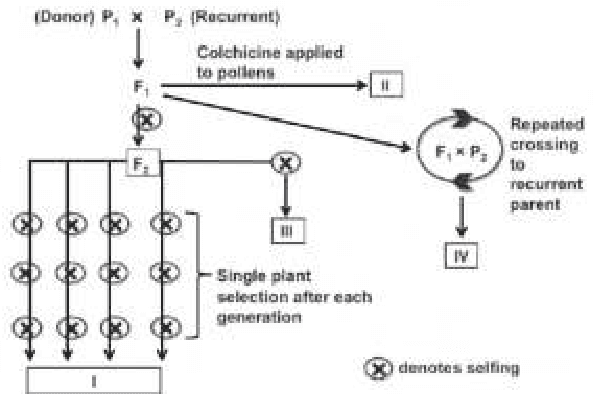
A list of probable mapping populations denoted by I to IV in the figure and their status of genetic mortality is given below.
- A. I – Recombinant inbred lines (RILs) – immortal
- B. II – Doubled haploid – Not immortal
- C. III – F2:3 – Not immortal
- D. IV – Near isogenic Lines (NILs) – immortal
Which one of the following options represents the combination of all correct matches?
- 1C only
- 2A and D only
- 3B and C only
- 4A, C and D
Show answer and solution
I is single-seed descent from F2, giving RILs (immortal, A). II is colchicine-doubled pollen, giving doubled haploids, which are immortal, so B is false. III is F2 selfed once, giving F2:3 families (not immortal, C). IV is repeated backcrossing, giving NILs (immortal, D). Answer: A, C and D.
Red-blue colour blindness is a human X-linked recessive disorder. The two parents with normal colour vision have two sons. Son 1 has 47, XXY chromosome composition and is colour blind. Son 2 has 46, XY and is also colour blind. Assuming that no crossing over took place in prophase I of meiosis, Klinefelter syndrome in Son 1 resulted due to nondisjunction during which one of the following events?
- 1Female gamete formation in meiosis I
- 2Female gamete formation in meiosis II
- 3Male gamete formation in meiosis I
- 4Male gamete formation in meiosis II
Show answer and solution
Both parents see normally, yet both sons are colour-blind, so the mother is XCXc. Son 1 is XcXcY, with two identical maternal Xc chromosomes. Without crossing over, sister chromatids staying together means maternal meiosis II nondisjunction.
Assume that the genes w+ and cv+ are located 20 cM apart on the X chromosome of Drosophila melanogaster. Mutations in w+ and cv+ give rise to white eyes and crossveinless phenotypes, respectively, which are recessive to the wild-type phenotype. A homozygous wild-type female was crossed to a white-eyed, crossveinless male. The F1 progeny was sib-mated. What percentage of the progeny will be white-eyed and crossveinless?
- 120
- 240
- 310
- 45
Show answer and solution
F1 females are w cv/+ + (coupling) and F1 males are + +/Y. All daughters receive the father’s + + X. Half the progeny are sons, and 40% of sons get the parental w cv chromosome (80% parental ÷ 2). So 0.5 × 0.4 = 20%.
A researcher wanted to test the effect of different chemical agents on double stranded DNA (dsDNA). dsDNA was taken in tubes (A, B, C and D), and four different agents were added individually to each tube. The researcher however forgot to label them. The properties of the added chemical agents on dsDNA were analysed. The possible product (Column X) and the specific action of the chemical agents are listed in Column Y.
| Column X | Column Y | ||
|---|---|---|---|
| A | Nucleotides | i | Breaks hydrogen bond |
| B | Only nitrogenous bases | ii | Removes phosphate group |
| C | Nucleosides | iii | Breaks phosphodiester bond |
| D | ssDNA | iv | Breaks N-glycosidic bond |
Which one of the following options represents all correct matches between Column X and Column Y?
- 1A-ii, B-i, C-iv, D-iii
- 2A-iii, B-iv, C-ii, D-i
- 3A-iv, B-iii, C-i, D-ii
- 4A-iii, B-ii, C-iv, D-i
Show answer and solution
Cutting phosphodiester bonds gives nucleotides (A–iii). Cutting N-glycosidic bonds releases free bases (B–iv). Removing phosphates leaves nucleosides (C–ii). Breaking hydrogen bonds melts dsDNA into ssDNA (D–i).
T4 phages were plated on three E. coli bacterial plates labelled I, II and III. The phenotypes obtained are depicted in the picture below. The black spots represent plaques.
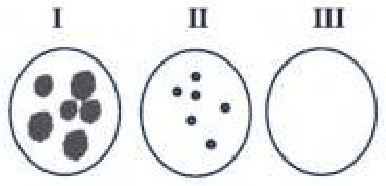
The following combination of conditions were given to explain the results obtained:
| Plate | Bacterial strain | rII locus |
|---|---|---|
| I | i. either B or K-12 | a. Wild type |
| II | ii. B | b. mutant |
| III | iii. K-12 |
From the options listed below, select the one that accurately lists the E. coli strain type and the corresponding rII locus type.
- 1I-iii-a, II-ii-b, III-iii-a
- 2I-ii-b, II-i-a, III-iii-b
- 3I-i-b, II-iii-b, III-ii-a
- 4I-ii-b, II-ii-a, III-ii-b
Show answer and solution
rII mutants make large, clear plaques on B (plate I = B, mutant) and cannot grow on K-12(λ) (plate III = K-12, mutant, no plaques). Wild-type T4 makes normal small plaques on either strain (plate II).
Alleles A, a, B and b can be distinguished on the basis of their mobility on an agarose gel. These genes are present on the same chromosome. In the gel image below, the band pattern reflects the alleles in parents and their progeny (number reflects the progeny counted).
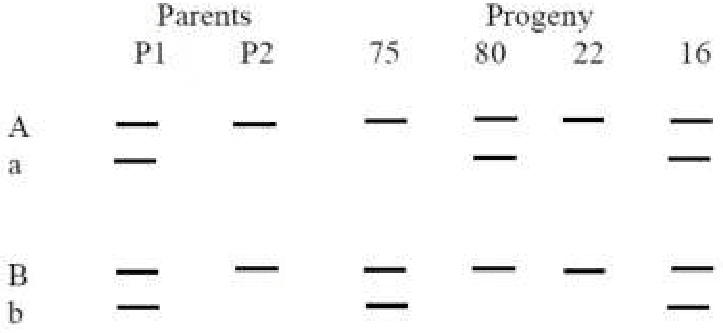
Which one of the following statements correctly explains the band pattern?
- 1In the heterozygous parent, the alleles are in coupling configuration.
- 2In the heterozygous parent, the alleles are in repulsion configuration.
- 3The alleles A and B are in different linkage groups.
- 4The information is insufficient for any conclusion.
Show answer and solution
P1 is Aa Bb and P2 is AA BB, so P1’s gamete in each child can be read from its bands. The common classes (75, 80) received A b and a B, the parental combinations. So the heterozygote has its alleles in repulsion. Recombinants are 38/193 ≈ 20%.
Which one of the following options correctly lists ecosystems of the world arranged according to the descending order of their average world net primary production (billion kcal/yr)?
- 1Tropical rain forests > Northern coniferous forests > Open Oceans > Estuaries
- 2Open Oceans > Tropical rain forests > Northern coniferous forests > Estuaries
- 3Tropical rain forests > Open Oceans > Northern coniferous forests > Estuaries
- 4Open Oceans > Northern rain forests > Estuaries > Northern coniferous forests
Show answer and solution
Total NPP is productivity × area. The open ocean is huge in area, so it comes first, ahead of tropical rain forest, then boreal forest. Estuaries are highly productive per m2 but tiny in area, so they come last.
India has designated regions as sanctuaries or national parks (column Q) dedicated for the conservation of specific species (column P).
| Column P | Column Q | ||
|---|---|---|---|
| A. | Gharial | i. | Bhitarkanika Wildlife Sanctuary |
| B. | Saltwater Crocodile | ii. | National Chambal Sanctuary |
| C. | Humpback Mahseer | iii. | Gahirmatha Sanctuary |
| D. | Hawksbill turtle | iv. | Cauvery Wildlife Sanctuary |
Select the option that depicts all correct matches between column P and column Q.
- 1A-ii; B-i; C-iv; D-iii
- 2A-iii; B-iv; C-i; D-ii
- 3A-iv; B-iii; C-ii; D-i
- 4A-ii; B-iv; C-i; D-iii
Show answer and solution
Gharial: National Chambal Sanctuary. Saltwater crocodile: Bhitarkanika. Humpback mahseer: Cauvery. Hawksbill (and other sea turtles): Gahirmatha marine sanctuary.
Amborellaceae, Aristolochiaceae, Illiciaceae and Winteraceae are four angiosperm families that, according to the APG IV system of classification belong to the ‘early diverging angiosperms’. The presence (V+) or absence (V-) of vessels in the xylem and the fusion of the carpels within the gynoecium are important angiosperm characters. ‘A’ and ‘S’ indicate apocarpous (or monocarpellary) and syncarpous condition of ovary, respectively. Which one of the following options correctly represents the characters found in the above families?
- 1Amborellaceae: V+, A; Aristolochiaceae: V+, A; Illiciaceae: V+, A; Winteraceae: V-, S.
- 2Amborellaceae: V-, A; Aristolochiaceae: V+, S; Illiciaceae: V+, A; Winteraceae: V-, A.
- 3Amborellaceae: V-, S; Aristolochiaceae: V-, S; Illiciaceae: V+, S; Winteraceae: V+, A.
- 4Amborellaceae: V+, S; Aristolochiaceae: V-, A; Illiciaceae: V+, S; Winteraceae: V-, S.
Show answer and solution
Amborella and Winteraceae lack vessels and have free carpels (V−, A). Illicium has vessels and free carpels (V+, A). Aristolochiaceae have vessels and a syncarpous inferior ovary (V+, S).
Which one of the following statements pertaining to global ocean ecosystem productivity is NOT correct?
- 1Higher chlorophyll concentrations and the general higher productivity observed around the equator is driven by the process of upwelling and/or mixing of high nutrient subsurface water into the euphotic zone.
- 2In some temperate and subpolar regions, productivity is least during the spring due to the transitioning of phytoplankton from light-limiting to nutrient-limiting conditions.
- 3In the nutrient-poor tropical and subtropical ocean, the cyanobacteria tend to be numerically dominant, as they specialize in taking up nutrients at low concentrations.
- 4Larger phytoplankton, such as diatoms, often dominate the nutrient-rich polar ocean, and these can be grazed directly by multicellular zooplankton.
Show answer and solution
In temperate and subpolar seas, the spring bloom is the peak of productivity, as light improves while nutrients are still plentiful. Statement 2 is therefore incorrect.
Members of the chlorophytes are structurally diverse. Select the option that correctly represents the increasing order of structural complexity among the given genera.
- 1Chlorella < Zygnema < Oedogonium < Draparnaldia
- 2Volvox < Chara < Oedogonium < Draparnaldia
- 3Chlorella < Draparnaldia < Fritschiella < Oedogonium
- 4Volvox < Ulothrix < Draparnaldia < Ulva
Show answer and solution
Chlorella is a single cell, Zygnema a simple unbranched filament, Oedogonium an unbranched filament with specialised cells and oogamy, and Draparnaldia a branched, heterotrichous thallus with a main axis and branch tufts.
It has been observed that within a flowering season, a plant may produce more male flowers which may be correlated with the longevity of the flowers and the seasonal distribution of flowering in the plant. Which one of the following arguments do NOT support this observation of sex-specific floral phenology.
- 1Females are often resource limited and therefore pollination levels will be increased by producing more male flowers.
- 2Fluctuations in the rainfall pattern can influence pollinator service due to altered physiology of the plant during its reproduction, leading to a shift in flowering phenology of both sexes.
- 3Plasticity in sex and their flowering phenology is determined neither by resource status of a taxa nor by fluctuations in climatic factors.
- 4Male competition will favour floral features that improve pollinator visits and therefore more male flowers.
Show answer and solution
Options 1, 2 and 4 each give a resource, climate or sexual-selection reason for producing extra male flowers. Option 3 says phenology depends on neither resources nor climate, so it gives no support to the observation.
The relationship between species and area of distribution is given by the following equation: S = CAz where S is the number of species on an island or isolated patch, A is the area of the habitat, and C and Z are constants. The following are a set of statements pertaining to the value of ‘Z’:
- A. Z value is typically not greater than 0.4 across all ecosystem types.
- B. Z value is positively related to a species’ dispersal capability, with flying and wind-dispersed organisms having the highest values.
- C. Z value, which represents the slope in the relationship, declines with area, especially when large landmasses such as continents are considered.
- D. The Z value is the exponent in the power model and can be used to estimate the proportion of area required to represent a given proportion of species present in any land class.
Select the option that represents the combination of all correct statements.
- 1A and B
- 2A and D
- 3B and C
- 4C and D
Show answer and solution
z usually lies between 0.15 and 0.35 and rarely exceeds 0.4 (A). As the exponent, it predicts the share of species kept in a given share of area, since S1/S2 = (A1/A2)z (D). Good dispersers have lower z, and z rises again at continental scales. Answer: A and D.
The diagram below depicts the cumulative fossil CO2 emissions (y axis) of different continents from the years 1850-2020 (x axis).
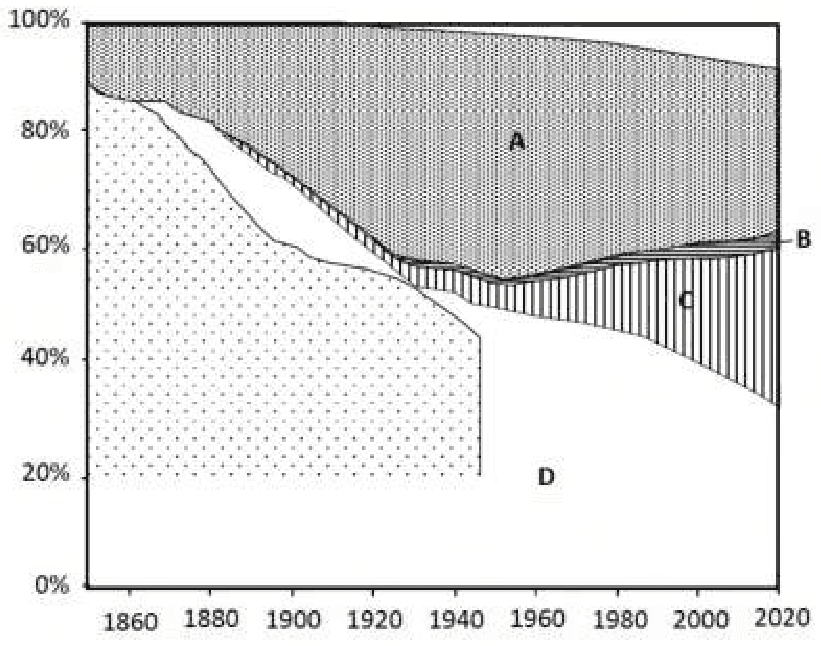
Select the option that correctly identifies the continents A-D:
- 1A-North America; B-Africa; C-Asia; D-Europe
- 2A-Europe; B-South America; C-Africa; D-Asia
- 3A-Europe; B-Africa; C-North America; D-Asia
- 4A-North America; B-Asia; C-Africa; D-Europe
Show answer and solution
Europe (D) dominated early cumulative emissions and its share has shrunk. North America (A) became the largest share in the 20th century. Asia (C) has grown fast since 1950. Africa (B) is a thin sliver.
Given below are a set of statements about metapopulation dynamics and habitat conservation:
- A. The sizes of suitable patches are important because demographic stochasticity can lead to extinction, especially in organisms with low reproductive output.
- B. In the incidence function model (IFM), the extinction risk of local populations increases with increasing habitat patch area, and the colonization probability is a function of patch isolation from existing local populations.
- C. From the conservation perspective, large numbers of suitable patches are not sufficient if distances are too large, preventing recolonization and the rescue effect.
- D. To minimize extinction risk there should be as low a variance in local patch quality as possible, to allow for synchronous dynamics.
Which one of the following options represents the combination of all correct statements?
- 1A and C
- 2B and C
- 3A and D
- 4B and D
Show answer and solution
Small patches risk demographic extinction (A), and well-separated patches cannot be recolonised or rescued (C). In the incidence function model, extinction risk falls as patch area grows (B false). Asynchrony, not synchronous dynamics, lowers metapopulation extinction risk (D false).
Ecologists examined the role of competition for below ground resources (water and nutrients) in the dispersion pattern of trees in the Acacia savannas of South Africa. The figure below depicts the result of their study.

In case all the other parameters were constant, select the option that best represents the dispersion patterns for populations labelled A and B in the figure above.
- 1A-Regular and B-Random
- 2A-Random and B-Clumped
- 3A-Clumped and B-Regular
- 4A-Regular and B-Regular
Show answer and solution
Below-ground competition spaces trees out evenly, giving a regular pattern. In dry soil (A) roots spread further, so neighbours are about 9 m apart. In moist soil (B) they are about 4 m apart, but still evenly spaced. Both are regular; only the spacing distance changes.
Four different plant communities that consisted of the same number of species were taken up for a species diversity study. The following table represents some of the outcomes:
| Community | Simpson’s Reciprocal Index Value |
|---|---|
| A | 7.25 |
| B | 8.20 |
| C | 6.80 |
| D | 7.05 |
Select the correct statement about the evenness of the above communities.
- 1The evenness of all the four communities is the same.
- 2B > A > D > C represents the decreasing order in evenness of the communities.
- 3C > D > A > B represents the decreasing order in evenness of the communities.
- 4Using the given information, we cannot compare the evenness of the communities.
Show answer and solution
All four communities have the same species richness, so evenness (reciprocal Simpson’s index ÷ S) follows the index values: B > A > D > C.
A food chain involving Spartina (a plant), the marsh periwinkle snail, the blue crab and an unknown fungus was identified in a Spartina-dominated salt marsh in North America. A study involving control and crab-exclusion experiments revealed:
- A. Radulations (scrape marks) on the leaf surface made by the snails indicate the presence of snail faeces, fungi and dead plant tissue.
- B. The fungi were present only at the radulations.
- C. The density of the radulations increased with higher snail densities.
- D. Spartina density decreased with increase in the snail density till it reached zero.
- E. In control experiments, all four species were present till the end.
Select the option that correctly depicts the positive (+) and negative (-) interaction-type between fungi-snail and Spartina-crab, respectively:
- 1− and +
- 2− and −
- 3+ and −
- 4+ and +
Show answer and solution
Snails graze cuts into Spartina and plant fungi in them, then eat the fungus. Each helps the other, so fungus–snail is +. Blue crabs eat the snails and so protect Spartina, an indirect benefit (+).
The following trees represent different evolutionary mechanisms.
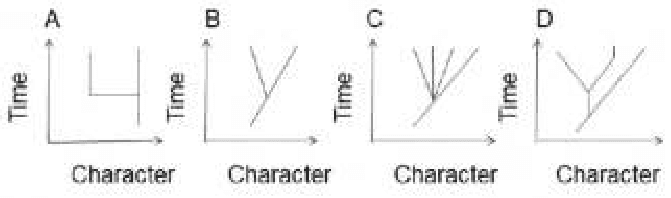
Select the tree that best represents punctuated equilibrium.
- 1A
- 2B
- 3C
- 4D
Show answer and solution
Punctuated equilibrium means long stasis (vertical lines) broken by rapid change at speciation (horizontal jumps). That is tree A. Trees B and D show gradual divergence.
The following list represents two types of reproductive isolation (Column P) that can lead to speciation. Column Q represents the processes by which these isolations can occur.
| Column P | Column Q | |
|---|---|---|
| A – Prezygotic | i. | Seasonal |
| B – Postzygotic | ii. | Hybrid inviability |
| iii. | F2 breakdown | |
| iv. | Stigmatic SI response |
Select the option that represents the correct match between the prezygotic and postzygotic isolation types listed in Column P and the processes described in Column Q?
- 1A-i and ii, B-i and iii
- 2A-i and iii, B-ii only
- 3A-i and iv, B-ii and iii
- 4A-ii only, B-i and iv
Show answer and solution
Seasonal (temporal) isolation and stigma self-incompatibility act before fertilisation. Hybrid inviability and F2 breakdown act after it.
A scientist is using the Hardy-Weinberg equation to assess if a population is in equilibrium or is evolving. She recorded the following characteristics for this population:
- A. The size of the population is very large.
- B. Individuals are randomly mating.
- C. Individuals are under natural selection.
- D. New alleles are added to the population through migration and dispersal.
- E. Mutation rates are high.
Which one of the following options contains all INCORRECT characteristics of a population in Hardy-Weinberg equilibrium?
- 1A and D
- 2C, D and E
- 3A, B and C
- 4B and E
Show answer and solution
Hardy–Weinberg needs a large, randomly mating population with no selection, no migration and no mutation. C, D and E break these conditions.
In many sexually reproducing organisms, females make mate choice decisions based on male display traits. Several models have been proposed to explain the evolution of exaggeration in male traits. Two of them have been given below in column P and their possible descriptions in column Q.
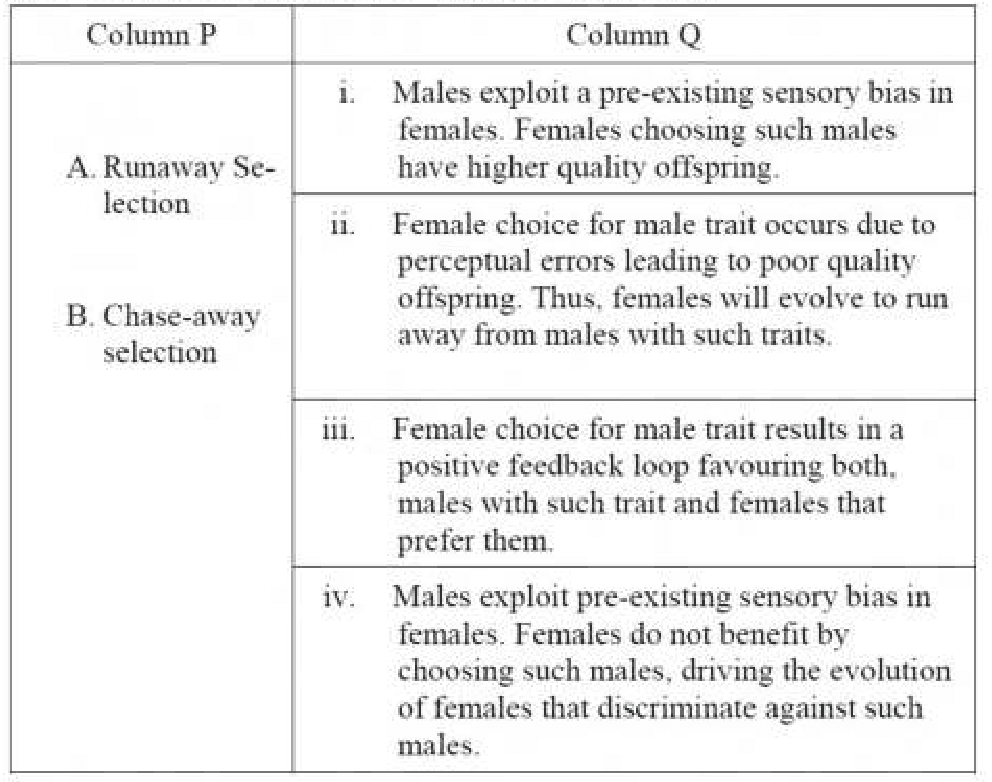
Match the models to their appropriate description and choose the correct option.
- 1A- i; B- ii
- 2A- ii; B- iii
- 3A- iii; B- iv
- 4A- iv; B- i
Show answer and solution
Fisherian runaway is a positive feedback between the male trait and the female preference for it (iii). Chase-away is when males exploit a sensory bias that harms females, so females evolve resistance (iv).
Based on the theory of kin selection, choose the correct statement:
- 1A gene for altruism will spread in the population if the act of altruism increases the actor’s gene in the next gene pool only through direct fitness.
- 2A gene for altruism will spread in the population if the act of altruism increases the actor’s gene in the next gene pool only through indirect fitness.
- 3A gene for altruism will spread in the population if the act of altruism increases the actor’s gene in the next gene pool through direct or indirect fitness.
- 4Altruistic behaviour reduces the fitness of the trait bearer so a gene responsible for altruism cannot spread in a population and will be maintained at a very low frequency.
Show answer and solution
Under Hamilton’s rule, an altruism allele spreads when rB > C, counting copies passed on both directly and through relatives. In other words, inclusive (direct + indirect) fitness must rise.
In four taxa (A, B, C and D), two characters (shape and color) were scored to infer their phylogenetic relationship. The two character states for shape were square and round, while the two character states for color were black and yellow. The character distribution is given in the table below.
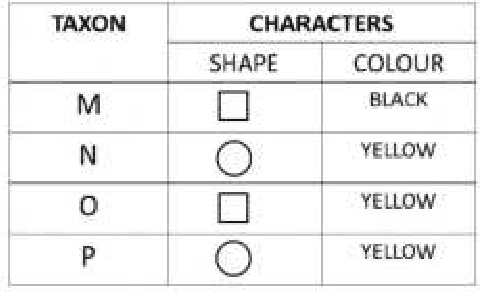
Using the above data, four trees were built using the method of maximum parsimony which are given below.
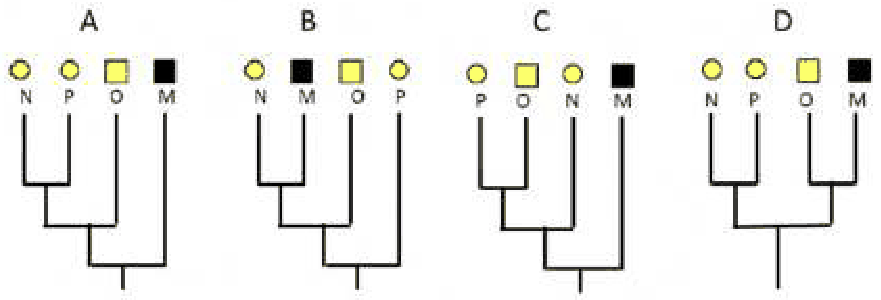
Select the option that represents the two most parsimonious trees.
- 1A and B
- 2C and D
- 3B and C
- 4A and D
Show answer and solution
Colour (black only in M) costs one step on every tree. Shape costs 1 step if the squares M and O group together and 2 otherwise. Trees A ((N,P) | (O,M)) and D group M with O, giving 2 steps in total. B and C need 3. Most parsimonious: A and D.
100 µL of cells were taken in a tube and 400 µL 0.4% Trypan Blue was added for staining. About 20 µL of this cell suspension was added between the hemocytometer and cover glass (refer figure below). The hemocytometer is divided into 9 major squares of 1 mm x 1 mm size. The height of the chamber formed with the cover glass is 0.1 mm. Empty circles indicate unstained cells and solid circles indicate stained cells.
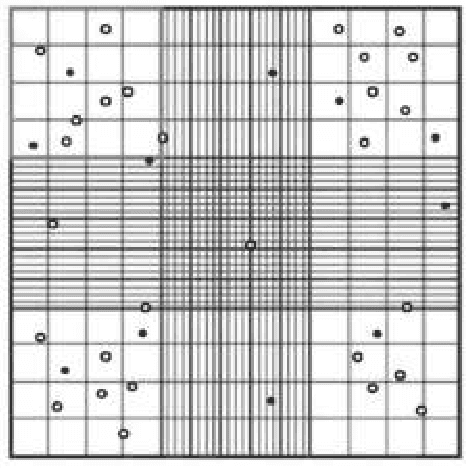
Based on the above figure, what is the total cell count in the original suspension and cell viability (%)?
- 13,75,000 cells/mL and 23%
- 23,75,000 cells/mL and 77%
- 318,75,000 cells/mL and 77%
- 475,000 cells/mL and 23%
Show answer and solution
The four corner squares (1 mm2 × 0.1 mm = 10−4 mL each) hold 30 cells, 23 of them unstained, an average of 7.5 per square. Cells per mL = 7.5 × 104 × 5 (dilution, 100 → 500 µL) = 3,75,000. Viability = 23/30 ≈ 77%.
A transgenic plant having a homozygous single-copy insertion for trait A was re-transformed by Agrobacterium-mediated transformation with a gene conferring trait B. Given below are a few statements regarding the above experiment:
- A. All T0 transgenic plants obtained after re-transformation would be single copy events for both traits, A and B.
- B. T1 progeny generated by self-pollination of single-copy transgenic plants obtained by retransformation would segregate in a 3:1 ratio for trait A.
- C. Plant selection marker genes used for transformation experiments for both traits, A and B should be necessarily identical. Different selection marker genes cannot be used.
- D. 25% of T1 progeny generated by self-pollination of single-copy transgenic plants obtained by retransformation would be homozygous for both traits, A and B.
Which one of the following options represents all INCORRECT statements?
- 1A, C and D
- 2A, B and C
- 3D only
- 4A and C only
Show answer and solution
T0 events need not be single-copy (A false). Trait A is already homozygous, so it does not segregate (B false). Different selection markers can be used, and usually are (C false). B segregates 1:2:1 and A is fixed, so 25% are homozygous for both (D true). Incorrect: A, B and C.
Given below are terms related to various techniques (Column X) and their features (Column Y):
| Techniques (Column X) | Features (Column Y) | ||
|---|---|---|---|
| A. | Reverse transcription | i. | Detection of clones encoding nucleic acid binding proteins |
| B. | Southwestern blotting | ii. | Determination of 5’ and 3’ DNA sequences flanking a known gene |
| C. | Genome walking PCR | iii. | Cloning of cDNA ends |
| D. | RACE | iv. | cDNA library |
Which one of the following options represents all correct matches between Column X and Column Y?
- 1A-iv, B-i, C-ii, D-iii
- 2A-iii, B-iv, C-i, D-ii
- 3A-ii, B-iii, C-iv, D-i
- 4A-iv, B-i, C-iii, D-ii
Show answer and solution
Reverse transcription makes a cDNA library (A–iv). Southwestern blots find DNA-binding proteins (B–i). Genome walking reads flanking DNA (C–ii). RACE clones cDNA ends (D–iii).
Given below are a few terms related to Bioinformatics resources (Column X) and their functions/applications (Column Y):
| Resources (Column X) | Functions/applications (Column Y) | ||
|---|---|---|---|
| A. | TrEMBL | i. | Analysis of recombination frequencies between molecular markers |
| B. | TBLASTN | ii. | Database of protein sequences |
| C. | SCOP | iii. | Comparison of amino acid sequence against nucleotide sequence database translated in all six reading frames |
| D. | JoinMap | iv. | Manually curated structural classification of proteins |
Which one of the following options represents all correct matches between Column X and Column Y?
- 1A – ii, B – iii, C – iv, D – i
- 2A – iv, B – i, C – ii, D – iii
- 3A – iii, B – i, C – iv, D – ii
- 4A – iv, B – iii, C – ii, D – i
Show answer and solution
TrEMBL is a protein sequence database (ii). TBLASTN searches a protein against a six-frame translated nucleotide database (iii). SCOP is the curated structural classification (iv). JoinMap builds linkage maps from recombination frequencies (i).
Mass spectrum of a pure peptide recorded in the positive ion mode is shown below.
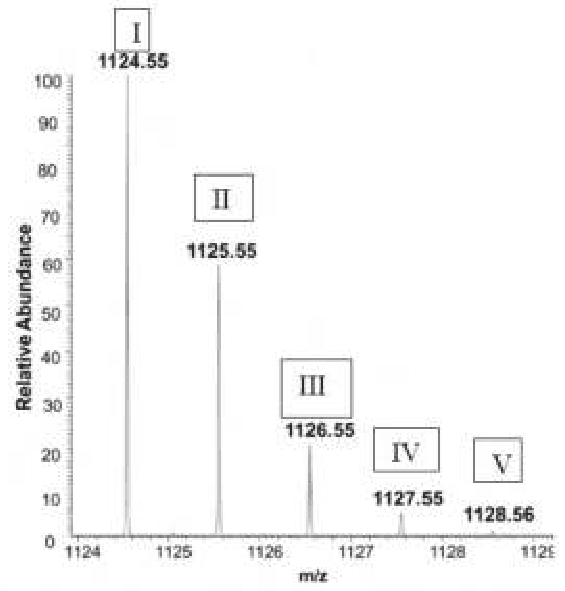
(A) What is the reason for multiple peaks in the mass spectrum of a pure peptide? (B) Which peak corresponds to the monoisotopic species of the peptide? (C) What is the monoisotopic mass of the peptide? Select the right answers from the options given below.
- 1(A) 13C isotope distribution, (B) peak V and (C) 1128.56 Da
- 2(A) 14C isotope distribution, (B) peak I and (C) 1124.55 Da
- 3(A) 13C isotope distribution, (B) peak I and (C) 1124.55 Da
- 4(A) 14C isotope distribution, (B) peak V and (C) 1128.56 Da
Show answer and solution
Peaks one mass unit apart (1124.55, 1125.55 and so on, so z = 1) come from natural 13C (about 1.1% of carbon). The lightest peak, I, has only 12C, giving a monoisotopic mass of 1124.55 Da. 14C is far too rare to show.
The following statements were made about phase contrast microscopy.
- A. Phase contrast microscopy can be equally utilized to examine stained and unstained specimens.
- B. A phase annulus generates hollow cone of light to illuminate the specimen.
- C. A light wave that passes through a cell nucleus and organelles lags compared to the light waves that pass through water only.
- D. A polarized light source is used to translate the minor phase shifts into grey values.
- E. Appearance of bright halos is a common artifact of phase contrast imaging.
Which one of the following options represents the combination of all correct statements?
- 1A, C and D
- 2B, C and E
- 3A, B and C
- 4B, D and E
Show answer and solution
The phase annulus gives a hollow cone of light (B). Light passing through dense organelles is retarded (C). Halos are the classic artefact (E). Phase contrast is meant for unstained living cells (A false), and it uses a phase plate, not polarised light, which is DIC (D false).
Following statements are about the features of immunoassays used to assay biomolecules:
- A. Radio-immunoassays (RIAs) are more sensitive than Enzyme-linked immunosorbent assays (ELISAs) with chromogenic substrates.
- B. ELISAs with chromogenic substrates are more sensitive than ELISAs with chemiluminogenic substrates.
- C. ELISPOT measures the number of cells capable of secreting particular biomolecules using a substrate that gives soluble product with enzyme reaction.
- D. In Western blot analysis, the product of enzyme-substrate reaction localises at the site precisely where the antibody-enzyme conjugate binds to its specific protein band.
Which of the following options represents the combination of all correct statements:
- 1A and C
- 2A and D
- 3B and C
- 4B and D
Show answer and solution
RIA is more sensitive than chromogenic ELISA (A), and in a Western blot the precipitating product forms exactly at the band (D). Chemiluminescent ELISA beats chromogenic (B false). ELISPOT needs an insoluble, precipitating product to make spots (C false).
Given below are terms related to various experimental techniques (Column X) and their applications (Column Y):
| Technique (Column X) | Application (Column Y) | ||
|---|---|---|---|
| A. | Mass Spectrometry | i. | Separation of whole chromosomes |
| B. | Pulsed Field Gel Electrophoresis | ii. | Separation of isoenzymes |
| C. | Isoelectric Focusing | iii. | Single-molecule-real-time sequencing |
| D. | PacBio | iv. | Identification of post-translational modifications of proteins |
Which one of the following options represents all correct matches between Column X and Column Y?
- 1A-iv, B-i, C-ii, D-iii
- 2A-iii, B-iv, C-i, D-ii
- 3A-ii, B-iii, C-iv, D-i
- 4A-iv, B-iii, C-i, D-ii
Show answer and solution
Mass spectrometry: PTM identification. PFGE: whole chromosomes. Isoelectric focusing: isoenzymes (charge variants). PacBio: SMRT sequencing.
The following table depicts the digital numbers of 12 pixels in two different bands (indicated below each pixel group) of an image collected from the LISS-IV sensor of Resourcesat1 satellite.
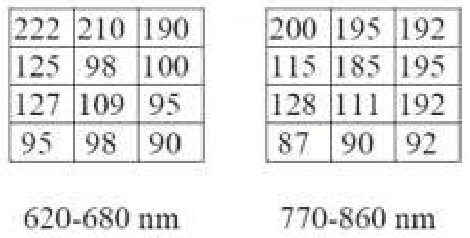
Which one of the following options represents the correct identification of only vegetated (darkened) pixels?
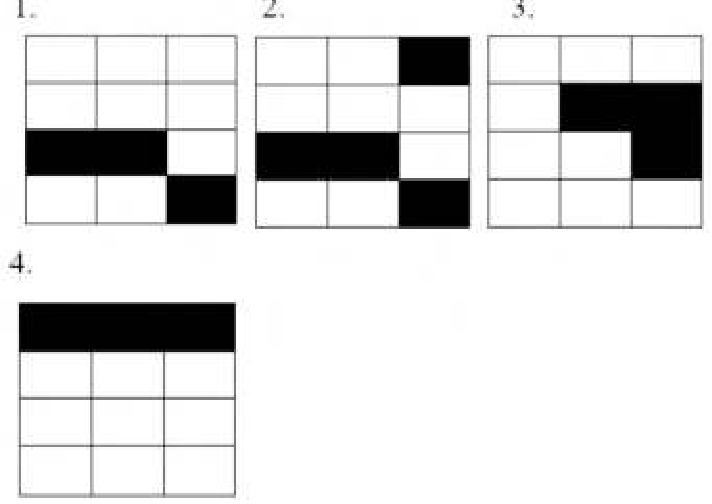
- 1Pattern 1
- 2Pattern 2
- 3Pattern 3
- 4Pattern 4
Show answer and solution
Vegetation absorbs red light (low DN in 620–680 nm) and reflects strongly in the NIR (high DN in 770–860 nm). Only three pixels have NIR far above red: row 2 middle (98 → 185), row 2 right (100 → 195) and row 3 right (95 → 192). That is pattern 3.
Changes in NTA’s final answer key
NTA dropped no question from this paper and accepted a single answer for every one, so each question below has exactly one correct option.
How to revise from this paper
- Attempt it in one 3-hour sittingAnswer 15 in Part A, 35 in Part B and 25 in Part C, as in the real exam, before you check any answers.
- Score it with negative markingAdd 2 or 4 marks for each correct answer and subtract 0.5 or 1 for each wrong one. That is the number to track.
- Sort your mistakes by unitUse the unit tag on each question. Two or three wrong answers in the same unit tell you where to revise first.
- Repeat with a fresh paperTake a full-length mock a week later and compare your unit-wise mistakes.
Keep going