

All 145 questions from the CSIR-NET Life Sciences paper of 17 February 2022 (June 2021 cycle, Shift 1), typed out in full, with NTA’s final answer key, a worked solution for every question and every diagram.
The Joint CSIR-UGC NET June 2021 cycle held its Life Sciences exam on 17 February 2022 in two shifts. This page covers the first shift. Below you will find every question from Part A (General Aptitude), Part B and Part C, in the order they appeared, each tagged with its syllabus unit. Tap Show answer and solution under any question to check the official answer and see how to reach it.
Marking scheme
| Part | Questions | Answer | Marks each | Wrong answer | Max marks |
|---|---|---|---|---|---|
| A: General Aptitude | Q1–20 | 15 | 2 | −0.5 | 30 |
| B: Life Sciences | Q21–70 | 35 | 2 | −0.5 | 70 |
| C: Life Sciences | Q71–145 | 25 | 4 | −1 | 100 |
| Total | 145 | 75 | 200 |
Which units this paper tested
We tagged each of the 125 Part B and Part C questions with its CSIR-NET syllabus unit. In this paper, Fundamental Processes, Methods in Biology and Cellular Organization carried the most questions.
Practise any unit across all 11 papers, with every question linked to a worked solution:
Jump to a question
Part A: General Aptitude (Q1–20)
20 questions; answer any 15. Each carries 2 marks, and a wrong answer costs 0.5.
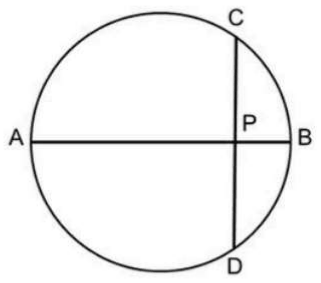
AB is the diameter of a circle. The chord CD is perpendicular to AB intersecting it at P. If CP=2 and PB=1, the radius of the circle is
- 11
- 22.5
- 32
- 45
Show answer and solution
By the intersecting chords theorem, CP × PD = AP × PB, and CP = PD = 2 because a diameter bisects a perpendicular chord. So 4 = AP × 1, AP = 4, AB = 5 and the radius is 2.5.
A shopkeeper purchases a product for Rs.100 and sells it making a profit of 10%. The customer resells it to the same shopkeeper incurring a loss of 10%. In these dealings the shopkeeper makes
- 1No profit, no loss
- 2Rs.11
- 3Rs.1
- 4Rs.20
Show answer and solution
The shopkeeper buys at 100, sells at 110, then buys it back at 110 × 0.9 = 99. He has the product again and has gained 110 − 99 = Rs 11.
The product of the perimeter of a triangle, the radius of its in-circle, and a number gives the area of the triangle. The number is
- 11/4
- 21/3
- 31/2
- 41
Show answer and solution
Area = r × s, where s is the semi-perimeter. So Area = r × perimeter × 1/2.
Starting from a point A you fly one mile south, then one mile east, then one mile north which brings you back to point A. Which of the following MUST be true?
- 1You are at the North pole
- 2You are in the Eastern hemisphere
- 3You are in the Western hemisphere
- 4You are at the South pole
Show answer and solution
From the North Pole, any “south” then “north” mile returns to the pole, and the eastward mile is spent on a circle of latitude. Of the options, this is the only one that must hold, since flying “south” from the South Pole is impossible.
Three boxes are coloured red, blue and green and so are three balls. In how many ways can one put the balls one in each box such that no ball goes into the box of its own colour?
- 11
- 22
- 33
- 44
Show answer and solution
These are derangements of 3 objects: !3 = 2, the two cyclic shifts.
There are two buckets A and B. Initially A has 2 litres of water and B is empty. At every hour 1 litre of water is transferred from A to B followed by returning ½ litre back to A from B half an hour later. The earliest A will get empty in:
- 15h
- 24h
- 33h
- 42h
Show answer and solution
A after each hour: 2 → 1 → 1.5, then → 0.5 → 1, then → 0. A is first empty at 3 h.
Density of a rice grain is 1.5 g/cc and bulk density of rice heap is 0.80 g/cc. If a 1 litre container is completely filled with rice, what will be the approximate volume of pore space in the container?
- 1350 cc
- 2465 cc
- 3550 cc
- 4665 cc
Show answer and solution
1 L of heap weighs 800 g. The grains themselves take up 800/1.5 ≈ 533 cc, so the pores are 1000 − 533 ≈ 465 cc.
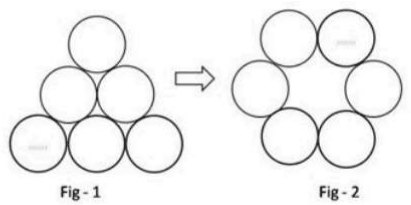
What is the minimum number of moves required to transform figure 1 to figure 2? A move is defined as removing a coin and placing it such that it touches two other coins in its new position.
- 11
- 22
- 33
- 44
Show answer and solution
Move one bottom corner coin to the top beside the apex, then the other bottom corner coin to the opposite side. Two moves turn the triangle into a ring of six.
It takes 5 days for a steamboat to travel from A to B along a river. It takes 7 days to return from B to A. How many days will it take for a raft to drift from A to B (assuming all speeds are constant)?
- 113
- 235
- 36
- 412
Show answer and solution
Downstream speed = d/5 and upstream = d/7. The current is half the difference: (d/5 − d/7)/2 = d/35. A raft drifts with the current, taking 35 days.
How many times starting at 1:00 pm would the minute and hour hands of a clock make an angle of 40° with each other in the next 6 hours?
- 16
- 27
- 311
- 412
Show answer and solution
The hands meet at a given angle twice in each 12/11 h of relative motion. Six hours is 5.5 such cycles, giving 11 occasions.
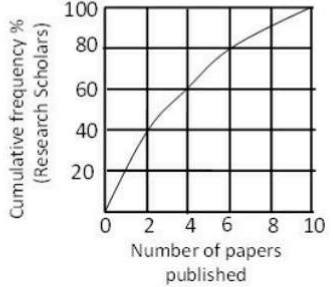
The graph shows cumulative frequency percentage of research scholars and the number of papers published by them. Which of the following statements is true?
- 1Majority of the scholar published more than 4 papers
- 260% of the scholar published at least 2 papers
- 380% of the scholar published at least 6 papers
- 430% of the scholars have not published any paper
Show answer and solution
The cumulative curve reads 40% at 2 papers, so the other 60% published at least 2. The curve starts at 0% at zero papers, so option 4 is false, and only 20% published more than 6.
The random errors associated with the measurement of P and Q are 10% and 2%, respectively. What is the maximum percentage random error in P/Q?
- 112.0
- 29.8
- 38.0
- 410.2
Show answer and solution
Percentage errors add for a quotient: 10% + 2% = 12%.
If a person travels x% faster than normal, he reaches y minutes earlier than normal. What is his normal time of travel?
- 1(100/x + 1)y minutes
- 2(x/100 + 1)y minutes
- 3(y/100 + 1)y minutes
- 4(100/y + 1)y minutes
Show answer and solution
At (1 + x/100) times the speed, time = T/(1 + x/100). The saving is y, so T(x/100)/(1 + x/100) = y, giving T = (100/x + 1)y.
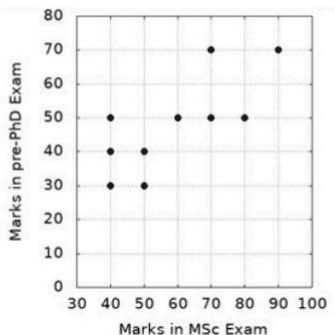
Pre-Ph.D. exam score of 10 students are plotted against their M.Sc. marks. Which of the following is true?
- 1Two students have scored better in Pre-Ph.D. than their M.Sc. exam
- 2All those students who scored 50 in Pre-D. scored more marks in their M.Sc. exam
- 3Two students scored the same marks in their Pre-Ph.D and M.Sc. exams
- 4The student who scored maximum in M.Sc. is the only student to get maximum in Pre-Ph.D. exam
Show answer and solution
The points (40, 40) and (70, 70) lie on the line of equal marks: two students. Only (40, 50) beat their M.Sc. mark, and two students share the top Pre-Ph.D. score.
What is the average value of y for the range of x shown in the following plot?
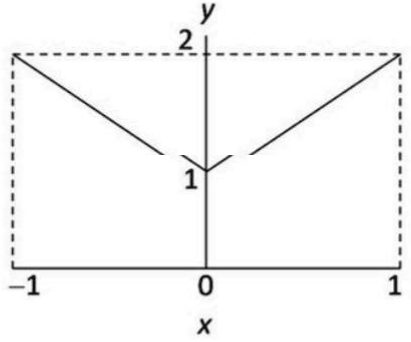
- 10
- 21
- 31.5
- 42
Show answer and solution
y = 1 + |x| rises linearly from 1 to 2 on each side, so its average is (1 + 2)/2 = 1.5.
A fair die was thrown three times and the outcome was repeatedly six. If the die is thrown again what is the probability of getting six?
- 11/6
- 21/216
- 31/1296
- 41
Show answer and solution
Throws are independent; a fair die has no memory. P(six) = 1/6.
What is the volume of soil in an open pit of size 2m × 2m × 10cm?
- 140 m3
- 20.4 m3
- 30 m3
- 44.0 m3
Show answer and solution
An open pit is a hole, so it contains no soil: 0 m3. The 0.4 m3 is the soil that was removed.
If a plant with green leaves is kept in a dark room with only green light on, which one of the following would we observe?
- 1The plant appears brighter than the surroundings
- 2The plant appears darker than the surroundings
- 3We cannot distinguish the plant from the surroundings
- 4It will have above normal photosynthetic activity
Show answer and solution
Green leaves reflect green light strongly, while the dark surroundings reflect little. So the plant looks brighter. Green light drives little photosynthesis.
The distance from city P to city Q is 27 km. A and B start walking from P towards Q at speeds of 5 km/hr and 7 km/hr, respectively. B reaches Q, returns immediately, and meets A at R. What is the distance between P and R? (assume all three cities to be in one straight line)
- 112.5 km
- 222.5 km
- 34.5 km
- 413.5 km
Show answer and solution
Together they cover 2 × 27 = 54 km at 5 + 7 = 12 km/h, which takes 4.5 h. A has walked 5 × 4.5 = 22.5 km.
A floor of size 13 × 24 is to be paved using square tiles only. What is the smallest number of tiles needed to do this?
- 16
- 215
- 38
- 49
Show answer and solution
One 13 × 13 leaves 13 × 11. One 11 × 11 leaves 2 × 11, which takes five 2 × 2 and two 1 × 1. Total 1 + 1 + 5 + 2 = 9 tiles.
Part B: Life Sciences (Q21–70)
50 questions; answer any 35. Each carries 2 marks, and a wrong answer costs 0.5.
Following statements are made about uncompetitive inhibition of an enzyme:
- A. Uncompetitive inhibitor binds to both free enzyme as well as an enzyme-substrate complex.
- B. Addition of uncompetitive inhibitor lowers the Vmax of the reaction.
- C. Apparent KM of the enzyme is lowered.
- D. Apparent KM of the enzyme remains unchanged.
Which one of the following option represents the correct combination of the statments?
- 1B and C
- 2A and C
- 3A and B
- 4A and D
Show answer and solution
An uncompetitive inhibitor binds only the ES complex (A false). It lowers Vmax (B) and lowers apparent KM by the same factor (C). Answer: B and C.
Following are the pKa’s of the ionizable groups in lysine
pKa1 = 2.16 (α – carboxylic group)
pKa2 = 9.06 (α – amino group)
pKa3 = 10.54 (ε – amino group)
Which one of the following options represents the pI of lysine?
- 17.25
- 25.61
- 36.35
- 49.8
Show answer and solution
For a basic amino acid, pI is the mean of the two amino pKa values: (9.06 + 10.54)/2 = 9.8.
The enzyme alkaline phosphatase was tested for its catalytic activity using the substrate para-nitrophenylphosphate. The KM obtained was 10 mM and Vmax was 100 µmol/min. Which one of the following options represents the initial velocity of the reaction at a substrate concentration of 10 mM?
- 150 µmol/min
- 2100 µmol/min
- 3500 µmol/min
- 420 µmol/min
Show answer and solution
At [S] = KM, v = Vmax/2 = 50 µmol/min.
How many hydrogen bonds involving the backbone CO and NH can be observed in an α-helix consisting of 15 amino acid residues?
- 110
- 211
- 312
- 413
Show answer and solution
In an α-helix, C=O of residue i bonds to N–H of i + 4. For 15 residues that gives 15 − 4 = 11 hydrogen bonds.
Progression across G1/S boundary followed by entry into S-phase is promoted by the activation of which one of the following protein complexes?
- 1Cdk4/Cyclin D
- 2Cdk2/Cyclin E
- 3Cdk4,6/Cyclin
- 4Cdk4,6/Cyclin D, E
Show answer and solution
Cyclin E–Cdk2 peaks at G1/S, finishes Rb phosphorylation and fires replication origins. Cyclin D–Cdk4/6 acts earlier in G1.
In eukaryotic cells, covalently attached lipids help to anchor some water soluble proteins to the plasma membrane. One group of cytosolic proteins are anchored to the cytosolic face of membrane by a fatty acyl group (e.g. myristate or palmitate). These groups are generally covalently attached to which amino acids present at the N-terminus of the polypeptide chain?
- 1Glycine
- 2Tyrosine
- 3Serine
- 4Lysine
Show answer and solution
N-myristoyltransferase attaches myristate to an N-terminal glycine after Met removal. Palmitate goes onto Cys thiols.
The movement of proteins bigger than 50 kDa across the nuclear envelope requires:
- 1Sec 61
- 2Tom 20
- 3Importin B
- 4Tim 44
Show answer and solution
Proteins above about 40–50 kDa cannot diffuse through the pore. They need an NLS recognised by importin α/β. Sec61, Tom20 and Tim44 handle ER and mitochondrial import.
Iron-sulphur clusters [Fe-S] are the key prosthetic groups that carry electrons in all of the below EXCEPT:
- 1NADH – CoQ reductase
- 2Succinate – CoQ reductase
- 3Cytochrome C oxidase
- 4CoQH2 – Cytochrome C reductase
Show answer and solution
Cytochrome c oxidase carries electrons on hemes a and a3 and copper centres (CuA, CuB), with no Fe–S clusters. Complexes I, II and III all have Fe–S centres.
In bacteria many of the tRNA genes do not contain the CCA sequence found at the 3’ end of tRNA. In this context which one of the following statements represents the correct explanation?
- 1In these tRNAs amino acylation occurs at the 3’ end of the tRNA irrespective of the presence of the – CCA sequence.
- 2CCA sequence is added to these tRNA transcripts in a DNA template independent manner.
- 3These tRNAs exploit the process of trans- splicing to include a CCA sequence at their 3’ end.
- 4The absence of CCA sequence occurred only in the last common ancestor (LCA) during the course of evolution and the current day tRNA genes always possess a sequence to encode the CCA end of the tRNA.
Show answer and solution
CCA-adding enzyme (tRNA nucleotidyltransferase) adds C, C and A to the 3′ end without a template.
Some cells possess peptides which contain D- form of amino acids. How do they arise?
- 1These peptides are produced by ribosomes by incorporating D- amino acids at specific positions.
- 2Ribosome makes peptides with L-amino acids only. However, some of the amino acids in the peptides are replaced by D- amino acids by a pathway that involves excision of the L- amino acids.
- 3The peptides with the D-amino acids are produced in a ribosome-independent manner.
- 4Peptides with D-amino acids exist only in archaea where they are made by the presence of racemases.
Show answer and solution
Ribosomes use only L-amino acids. Peptides containing D-residues, such as gramicidin S and the cell-wall peptides, are made by non-ribosomal peptide synthetases with epimerase domains.
All of the following statements about bacterial transcription termination are true EXCEPT
- 1some terminator sequences require Rho protein for termination.
- 2Inverted repeat and ‘T’ rich non- template strand define intrinsic terminators.
- 3Rho-dependent terminators may possess inverted repeat elements.
- 4Nus A is necessary for intrinsic transcription termination.
Show answer and solution
Intrinsic termination needs only a GC-rich hairpin followed by a U-tract. NusA boosts pausing but is not required.
Which one of the following proteins is essential for both the initiation of DNA replication as well as the continued advance of the replication fork?
- 1ORC
- 2Geminin
- 3Cdc45
- 4Cdc6
Show answer and solution
Cdc45 joins MCM2–7 and GINS to form the CMG helicase. It is needed to fire origins and also travels with the fork. ORC and Cdc6 act only in licensing, and geminin inhibits Cdt1.
Which one of the following combinations represents the major protein or protein complex involved in chromatin condensation in yeast and human, respectively?
- 1HP1 and SIR Complex
- 2SIR complex and HP1
- 3HP1 and Su(var)
- 4SIR complex and Su(var)
Show answer and solution
Budding yeast silences chromatin with the SIR complex (Sir2/3/4). Humans use HP1 bound to H3K9me3.
Which of the following is the causative agent of filariasis?
- 1Listeria monocytogenes
- 2Cryptococcus neoformans
- 3Francisella tularensis
- 4Brugiya malayi
Show answer and solution
Lymphatic filariasis is caused by the nematodes Wuchereria bancrofti and Brugia malayi, carried by mosquitoes.
The cytoplasmic domain of the receptor of which of the following proteins does NOT function as tyrosine kinase?
- 1Epidermal growth factor
- 2Platelet derived growth factor
- 3Insulin
- 4Asialoglycoprotein
Show answer and solution
The asialoglycoprotein receptor of hepatocytes is a C-type lectin for endocytosis and has no kinase domain. EGF, PDGF and insulin receptors are RTKs.
Tumors are generally classified by
- 1the virus which caused them
- 2the person who discovered them
- 3their metastatic ability
- 4the tissue or cell of origin
Show answer and solution
Tumours are named by their tissue or cell of origin: carcinoma (epithelium), sarcoma (connective tissue), leukaemia or lymphoma (blood).
A breakthrough in cancer therapy is expected where T- cells are taken from a patient are modified in the laboratory to attack cancer cells before re-infusion in the patient. These T cells are called
- 1cancer associated receptor T cells
- 2chimeric antigen-receptor T cells
- 3chimeric B and T cell
- 4cancer antigens recognition T cells
Show answer and solution
CAR-T cells are the patient’s T cells engineered with a chimeric antigen receptor (an scFv joined to CD3ζ and co-stimulatory domains) that recognises a tumour antigen.
Which one of the following statements with respect to development in amphibians is correct?
- 1Gastrulation begins with the invagination of bottle cells, followed by coordinated involution of the mesodermal precursors and the epiboly of the prospective ectoderm
- 2The organizer induces the Nieuwkoop centre
- 3The organizer is formed by the accumulation of β-catenin
- 4In the absence of BMP inhibitors ectodermal cells form neural tube
Show answer and solution
Xenopus gastrulation starts with bottle cells at the dorsal lip, then mesoderm involutes and animal cap ectoderm spreads by epiboly. The Nieuwkoop centre induces the Organizer, not the reverse.
During normal development of sea urchin, β-catenin accumulates predominantly in the micromeres, which are fated to become endoderm and mesoderm. If GSK- 3 is blocked in the developing embryo:
- 1β-catenin accumulation in the nuclei of large micromeres will be inhibited leading to formation of ectodermal ball.
- 2β-catenin will accumulate in the nuclei of all blastula cells leading to an ectodermal ball.
- 3β-catenin will accumulate in the nuclei of all blastula cells leading to animal cells getting specified as endoderm and mesoderm.
- 4β-catenin which accumulate in the nuclei of large micromeres will be inhibited leading to animal cells getting specified as endoderm and mesoderm.
Show answer and solution
GSK-3 normally degrades β-catenin. Blocking it (for example with LiCl) lets β-catenin into every nucleus, so animal cells are vegetalised into endoderm and mesoderm.
In which of the following stages of Arabidopsis embryogenesis do the visible distinctions between the adaxial and abaxial tissues of the cotyledons become initially apparent?
- 1Globular stage
- 2Zygotic stage
- 3Torpedo stage
- 4Mature stage
Show answer and solution
Adaxial and abaxial cotyledon tissues first become visibly distinct at the torpedo stage, as the cotyledons grow out (per NTA’s key).
In a transplantation experiment, the area of presumptive ectoderm from an early frog gastrula was transplanted to a region of the newt gastrula destined to become parts of the mouth. The resulting salamander larvae had frog like mouth parts (frog tadpole suckers) instead of balancers as observed during development of wild type newt embryo. This is an example of
- 1Determination
- 2Genetic specificity of interaction
- 3Regional specificity of interaction
- 4Autonomous specification
Show answer and solution
Frog ectoderm answered the newt’s “make mouth” signal but built frog structures. What the tissue can make is set by its own genome: genetic specificity of induction.
Which of the following ‘R’ gene products do not contain NBS-LRR domain?
- 1RPS2 protein of Arabidopsis
- 2Xa1 protein of rice
- 3N protein of tobacco
- 4Mlo protein of barley
Show answer and solution
MLO is a seven-transmembrane, plasma-membrane protein; mlo loss-of-function gives powdery mildew resistance. RPS2, N and Xa1 are NBS-LRR proteins.
Photochemically generated ATP is consumed in which one of the following phases of Calvin-Benson cycle?
- 1Only carboxylation
- 2Only regeneration
- 3Carboxylation and reduction
- 4Reduction and regeneration
Show answer and solution
ATP is used by phosphoglycerate kinase in the reduction phase and by phosphoribulokinase in regeneration. Carboxylation needs none.
Dirigent proteins predominantly play an important role in biosynthesis of:
- 1lignans
- 2alkaloids
- 3terpenoids
- 4amino acids
Show answer and solution
Dirigent proteins steer stereoselective radical coupling of coniferyl alcohol into (+)-pinoresinol, the entry step in lignan synthesis.
Which one of the following is used in organification of tyrosine residues in thyroglobulin protein, during thyroid hormone biosynthesis?
- 1Iodine
- 2Reduced Iodine
- 3Oxidized Iodine
- 4Hydrogen Iodide
Show answer and solution
Thyroid peroxidase uses H2O2 to oxidise iodide into a reactive iodine species, which iodinates tyrosines on thyroglobulin.
The dark current in retina is due to
- 1Closing of Na+ channels in the outer segment of photoreceptors
- 2Opening of K+ channels in the inner segment of photoreceptors
- 3Opening of Na+ channels in the outer segment of photoreceptors
- 4Closing of K+ channels in the outer segment of photoreceptors
Show answer and solution
In the dark, high cGMP keeps cGMP-gated Na+/Ca2+ channels in the outer segment open, so cations flow in. This is the dark current, which keeps the rod depolarised.
Which one of the following is not present in the filtration slit diaphragm?
- 1NEPH1
- 2Paxillin
- 3Nephrin
- 4NEPH2
Show answer and solution
The slit diaphragm is built from nephrin, NEPH1/2, podocin and CD2AP. Paxillin belongs to focal adhesions.
DNA was isolated from a strain of bacterium with genotype a+ b+ c+ d+ e+ and transformed into a bacterial strain a− b− c− d− e−. The transformants were tested for the presence of the donated genes. The cotransformed genes were found as follows:
a+ and b+; c+ and e+; d+ and c+; b+ and d+;
What is the order of genes on the bacterial chromosome?
- 1a b c d e
- 2a c b e d
- 3a b c e d
- 4a b d c e
Show answer and solution
Genes transformed together must be close neighbours: a–b, b–d, d–c and c–e chain into a b d c e.
A fly with apricot coloured eye was crossed with a sepia eyed fly of opposite sex. In F1 all flies were wild type. The genes responsible for the two phenotypes were
- 1allelic
- 2non-allelic
- 3pseudo-allelic
- 4paralogous genes
Show answer and solution
The F1 are wild-type, so the two mutations complement each other. They are in different genes: non-allelic.
Human polydactyly traits having extra fingers or toes are caused by a dominant allele. In a screening it was found that out of 42 individuals having an allele for polydactyly, only 38 of them were polydactylus. Which of the following is the correct interpretation of the observation?
- 1The penetrance of polydactyly is estimated to be 90%
- 2The expressivity of polydactyly is 90%
- 3This is an example of variable expressivity
- 4The polydactyly trait is showing complete penetrance
Show answer and solution
Penetrance is the share of carriers showing the trait: 38/42 ≈ 90%. Expressivity is about how strongly the trait shows.
The basic difference between direct repair and base excision repair is
- 1Direct repair restores original structure of altered nucleotide without replacement, while in base excision repair the section of DNA containing the distortion is removed, the correct base is added and resealed.
- 2In direct repair, homologous recombination repairs the broken region while base excision repair restores original structure of altered nucleotide by modification.
- 3Direct repair restores original structure by non-homologous end joining without using homologous template while in base excision repair the section of DNA containing the distortion is repaired by using homologous recombination.
- 4In direct repair, an exonuclease, a DNA polymerase and a ligase are used, while in base excision repair a translesion polymerase that bypasses the bulky lesions is used by the cell.
Show answer and solution
Direct repair reverses the damage in place (photolyase, MGMT), without removing anything. BER removes the damaged base, cuts the backbone, fills the gap and seals it.
Eukaryotes are classified into 5-6 super groups based on phylogenomic studies. Which one of the following statements about eurkaryotic supergroups is FALSE?
- 1Fungi and animals are more closely related to each other than either group is to plants.
- 2Amoebozoa and opisthokonts are unikonts.
- 3Land plants and green algae belong to Archaeplastida.
- 4Alveolates and amoeba belong to same super group.
Show answer and solution
Alveolates belong to the SAR supergroup, while amoebae (Amoebozoa) are unikonts, so statement 4 is false.
What is the pattern of cleavage observed in mammals?
- 1Radial
- 2Spiral
- 3Rotational
- 4Bilateral
Show answer and solution
Mammalian eggs show rotational holoblastic cleavage: at second cleavage one blastomere divides meridionally and the other equatorially.
Which of the following combinations would best characterize the dominant phase of the life cycle of a pteridophyte?
- 1Diploid gametophyte
- 2Haploid gametophyte
- 3Diploid sporophyte
- 4Haploid sporophyte
Show answer and solution
The fern plant itself is the diploid sporophyte, which dominates and lives independently. The haploid prothallus is short-lived.
Which one of the following gases is present in the stratosphere at a concentration higher than its concentration in troposphere?
- 1Nitrogen
- 2Oxygen
- 3Ozone
- 4Carbon dioxide
Show answer and solution
About 90% of atmospheric ozone lies in the stratospheric ozone layer (15–35 km). N2, O2 and CO2 concentrations are higher lower down.
The graph below shows the change in the size of four populations (A-D) over time.
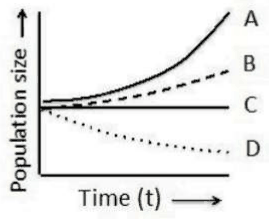
Which among the four populations (A, B, C, and D) would have the lowest intrinsic rate of population growth (r)?
- 1A
- 2B
- 3C
- 4D
Show answer and solution
D is shrinking, so its r is negative, the lowest of the four. C has r = 0, and A has the highest.
Consider the following ecosystems.
- A. Tropical rain forests
- B. Open ocean
- C. Algal beds and Coral reefs
- D. Marshes and Swamps
Which one of the following options represents these ecosystems in an increasing order of their contribution to annual world net primary production?
- 1B, C, D and A
- 2C, D, B and A
- 3D, C, A and B
- 4C, D, A and B
Show answer and solution
Global NPP (production × area): algal beds and reefs < marshes and swamps < tropical rain forest < open ocean, which is huge in area. Order: C, D, A, B.
Historical frequencies of fires in an area can be determined by
- 1radioactive dating of the tree remains.
- 2examining the fire scars in growth rings of living trees.
- 3measuring carbon content on the soil surface after fire.
- 4examining records of evacuation history of the nearby villages.
Show answer and solution
Living trees record past fires as fire scars in datable annual rings, an approach called dendropyrochronology.
Given below are statements on ‘living fossils’. Select the correct statements.
- 1Living fossils are impressions of extant organisms in old rocks.
- 2Living fossils show high morphological divergence from fossil records.
- 3Living fossils are always an evolutionary link between two classes of organisms.
- 4Living fossils are organisms that have remained unchanged for millions of years.
Show answer and solution
“Living fossils”, such as Ginkgo, the coelacanth and the horseshoe crab, are living species that have changed little in form for millions of years.
Mimicry where deceptiveness of the mimic’s signal is high and fitness consequences signaled to the receiver by the mimic is also high (and negative) is
- 1Batesian mimicry
- 2Müllerian mimicry
- 3Fisherian mimicry
- 4Millerian mimicry
Show answer and solution
In Batesian mimicry a harmless mimic copies a harmful model. The signal is deceptive, and predators that learn from mimics suffer when they meet the model.
Consider the following four geological periods.
- A. Quaternary
- B. Cretaceous
- C. Jurassic
- D. Cambrian
Which one of the following options represents the correct arrangement of these geological periods from earliest to recent:
- 1A-B-D-C
- 2D-C-B-A
- 3C-B-D-A
- 4B-A-C-D
Show answer and solution
Cambrian (~540 Ma) → Jurassic (~200 Ma) → Cretaceous (~145 Ma) → Quaternary (2.6 Ma): D-C-B-A.
Select the correct statement related to phylogeny of primates.
- 1Lemurs are more closely related to lorises than to gibbons.
- 2Orangutans are closer to lorises than to gibbons.
- 3Tarsiers are same as old world monkeys.
- 4Humans are closer to new world monkeys than to orangutans.
Show answer and solution
Lemurs and lorises are both strepsirrhines, while gibbons are hominoid apes. So lemurs are closer to lorises.
Which one of the following combinations of terms is matched INCORRECTLY?
- 1Nanopore : DNA sequencing
- 2Pyrosequencing : Protein primary structure
- 3Homologous recombination : chloroplast transformation
- 4SSRs : Co-dominant markers
Show answer and solution
Pyrosequencing is DNA sequencing by synthesis, detecting released PPi as light. It does not give protein sequence.
Which one of the following statements is correct?
- 1If a transgenic plant heterozygous for an insert segregates into 1:1 ratio for the transgenic phenotype on back- crossing then it contains two unlinked copies of the insert.
- 2ANOVA allows a plant breeder to test whether measurements from three or more treatments show statistically significant differences.
- 3Comparative genomics allows scientists to identify regions of collinearity but not synteny between different species.
- 4For genetic mapping of a quantitative trait in plants, an RIL mapping population comprising of individuals that are heterozygous at most loci is preferred.
Show answer and solution
ANOVA tests whether the means of three or more groups differ significantly. A 1:1 backcross ratio means a single locus, synteny can be studied, and RILs are homozygous.
Which one of the following regions of the target gene is NOT used for making an RNAi construct to knock down its expression?
- 15’ UTR of the mature transcript
- 23’ UTR of the mature transcript
- 3Exonic region
- 4Intronic region
Show answer and solution
RNAi targets the mature mRNA in the cytoplasm. Introns are spliced out in the nucleus, so they cannot be used. UTRs and exons work.
Which one of the following options represents a combination of terms that are matched INCORRECTLY?
- 1ddNTPs : Chain termination
- 2South Western blot: Physical interaction between DNA and proteins
- 35′–3′ exonuclease activity : Proof reading polymerase for PCR
- 4Yeast two hybrid system: Interaction between proteins
Show answer and solution
Proofreading needs 3′→5′ exonuclease activity, as in Pfu. A 5′→3′ exonuclease (Taq) does not proofread.
For a nuclear spin of spin quantum no. (I = 1/2), precessing in a magnetic field at a Larmor frequency of 300 MHz, the wavelength of incident radiation required to excite the nuclear spins must be approximately
- 11 nm
- 21 cm
- 31 m
- 410 m
Show answer and solution
λ = c/ν = 3 × 10⁸/3 × 108 = 1 m, in the radio-frequency band.
Widal test, a widely used serological test for enteric fever, is a type of
- 1precipitation reaction
- 2agglutination reaction
- 3complement fixation test
- 4immunofluorescence detection
Show answer and solution
In the Widal test, patient serum agglutinates Salmonella Typhi O and H antigens.
Fluorescence microscope that requires photoactivatable probes to obtain super-resolution is
- 1Structured illumination microscope (SIM)
- 2dSTORM – stochastic optical reconstruction microscopy
- 3Stimulated emission depletion microscopy (STED)
- 4Laser scanning confocal microscope
Show answer and solution
dSTORM is single-molecule localisation: photoswitchable dyes are turned on a few at a time and each is located precisely. SIM and STED do not need switchable probes.
A protein solution (0.2 ml) of unknown concentration was diluted with 0.8 ml of water. To 0.5 ml of this diluted solution 4.5 ml of biuret reagent was added and the color allowed to develop. The absorbance of this mixture taken in a test tube of 1cm diameter at 540 nm was observed to be 0.20. 0.5 ml of BSA (4 mg/ml) solution plus 4.5 ml of biuret gave an absorbance of 0.20 when measured as above. What is the protein concentration (mg/ml) in the undiluted unknown solution?
- 120
- 240
- 350
- 480
Show answer and solution
The diluted unknown matches 4 mg/mL BSA. The dilution was 0.2 → 1.0 mL (×5), so the original is 20 mg/mL.
Part C: Life Sciences, analytical (Q71–145)
75 questions; answer any 25. Each carries 4 marks, and a wrong answer costs 1.
A schematic of a metabolic pathway is shown below.
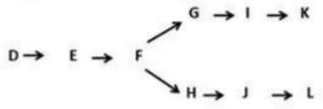
Under which of the following conditions would stoichiometric amounts of end products K and L be obtained if a concerted feedback inhibition mechanism were in operation?
- 1K inhibits F→G and L inhibits F→H; D→E is inhibited at equal amounts of K and L
- 2D→E is inhibited at equal amounts of K and L; K inhibits F→H and L inhibits F→G
- 3D→E is inhibited at equal amount of G and H; K inhibits F→H and L inhibits F→G
- 4K inhibits F→H and L inhibits F→G
Show answer and solution
In concerted feedback inhibition, the shared committed step (D→E) is shut only when both end products are present together. Each product also inhibits the first step of its own branch: K blocks F→G and L blocks F→H. Together these keep K and L balanced.
The following statements are being made to define the Michaelis constant (KM). It is:
- A. Independent of enzyme concentration [E] and substrate concentration [S]
- B. Equal to the dissociation constant when the [ES] complex dissociates more rapidly than product formation
- C. Equal to the dissociation constant when product formation is more rapid than [ES] complex dissociation
- D. An intrinsic property of an enzyme and does not depend on pH, temperature and ionic strength
Which one of the following combination of statements is correct?
- 1A and B only
- 2A, B and D only
- 3C and D only
- 4A and D only
Show answer and solution
KM = (k−1 + k2)/k1, a constant that does not depend on [E] or [S] (A). When ES falls apart much faster than it forms product (k−1 » k2), KM ≈ Kd (B). It does change with pH, temperature and ionic strength (D false).
The table below lists the biochemical characteristics of proteins and experimental procedures used to determine them. Match the characteristics with the experimental procedure.
| Biochemical Characteristics (List I) | Experimental Procedure (List II) | ||
|---|---|---|---|
| A. | 3-dimensional structure | I. | Nuclear magnetic resonance |
| B. | Ionic Charge | II. | Isoelectric focusing |
| C. | Binding specificity | III. | Affinity Chromatography |
| D. | Molecular Size | IV. | Ultracentrifugation |
Which one of the following matches is correct?
- 1A – III, B – I, C – II, D – IV
- 2A – I, B – II, C – III, D – IV
- 3A – II, B – I, C – III, D – IV
- 4A – IV, B – II, C – I, D – III
Show answer and solution
NMR gives 3-D structure. Isoelectric focusing separates by charge. Affinity chromatography tests binding specificity. Ultracentrifugation measures size (sedimentation).
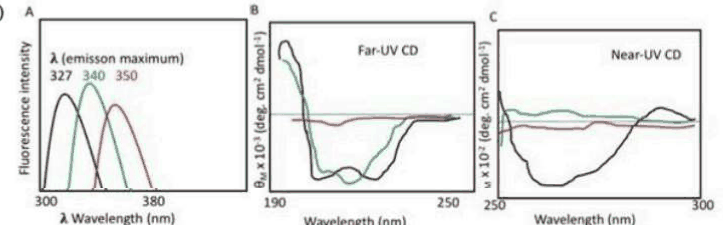
A circular dichroism spectrum in the far-UV region informs on the kind and content of secondary structures in a protein. Near-UV and tryptophan emission spectra inform on the tertiary structure. Shown in the panels above are (A) Intrinsic fluorescence emission spectra of protein ‘X’, (B) Far-UV CD spectra of protein ‘X’, (C) Near-UV CD spectra of protein ‘X’ recorded under different conditions.
Curves represent the spectra of protein ‘X’ at pH 7.0 (black), pH 3.0 (green), and pH 7.0 in the presence of 6.0 M guanidine hydrochloride (red).
What does the experiment report?
- 1Protein is fully folded at pH 7.0, acid-induced molten globule at pH 3.0 and unfolded in 6M guanidine hydrochloride.
- 2Protein secondary structure is reduced at pH 7.0 and the protein has formed beta fibrils at the other two conditions.
- 3The changes in fluorescence and near-UV CD indicate increase in hydrodynamic radius at pH 3.0 and in 6M guanidine hydrochloride.
- 4There is extensive denaturation of the protein both at pH 3.0 and in 6M guanidine hydrochloride.
Show answer and solution
At pH 3 the far-UV CD (secondary structure) is mostly kept, but the near-UV CD signal is lost and Trp fluorescence red-shifts (327 → 340 nm). That is a molten globule. In 6 M GdnHCl all signals are lost and emission shifts to 350 nm: fully unfolded.
The pI of four proteins (A, B, C, D) are shown in the table below:
| Protein | pI |
|---|---|
| A | 4 |
| B | 5.5 |
| C | 7 |
| D | 9 |
To purify ‘D’ from a mixture of these four proteins in a single step, using ion-exchange chromatography, what combination of buffer pH and ion-exchange resin would you select?
- 1pH 11, cation exchanger resin
- 2pH 2, anion exchanger resin
- 3pH 6, anion exchanger resin
- 4pH 8, cation exchanger resin
Show answer and solution
At pH 8, protein D (pI 9) is positive while A, B and C (pI < 8) are negative. On a cation exchanger only D binds, so one step purifies it.
The curve B in the figure below shows the oxygen dissociation profile at physiological concentration of CO2 and at pH 7.

An increase in pH would lead to oxygen dissociation profile indicated by:
- 1curve B (no change in the dissociation profile)
- 2curve A
- 3curve C
- 4curve D
Show answer and solution
Higher pH (the Bohr effect in reverse) raises O2 affinity and shifts the curve left, to curve A.
Following statements were made about chromosome cohesion during mitosis and meiosis.
- A. Though cohesin is important for pairwise alignment of the chromosomes on the mitotic spindle, it is not important for the generation of tension across the centromere.
- B. Cohesin binds to the chromosome even before the initiation of S-phase.
- C. In fission yeast, centromere specific localization of Moa1 and Rec8 regulates the orientation of kinetochores at meiosis-I.
- D. Cohesin exhibits uniform distribution/localization pattern across the chromosomal length.
- E. Polo/Cdc5 is a positive regulator of Separase, an endopeptidase that facilitates opening of the cohesin ring.
Which one of the following combination contains all correct statments?
- 1A, B and D only
- 2A, C and E only
- 3B, C and D only
- 4B, C and E only
Show answer and solution
Cohesin is loaded in G1, before S phase (B). In fission yeast, Moa1 with Rec8 at centromeres sets meiosis I mono-orientation (C). Polo/Cdc5 phosphorylates cohesin, which helps separase cut it (E). Cohesin is needed for centromere tension (A false) and is enriched at centromeres rather than spread evenly (D false).
Which one of the following is valid with respect to, one step growth experiment developed by Ellis and Delbruck in 1939?
- 1The reproduction of large phage population is synchronized.
- 2A culture is directly developed by inoculation of single bacterial colony from the agar plate into liquid medium.
- 3Involves only a single step of overnight culture development followed by inoculation of a fresh medium with 1% inoculum.
- 4Only a single carbon source such as glucose is used in the medium.
Show answer and solution
Ellis and Delbrück’s one-step growth experiment synchronises a single round of infection, showing the latent period, rise period and burst size.
Given below are a few statements about nuclear transport.
- A. RanGTP levels are higher in the nucleus than the cytoplasm.
- B. Nuclear import receptors can shuttle between the nucleus and cytoplasm.
- C. NTF2 transports RanGDP into the cytosol.
- D. Export of mRNA is not directly dependent on Ran.
- E. tRNA and miRNA export is mediated by exportins.
Which one of the following combination contains all correct statments?
- 1A, B, C, D only
- 2B, C, D only
- 3A, B, D, E only
- 4A, C, E only
Show answer and solution
RanGTP is high in the nucleus (A). Import receptors shuttle back and forth (B). Bulk mRNA export uses NXF1/TAP and does not depend on Ran (D). tRNA (exportin-t) and pre-miRNA (exportin-5) use exportins (E). NTF2 carries RanGDP into the nucleus (C false).
During cytokinesis, a small GTPase, RhoA, localizes to the equatorial membrane above the spindle midzone. The localization/activity of RhoA is potentially modulated by:
- A. RhoGEF Ect2
- B. Aurora B kinase
- C. PLK1 kinase
- D. MKLP1 kinesin
- E. ATM and ATR
Which one of the following combination contains all correct statments?
- 1A, B and D only
- 2A, B,C and D only
- 3B, C,D and E only
- 4A, C and D only
Show answer and solution
Centralspindlin (MKLP1 with MgcRacGAP) recruits the RhoGEF Ect2 to the midzone. PLK1 and Aurora B phosphorylations control this. ATM and ATR are DNA-damage kinases. Answer: A, B, C and D.
Cellular actin levels can be as high as 100-400 µM. Of this, unpolymerized actin concentration can be as much as 50-200 µM. However, the critical concentration for actin polymerization in-vitro is about 0.2 µM. Some of the following proteins inhibit polymerization of actin in cells.
- A. Thymosin-β4
- B. Capping protein CapZ
- C. Tropomodulin
- D. XMAP215
Which one of the following options lists all inhibitors?
- 1A, B and C only
- 2B, C and D only
- 3C, D and A only
- 4D, A and B only
Show answer and solution
Thymosin-β4 sequesters actin monomers, CapZ caps barbed ends and tropomodulin caps pointed ends. All three hold back polymerisation. XMAP215 is a microtubule polymerase.
To delineate the steps in endoplasmic reticulum (ER) transport, a PhD student homogenized pancreatic acinar cells to isolate microsomes, which retain most of the biochemical properties of the ER. For this experiment, the student has planned a number of controls as mentioned below.
- A. Treat one set of microsomes first with detergent and then with protease.
- B. Treat one set of microsomes with protease only.
- C. Treat one set of microsomes with micrococcal nuclease.
- D. Treat one set of microsomes with detergent only.
Select the option that represents the best combination of the controls.
- 1A, B and D only
- 2B, C and D only
- 3A and C only
- 4B and D only
Show answer and solution
In a protease-protection assay: protease alone shows that proteins in the lumen are protected (B). Detergent plus protease is the positive control showing they can be digested once the membrane is opened (A). Detergent alone controls for detergent effects (D).
Following statements were made about imprinting in the human genome.
- A. Imprinting control centre (IC) harbors part of the SNRPN gene.
- B. Imprinting of genes in an individual cannot be tissue specific.
- C. Sperms and eggs exhibit identical pattern of genome methylation, except in the sex chromosomes.
- D. At imprinted loci, expression depends on the parental origin.
Select the option with all the correct statements.
- 1A and D
- 2B and D
- 3A and C
- 4B and C
Show answer and solution
The imprinting centre at 15q11–q13 overlaps the SNRPN promoter and exon 1 (A). Imprinted genes are expressed according to parent of origin (D). Imprinting can be tissue-specific, and sperm and egg methylation patterns differ.
Mitochondrial protein synthesis is of prokaryotic origin. Following statements are being made about the ribosomes from bacteria and mitochondria:
- A. The bacterial ribosome consists of small and large subunits of 30S and 50S respectively, whereas in mitochondria of mammals these subunits are of 28S and 39S
- B. In the bacterial ribosomes the RNA: protein ratio is about 2:1 whereas in mitochondria ribosomes this ratio is usually 1:2
- C. Both the bacterial and mitochondrial ribosomes consist of 30S and 50S subunits
- D. Both the bacterial and mitochondrial ribosomes consist of RNA and protein in the ratio of 1:1
Choose the option that represents all correct statments.
- 1A and B only
- 2B and C only
- 3C and D only
- 4A and D only
Show answer and solution
Mammalian mitoribosomes (55S) have 28S and 39S subunits (A) and are protein-rich, with RNA:protein about 1:2, the reverse of bacteria (B).
Given below are a few statements about the λ infection cycle
- A. Competition between cI and cII gene products determines the establishment of lysogeny versus lysis.
- B. cI binds OR1 first while cro binds to OR3 first
- C. Cro binding to OR represses cI transcription
- D. Rich medium favours lytic cycle because cII is protected from cellular proteases
Which one of the following options represents all correct statements?
- 1B and C
- 2A and B
- 3C and D
- 4A and C
Show answer and solution
CI binds OR1 first and Cro binds OR3 first (B). Cro at OR3 represses PRM, the promoter for cI (C). The real competition is CI against Cro (A false). In rich medium, proteases degrade CII, which favours lysis (D false).
Reproduction of ϕ×174, a single stranded DNA phage involves several steps. A few statements are given below to explain the mechanism.
- A. The single stranded ϕ×174 DNA is converted into a double- stranded replicative form (RF)
- B. Replication of double stranded replicative form results in the production of single stranded phages, about 50% of which are +ve sense phages and the remaining are −ve sense phages
- C. Replication of the double stranded replicative form results in the production of only −ve sense phages
- D. Replication of the double stranded replicative form results in the production of only +ve sense phages
Choose the option that correctly describes the process
- 1A only
- 2A and B
- 3A and C
- 4A and D
Show answer and solution
φX174’s (+) single strand is first made into a double-stranded RF (A). Rolling-circle replication then makes and packages only (+) strands (D).
Which one of the following schematics depicts the potential relationship among the subunits IIo, IIa, and IIb of RNA polymerase II?
- 1

- 2

- 3

- 4


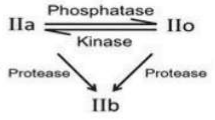


Show answer and solution
Phosphorylating the CTD turns Pol IIA into IIO, and phosphatases reverse it. Proteolysis that removes the CTD from either form gives IIB. That is scheme 1.
DNA replication occurs in S phase. The entry of cells into S phase is regulated by the tumor suppressor protein Rb. The statements below are made with reference to the role of Rb.
- A. Rb binds to E2F in the cytosol and prevents E2F entry into the nucleus.
- B. Rb is phosphorylated by cyclin A/ cdk 4.
- C. Phospho Rb activates E2F.
- D. E2F activates cyclin E production which promotes the G1/S transition.
Which one of the following options represents all correct statements?
- 1A, B and C only
- 2B, C and D only
- 3A, C and D only
- 4C and D only
Show answer and solution
Phosphorylated Rb releases, and so activates, E2F (C). E2F then switches on cyclin E for the G1/S transition (D). Rb holds E2F in the nucleus (A false) and is phosphorylated first by cyclin D–Cdk4/6 (B false). NTA accepted options 3 and 4.
The following statements are made with reference to DNA replication:
- A. Camptothecin causes intra- strand and inter- strand crosslinks in DNA, leading to stalling of replication forks.
- B. Prevention of reinitiation of DNA replication during the same cell cycle is mediated by regulating the loading of the initiator complex ORC.
- C. A glu → ala mutation in the nucleotide building pocket of DNA polymerase III could lead to the incorporation of ribonucleotides in the extending DNA chain.
- D. A mutation in the gene encoding Topoisomerase II could lead to entanglement of DNA daughter strands during replication.
Which one of the following options represents all correct statements?
- 1A and B only
- 2B and C only
- 3C and D only
- 4B, C and D only
Show answer and solution
A Glu→Ala change at the “steric gate” of the nucleotide pocket lets ribonucleotides in (C). Without topo II, daughter duplexes stay catenated (D). Camptothecin traps topo I and does not crosslink DNA (A false). Re-replication is blocked by controlling MCM loading (Cdc6/Cdt1), not ORC loading (B false).
The population that is at highest risk against influenza infection should be immunized annually. Which one of the following is the most important reason for this?
- 1Influenza virus can change its surface antigen very frequently.
- 2Influenza virus has a very short incubation period.
- 3Influenza virus has a reasonably longer incubation period giving memory B cells time to respond by producing high levels of serum antibody.
- 4Repeated immunization interferes with the differentiation of plasma cells from memory cells thereby decreasing levels of neutralizing antibody.
Show answer and solution
Influenza’s incubation period is very short (1–3 days), too short for memory B cells to produce protective antibody in time. High-risk people need high antibody levels before exposure, hence yearly vaccination (as Kuby explains). Antigenic drift also matters.
Localized increases in the cytosolic level of free Ca2+ are critical to its function as second messenger. Calmodulin, a small cytosolic protein, mediates many cellular effects of Ca2+. Which of the following is NOT CORRECT for Ca2+-calmodulin interaction?
- 1Each calmodulin molecule binds six Ca2+ ions in a cooperative fashion.
- 2Binding of Ca2+ causes calmodulin to undergo a conformational change leading to active calmodulin.
- 3Since binding of Ca2+ is cooperative, a small change in the level of cytosolic Ca2+ leads to a large change in the level of active calmodulin.
- 4One of the many enzymes activated by Ca2+– calmodulin is cAMP phosphodiesterase, which degrades cAMP and links Ca2+ and cAMP signaling.
Show answer and solution
Calmodulin has four EF-hands and binds four Ca2+, not six, so statement 1 is not correct. Binding is cooperative and switches on targets including PDE1, which links Ca2+ to cAMP.
Some cellular and extracellular proteins are enlisted in List I and their typical characteristics are enlisted in List II
| List I | List II | ||
|---|---|---|---|
| A. | Nidogen | I. | In human genome, one gene of this protein is present but many different isoforms are there due to alternative splicing |
| B. | Fibronectin | II. | An intermediate filament protein that is typically expressed in epithelial and mesenchymal cells |
| C. | Integrin | III. | One of the principal structural proteins of basal laminae. |
| D. | Vimentin | IV. | Heterodimer of α and β subunit and binds to extracellular matrix proteins. |
Which one of the following is the most appropriate match?
- 1A – I, B – II, C – III, D – IV
- 2A – II, B – III, C – IV, D – I
- 3A – III, B – I, C – IV, D – II
- 4A – II, B – IV, C – I, D – III
Show answer and solution
Nidogen (entactin) is a core basal lamina protein. Fibronectin comes from one gene with many splice isoforms. Integrins are αβ heterodimers that bind the ECM. Vimentin is the mesenchymal intermediate filament.
Following statements have been proposed for cancer cells and cancer stem cells:
- A. Cancer cells mostly have mutations whereas cancer stem cells do not.
- B. Cancer cells divide to form two different populations of cells whereas cancer stem cells do not divide.
- C. Cancer stem cells can undergo self-renewal whereas cancer cells cannot.
- D. Cancer cells are predominantly resistant to chemotherapy and radiation.
- E. Cancer stem cells are found only in the bone marrow and placenta.
Which one of the following combination of statements is correct?
- 1A and C
- 2A and B
- 3C and E
- 4C and D
Show answer and solution
Cancer stem cells self-renew, while the bulk tumour cells do not (C). NTA’s key also accepts A (that the bulk cells carry most mutations), giving A and C. It is the cancer stem cells, not most cancer cells, that resist chemotherapy and radiation (D false). This solution follows NTA’s key.
Which of the following is/are associated with the presentation of endogenous antigens by Class I MHC molecule by an Antigen Presenting Cell (APC), given the condition that there is no cross-presentation of antigens by the APC?
- 1TAP1 and TAP2 proteins only
- 2Invariant chain (Ii)
- 3Proteosome-like subunits LMP2 and LMP7 only
- 4TAP1, TAP2 proteins and proteosome-like subunits LMP2, LMP7
Show answer and solution
Endogenous antigens are cut up by the immunoproteasome (LMP2 and LMP7 subunits) and pumped into the ER by TAP1/TAP2 for loading onto class I. The invariant chain belongs to the class II pathway.
Which one of the following statements is NOT correct regarding the tetrapod limb development?
- 1As the limb grows outward, the stylopod forms first, then the zeugopod and the autopod is formed last. Each phase is characterized by a specific pattern of Hox gene expression.
- 2The zone of polarizing activity (ZPA) is maintained by the interaction of the FGFs from the AER and Shh expressed from the mesenchyme.
- 3Although cell death in the limb is necessary for the formation of digits and joints, it is never mediated by the BMPs, which is only responsible for differentiating mesenchyme cells into cartilage.
- 4The dorsal-ventral axis is formed in part by the expression of Wnt7a in the dorsal portion of the limb ectoderm, which maintains expression level of Shh in the ZPA and Fgf4 in the posterior AER.
Show answer and solution
BMPs do drive the interdigital and joint cell death that separates digits, so statement 3 is the incorrect one.
The Dorsal protein is involved in generating the dorsal-ventral (DV) polarity in Drosophila. The following statements were made regarding the activity of the Dorsal protein in establishing the DV polarity.
- A. In embryos that lack Gurken protein, the Dorsal protein is not translocated to the nucleus of the follicle cells which then causes ventralization of the embryo
- B. Though Dorsal protein acts as a morphogen, it is found throughout the syncytial blastoderm of the early Drosophila embryo.
- C. In embryos that lack Cactus protein the Dorsal protein can be found in the nucleus of cells with a ventral fate.
- D. If the Dorsal protein is blocked from entering the nucleus, the genes responsible for specifying dorsal cell types are not transcribed.
Which of the above statements are correct?
- 1A and B
- 2B and C
- 3C and D
- 4A and C
Show answer and solution
Dorsal protein is present throughout the syncytial blastoderm but enters nuclei only ventrally (B). Without the inhibitor Cactus, Dorsal enters all nuclei, including ventral ones (C). Gurken acts on follicle cells, not on Dorsal in them (A false). Blocking Dorsal stops ventral genes; dorsal genes are then expressed everywhere (D false).
Following are certain statements regarding root growth and differentiation in plants:
- A. Root hair, endodermis, xylem and phloem reach maturation in elongation zone of a developing root.
- B. The root epidermal cells that are incapable of forming root hairs are called atrichoblasts.
- C. Quiescent center is present just above root cap.
- D. In Arabidopsis, an auxin transporter (ABCB4) plays a role in root hair emergence by maintaining intracellular auxin concentration.
Which one of the following combination of statements is correct?
- 1A, B and C
- 2B, C and D
- 3A, C and D
- 4A, B and D
Show answer and solution
Atrichoblasts are epidermal cells that do not make root hairs (B). The quiescent centre sits just above the root cap (C). ABCB4 helps root hair growth by controlling cellular auxin (D). Root hairs and vascular tissues mature in the maturation zone, not the elongation zone (A false).
Match the terms used in vertebrate limb development in List I with their descriptions in List II:
| List I | List II | ||
|---|---|---|---|
| A. | EMT | I. | The cells found within the most posterior region of the limb bud |
| B. | Mesenchyme | II. | The thickening of ectoderm at the apex of the developing limb |
| C. | AER | III. | A loosely organized, mainly mesodermal embryonic tissue |
| D. | Progress zone | IV. | Epithelial cells making up the mesoderm of the early somatopleure undergo this transition and get included in mesenchyme cell pool |
| E. | ZPA | V. | The proliferative mesenchyme that fuels limb bud growth |
| F. | Autopod | VI. | The distal part of tetrapod limb |
Which one of the following combination of the statements is correct?
- 1A – IV, B – III, C – II, D – V, E – I, F – VI
- 2A – I, B – II, C – III, D – IV, E – V, F – VI
- 3A – V, B – IV, C – II, D – VI, E – III, F – I
- 4A – II, B – V, C – I, D – III, E – IV, F – VI
Show answer and solution
Somatopleure epithelium undergoes EMT to make limb mesenchyme (A–IV). Mesenchyme is loose embryonic tissue (B–III). The AER is the apical ectodermal thickening (C–II). The progress zone is the proliferating distal mesenchyme (D–V). The ZPA is posterior (E–I). The autopod is the distal limb (F–VI).
Given below are some of the statements in connection with neural tube formation in vertebrates:
- A. In primary neurulation the cells surrounding the neural plate direct the neural plate cells to proliferate, invaginate and separate from the surface ectoderm to form an underlying hollow tube.
- B. In secondary neurulation the neural tube arises from the aggregation of mesenchyme cells into a solid cord that subsequently forms cavities to create a hollow tube
- C. In birds primary neurulation generates the neural tube from anterior up to the hind limb developing region
- D. In mammals, secondary neurulation begins at the level of sacral vertebrae
- E. Anencephaly results when a failure to close the neural tube occurs, resulting in the forebrain remaining in contact with amniotic fluid.
Which one of the following options gives all correct statements?
- 1A, B, C, D and E
- 2A only
- 3B and E only
- 4C, D and E only
Show answer and solution
All five are textbook statements (Gilbert). Primary neurulation folds the plate, and secondary neurulation hollows a solid cord. In birds, primary neurulation forms the tube down to the hind-limb level, and in mammals secondary neurulation begins at the sacral level. Anencephaly is failure of the anterior tube to close.
Following are certain statements regarding tracheary elements of vascular plants
- A. Xylem tracheids are highly elongated tapered cells that conduct water
- B. Xylem vessel elements are less elongated and narrower than tracheids
- C. Angiosperms may have both tracheids and vessel elements
- D. Vessel elements are the only tracheary elements in almost all gymnosperms
Which one of the following options represents the combination of correct statements?
- 1A, B and C only
- 2A and C only
- 3B and C only
- 4B and D only
Show answer and solution
Tracheids are long, tapered water conductors (A), and angiosperms have both tracheids and vessels (C). Vessel elements are shorter but wider than tracheids (B false), and almost all gymnosperms have only tracheids (D false).
Following are certain statements regarding phytochrome interacting factors (PIFs), a family of proteins that regulates photomorphogenic response in plants:
- A. PIFs promote skotomorphogenesis by serving as transcriptional activators of dark induced genes.
- B. PIFs on interaction with Pfr get phosphorylated, followed by degradation via the proteasome complex.
- C. The degradation of PIFs takes place in the presence of light.
- D. PIF-induced genes are not expressed in light.
Which one of the following options represents the combination of correct statements?
- 1A, B and C
- 2A, C and D
- 3A, B and D
- 4B, C and D
Show answer and solution
PIFs activate dark-induced (skotomorphogenic) genes (A). Light-activated Pfr triggers their degradation (C), so PIF-target genes switch off in light (D). NTA’s key is A, C and D. Statement B (phosphorylation then proteasomal degradation) is also correct in textbooks, so this solution follows NTA’s key.
The phytohormones ethylene (ET), methyl jasmonate (MeJA) and salicylic acid (SA) play important roles in plant defense. The following statements were made regarding induction of defensin PDF1.2 and pathogenesis related protein PR1:
- A. ET/MeJA activates PDF1.2
- B. ET/MeJA activates PR-1
- C. SA activates PDF1.2
- D. SA activates PR-1
Which one of the following options represents the combination of correct statements?
- 1A and B
- 2A and D
- 3B and C
- 4C and D
Show answer and solution
PDF1.2 is the marker of the ET/JA pathway (A), and PR-1 of the SA pathway (D).
A researcher has obtained an Arabidopsis mutant defective in strigolactones (SLs), a novel plant hormone. The following statements were made regarding the mutant phenotype:
- A. Shoot branching gets enhanced in the mutant plant
- B. Hyphal branching of arbuscular mycorrhizal fungi (AM-fungi) gets enhanced during colonization in the mutant plants
- C. Shoot branching gets inhibited in the mutant plants
- D. Germination of seeds of parasitic plant is prevented near the mutant plant
Which one of the following options represents the combination of correct statements?
- 1A and B
- 2B and C
- 3B and D
- 4A and D
Show answer and solution
Strigolactones suppress shoot branching, so the mutant is bushier (A). SLs exuded from roots trigger Striga and Orobanche germination, so parasite seeds stay dormant near the mutant (D). SLs stimulate AM hyphal branching, so B is false.
During light reaction in photosynthesis, electron is transported in electron transport chain (ETC) and produces ATP and NADPH in the process. Following are certain statements regarding ETC during light reaction:
- A. Electron from P680 moves first to quinone and then to the pheophytin
- B. P700 can receive electrons from plastocyanin
- C. NADPH is produced at the end of light reaction
- D. The hydrogen ions produced during light reaction gets concentrated in thylakoid lumen
Choose the correct answer from the options given below:
- 1A, B and C
- 2A, B and D
- 3A, C and D
- 4B, C and D
Show answer and solution
Plastocyanin passes electrons to P700 (B). Ferredoxin–NADP+ reductase makes NADPH at the end of the chain (C). Protons build up in the lumen (D). Electrons go from P680 to pheophytin first, then to QA, so A is reversed.
Given below are various plant natural products and their basic structural unit:
| Natural products (List I) | Basic unit (List II) | ||
|---|---|---|---|
| A. | Phenolics | I. | Five-carbon isoprene unit |
| B. | Alkaloids | II. | Glucose unit attached by O-β-D-glucosyl linkage |
| C. | Terpenoids | III. | Nitrogen containing |
| D. | Cyanogenic glycoside | IV. | Aromatic arene ring with OH group |
Which of the following options represents the correct match of natural product and the basic unit:
- 1A – IV, B – I, C – III, D – II
- 2A – III, B – II, C – I, D – IV
- 3A – III, B – I, C – IV, D – II
- 4A – IV, B – III, C – I, D – II
Show answer and solution
Phenolics: an aromatic ring with an OH group. Alkaloids: nitrogen-containing. Terpenoids: built from C5 isoprene units. Cyanogenic glycosides: a cyanohydrin linked to β-D-glucose.
The mechanisms of thermogenesis in brown adipose tissue (BAT) in cold are described in the following proposed statements:
- A. A thermogenic uncoupling protein, UCP1 helps in the heat production in BAT
- B. Norepinephrine secretion from sympathetic nerve endings in BAT is decreased
- C. Lipolysis is increased by low level of norepinephrine in BAT
- D. A high content of mitochondria in BAT helps in the oxidation of fatty acids
- E. Oxidation produces much heat as ATP synthase activity is low
Which one of the following options represents the combination of correct statements?
- 1A, B and C
- 2A, D and E
- 3B, C and D
- 4B, D and E
Show answer and solution
Cold raises sympathetic noradrenaline release, which drives lipolysis (B and C false). BAT’s many mitochondria oxidise the fatty acids (D). UCP1 lets protons leak back into the matrix (A), so the energy becomes heat rather than ATP (E).
The pressure in the ‘space’ between lungs and chest wall is known as intrapleural pressure. The following statements are related to the intrapleural pressure at different phases of respiration:
- A. At the end of quiet expiration the tendency of the lung to recoil from chest wall is balanced by the recoil of chest wall in opposite direction, and intrapleural pressure is subatmospheric.
- B. At the start of inspiration the intrapleural pressure is subatmospheric.
- C. The intrapleural pressure becomes more negative during inspiration.
- D. The intrapleural pressure attains value above atmospheric pressure during expiration.
- E. The intrapleural pressure becomes positive (relative to atmospheric pressure) during strong inspiratory efforts.
Which one of the following combinations is correct?
- 1A, B and C
- 2B, C and D
- 3C, D and E
- 4A, C and D
Show answer and solution
At the end of quiet expiration the lung and chest-wall recoils balance and intrapleural pressure is about −5 cmH2O (A, B). It becomes more negative during inspiration (C). It turns positive only in forced expiration, never during inspiration.
Hemoglobin (Hb) transports CO2 in venous blood as carbamates. The following statements refer to the formation of these carbamates:
- A. CO2 interacts with amino terminal nitrogens of Hb polypeptide chains
- B. CO2 interacts with carboxyl terminal carbons of Hb polypeptide chains
- C. Carbamates helps formation of salt bridges between α and β chains of Hb
- D. Carbamates helps formation of disulfide bridges between α and β chains of Hb
Which one of the following options is a combination of correct statements?
- 1A and C
- 2B and D
- 3B and C
- 4A and D
Show answer and solution
CO2 reacts with the uncharged N-terminal α-amino groups to form carbamino-Hb (A). The negative carbamates form salt bridges that stabilise the T (deoxy) state (C).
Following statements are given for the ovarian hormones:
- A. 17β-estradiol, estrone and estriol are naturally occurring estrogens
- B. They are 18 C steroids which do not have methyl group at 10th positions
- C. They are 21 C steroids which have methyl group at 10th position
- D. They are primarily synthesized by granulosa cells of the ovarian follicles
- E. Their biosynthesis does not depend on the enzyme aromatase
Which one of the following options represents the combination of correct statements?
- 1A, B and C
- 2A, B and D
- 3B, C and D
- 4C, D and E
Show answer and solution
Oestradiol, oestrone and oestriol are the natural oestrogens (A). They are C18 steroids with an aromatic A-ring and no C-19 methyl (B). They are made by granulosa cells from theca androgens using aromatase (D).
Below are given a set of statements for the glucocorticoid hormones:
- A. They bind to cell surface receptors and influence stress adaptation
- B. They bind to intracellular receptors and influence stress adaptation
- C. They inhibit ACTH secretion from anterior pituitary
- D. Prolonged treatment with glucocorticoids leads to atrophic and unresponsive adrenals
- E. Their secretion does not show circadian variations
Which one of the following combination of the statements is correct?
- 1A, C and E
- 2B, C and D
- 3C, D and E
- 4A, D and E
Show answer and solution
Glucocorticoids act through intracellular receptors (B). They give negative feedback on CRH and ACTH (C), and long-term use makes the adrenals atrophy (D). Cortisol shows a strong circadian rhythm, peaking in the early morning, so E is false.
The pedigree given below represents the genotype at four different loci for the children in generation III.
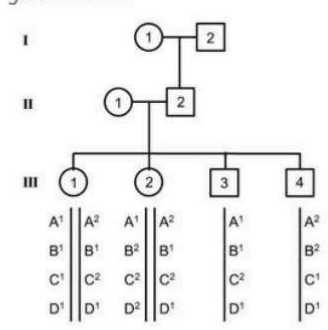
Which one of the given genotypes is likely to represent the genotype of individual II-1?
- 1

- 2

- 3
- 4


Show answer and solution
Both daughters carry A2B1C2D1, the chromosome from II-2. Their other chromosomes, A1B1C1D1 (III-1) and A1B2C2D2 (III-2), came from II-1. The sons’ haplotypes are also crossover products of two parental chromosomes, A1B1C1D1 / A2B2C2D2.
A Drosophila mutant (line A) with vestigial wings is isolated in a laboratory. The vestigial wing phenotype was observed to be recessive and mapped to gene ‘X’. Three other laboratories also isolated vestigial mutants, called line B, C and D. In order to test if the mutation in lines B-D also mapped to gene ‘X’, the following crosses were made and phenotype of F1 progeny observed.
| Cross | F1 progeny (wing morphology) |
|---|---|
| A × B | Vestigial |
| A × C | Vestigial |
| A × D | Normal |
| B × C | Vestigial |
| B × D | Normal |
| C × D | Normal |
Based on the above identify the line(s) which is most likely NOT to have a mutation in gene ‘X’.
- 1Both lines B and C
- 2Line C only
- 3Line D only
- 4Both lines B and D
Show answer and solution
A, B and C fail to complement one another (F1 vestigial), so they share the mutated gene X. D complements all three (F1 normal), so line D has its mutation in a different gene.
P22 transduction was used to map the fadL gene. The result of two-factor crosses between fadL and two linked markers, purF and aroC are shown below.
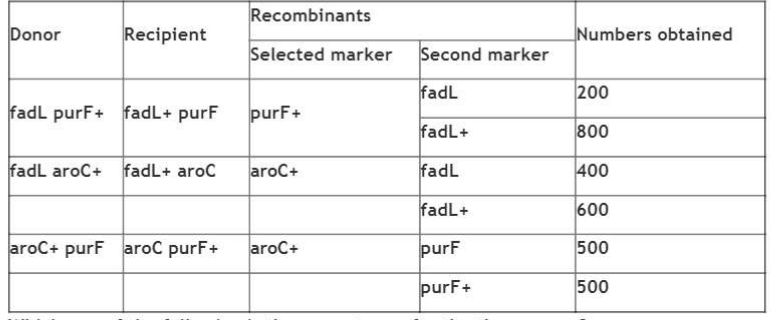
Which one of the following is the correct map for the three genes?
- 1

- 2

- 3

- 4

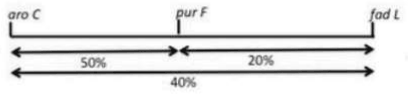


Show answer and solution
Higher co-transduction means closer genes. purF–fadL is 20%, aroC–fadL 40% and aroC–purF 50%. So aroC sits between them: fadL – aroC – purF.
Wheat plants can have kernels of white colour or in shades of red i.e. light red, red, dark red and very dark red (purple).
A researcher made the following cross:
| P | wheat plants with white kernels × wheat plants with purple (very dark red) kernels |
|---|---|
| F1 | All plants with red kernels |
| F2: 1/16 | Plants with purple kernels |
| 4/16 | Plants with dark red kernels |
| 6/16 | Plants with red kernels |
| 4/16 | Plants with light red kernels |
| 1/16 | Plants with white kernels |
The following conclusions are made from the results obtained:
- A. It is a dihybrid cross where white colour is coded by gene A and the purple colour is coded by gene B
- B. Two genes, both coding for the colour of kernel and each gene having two alleles, one that produced red pigment and the other that produced no pigment.
- C. Four genes, one coding for no pigment, which is epistatic over the other genes. The remaining three genes have 2 alleles each, one that produced red pigment and the other that produced no pigment.
- D. The trait is influenced by the environment leading to the observed variation in kernel colour.
Which of the above conclusion(s) is/are correct?
- 1A only
- 2B only
- 3C only
- 4C and D only
Show answer and solution
A 1:4:6:4:1 ratio in sixteenths is the signature of two additive (polygenic) genes. Each has a pigment-producing and a null allele, and colour deepens with each pigment allele (Nilsson-Ehle). That matches B.
A group of transposable elements described as ‘retroelements’ encompass
- 1P elements in Drosophila; LINES but not SINES in humans
- 2Copia element in Drosophila; SINES but not LINES in humans
- 3Copia element in Drosophila; LINES as well as SINES in human
- 4P elements in Drosophila; LINES as well as SINES in human
Show answer and solution
Retroelements move through an RNA intermediate. Drosophila copia is an LTR retrotransposon, and human LINEs and SINEs are non-LTR retrotransposons. P elements are DNA transposons.
Given below are two columns listing angiosperm families and their groups
| Group (List I) | Family (List II) | ||
|---|---|---|---|
| A. | Basal angiosperms | I. | Brassicaceae |
| B. | Fabids | II. | Cucurbitaceae |
| C. | Malvids | III. | Solanaceae |
| D. | Lamids | IV. | Nympheaceae |
Which one of the following option represents the correct match of the two columns?
- 1A – IV, B – II, C – I, D – III
- 2A – IV, B – I, C – III, D – II
- 3A – III, B – IV, C – II, D – I
- 4A – II, B – III, C – I, D – IV
Show answer and solution
Nymphaeaceae: basal angiosperms (ANA grade). Cucurbitaceae: fabids. Brassicaceae: malvids. Solanaceae: lamiids.
Given below are the names of diseases caused in rice in Column X and the names of the disease-causing organisms in Column Y.
| Column X | Column Y | ||
|---|---|---|---|
| A. | Bacterial blight | I. | Entyloma oryzae |
| B. | Grain rot | II. | Rhizoctonia solani |
| C. | Sheath blight | III. | Xanthomonas oryzae pv. oryzae |
| D. | Leaf smut | IV. | Sclerophthora macrospora |
| E. | Downy mildew | V. | Burkholderia glumae |
Which one of the following options represents the match of column X and Y?
- 1A – II, B – I, C – V, D – IV, E – III
- 2A – III, B – IV, C – II, D – V, E – I
- 3A – IV, B – III, C – I, D – II, E – V
- 4A – III, B – V, C – II, D – I, E – IV
Show answer and solution
Bacterial blight: Xanthomonas oryzae pv. oryzae. Grain rot: Burkholderia glumae. Sheath blight: Rhizoctonia solani. Leaf smut: Entyloma oryzae. Downy mildew: Sclerophthora macrospora.
The table given below lists the conservation areas and the major group of organisms that they are best known for.
| Conservation areas (Column X) | Organisms (Column Y) | ||
|---|---|---|---|
| A. | Hemis National Park | I. | Orchids |
| B. | National Chambal Sanctuary | II. | Gharial |
| C. | Nokrek National Park | III. | Nepenthes |
| D. | Sessa Sanctuary | IV. | Snow leopard |
| E. | Baghmara wildlife sanctuary | V. | Endemic citrus species |
Which one of the following options represents the correct match of column X and Y
- 1A – I, B – II, C – III, D – IV, E – V
- 2A – IV, B – II, C – V, D – I, E – III
- 3A – III, B – I, C – V, D – II, E – IV
- 4A – V, B – IV, C – III, D – II, E – I
Show answer and solution
Hemis: snow leopard. Chambal: gharial. Nokrek: wild citrus (Citrus indica) gene sanctuary. Sessa: orchid sanctuary. Baghmara: pitcher plant (Nepenthes khasiana) sanctuary.
The table given below lists the morphological features and groups of plants.
List I (Plant group): A. Liverwort; B. Moss
List II (Morphological characters): I. Unicellular rhizoids; II. Multicellular rhizoids; III. Presence of pyrenoids; IV. Stomata on sporophyte; V. Dominant gametophyte
Which one of the followings options represents the correct match between the two columns?
- 1A – I, III and V; B – II, III, and V
- 2A – I, III and IV; B – II and IV
- 3A – II and V; B – I and III
- 4A – I and V; B – II, IV, and V
Show answer and solution
Liverworts have unicellular rhizoids and a dominant gametophyte. Mosses have multicellular rhizoids, stomata on the sporophyte, and a dominant gametophyte.
The table given below lists types of extremophiles and the environments that they are adapted to.
| Type of extremophile (List I) | Environment (List II) | ||
|---|---|---|---|
| A. | Psychrophile | I. | High salinity |
| B. | Hyperthermophile | II. | High pressure |
| C. | Alkaliphile | III. | High alkaline environment |
| D. | Hyperpiezophile | IV. | Extreme high temperature |
| E. | Halophile | V. | Extreme cold temperatures |
Which one of the following options represents the correct match of the columns?
- 1A – I, B – II, C – III, D – IV, E – V
- 2A – V, B – II, C – III, D – IV, E – I
- 3A – V, B – IV, C – III, D – II, E – I
- 4A – V, B – II, C – IV, D – III, E – I
Show answer and solution
Psychrophile: cold. Hyperthermophile: very high temperature. Alkaliphile: high pH. Hyperpiezophile: high pressure. Halophile: high salt.
The table given below lists fossils and the major group of plants to which they belong.
| Fossil (List I) | Plant group (List II) | ||
|---|---|---|---|
| A. | Naiadita lanceolata | I. | Angiosperm |
| B. | Rhynia gwyne-vaughanii | II. | Pteridophyte |
| C. | Antarticycas schopfii | III. | Bryophyte |
| D. | Tricolpites minutus | IV. | Gymnosperm |
Which one of the following options represents the correct match between columns?
- 1A – I, B – III, C – IV, D – II
- 2A – III, B – II, C – IV, D – I
- 3A – I, B – II, C – IV, D – III
- 4A – II, B – III, C – I, D – IV
Show answer and solution
NTA dropped this question. The usual assignments are Naiadita (bryophyte), Rhynia (early vascular plant), Antarcticycas (cycad, a gymnosperm) and Tricolpites (angiosperm pollen), which matches option 2.
The tables below show the bird species and their abundance in three habitats P, Q and R.

Which one of the combinations below best represents the habitats in decreasing order of diversity?
- 1P, R, Q
- 2R, Q, P
- 3R, P, Q
- 4Q, R, P
Show answer and solution
Q has the most species (8) and near-equal counts, so it is the most diverse. R also has 8 species but is dominated by one (80). P has only 5 and is dominated by one species (120). Order: Q, R, P.
The following are a few statements on shade leaves vis-à-vis sun leaves in tree species
- A. Higher amount of chlorophyll per dry weight
- B. Lower density of stomata
- C. Thicker leaves
- D. Lower rates of dark respiration per unit area
Which one of the following combinations of above statements is correct?
- 1A and D
- 2B and C
- 3A, B and D
- 4B and D
Show answer and solution
Shade leaves have more chlorophyll per dry weight (A), fewer stomata (B) and lower dark respiration (D). They are thinner, not thicker (C false).
The diagram below depicts energy flow within a single trophic level, where I=amount ingested, NA= amount not assimilated, R=respiration, and Pn= biomass production at trophic level.

Which one of the following options represents correct values for Pn, NA, R and I in kcal respectively, if Pn-1 =1000 kcal, I/ Pn-1 = 20%, A/I = 35% and Pn/A= 20%?
- 156 14 130 200
- 214 130 56 200
- 3200 130 56 14
- 456 130 200 14
Show answer and solution
I = 20% of 1000 = 200. A = 35% of 200 = 70, so NA = 200 − 70 = 130. Pn = 20% of 70 = 14, and R = 70 − 14 = 56. In order (Pn, NA, R, I): 14, 130, 56, 200.
The following graph shows the change in proportion of biomass in foliage (leaves), branch and stemwood (bole) for a tree species as a function of DBH (diameter at 1.5 m above ground)

Which one of the following options correctly matches the curves (A, B, and C) with stemwood, foliage and branch, respectively?
- 1A, B and C
- 2A, C and B
- 3B, C and A
- 4B, A and C
Show answer and solution
As trees get thicker, the stem (bole) takes an increasing share of biomass (A). Foliage falls steeply from a high share in saplings (C). Branches stay a small, roughly constant share (B).
The graphs given below show the possible behavior of two species over the course of succession.
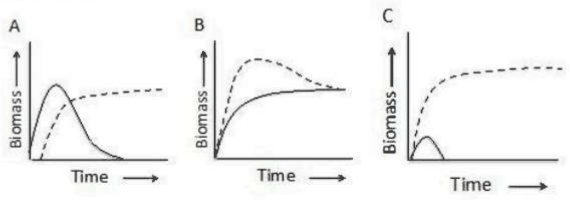
Possible effects observed during succession are:
i. Total suppression
ii. Convergence
iii. Sequential succession
Choose the correct option matching the graphs with the possible effect:
- 1A-(i) B-(ii) C-(iii)
- 2A-(ii) B-(iii) C-(i)
- 3A-(iii) B-(ii) C-(i)
- 4A-(iii) B-(i) C-(ii)
Show answer and solution
In A one species gives way to another: sequential succession. In B the two reach similar biomass: convergence. In C one is wiped out early: total suppression.
Consider the following graphs for per capita growth rate (1/N)(dN/dt) as a function of population density (N).
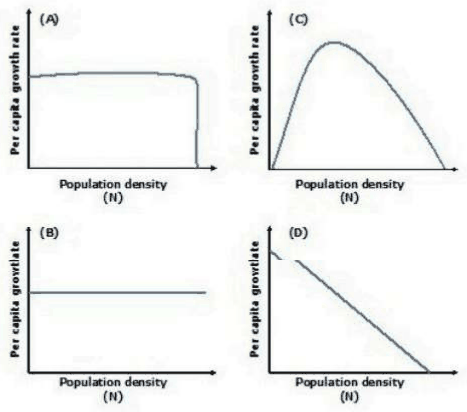
Which one of the plots correctly depicts strong Allee effect in a population?
- 1A
- 2B
- 3C
- 4D
Show answer and solution
With an Allee effect, per-capita growth is lowest at low density, rises with N and then falls as competition sets in. Plot C has this hump shape. D shows ordinary logistic density dependence, and B shows exponential growth.
In the Table below, Column I describes movements of organisms and Column II describes the type of movement.
| Column I | Column II | ||
|---|---|---|---|
| A. | A silk moth flies at an angle perpendicular to the direction of the wind to pick up a scent trail | I. | Mnemotaxis |
| B. | Bacteria burrow down into mud in the northern hemisphere in response to the earth’s magnetic field | II. | Klinotaxis |
| C. | A girl reaches her school using a pharmacy and a bookshop as landmarks | III. | Magnetotaxis |
| D. | Planaria move towards the direction of higher concentration of food by comparing the gradient of stimuli around it | IV. | Menotaxis |
Which one of the following options represents the correct match of column I with Column II
- 1A – IV, B – III, C – I, D – II
- 2A – IV, B – III, C – II, D – I
- 3A – I, B – III, C – IV, D – II
- 4A – I, B – II, C – III, D – IV
Show answer and solution
Flying across the wind to find a scent plume is menotaxis (a fixed angle to a cue). Magnetotactic bacteria show magnetotaxis. Using landmarks is mnemotaxis. Turning to compare concentrations on each side is klinotaxis.
The following represents an equation for Bayesian statistics:
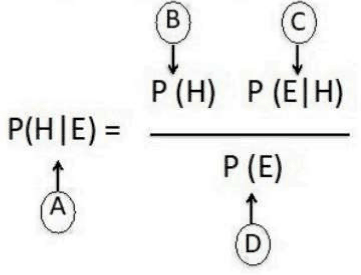
Which one of the following options correctly represents A, B, C and D in the above equation?
- 1A-Evidence, B-Posterior probability, C-Likelihood, D-Prior probability
- 2A- Likelihood, B-Prior probability, C-Posterior probability, D-Evidence
- 3A-Posterior probability, B-Prior probability, C-Likelihood, D-Evidence
- 4A-Prior probability, B-Evidence, C-Posterior probability, D-Likelihood
Show answer and solution
Bayes’ theorem: P(H|E) is the posterior, P(H) the prior, P(E|H) the likelihood, and P(E) the evidence (normaliser).
In a population that is in Hardy-Weinberg equilibrium, the frequency of the recessive homozygote genotype of trait q is 0.04. The percentage of individuals homozygous for the dominant allele is
- 164
- 240
- 332
- 416
Show answer and solution
q2 = 0.04 gives q = 0.2 and p = 0.8. Homozygous dominant = p2 = 0.64 = 64%.
A researcher is interested in investigating if parental investment (PI, panel A) by male seahorses and pipefishes is correlated with their mating patterns (MP-monogamy and polygamy, panel B). For this, the researcher builds a phylogenetic tree of seahorses and pipefishes and maps PI and MP scores on to the tree as shown in figure below.

Based on the trees generated, which one of the following conclusions can the researcher correctly arrive at?
- 1Polygamy is correlated with simpler brood pouches.
- 2Monogamy is not correlated with elaborate brood pouches.
- 3Monogamy is correlated with elaborate brood pouches.
- 4Polygamy is correlated with elaborate brood pouches.
Show answer and solution
Mapping both traits onto the tree shows that the elaborate brood pouches (A) are not in the lineages coloured monogamous (B), and monogamy also occurs with simple pouches. So monogamy is not correlated with elaborate brood pouches.
Given below are graphs depicting two possible dynamics of gene duplication events over a period of time during genome evolution.

Based on the above figures, which one of the following options correctly represents the identity of A, B, C and D?
- 1A-Gene duplication event, B-random loss of duplicated genes, C-remaining pairs of duplicated genes, D-additional gene duplication events
- 2A-remaining pairs of duplicated genes, B-gene duplication event, C-random loss of duplicated genes, D-additional gene duplication events
- 3A-additional gene duplication events, B-random loss of duplicated genes, C-remaining pairs of duplicated genes, D- Gene duplication event
- 4A-Random loss of duplicated genes, B-additional gene duplication events, C-gene duplication event, D-remaining pairs of duplicated genes
Show answer and solution
After a duplication event (A), most extra copies are lost at random (B), leaving a tail of retained pairs (C). The second plot’s new peaks are additional duplication events (D).
A researcher working on island biogeography mapped how isolation-controlled immigration (I), and area-controlled extinction (E), will act on number of species present on the islands. He forgot to label the size of the islands (small or large) and the location of the islands (near or far) on the graph.
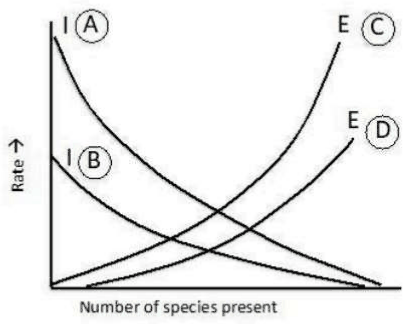
Using information from MacArthur and Wilson’s equilibrium theory, select the option that correctly identifies A, B, C and D in the figure above.
- 1A-large, B- small, C-near, D-far
- 2A-small, B-large, C-far, D-near
- 3A-near, B-far, C-small, D-large
- 4A-far, B-near, C-large, D-small
Show answer and solution
Immigration is higher for near islands (A) than far ones (B). Extinction is higher for small islands (C) than large ones (D).
Given below are some terms and concepts related to phytoremediation in Column A and B
| Column A | Column B | ||
|---|---|---|---|
| A. | Excluders | I. | Can absorb and transfer heavy metals to aerial parts without phytotoxicity symptoms |
| B. | Heavy metal protein transporter | II. | Salix sp. and Populus sp. |
| C. | Hyperaccumulators | III. | Transgenesis |
| D. | High biomass, non-accumulators | IV. | Can restrict heavy metal ions to the roots and detoxify them |
Which one of the following options represents the most appropriate match of all terms/concepts in column A and B?
- 1A – II, B – IV, C – I, D – III
- 2A – III, B – IV, C – II, D – I
- 3A – II, B – III, C – IV, D – I
- 4A – IV, B – III, C – I, D – II
Show answer and solution
Excluders keep metals in the roots (IV). Metal-transporter genes are used in transgenesis (III). Hyperaccumulators move metals to shoots without toxicity (I). Fast-growing Salix and Populus are high-biomass non-accumulators (II).
Given below are the various protein cleaving reagents (List I) and their recognition sites (List II) in the target protein.
| List I | List II | ||
|---|---|---|---|
| A. | CNBr | I. | -Asp-Ala- |
| B. | Trypsin | II. | -Phe-Ala- |
| C. | Caspase | III. | -Met-Ala- |
| D. | Chymotrypsin | IV. | -Arg-Gly- |
Which one of the following options represents the correct combination of items
- 1A – III, B – II, C – I, D – IV
- 2A – IV, B – II, C – I, D – III
- 3A – IV, B – I, C – II, D – III
- 4A – III, B – IV, C – I, D – II
Show answer and solution
CNBr cuts after Met. Trypsin cuts after Arg/Lys. Caspases cut after Asp. Chymotrypsin cuts after Phe and other aromatics.
Given below are a few terms related to map-based sequencing of genomes:
- A. Partial digestion with restriction enzymes.
- B. Assembly of contigs
- C. Pulsed field gel electrophoresis
- D. Cloning in cosmids/YACs/BACs
- E. Sub-cloning and sequencing
Which one of the following options represents the correct order of steps (based on the above terms) in map-based sequencing?
- 1C-B-D-E-A
- 2C-A-D-B-E
- 3E-A-B-D-C
- 4A-C-B-D-E
Show answer and solution
Size the large fragments by PFGE (C), partially digest (A), clone into BACs, YACs or cosmids (D), order the clones into contigs (B), then subclone and sequence (E): C-A-D-B-E.
Given below are a few statements on technologies/concepts related to development of transgenic plants:
- A. Frequency of genetic transformation is influenced only by the genes of Agrobacterium and not by those of the host plants.
- B. Transgenic plants containing a single copy of the transgene are preferred over those that contain multiple transgene copies for subsequent genetic analysis.
- C. Supervirulent strains of Agrobacterium can be generated by increasing the copy number of virulence genes.
- D. A nonconditional negative selection marker has to be necessarily used with a strong constitutive promoter for the development of transgenic plants.
Which one of the following options represents a combination of all INCORRECT statements?
- 1A and D only
- 2C only
- 3B and C only
- 4D only
Show answer and solution
Host genes do affect transformation frequency (A wrong). A non-conditional negative marker would kill every transformant if driven by a strong constitutive promoter (D wrong). Single-copy events are preferred (B), and extra vir copies make supervirulent strains (C).
Consider the four results that were obtained from immunophenotyping of human breast cancer cells.

Which one of the following options correctly depicts the above results?
- 1‘B’ represents a plot that denotes a high percentage of cancer stem cells in the breast cancer cells.
- 2‘D’ denotes a plot where dual positive cells predominate, representing the dead cells.
- 3‘A’ denotes a plot where only cells stained with CD44 and CD24 are observed.
- 4‘C’ represents a plot where only fibroblast cells are present.
Show answer and solution
Breast cancer stem cells are CD44+/CD24−/low. Plot B has most cells in the CD44-high, CD24-low quadrant, so it shows a high share of cancer stem cells.
A culture was started by inoculating the medium with 100 cells having a generation time of 2 hours. Assuming the culture grows in ideal synchrony for at least 24 hours, what will be the number of cells in the culture at 2 hours and 9 hours?
- 12.0 × 10² cells, 1.6 × 10³ cells, respectively.
- 22.0 × 10² cells, 2.4 × 10³ cells, respectively.
- 32.0 × 10⁴ cells, 3.2 × 10³ cells, respectively.
- 42.0 × 10⁴ cells, 1.6 × 10⁸ cells, respectively.
Show answer and solution
Synchronous division every 2 h: at 2 h, 100 × 2 = 200. By 9 h there have been four divisions (at 2, 4, 6 and 8 h): 100 × 24 = 1600.
From the steps listed below, some are used to evaluate the goodness of fit using the chi-square test.
- A. The mean, variance and standard deviation are calculated
- B. Variance calculated using Σ(xi − x̄)2/(n − 1)
- C. Test statistic calculated using Σ(observed − expected)2/expected
- D. The degree of freedom is calculated as n-1, where n is the number of ways in which the expected classes are free to vary
- E. The probability value is obtained
Which one of the following options provides the correct sequence of steps in this statistical analysis?
- 1A, C, D
- 2C, D, E
- 3B, A, D
- 4A, D, E
Show answer and solution
Chi-square goodness of fit: calculate Σ(O − E)2/E (C), find the degrees of freedom (D), then read off the P value (E). Mean and variance are not needed.
Inverse PCR is performed for site-directed mutagenesis with complementary primers (having the desired mutation) using a plasmid having the cloned gene as template. The following statements were made regarding the above experiment.
- A. PCR is followed by transformation of bacterial cells directly with the reaction mixture. A large number of the transformants will have the wild type gene.
- B. The PCR mixture is treated with Dpn I and then used to transform bacterial cells. Most of the transformants will have the mutant gene.
- C. PCR is followed by transformation of bacterial cells directly with the reaction mixture. None of the transformants will have the mutant gene.
- D. The PCR mixture is treated with Dpn I and then used to transform bacterial cells. Half of the transformants will have the mutant gene.
Which one of the following options represents a combination of all correct statements?
- 1A and B
- 2A and D
- 3B and C
- 4B only
Show answer and solution
Unless the methylated parental plasmid is removed, many transformants carry the wild-type template (A). DpnI cuts only methylated (parental) DNA, so after DpnI most colonies carry the mutant (B).
The molecular ion peak [M]+• of an analyte as measured by Electron Ionization Mass Spectrometry has an m/z of 149 and a relative abundance of 100%. The [M]+• has a relative abundance of 6.7% and the [M + 2]+• peak has a relative abundance of 5%. The abundance of the major isotope of H, C, N, O, and S are 1H-100%, 12C-98.9%, 13C-1.1%, 14N-99.6%, 15N-0.4%, 16O, 99.8%, 18O-0.2%, 32S-95.0%, 33S-0.75 % and 34S-4.2%. The most probable molecular formula of the compound is:
- 1C7H21N2O
- 2C5H11NO2S
- 3C6H13O2S
- 4C6H15NOS
Show answer and solution
M+ = 149. An M + 2 of 5% points to one S (34S is 4.2%) plus a little 18O. An M + 1 of 6.7% ≈ 5 × 1.1 (C) + 0.4 (N) + 0.75 (33S). C5H11NO2S (methionine) = 149.
Which one of the statements given below regarding generation of monoclonal antibodies is INCORRECT?
- 1Monoclonal antibodies are the product of a single stimulated B-lymphocyte.
- 2To generate large quantity of monoclonal antibodies, a normal stimulated antibody producing B cell is fused with a long lived B cell tumor.
- 3The hybridoma generated for antibody production is selected on HAT medium.
- 4For HAT selection of hybridoma, the antibody producing B-cells are pre-treated with 8-azaguanine to block salvage pathway of DNA synthesis.
Show answer and solution
8-Azaguanine is used to select HGPRT-deficient myeloma partner cells, not B cells. The B cell supplies HGPRT, so only hybrids survive in HAT medium.
Optical remote sensing has been increasingly used to monitor vegetation globally. The table below lists different regions of the electromagnetic radiation (EMR) spectrum as well as different vegetation characteristics:
List I (Part of the EMR spectrum): A. Ultraviolet; B. Visible; C. Near Infrared; D. Shortwave Infrared
List II (Vegetation characteristics): I. Plant water content; II. Foliage density; III. Plant photosynthetic pigments
Which one of the following combinations correctly matches the EMR region with the vegetation character analysed:
- 1A – I, B – II, C – III
- 2A – I, B – III, C – II
- 3B – II, C – III, D – I
- 4B – III, C – II, D – I
Show answer and solution
Visible light is absorbed by photosynthetic pigments. NIR reflectance tracks leaf structure and foliage density. SWIR is absorbed by water, so it measures plant water content.
Pichia pastoris is a good host for producing human proteins for therapeutic use. Given below are some statements on the reasons for its utility.
- A. It produces large amount of recombinant protein.
- B. It has the property of secreting proteins into the medium.
- C. It allows the formation of disulphide bonds similar to those in humans.
- D. It carries out protein glycosylations identical to those found in humans.
Which one of the following options represents a combination of correct statements?
- 1A and B only
- 2A, B and C only
- 3A, B and D only
- 4B, C and D only
Show answer and solution
Pichia gives high yields from the strong AOX1 promoter (A), secretes proteins (B) and forms disulfide bonds (C). It adds yeast-type high-mannose glycans, not human-type glycosylation, so D is false.
Changes in NTA’s final answer key
Dropped: Q121 (marks given to everyone). Two options accepted: Q88. Every other question has the single answer shown.
How to revise from this paper
- Attempt it in one 3-hour sittingAnswer 15 in Part A, 35 in Part B and 25 in Part C, as in the real exam, before you check any answers.
- Score it with negative markingAdd 2 or 4 marks for each correct answer and subtract 0.5 or 1 for each wrong one. That is the number to track.
- Sort your mistakes by unitUse the unit tag on each question. Two or three wrong answers in the same unit tell you where to revise first.
- Repeat with a fresh paperTake a full-length mock a week later and compare your unit-wise mistakes.
Keep going
<
p class=”lbq-src”>Source: question paper of the Joint CSIR-UGC NET June 2021 cycle, Life Sciences Shift 1 held on 17 February 2022 (subject code 703); answers from the National Testing Agency’s final answer keys for that cycle, which list the correct option ID for each question. Question text is reproduced for practice; any transcription error is ours, and NTA’s documents are the authority.